Home » NBC » Recent Articles:

Comcast’s NBC Preparing Launch of Subscription “All Access”-Style Streaming Service

Comcast’s NBCUniversal is laying plans to introduce a premium online video service highlighting NBC Network content and possibly various programming from the various cable channels owned by Comcast.

After watching rival CBS amass more than 1.5 million subscribers for its “All Access Pass” ($5.99, $9.99/mo for commercial-free option), Comcast’s NBC entertainment division isn’t willing to leave money on the table any longer.

The yet unnamed service is expected to compete with services like Hulu and Netflix, but will most likely be comparable to CBS’ premium subscription offering. In addition to featuring a deep library of NBC content, the service could include a significant catalog of past and present shows from cable networks like Bravo, SyFy and USA. Also to be determined is whether NBC will follow CBS’ lead and offer viewers live streaming of their local NBC station as part of the package.

The new service may not launch in the immediate future because Comcast is still observing restrictions imposed by regulators as a condition of its 2011 acquisition of NBCUniversal. The rules make it difficult for Comcast to develop services comprised entirely of content it owns or controls. Federal regulators added the restriction out of concern Comcast could interfere with Hulu’s access to NBC content. Hulu is popular with cord-cutters, and is seen as a viable alternative to cable television. The last of these restrictions expire in September 2018, about the time Bloomberg News reports Comcast is likely to launch the service.

If all the major American networks decide to develop their own premium streaming services, it could have significant implications for Hulu, which combines content from its partners NBC, ABC, and FOX. If NBC pulls out of the partnership, it will be free to keep all the revenue earned from its own streaming platform, and could inspire ABC and FOX to follow.

Observers suspect this represents more evidence that broadcast networks increasingly expect viewers to pay for access to their programming, at least online.

Comcast Obliterates Viewership of Its Own NBC Station in Boston

Phillip Dampier February 9, 2017 Comcast/Xfinity, Consumer News 2 Comments

Comcast’s effort to run its own NBC affiliate in Boston from an over-the-air station in New Hampshire appears to have initially backfired, causing the ratings to hit rock bottom with fewer than 10,000 viewers aged 25-54 watching the station’s 6pm local newscast.

In its first month as an NBC station, WBTS-TV’s local newscasts scored in the ratings about as well as an infomercial, coming in last place for most of its newscasts in all the ratings demographics that count with advertisers. NBC Boston’s 5pm local newscast averaged only 5,555 viewers aged 25-54. Its 6pm local news only attracted 9,340. In contrast, NBC’s former home in Boston – WHDH, managed to bring in 26,791 and 30,999 viewers for its two evening newscasts. Despite that, the NBC affiliation loss still hurt WHDH, which dropped to second place in the Boston market for some of its newscasts.

But a ratings collapse hurt WBTS even more, considering most locals watch the station over Comcast Cable and don’t have trouble finding NBC on the cable dial. Cord-cutters have to contend with challenging reception, especially in areas south of Boston. In response to viewer complaints, Comcast’s David Cohen said the cable company temporarily bought a digital subchannel on WMFP-TV, the full power Boston affiliate of preacher Jimmy Swaggart’s Sonlife Broadcasting Network.

Comcast’s long-term solution to solving its reception problems in Boston? Cohen told Sen. Ed Markey (D-Mass.) the cable company would eventually buy another full-power TV station in or around Boston.

Comcast Abandoning Over-the-Air TV for South Boston; Will You Need Cable for NBC Shows?

whdhFor more than 20 years, Boston residents have watched NBC for free on WHDH-TV Channel 7. But if Comcast gets its way, at least four million Beantown viewers may have to subscribe to pay cable television service to keep watching.

This morning, WHDH filed suit against the cable giant in federal court in Boston alleging Comcast broke federal and state laws and an agreement it signed with antitrust regulators when it announced it would not renew WHDH’s affiliation contract with NBC. Comcast acquired NBC in 2011, after agreeing to conditions preventing the cable company from engaging in anti-competitive behavior.

Media observers say Comcast has made no secret of its desire to buy WHDH or another Boston over the air station, to build its network of affiliates directly owned and operated by the cable company. Station owner Ed Ansin isn’t selling, at least not at Comcast’s current asking price. But eyebrows were raised when Comcast announced it would end its affiliation agreement with WHDH – a well-known, high-powered television station – and move NBC programming to New England Cable News (NECN), a low-rated Comcast-owned cable channel.

Comcast-LogoUnless something changes, NECN will disappear on Jan. 1, 2017, replaced by a new “NBC Boston” cable channel. The decision will also strand WHDH without a major network affiliation, which is likely to significantly cut the station’s value and ratings.

“Comcast has a reputation for pushing the envelope wherever they can but they’ve just done an awful lot of things wrong here,” said Ansin.

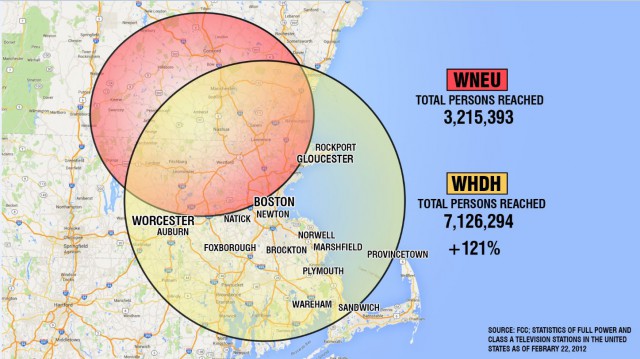
In an effort to limit the damaging optics of Comcast forcing free network television programming to pay cable, Comcast announced it would also relay its NBC Boston cable channel over a UHF channel in another state now showing Telemundo programming. Those without cable will have to adjust their antennas carefully to receive WNEU-TV Channel 60, in Merrimack, N.H, the new home of NBC for Boston-area cord-cutters and cord-nevers.

WNEU's coverage area only reaches 50% of the Boston television market.

WNEU’s coverage area only reaches 50% of the Boston television market.

That may be good news for New Hampshire residents in Concord or Nashua that may have had trouble watching NBC shows over WHDH, but very bad news for about four million people inside Greater Boston who live where WNEU’s signal doesn’t reach, including those in primarily minority communities like Roxbury, Dorchester, Mattapan, and Brockton. Those residents, along with other areas in southern Boston, will likely have to call Comcast and buy cable TV to keep watching NBC starting this January.

WNEU60WHDH’s lawyers have now pushed back:

When Comcast, the largest cable company in the world, acquired NBC in 2011, there was widespread concern about the impact this unprecedented accumulation of power in the television industry would have on viewers and other market participants. Particularly in markets like Boston, where Comcast is the dominant cable provider, citizen groups, industry participants and government agencies expressed concern that Comcast would seek to leverage its cable holdings and in the process degrade its broadcasting presence and diminish the important public service role that broadcast television stations historically have played.  To address those concerns, Comcast promised its NBC affiliates (including WHDH) that it would negotiate affiliate extensions in good faith such that over the air access would be maintained, and cable interests would not influence those negotiations.  As part of the FCC’s approval of Comcast’s acquisition of NBC, the FCC adopted these same conditions in order to protect the public interest.

WHDH believes that Comcast has violated these conditions.  It also believes that Comcast’s actions violate Massachusetts law prohibiting unfair and deceptive business practices.  Finally, WHDH believes that Comcast’s actions violate federal and state antitrust laws because they have enabled Comcast to increase its monopoly power in the Boston television market, and the resulting decrease in competition will harm consumers, advertisers and other broadcasters.

In its suit WHDH is seeking an injunction and an order requiring Comcast to comply with its obligations under its agreement with WHDH and the FCC order. WHDH will also seek damages.

WHDH also accuses Comcast of stringing it along on the renewal of its affiliate agreement, claiming they were told discussions about an extension would begin “when the time was right.” WHDH says Comcast was plotting to launch its own cable network alternative all along, and didn’t negotiate in good faith. In July 2013, NECN ad sales representatives began telling advertisers it would soon become the local NBC affiliate. After WHDH protested to Comcast, the cable company claimed NECN’s statements were untrue.

“No major national broadcaster has ever terminated its relationship with a successful independent affiliate in a major market to build its own local affiliate from scratch,” WHDH lawyers wrote.

[flv]http://www.phillipdampier.com/video/WHDH Boston Major announcement involving NBC and WHDH-TV 1-7-16.mp4[/flv]

WHDH in Boston informed viewers back in January that Comcast was not going to renew its affiliation agreement with NBC. Today, WHDH’s lawyers took Comcast to court. (3:27)

Comcast Loses 69,000 Subscribers; Internet Customer Additions Down 12%, But Revenue Higher

Phillip Dampier July 23, 2015 Comcast/Xfinity, Consumer News Comments Off on Comcast Loses 69,000 Subscribers; Internet Customer Additions Down 12%, But Revenue Higher

Comcast-LogoNEW YORK (Reuters) – Comcast Corp, the largest U.S. cable operator, posted in-line second-quarter results, as its high-speed Internet and NBC Universal businesses grew amid a drop in pay-TV subscriber departures.

Comcast, also the No.1 U.S. high-speed Internet provider, said on Thursday total revenue rose 11.3 percent to $18.74 billion in the second quarter ended June 30. Analysts on average had forecast revenue of $18.14 billion, according to Thomson Reuters I/B/E/S.

Net income attributable to Comcast rose 7.3 percent to $2.14 billion, or 84 cents per share, from a year earlier.

Profit was up 10 percent from a year ago to 84 cents per share after excluding items such as investments and acquisition-related items, matching Wall Street estimates.

The company, which lost 8,000 video customers last quarter, reigned in subscriber losses in the second quarter compared to a year ago. It said 69,000 subscribers departed from April through June, but it was less than the 144,000 users who left a year earlier.

cablecordWall Street keeps a close watch on the number of new video subscribers as pay TV operators fight to keep customers amidst intense competition from streaming video services such as Dish Corp’s Sling TV.

Earlier this month, Comcast said it is beta testing a new cable streaming service called Stream, which will broadcast live TV from HBO and about a dozen other networks for $15 per month. The new service lets Comcast’s Xfinity Internet customers stream live TV over phones, tablets and laptops.

Comcast’s high-speed Internet customer additions dropped 12 percent to 180,000, but revenue from the business rose about 10 percent to $3.1 billion.

Business services revenue increased 20.4 percent to $1.16 billion.

At NBC Universal, revenue rose 20.2 percent to $7.23 billion from a year earlier.

Revenue at the film studio rose 93 percent from a year earlier to $2.3 billion, bolstered by its summer blockbusters “Furious 7” and “Jurassic World.”

The Universal theme park business, with its popular “Harry Potter” attraction in Florida, saw revenue rise 26 percent to $773 million.

Advertising revenue at cable networks fell 3 percent in the quarter to $917 million amid a decline in ratings that has hit networks across the TV industry. The NBC broadcast network’s ad revenue rose a modest 0.3 percent to $1.25 billion.

Shares of Comcast, which abandoned its proposed $45 billion merger with Time Warner Cable Inc in late April, closed at $64.50 on Wednesday on the Nasdaq.

(By Malathi Nayak; Editing by Bernard Orr)

Shakedown Sharpton: Buy Quid Pro Quo Minority Support for Your Big Telecom Merger Deal

Phillip Dampier January 12, 2015 Astroturf, AT&T, Comcast/Xfinity, Competition, Consumer News, Net Neutrality, Public Policy & Gov't Comments Off on Shakedown Sharpton: Buy Quid Pro Quo Minority Support for Your Big Telecom Merger Deal

shakedown alLooking for civil rights groups to support your multi-billion dollar telecom merger and keep minority groups off your back?

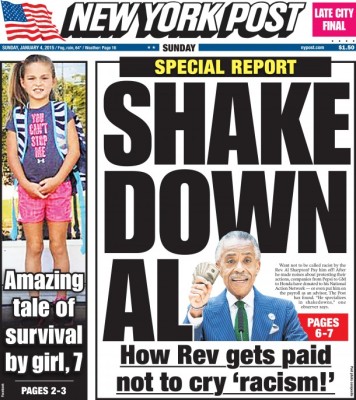
You couldn’t do better than cutting a check to Rev. Al Sharpton, whose National Action Network (NAN) will generate form letters praising your killer deal before regulators or help garner support in Congress for more deregulation and less Net Neutrality. All it takes is a few donations and consulting fees, according to a special report published by the New York Post.

“Al Sharpton has enriched himself and NAN for years by threatening companies with bad publicity if they didn’t come to terms with him. Put simply, Sharpton specializes in shakedowns,” Ken Boehm, chairman of the National Legal & Policy Center told the Post.

“Once Sharpton’s on board, he plays the race card all the way through,” said a source who has worked with the Harlem preacher. “He just keeps asking for more and more money.”

Sharpton’s 60th birthday party bash last October at Manhattan’s Four Seasons restaurant departed from the usual friends and family oriented affair most of us would expect, as envelopes arrived from some of America’s largest corporations, including AT&T and Verizon, containing at least $1 million in donations for Sharpton’s civil rights group.

Coincidentally, that same month Sharpton co-signed a letter sent to the FCC urging the regulator to approve AT&T’s deal to buy DirecTV.

“We believe the evidence and the company’s record, as well as future impact and commitments post-merger, provide a clear and compelling basis for the FCC to determine that this merger is in the public’s best interest,” the letter said. “If approved, the combined AT&T-DirecTV will have greater incentive to deploy a state of the art Internet service and give millions of Americans a new way to access the Internet’s economic, social, and civic benefits.”

If approved, the deal would also eliminate one of AT&T’s chief competitors for pay television customers, making DirecTV part of the AT&T family.

Money-Stuffed-Into-PocketWhile the money keeps rolling in, Sharpton has left taxpayers footing his bills. Sharpton himself, his nonprofit NAN, and two for-profit firms controlled by him have racked up $4.7 million in outstanding debt and tax obligations according to federal and New York State records. He owes New York taxpayers $806,875 and after not bothering to pay his personal income taxes in full, he owes $2.6 million in federal liens. Sharpton’s NAN still owes more than $800,000 to the federal government and his two for-profit ventures separately owe New Yorkers nearly $450,000.

Raising money to repay debts appears to be a major priority for Sharpton these days, and companies like Comcast covet his support of their corporate agendas.

Shortly after Comcast announced its intention to acquire NBC-Universal in late 2009, Comcast’s chief executive, Brian L. Roberts, and the head of the company’s lobbying effort, David L. Cohen, met with Sharpton and other representatives of minority groups to talk about their bid. Comcast recognized that support from minority groups would be crucial to answering the inevitable charge that giant media mergers have a tendency to reduce diversity in programming, particularly from and for minorities.

Comcast turned on its money spigot, donating at least $140,000 to Sharpton’s National Action Network. In turn, Sharpton took a sudden interest in the merger, penning letters of strong support to the FCC. Between 2008 and 2010, Comcast’s corporate foundation donated more than $3 million to 39 minority groups that wrote letters to federal regulators in support of the NBC deal. Comcast and NBC Universal also worked out an agreement with advocacy groups guaranteeing increased “minority participation in news and public affairs programming”—so long as the deal went through.
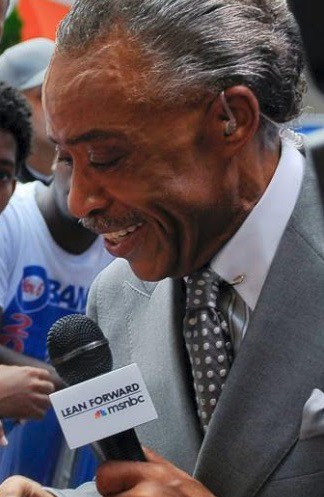
Comcast supporter turned Comcast-owned MSNBC host.

Sharpton: Comcast supporter turned Comcast-owned MSNBC host.

Few expected that Sharpton himself would be a direct beneficiary of Comcast’s gratitude after the merger was approved. Sharpton was suddenly hired (for an undisclosed amount) as host of his own MSNBC weeknight show, still on the network today.

The New York Times noticed.

“Rarely, if ever, has a cable news channel employed a host who has previously campaigned for the business goals of the channel’s parent company,” the newspaper wrote.

Since the cable company began cutting checks to the NAN, Sharpton has towed the line on Comcast’s public policy agenda.

Last July, Sharpton’s group joined several other civil rights groups (most, if not all financially supported by Comcast) complaining that enforcing Net Neutrality would “harm communities of color.”

“The groups wrote to the FCC to tell them that ‘we do not believe that the door to Title II should be opened,'” said Lee Fang in a piece that was quickly censored by a Comcast-owned news outlet. “Simply put, these groups, many of which claim to carry the mantle of Martin Luther King Jr., are saying that Comcast and Verizon should be able to create Internet slow lanes and fast lanes, and such a change would magically improve the lives of non-white Americans.”

“Just as Martin Luther King Jr.’s children have embarrassingly descended into fighting bitterly over what’s left of his estate, the civil rights groups formed to advance Dr. King’s legacy seem willing to sell out their own members for a buck,” Fang concluded.


Search This Site:

Contributions:

Recent Comments:

Your Account:

Stop the Cap!