Home » consumption billing » Recent Articles:

Rogers Doubles Maximum Overlimit Usage Fee from $50 to $100 to “Protect Customers”

Phillip Dampier July 5, 2012 Canada, Consumer News, Data Caps, Editorial & Site News, Rogers Comments Off on Rogers Doubles Maximum Overlimit Usage Fee from $50 to $100 to “Protect Customers”

Lowering the bar on customers by increasing the maximum overlimit fee. It’s another example of Rogers’ Broadband Limbo Dance.

Rogers Communications is quietly notifying its broadband customers it is doubling the overlimit fee for excessive use of its broadband service from $50 to $100, effective Aug. 16, 2012.

The company characterizes the new maximum fee as “protecting you from unexpected high charges,” but of course does nothing of the sort. Rogers’ charges eastern Canada some of the continent’s most expensive prices around for usage-limited broadband. Its Internet Overcharging scheme has relied on all of the classic tricks of the trade to get consumers to pay higher and higher prices for broadband service, while assuring investors the company can rake in additional profits at will just by adjusting your allowance and overlimit fee.

Companies that introduce usage caps and consumption billing are monetizing broadband usage. By adjusting prices upwards and reducing usage allowances, customers can find themselves paying confiscatory overlimit fees. But until recently companies in Canada capped the maximum overlimit penalties. Over the last three years, those maximum fees have increased dramatically, and some companies like Cogeco have removed the maximum limit altogether.

While Rogers’ cost to deliver service continues to decline, these kinds of policy changes can cause broadband bills to soar, especially when customers are in overlimit territory.

Rogers (with thanks to Broadband Reports readers who shared the text):

“To protect you from unexpected high charges, we currently cap the maximum monthly amount you can be charged for additional internet usage at $50 in addition to your Hi-Speed Internet plan’s monthly service fee, modem rental fee (if applicable) and taxes. Effective August 16, 2012 this monthly limit will be increased to $100 in addition to your plan’s monthly service fee, modem rental fee (if applicable) and taxes. If you exceed the monthly usage allowance included in your Hi-Speed Internet plan you will begin to see charges up to the new limit beginning on your first invoice on or after September 16, 2012. All other aspects of your Rogers service(s) will remain the same. Remember, you can track your internet usage online by signing into My Rogers at rogers.com/myinternetusage. For more information or questions please contact us in any of the ways listed on page 2 of this invoice. Thank you.”

Customers can use the occasion of Rogers’ contract changes to potentially switch providers without paying early cancellation fees. This process is more straightforward in Quebec, according to the company’s terms and conditions.

Quebec Residents Only

Unless otherwise specified in the Service Agreement, we may change, at any time, but upon no less than 30 days’ prior written notice to you:

  • a) with respect to a  plan or Service not subscribed to for a Commitment Period (as defined below), any charges, features, content, functionality, structure or any other aspects of the plan or Service, as well as any term or provision of the Service Agreement, and
  • b) with respect to a plan or Service subscribed to for a Commitment Period, any aspect of the plan or Service, as well as any term or provision of the Service Agreement, other than essential elements of the plan, Service or Service Agreement.

If the change entails an increase in your obligations or a decrease in our obligations and if you do not accept such a change, you may terminate your Services without an ECF (as defined below) by sending us a notice to that effect no later than 30 days after the amendment takes effect.

Rogers’ Customers Elsewhere in Canada

Unless otherwise specified in the Service Agreement, we may change, at any time, any charges, features, content, functionality, structure or any other aspects of the Services, as well as any term or provision of the Service Agreement, upon notice to you. If you do not accept a change to the affected Services, your sole remedy is to terminate the affected Services provided under the Service Agreement, within 30 days of your receipt of our notice of change to the Services (unless we specify a different notice period), by providing us with advance notice of termination pursuant to Section 34. If you do not accept a change to these Terms, your sole remedy is to retain these Terms unchanged for the duration of the Commitment Period (as defined below), upon notice to us within 30 days of your receipt of our notice of change to these Terms.

While Quebec residents have a clear path to avoid Rogers’ ECF, customers elsewhere may be subject to an early cancellation fee because of Section 9 of Rogers’ agreement:

Unless otherwise set out in the Materials, if you agree to subscribe to one of our plans or Services for a committed period of time (the “Commitment Period”), you may be subject to an early cancellation fee (“ECF”) for each Service. Any decrease in your Commitment Period may be subject to a fee. If your Service is terminated prior to the end of the Commitment Period, you will pay us an ECF as specified in the Service Agreement, plus taxes.

Customers outside of Quebec may want to check with Rogers directly to determine if an early cancellation fee will apply when canceling service because of the change in maximum overlimit fees.

Customers leaving Rogers can find better deals for broadband services from independent ISPs like TekSavvy or Start.

The Illusory Savings of “Usage Based Billing”: Your Bill Will Get Higher, Not Lower

Phillip Dampier July 2, 2012 Broadband "Shortage", Broadband Speed, Competition, Consumer News, Data Caps, Editorial & Site News, Online Video Comments Off on The Illusory Savings of “Usage Based Billing”: Your Bill Will Get Higher, Not Lower

Phillip “They Want to Save You Money By Charging You More” Dampier

The pro-Internet Overcharging forces’ meme of “pay for what you use” sounds good in theory, but no broadband provider in the country would dare switch to a true consumption-based billing system for broadband, because it would destroy predictable profits for a service large cable and phone companies hope you cannot live without.

Twenty years ago, the cable industry could raise rates on television packages with almost no fear consumers would cancel service. When I produced a weekly radio show about the cable and satellite television industry, cable companies candidly told me they expected vocal backlashes from customers every time a rate increase notice was mailed out, but only a handful would actually follow through on threats to cut the cord. Now that competition for your video dollar is at an all-time-high, providers are shocked (and some remain in denial) that customers are actually following through on their threats to cut the cord. Goodbye Comcast, Hello Netflix!

Some Wall Street analysts have begun warning their investor clients that the days of guaranteed revenue growth from video subscribers are over, risking profits as customers start to depart when the bill gets too high. Cable companies have always increased rates faster than the rate of inflation, and investors have grown to expect those reliable profits, so the pressure to make up the difference elsewhere has never been higher.

With broadband, cable and phone companies may have found a new way to bring back the Money Party, and ride the wave of broadband usage to the stratosphere, earning money at rates never thought possible from cable-TV. The ticket to OPEC-like rivers of black gold? Usage-based billing.

Since the early days of broadband, most Americans have enjoyed flat rate access through a cable or phone company at prices that remained remarkably stable for a decade — usually around $40 a month for standard speed service.

In the last five years, as cord-cutting has grown beyond a phenomena limited to Luddites and satellite dish owners, the cable industry has responded. As they learned customers’ love of broadband has now made the service indispensable in most American homes, providers have been jacking up the price.

Time Warner Cable, for example, has increased prices for broadband annually for the last three years, especially for customers who do not subscribe to any other services.

Customers dissatisfaction with rate hikes has not led to broadband cord cutting, and in fact might prove useful on quarterly financial reports -and- for advocating changes in the way broadband service is priced:

  1. Enhance revenue and profits, replacing lost ground from departing video customers and the slowing growth of new customers signing up for video and phone services (and keeping average revenue per user ((ARPU)) on the increase);
  2. Using higher prices to provoke an argument about changing the way broadband service is sold.

Pouring over quarterly financial reports from most major providers shows remarkable consistency:

  • The costs to provide broadband service are declining, even with broadband usage growth;
  • Revenue and profits enjoy a healthy growth curve, especially as increased prices on existing customers make up for fewer new customer additions;
  • Earnings from broadband are now so important, a cable company like Time Warner Cable now refers to itself as a broadband company. It is not alone.

Still, it is not enough. As usage continues to grow in the current monopoly/duopoly market, providers are drooling with anticipation over the possibility of scrapping the concept of “flat rate” broadband, which limits the endless ARPU growth Wall Street demands. If a company charges a fixed rate for a service, it cannot grow revenue from that service unless it increases the price, sells more expensive tiers of service, or innovates new products and services to sell.

Providers have enjoyed moderate success selling customers more expensive, faster service, also on a flat rate basis. But that still leaves money on the table, according to Wall Street-based “usage billing” advocates like Craig Moffett, who see major ARPU growth charging customers more and more money for service as their usage grows.

Moffett has a few accidental allies in the blogger world who seem to share his belief in “usage-based” billing. Lou Mazzucchelli, reading the recent New York Times piece on Time Warner’s gradual move towards usage pricing, frames his support for consumption billing around the issue of affordability. In his view, usage pricing is better for consumers and the industry:

It costs real money to upgrade networks to keep pace with this demand, and those costs are ultimately borne by the subscriber. So in the US, we have carriers trying to raise their rates to offset increases in capital and operating expenses to the point where consumers are beginning to push back, and the shoving has come to the attention of the Federal Communications Commission, which has raised the possibility of treating Internet network providers as common communications carriers subject to regulation.

I believe that flat-rate pricing is a major source of problems for network carriers and consumers. In the carrier world, the economics are known but ignored because marketers believe that flat rates are the only plans consumers will accept. But in the consumer world, flat rates are rising to incomprehensible levels for indecipherable reasons, with little recourse except disconnection. Consumer dissatisfaction is rising, in part because consumers feel they have no control over the price they have to pay. This is driven by their sense of pricing inequity that is hard to visualize but comes from implicit subsidies in the current environment. The irony is that pay-per-use pricing solves the problem for carriers and consumers.

Mazzucchelli reposted his blog piece originally written in 2010 for the benefit of Times readers. Two years ago, he measured his usage at 11GB a month. His provider Verizon Communications was charging him $64.99 a month for 25Mbps service, which identifies him as a FiOS fiber to the home customer.  Mazzucchelli argues the effective price he was paying for Internet access was $5.85 for each of the 11GB he consumed, which seemed steep at the time. (Not anymore, if you look at wireless company penalty rates which range from $10-15/GB or more.)

Mazzucchelli theorized that if he paid on a per-packet basis, instead of flat rate service based on Internet speed, he could pay something like $0.0000025 per packet, which would result in a bill of $31.91 for his 11GB instead of $65. For him, that’s money saved with usage billing.

On its face, it might seem to make sense, especially for light users who could pay less under a true usage-based pricing scenario like the one he proposes.
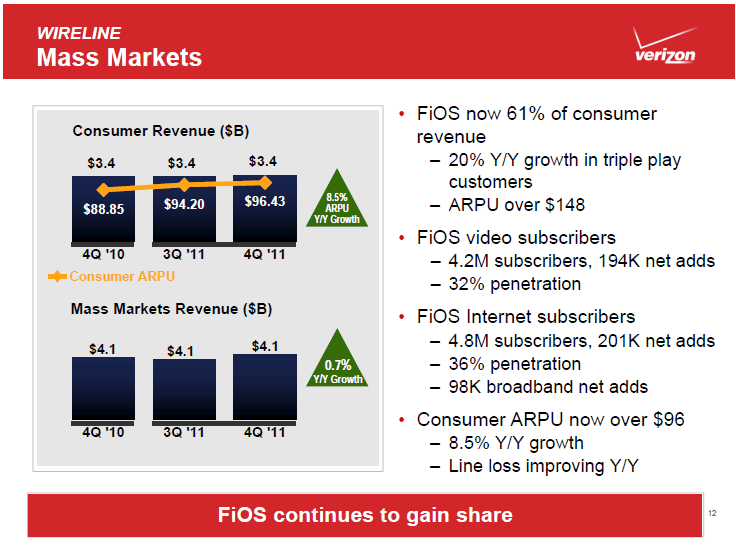
Verizon Communications is earning more average revenue per customer than ever with its fiber to the home network. That’s about the only bright spot Wall Street recognizes from Verizon’s fiber network, which some analysts deride as “too expensive.”

Unfortunately for Mazzucchelli, and others who claim usage-based pricing will prove a money-saver, the broadband industry has some bad news for you. Usage pricing simply cannot be allowed to save you, and other current customers money. Why? Because Wall Street will never tolerate pricing that threatens the all-important ARPU. In the monopoly/duopoly home broadband marketplace most Americans endure, it would be the equivalent of unilaterally disarming in the war for revenue and profits.

That is why broadband providers will never adopt a true usage-based billing system for customers. It would cannibalize earnings for a service that already enjoys massive markups above true cost. In 2009, Comcast was spending under $10 a month to sell broadband service priced above $40.

Mazzucchelli

Instead, providers design “usage-based” billing around rates comparable to today’s flat rate pricing, only they slap arbitrary maximum usage allowances on each tier of service, above which consumers pay an overlimit fee penalty. That would leave Mazzucchelli choosing a lower speed, lower usage allowance plan to maximize his savings, if his use of the Internet didn’t grow much. On a typical light use plan suitable for his usage, he would subscribe to 1-3Mbps service with a 10GB allowance, and pay the overlimit fee for one extra gigabyte if he wanted to maximize his broadband dollar.

But his usage experience would be dramatically different, both because he would be encouraged to use less, fearing he might exceed his usage allowance, and he would be “enjoying” the Internet at vastly slower speeds. If Mazzucchelli went with higher speed service, he would still pay prices comparable for flat rate service, and receive a usage allowance he personally would find unnecessarily large. The result for him would be little to no savings and a usage allowance he did not need.

Mazzucchelli’s usage pattern is probably different today than it was in 2010. Is he still using 11GB a month? If he uses double the amount he did two years ago, under his own pricing formula, the savings he sought would now be virtually wiped out, with a broadband bill for 22GB of consumption running $63.82. By the following year, usage-based pricing would cost even more than Verizon’s unlimited pricing, as average use of the Internet continues to grow.

That helps the broadband industry plenty but does nothing for consumers. Mazzucchelli might be surprised to learn that the “real money to upgrade networks to keep pace with this demand,” is actually more than covered under today’s profit margins for flat-rate broadband. In fact, if he examines financial reports over the last five years and the statements company executives make to shareholders, virtually all of them speak in terms of reducing capital investments and the declining costs to deliver broadband, even as usage grows.

Verizon’s fiber network, while expensive to construct, is already earning the company enormous boosts in ARPU over traditional copper wire phone service. While Wall Street howled about short term capital costs to construct the network, then-CEO Ivan Seidenberg said fiber optics was the vehicle that will drive Verizon earnings for decades selling new products and services that its old network could never deliver.

Still, is Mazzucchelli paying too much for his broadband at both 2010 and 2012 prices? Yes he is. But that is not a function of the cost to deliver broadband service. It is the result of a barely competitive marketplace that has an absence of price-moderating competitors. Usage-based pricing in today’s broadband market assures lower costs for providers by retarding usage. It also brings even higher profits from bigger broadband bills as Internet usage grows, with no real relationship to the actual costs to provide the service. It also protects companies from video package cord-cutting, as customers will find online viewing prohibitively expensive.

One need only look at pricing abroad to see how much Americans are gouged for Internet service. Unlimited high speed Internet is available in a growing number of countries for $20-40 a month.

Usage-based billing is a dead end that might deliver temporary savings now, but considerably higher broadband bills soon after. It is not too late to turn the car around and join us in the fight to keep unlimited broadband, enhance competition, and win the lower prices users like Mazzucchelli crave.


Time Warner Cable Reintroduces Usage Caps in Austin; Tell Them ‘No Thanks!’

Time Warner Cable has a usage meter up for some customers.

Time Warner Cable has reintroduced usage-limited broadband plans in Austin, Tex., three years after shelving an earlier market test that drew protests from local residents and civic leaders.

Time Warner Cable is offering three tiers of what it calls “Internet Essentials,” each offering different speeds of service, all with a 5GB usage allowance for a $5 monthly discount.

“It’s clear that one-size-fits-all pricing is not working for many consumers, particularly in a challenging economy,” regional vice president of operations in Texas Gordon Harp said. “We believe the choice and flexibility of Essentials will enhance value for lighter users, help us retain existing customers in a competitive marketplace and attract new customers to our superior Internet experience.”

But Stop the Cap! disagrees, noting the three variations of Internet Essentials all offer a tiny discount and come with a ridiculously low usage allowance.

With usage overlimit fees of $1/GB, currently limited to a maximum of $25, customers are playing Russian Roulette with their wallets. Just exceeding the allowance by 5GB a month eliminates any prospects of savings, and going beyond that will actually cost customers more than what they would have paid for unlimited Internet.

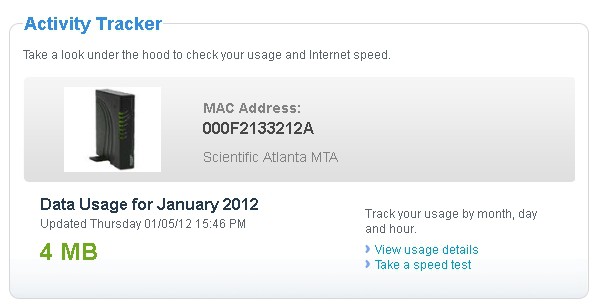
The company has added a usage tracker for Texas customers qualified to get the plan. It can be found under the My Services section of Time Warner Cable’s website.

Customers in Texas can choose from Grande Communications, AT&T or Verizon if they want to say goodbye to Time Warner’s endless interest in Internet Overcharging.  Image courtesy: Jacobson

Stop the Cap! recommends consumers strongly reject these plans. If customers are looking for a better deal on broadband, it is wiser to call Time Warner and threaten to take your broadband business to the competition. The savings that will result on a retention plan are sure to be better than the Internet Essentials discount, and no one will have to think twice about how they use their broadband account. Customers on an extremely tight budget can also downgrade to a slower speed plan that offers unlimited access, essential in any home with multiple broadband users.

Time Warner Cable does not help their position by significantly distorting the truth about their last experiment trying to limit customer broadband usage. In 2009, the company proposed changing the price for unlimited broadband to an enormous $150 a month. Customers protested in front of the company’s offices in several cities. Despite that, and the intense negative media coverage the company endured, Time Warner still believes its customers are itching to have their broadband usage limited:

Previous Experience with Usage-based Pricing

Time Warner Cable began testing usage-based pricing in 2009. Although many customers were interested in the plan, many others were not and we decided to not proceed with implementation of the plan. Over the past few years, we consulted with our customers and other interested parties to ensure that community needs are being met and in late 2011 we began testing meters which will calculate Internet usage.

We’d be interested to know what customers in the Austin area were consulted about the desire for usage-limited plans. Nobody consulted us either. We can imagine the “other interested parties” are actually Wall Street analysts and fellow industry insiders. We’re confident the overwhelming number of Time Warner Cable customers have no interest in seeing their unlimited use plans changed and company customer service representatives have told us there has been very little interest in the plans to date. For now, the company claims it won’t force people to take usage limited plans, but as we’ve seen in the wireless industry, yesterday’s promises are all too quickly forgotten.

With a usage meter now established, all it takes is an announcement Time Warner is doing away with unlimited broadband (or raising the price of it to the levels the company proposed in 2009), and customers are ripe for a broadband ripoff.

Time Warner Cable says it is “listening” to customers on its TWC Conversations website. We suggest you visit, click the tab marked Essentials Internet Plans, and let Time Warner Cable know you have no interest in these usage-limited plans and are prepared to go to war to keep affordable, unlimited Internet. With your voice, perhaps Time Warner Cable will finally realize that usage caps and consumption billing just don’t work for you or your family.

Broadband Money-Maker: Insights from Time Warner Cable’s Latest Financial Results

Phillip Dampier May 2, 2012 Broadband Speed, Competition, Data Caps, Online Video Comments Off on Broadband Money-Maker: Insights from Time Warner Cable’s Latest Financial Results

Highlights:

  • Company still losing video customers, but picking up phone customers (on the cheap), and winning with broadband;
  • Broadband consumption pricing still CEO’s favorite flavor of Internet billing, but only for other people’s content;
  • Broadband speed matters, as Time Warner continues to win over dissatisfied DSL customers;
  • ‘If customers love our broadband, we can charge more for it;’
  • Verizon/Time Warner’s cooperative marketing agreement starts with discounts but ends with “exclusive product enhancements.”
  • The future of Time Warner Cable Wi-Fi.

Time Warner Cable reported unexpectedly strong profits in its first quarter as the company’s broadband services helped stem the losses from departing cable TV customers.

The cable operator told investors it boosted profits 18%, mostly from increasing revenue the company earns selling broadband access to the Internet and convincing customers to add more Time Warner services.

Time Warner Cable said goodbye to 94,000 residential video subscribers last quarter, higher than analysts expected. But that did little damage to earnings because the company picked up an additional 214,000 broadband customers over the same period, most switching from phone company DSL service.

Time Warner Cable’s increasingly aggressive bundled service promotions, particularly on its triple-play offer of cable, broadband, and phone service, even managed to attract 112,000 new landline customers — a significant accomplishment as Americans continue to disconnect traditional phone lines in favor of cell phones.  It also helped increase the average revenue earned per subscriber.  Time Warner Cable pitches double play promotions as low as $79.00 a month. For just $10 a month more, customers can add a third service, and many do.

Most discounts last for one year, but the operator now often sends letters to customers reaching the end of their promotion offering additional, but lower-value discounts going forward. This has limited bill shock for customers surprised by the company’s regular prices. It also might reduce the urge for customers to shop around for a better deal.

Judging from the company’s financial results, most customers hang on to Time Warner Cable’s broadband regardless of price, if the competition happens to be traditional DSL from the phone company. In fact, as phone and cable companies realize they have sold broadband to virtually every home in their service area that wants it, growth in subscriber numbers going forward largely depends on poaching customers from someone else.  Nobody makes that easier than phone companies trying to sell customers DSL with speeds under 10Mbps.  According to CEO Glenn Britt, Time Warner Cable picked up more new broadband customers than Verizon and AT&T combined.

Time Warner Cable broadband speeds give headaches to phone companies trying to sell traditional DSL.

While phone companies continue to argue that speeds don’t matter (at least for their DSL product line), Time Warner believes otherwise and apparently so do their new customers.  The company reports that almost two-thirds of those dumping DSL said their old service was too slow.

Much of the company’s growth in broadband revenue is also coming from the high end, as customers increasingly gravitate towards faster broadband speed tiers.

Britt

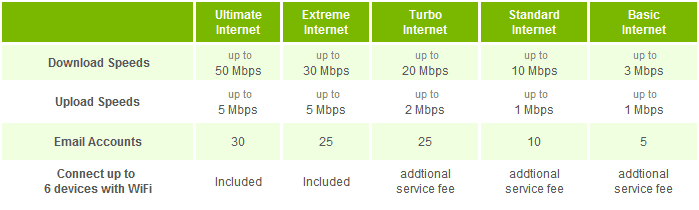
Residential DOCSIS 3 (Extreme/Ultimate) customers increased 50% to 218,000, and almost 66% of new broadband customers signed up for either Turbo (20Mbps), Extreme (30Mbps) or Ultimate (50Mbps) service.  Together, these customers now make up 20% of Time Warner’s broadband subscribers, up from less than 16% a year earlier.

Customers are willing to pay higher prices for faster service, a point not lost on Britt, who noted that once customers perceive broadband has more and more value, the company can charge more for it over time.

If Britt’s steadfast belief in Internet Overcharging-consumption billing schemes holds true, some customers might find they are charged substantially more if the company decided to discontinue offering unlimited Internet service.

For now, the company plans to continue its experiments in consumption billing through its Internet Essentials program, now testing in South Texas, which limits customers to 5GB of usage per month before overlimit fees kick in.  But going forward:

“I think we’ve been pretty clear about this, we do think over time, there will be consumption element to the tiers,” Britt said.

But Britt says he wants to keep unlimited access for customers willing to pay for it.

Time Warner's Hotspots in southern California.

“We retained our unlimited tier with no cap (I actually don’t like the term cap),” Britt added. “And I think we should always have that. So that this was not in any way coercive, people who wanted to save money, could. People who wanted to keep what they had have kept it, and they still have unlimited. So our plan is to roll that out further across [the country] as the year goes on.”

Britt noted the company’s own streamed video products would not drain customers’ usage allowances.  But Netflix and other online streamed video would.  Britt adopted the same argument Comcast has used to defend the practice.

“So there’s a set of standards called the IP, Internet Protocol, and those can be used for a wide variety of things in the world,” Britt explains. “There’s also something called the public Internet, which happens to use IP standards. That doesn’t mean those two things are exactly the same. So the application that we have on the iPad is over our closed-circuit network. It’s just a different standard than we’ve used traditionally for our video. But it’s not the public Internet.”

In other developments, the company’s controversial co-marketing agreement with Verizon Wireless has now expanded to four cities: Raleigh, N.C., Cincinnati and Columbus, Ohio, and Kansas City, Mo.

Time Warner Cable executives told investors the early stages of the cooperative marketing agreement will consist of a promotion that includes a $200 gift card when a customer buys both a Verizon Wireless plan and upgrades at least one service on their Time Warner Cable account.  But the company plans to gradually reduce discounts and instead offer unspecified “exclusive product enhancements” that will only be available to customers who subscribe to both services.

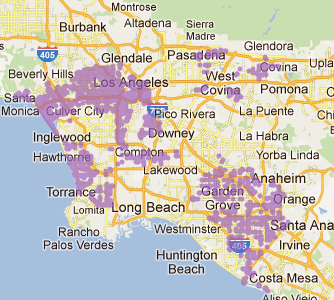
Lastly, expect Time Warner Cable to continue aggressive deployment of its Wi-Fi networks in New York and Los Angeles.  The company signaled it intends to construct similar Wi-Fi networks in other cities in serves, but most likely not during 2012.

Internet Overcharging Gravy Train: Average Home Wi-Fi Use to Exceed 440GB By 2015

Providers establishing Internet Overcharging schemes like usage caps, so-called “consumption billing,” and speed throttles that force subscribers into expensive upgrades are planning for a growth industry in data consumption.

According to new research from a firm that specializes in market strategies, data usage is going up and fast.  Providers that seek to monetize that usage could win enormous new profits just sitting back and waiting for customers to exceed the arbitrary usage caps some companies are now enforcing with their customers and take the proceeds to the bank.

iGR says the demand for connectivity inside the home is at an all-time high, with the biggest growth coming from wireless Wi-Fi connections.  The more devices consumers associate with their home broadband connection, the greater the usage.

That is one of the reasons why providers are increasingly supplying customers with free or inexpensive Wi-Fi routers, to make the connections quick, simple, and potentially profitable down the road.

Comcast's Wireless Gateway: A Future Money Machine?

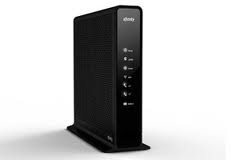
Comcast announced this week it would supply a free 802.11N “home gateway” free of charge to every new customer signing up for Blast!, Extreme 50 or Extreme 105 broadband service.  In addition to wireless connectivity for every device in the home, the Xfinity Wireless Gateway also includes a built-in cable modem and phone service adapter.  Time Warner Cable strongly encourages new DOCSIS 3 customers use their equipment for Wi-Fi service as well.  AT&T has included its own wireless gateway with U-verse for a few years now.

The offer is hard to refuse.  Nearly 80 percent of homes use wireless access, connecting cell phones, tablets, laptops, personal computers, game consoles, and even set top boxes that let customers stream video entertainment to their television sets.

iGR found average usage in heavily-connected homes at the all time high of 390GB per month.  By 2015, that will rise to more than 440GB per month.  Both numbers are well in excess of average consumption limits by providers like Comcast and AT&T, which top out at just 250GB per month.  Of course, not all Wi-Fi usage is based on traffic from the Internet.  Some users stream content between computers or devices within the home.  But the research is clear — usage is growing, dramatically.

Video is by far the biggest factor, according to iGR.  Their report, U.S. Home Broadband & WiFi Usage Forecast, 2011-2015, says the appetite for downloaded and streamed video is only growing.

Matt Vartabedian, vice president of the wireless and mobile research service at iGR, says home Wi-Fi has become inextricably woven into the personal, social and business fabric of today’s life.

Broadband is increasingly seen by consumers as an essential utility, as important as the home wired telephone, safe drinking water, and reliable electric and natural gas service.

Providers are positioning themselves to take advantage of the growth market in data by establishing what, at first glance, may seem to be generous (often inflexible) usage limits that remain unchanged years after introduction.  While only a handful of consumers may cross those provider-imposed thresholds at first, within a few years, it will be more uncommon to remain within plan limits, especially if you watch online video.

Search This Site:

Contributions:

Recent Comments:

Your Account:

Stop the Cap!