Home » consumption billing » Recent Articles:

UsageCapMan Takes Exciting Trip Through D.C.’s Revolving Door; Now FCC’s Chief Economist

From writing friendly reports defending Internet Overcharging to the FCC's new chief economist -- D.C.'s revolving door keeps on spinning.

From writing friendly reports defending Internet Overcharging to the FCC’s new chief economist — D.C.’s revolving door keeps on spinning for Professor Steven Wildman.

The Federal Communications Commission has proved that Washington’s revolving door enjoys perpetual motion with the announcement it hired a new chief economist who just three weeks earlier was peddling his findings favoring usage caps and consumption billing before a National Cable & Telecommunications Association gathering that paid for his research.

Professor Steven Wildman’s move from the cable industry’s go-to-guy for defending Internet Overcharging to a cushy new position at the FCC just weeks after shilling for the country’s largest cable industry lobbying group is shocking even by Washington’s standards.

Remarkably, FCC Chairman Julius Genachowski praised this cheerleader of wallet-pilfering by saying “his deep economic expertise and problem solving abilities” are the perfect fit for an agency pressed with challenging initiatives – like charging you more for your broadband service and calling it “pro-consumer.”

There is no doubt Wildman has deep economic expertise — he has found success penning dubious research bought and paid for by an industry that expects his findings to echo their own talking points. His problem-solving abilities at fixing the facts around the cable industry’s agenda are also unquestioned.

But his research reports aren’t worth wasting your monthly usage allowance to download because they only tell part of the story.

At the December NCTA Connects event, Wildman was the darling of the cable industry echo chamber telling tall tales about the problems of broadband penetration in a country where providers enjoy up to 95 percent gross margins on broadband pricing:

“One of the key mechanisms through which positive welfare effects are realized is the crafting of lower-priced plans for users who otherwise might not take service, while users who have a more intensive demand for broadband are able to contract for more advanced services. We also showed that UBP has flexibility advantages for users whose data service needs vary over time. Because UBP creates an incentive to offer lower cost-lower usage plans to consumers who otherwise could not profitably be served at a unitary price, UBP can be an effective tool for promoting increased broadband penetration in the United States, a role that is enhanced by the fact that low price-low usage options reduce the financial risks to consumers thinking about trying broadband for the first time.”

“Tiered pricing also has benefits for the recovery of shared network costs and for network investment. Whereas investment decisions are also influenced by other factors, including the costs of extending networks, potential revenues, and overall economic conditions, we found that, other things equal, usage tiers will likely contribute to better cash flows and stronger incentives to invest in broadband plant, both to improve the quality of service for current customers and to extend networks into unserved and underserved territories.”

usage cap manWildman does not mention his cable benefactors earn a higher percentage of profit on broadband than oil sheikhs in the Middle East rake in charging $90+ for a barrel of oil. So it is unsurprising his analysis lacks one simple solution providers could use to differentiate their services and enhance broadband penetration: lower the price to compete. He also ignores the fact that true usage pricing would offer consumers a chance to pay only for what they actually consumed during a month, but those plans are not on offer anywhere.

Wildman ignores the real industry agenda: monetizing broadband usage to create even higher profits. The cable industry is well on its way, using the enormous market power enjoyed in the current monopoly/duopoly state of consumer broadband to preserve today’s near-extortionist pricing while trying to pick up customers currently unwilling to pay, charging for slightly discounted service that comes with a paltry usage allowance.

The meme that unlimited, flat rate broadband is somehow responsible for America’s broadband-unserved is a popular one at the FCC, where Chairman Genachowski has applauded usage based pricing as an “innovative” experiment that could change how broadband is marketed in the U.S. and promote its expansion.

While those in D.C. may live in a bubble populated by industry lobbyists, others do not.

[flv width=”640″ height=”380″]http://www.phillipdampier.com/video/NCTA Connects The Pros and Cons of Broadband Peak Load Pricing Dec 2012.flv[/flv]

Message Confusion: While some in the cable industry still advocate usage pricing and caps as a matter of “fairness” and as a salve for peak time congestion, today’s advocates of usage-based billing appearing at a cable-industry event in December admit congestion is simply no longer a problem on wired networks. Sandvine’s Dave Caputo and Professor David M. Lyons of Boston College Law School dismiss the notion of congestion-based pricing only during peak usage, arguing congestion is no longer the real issue driving usage caps. That is why everyone must be subjected to higher priced, usage-capped broadband no matter what time of day they use the network. (3 minutes)

The inevitable outcome of "differentiated pricing" is charging consumers more to access popular websites, as is already the case in countries like Colombia.

The inevitable outcome of “differentiated pricing” is charging consumers more to access popular websites, as is already the case in countries like Colombia.

Wildman argues that like car manufacturers that offer many different models ranging from basic to well-appointed with luxury extras, providers should be free to offer different types of plans to consumers.

Wildman’s auto analogy fails because consumers have more than a dozen different manufacturers to choose from, each making a range of different models. For broadband, the overwhelming majority of Americans have two choices: the cable and phone company. Unlike auto manufacturers that respond to consumer demand, broadband providers are hellbent on eliminating the overwhelmingly popular flat rate, unlimited option in favor of mandatory usage pricing and/or usage caps. It would be like telling auto-buyers that their Honda Accord, Toyota Camry, or Chevy Malibu no longer met the needs of manufacturers. Instead, you have one choice: the Toyota Yaris. But you can get it with heated leather seats, so what’s the problem?

Wildman also ignores the fact providers already sell different plans, based on different speeds. Customers with only light web use can select a cheaper, lower speed tier and never notice the difference. Heavier users buy up into premium speed tiers, paying higher prices to cover their additional usage and expectations of performance.

Providers have spent the last few years trying to justify adding a usage component to the pricing equation and Wildman is perplexed by public policy and consumer groups overwhelmingly hostile to plans that would leave current pricing largely intact and add an artificial usage cap. Considering who pays for his research, this is not too surprising.

Wildman’s style of “innovation” already exists in countries like Canada, Australia, New Zealand, and in parts of Europe allowing everyone to witness what actually happens when these pricing schemes gain a foothold. Usage-based pricing has successfully boosted the profits of providers but has done nothing to expand rural broadband networks or offer customers big savings. When providers gorge on profits made possible in uncompetitive markets, the money goes straight into bank accounts or back to investors, not into capital spending to improve service or expand into areas deemed unprofitable to serve.

Customers despise usage caps so much that in Australia and New Zealand, the government has partially taken over rebuilding infrastructure with new fiber to the home networks and promoting international capacity expansion that will eventually banish usage pricing for good. In western Canada, Shaw Cable heard so much condemnation about usage caps during its listening tour, it greatly relaxed them. (The fact its biggest competitor Telus barely enforces their own caps didn’t hurt either.)

In the rest of Canada, independent ISPs have found a growing niche selling plans with considerably larger usage allowances or flat rate access. How did dominant providers like Bell (BCE) respond? They asked regulators to force the competition to stop selling flat rate service.
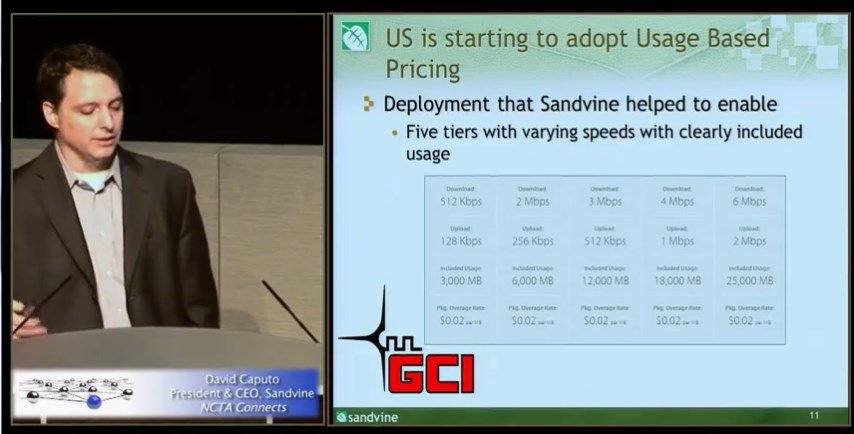
sandvine helping

How Sandvine helps providers “innovate.” Alaska’s GCI implemented its draconian caps and overlimit fees using Sandvine’s Internet Overcharging technology.

Wildman’s report flies in the face of reality, and every so often the cable industry itself admits as much. Take the word of Suddenlink president and CEO Jerry Kent, who runs a largely rural cable company that launched its own Internet Overcharging scheme:

“I think one of the things people don’t realize [relates to] the question of capital intensity and having to keep spending to keep up with capacity,” Kent said. “Those days are basically over, and you are seeing significant free cash flow generated from the cable operators as our capital expenditures continue to come down.”

Unsurprisingly, that sentiment did not make it into Wildman’s analysis either.

Wildman

Wildman

Financial reports from providers that have usage caps and those that don’t show the same remarkable trend: broadband expenses are way down, capital intensity is well within expected norms, and cable operators are not pouring their profligate earnings into expanding rural broadband.

That makes Wildman the consummate team player, and hardly the best choice for taxpayers who will cover his salary for a few years before he takes another trip through the revolving door back to his industry friends. When Americans wonder why Washington doesn’t seem to be living in the reality-based community, this is why. We can hardly expect Mr. Wildman to represent our interests when he has spent the last several years representing an extremely profitable industry reviled for its overcharging, poor service, and scheming, and will be more than welcomed back if he remembers his friends while working at the FCC.

This latest move represents another disappointment from Chairman Julius Genachowski, who increasingly appears to be warming up to a telecommunications industry he used to aggressively oversee at the start of his tenure.

[flv width=”640″ height=”380″]http://www.phillipdampier.com/video/NCTA Connects The Evolving Internet – Patterns in Usage and Pricing Dec 2012.flv[/flv]

Three weeks ago, the Three Musketeers of Internet Overcharging appeared at a cable industry-sponsored event promoting usage caps and consumption billing. Sandvine CEO Dave Caputo makes his living scaring providers and consumers about Internet growth and (conveniently) selling the equipment that manages the traffic “tsunami” with speed throttles and usage limits. Professor David M. Lyons of Boston College Law School calls usage pricing “second degree price discrimination,” a term he hopes the industry will rebrand into something less ominous and obvious. He argues selling broadband at incremental costs will never recover “fixed costs” for networks the cable industry itself admits have already been largely paid off. Professor Steven Wildman, now on the way to the FCC as its new chief economist, peddles research bought and paid for by the cable industry. They got their money’s worth. (1 hour, 9 minutes)

Panic 911: Big Telecom Front Group’s Silly Defense of Internet Overcharging

Phillip "Oh look, more industry-backed research in denial of consumer-loathing of Internet Overcharging" Dampier

Phillip “Oh look, more industry-backed research in denial regarding unpopular usage caps and consumption billing” Dampier

It seems America’s biggest industry-funded broadband astroturf group, Broadband for America, thinks the New America Foundation completely misses the point of “new pricing strategies” like restrictive usage caps, costly consumption-based billing, and fiendishly high overlimit fees. In a hurry, they released this particularly weak argument favoring usage pricing:

A new report by the New America Foundation suggests that “dwindling competition is fueling the rise of increasingly costly and restrictive Internet usage caps” in the broadband sector. But as we’ve explained before, these experimental new pricing strategies are actually signs of competition in the market and ultimately benefit consumers.

In terms of competition between broadband service providers, a study by Boston College Law School Professor Daniel Lyons concluded “data caps and other pricing strategies are ways that broadband companies can distinguish themselves from one another to achieve a competitive advantage in the marketplace.” He also concluded these practices were not anti-consumer: “When firms experiment with different business models, they can tailor services to niche audiences whose interests are inadequately satisfied by a one-size-fits-all flat-rate plan.” Indeed, many consumers are no longer satisfied with one-size-fits-all rate plans. Since data usage by individual users can vary dramatically, imposing a one-size-fits-all approach to pricing would result in light data users subsidizing the use of heavier ones. As Michigan State University Professor of Information Studies Steven Wildman explains, not having usage-based pricing models “means that light users pay a higher effective rate for broadband service, cross-subsidizing the activities of those who spend more time online. With usage-based pricing, those who use more bandwidth contribute more toward the cost of building and maintaining broadband networks.”

Broadband providers should be free to experiment with usage-based pricing and other pricing strategies as tools in their arsenal to meet rising broadband demand on their networks. Moving forward, Lyons recommends instituting public policies that allow providers the freedom to experiment, in order to best preserve the spirit of innovation that has characterized the Internet since its inception.

Broadband for America thinks they are clever when they introduce “academic papers” that extend credibility to their arguments. No, Broadband for America, we get the point. Your benefactors want to charge customers more  money for less service and call that a fair deal.

The wheels driving their talking points start to fall off the moment one peaks under their covers:

1. Broadband for America (BfA) is America’s largest telecom industry front group, backed almost entirely by cable and phone companies and dozens of supporting groups that are typically funded by those companies, have telecom industry board members, or whose lifeblood depends on doing business with Big Telecom companies.

2. Experimental pricing plans that largely leave existing pricing in place –and– impose new service limitations is not a sign of competition that benefits consumers, it is proof of its absence. With today’s broadband duopoly, there is little risk imposing new fees or service restrictions when the only competition you have typically follows suit. There is no evidence that usage-based pricing is saving consumers money, particularly when broadband providers are using their marketplace power to further increase prices.

3. There is no evidence “many consumers are no longer satisfied with one-size-fits-all rate plans” for home broadband. In fact, the reverse has been proved conclusively, sometimes by industry-funded researchers.

4. With a 90-95% gross margin on broadband, there is plenty of room for price cuts –and– unlimited broadband, but why give those profits away when lack of competition doesn’t provide the necessary push. Instead, providers’ ideas of “innovative pricing” are always upwards and include usage limits, modem rental fees, and other restrictions.

5. The railroad industry argued much the same case in the early 20th century when communities complained about wide pricing disparity, depending on local competition. We all know what eventually happened there.

6. Full disclosure, as is too often the case, is completely lacking at BfA. So we’ve offered to help:

The “study by Boston College Law School Professor Daniel Lyons” is accurate. He is now a faculty member there. But BfA fails to disclose the study was actually produced on behalf of the Koch Brother-funded Mercatus Center, which specializes in industry-friendly position papers on deregulation. Lyons is also on the Board of Academic Advisers at the Free State Foundation, itself an industry-backed astroturf group that advocates on behalf of large telecom companies, among others.

His colleague Michigan State University Professor of Information Studies Steven Wildman is also an adviser at the Free State Foundation. He is also a bit more transparent about where the money comes from for his studies advocating usage-based pricing – the National Cable and Telecommunications Association (NCTA), the largest cable industry lobbying and trade group in the United States.

The only surprise Lyons and Wildman could have delivered is if they advocated against these Internet Overcharging schemes. But then they probably would not have been invited to present their findings at an NCTA Connects briefing last week entitled, “Connecting the Dots on Usage-Based Pricing.”

We at Stop the Cap! can connect the dots as well.

New Report Slams Data Caps: An Internet Overcharging Climate of False Internet Scarcity

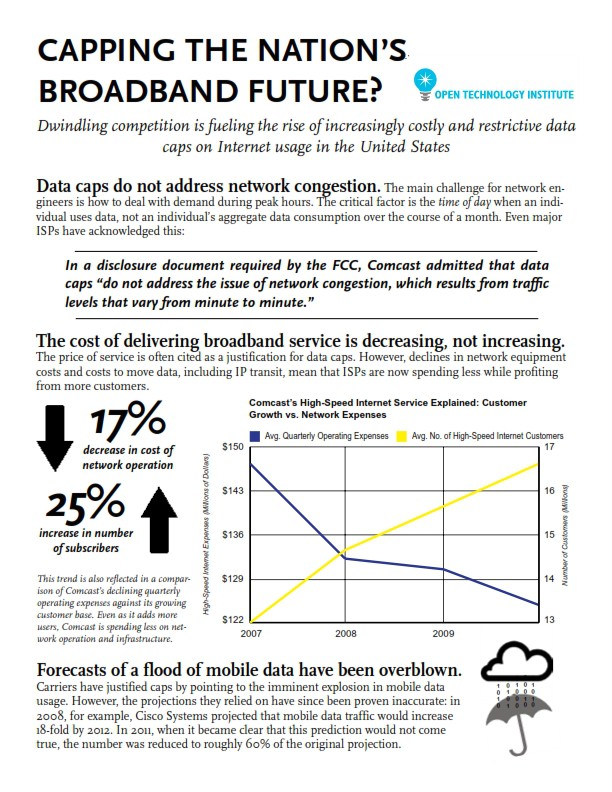
Data Caps 2-Pager_001

A new report critical of broadband providers’ implementation of usage-based billing and data caps finds providers are not using them to handle traffic congestion, instead implementing them to monetize broadband usage and protect pay television from online video competition.

stop_signThe New America Foundation and the Open Technology Institute today released its report, “Capping the Nation’s Broadband Future?,” which takes a hard look at the increasingly common practice of limiting subscribers’ broadband usage.

The paper finds that provider arguments for limiting broadband traffic don’t make sense, but do earn more dollars from customers forced to upgrade their service to win a larger monthly usage allowance.

“Although traffic on U.S. broadband networks is increasing at a steady rate, the costs to provide broadband service are also declining, including the cost of Internet connectivity or IP transit as well as equipment and other operational costs,” the reports argues. “The result is that broadband is an incredibly profitable business, particularly for cable ISPs. Tiered pricing and data caps have also become a cash cow for the two largest mobile providers, Verizon and AT&T, who already were making impressive margins on their mobile data service before abandoning unlimited plans.”

The study finds providers are attempting to invent a climate of broadband scarcity, particularly on the nation’s wired networks, to defend the introduction of various forms of Internet Overcharging, including data caps, usage-based billing, and overlimit fees.

The New America Foundation is calling on policymakers to take a more active role in defending online innovation and controlling provider zeal to cap the nation’s broadband future.

The False Argument of Network Congestion

Courtesy: Broadbast Engineering

Providers’ tall tales.

The most common defense for usage caps providers put forward is that they curb “excessive use” and impact almost none of their customers. The report points out many of the providers implementing usage caps have left them largely unchanged, despite ongoing usage growth patterns. In 2008, the report notes Comcast measured the average monthly usage of each broadband customer at around 2.5GB. Just four years later that number has quadrupled to 8-10GB. While many customers rely on Comcast’s broadband service for basic e-mail and web browsing, the cable operator has begun to entice customers into utilizing its online video platform, which in certain cases can dramatically eat into a customer’s monthly usage allowance, which remained unchanged until earlier this year.

Many broadband providers are less generous than Comcast, some imposing caps as low as 5GB of usage per month.

“Data caps encourage a climate of scarcity in an increasingly data-driven world,” the report concludes. “Broadband appears to be one of few industries that seek to discourage their customers from consuming more of their product. Thus, even as the economic and engineering rationale for data caps on wireline broadband does not hold up given the declining costs of providing service and rapid technological advancement, the proliferation of data caps is increasing. The trend is driven in large part by a woefully uncompetitive market that allows the nation’s largest providers to generate enormous profits as well as protect legacy business models from new services and innovators.”

The argument that increased usage puts an undeniable burden on providers is untenable when one examines the financial reports of providers.

The study found, for example, Time Warner Cable’s latest 10-K report shows that connectivity costs as a percentage of revenue have decreased by half, from an already modest 1.20% in 2008 to a little over 0.60% in 2011.

In 2012, the company is again exploring ways to introduce usage caps on at least some of its customers, in return for a modest discount.

Upgrade? Spend Less and Charge Customers More Instead!

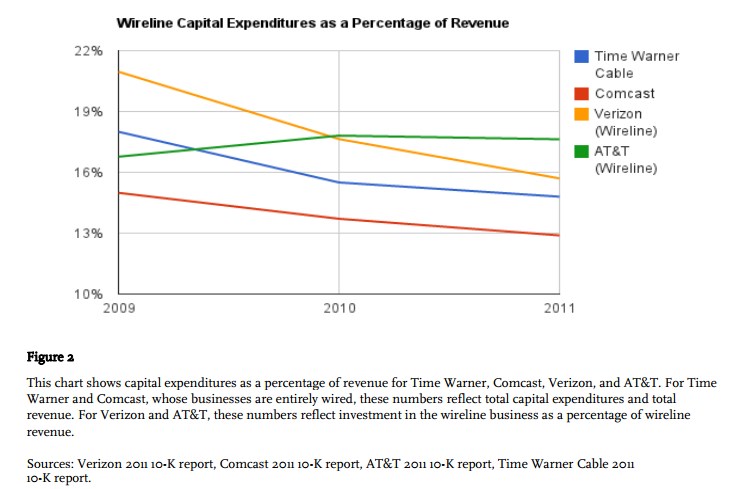
wireline capital

The report notes cable companies like Time Warner Cable and Comcast, whose networks were originally built for television services and have now been repurposed for broadband as well, are enjoying lucrative profits on
networks that have long been paid off. In fact, Time Warner Cable recently disclosed it earns more than 95 percent in gross margins on its broadband service, with additional rate increases for consumers likely in the near future. The company recently began charging its customers a modem rental fee as well.

Shammo

Shammo

At these margins, the report concludes selling broadband service to “data hogs” who consume hundreds of gigabytes of traffic per month are still profitable for providers.

As financial reports disclose capital spending on network upgrades continue to fall, operators are instead content imposing usage limits on customers to control traffic growth and further monetize an already enormously-profitable business.

The nation’s largest phone companies also come in for criticism. The report quotes from Stop the Cap!’s coverage of Verizon’s chief financial officer openly admitting it is investing most of its available capital in the highly profitable wireless sector.

“It is clear that in shifting a greater percent of their overall capital expenditures to their wireless segments, Verizon and AT&T are more interested in expanding their dominance in the wireless industry than they are in upgrading DSL or expanding fiber connectivity to provide aggressive competition for residential broadband service,” the report found.

Verizon’s chief financial officer recently made the following statement at an investor relations event:

“The fact of the matter is wireline capital — and I won’t give the number but it’s pretty substantial — is being spent on the wireline side of the house to support wireless growth,” [Verizon CFO Fran Shammo] said. “So the IP backbone, the data transmission, fiber to the cell, that is all on the wireline books but it‖s all being built for the wireless company.”

Wall Street Educates Providers on How to Lead the Way With Data Caps

Although the majority of subscribers loathe usage restrictions on their already-expensive broadband accounts, a vocal group on Wall Street strongly favors them, and routinely browbeats providers on the issue.

Helping educate cable companies about how usage caps can protect against cord cutting and further monetize broadband.

Helping educate cable companies how usage caps can protect against cord cutting and further monetize broadband.

The report’s authors discovered some Wall Street banks even invest time and money developing presentations advocating usage caps and consumption billing to protect video revenue. A 2011 Credit Suisse presentation outlined ways usage-based billing can protect cable operators’ video revenues:

“…over the longer term, consumption based billing could reduce the attractiveness of over the top video options (e.g., Netflix and Hulu), as the economic attractiveness of such over the top options could be partially offset by a [broadband] bill that is higher, due to [broadband] overage charges that would be driven by large amounts of data being streamed via a customer’s [broadband] connection.”

Yet most cable operators vehemently deny usage caps and consumption billing are designed to decrease usage or protect video revenue. Credit Suisse and other Wall Street banks and analysts say otherwise, and express little concern over network congestion.

The report finds compelling evidence that data caps have effectively stopped new competitors and online innovation already, noting a Sony executive stated that the company was putting the development of its own online video service on hold, citing Comcast’s monthly usage cap.

The Wireless Cap Shell Game: Caps Protect Scarce Airwaves While Companies Promote More Usage, For a Price

The report also found suggestions of a forthcoming wireless traffic tsunami are greatly exaggerated. AT&T and Verizon Wireless have issued repeated alarmist rhetoric claiming that wireless data’s exponential growth is threatening to overwhelm available network capacity.

But both carriers recently changed pricing models to encourage consumers to bring more devices to their networks, along with suggestions customers upgrade to higher allowance plans to handle the additional traffic generated by those devices. In fact, both AT&T and Verizon Wireless see profitable futures in forthcoming “machine to machine” wireless traffic that will allow cars, appliances and medical devices to communicate over their respective mobile networks. AT&T’s security and home automation system also relies on its own wireless network, offering customers remote access to their homes, chewing up wireless bandwidth as they go.

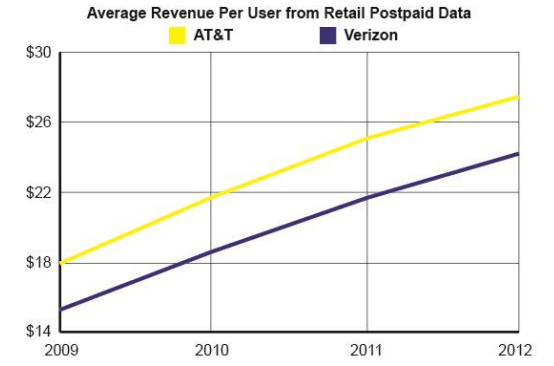
Despite suggestions from both providers their new wireless data plans would save customers money, in fact it has resulted in overall increases in the average revenue earned from each subscriber.

Despite suggestions from both providers their new wireless data plans would save customers money, it has brought overall increases in the average revenue earned from each subscriber instead.


Time Warner Cable Expands ‘Usage Cap-for-$5 Discount’ Nationwide by End of December

CEO Glenn Britt tells investors the company successfully pushed through modem fee as hidden “price increase”; Warns programmers unfettered rate hikes will result in networks being dropped, Disses Google Fiber as publicity stunt, and suggests more broadband rate hikes are in our future.

Time Warner Cable has announced its intention to broaden its consumption billing scheme offering $5 discounts to customers willing to keep their monthly usage under 5GB per month to every cable system it owns, with the exception of Oceanic Cable in Hawaii.

CEO Glenn Britt, speaking Monday to a UBS conference in New York, told investors that despite the fact the Internet Essentials program which caps monthly usage has attracted little interest from customers, the company was still going to take the program nationwide for symbolic reasons.

Britt

“At the moment what we have been trying to do is to get this idea into the marketplace,” Britt said. “It probably won’t surprise you that not very many people have taken the lower offer. That is fine. It hasn’t had much impact on [average revenue per customer]. But I think the idea is to have this consumption idea out there in addition to the unlimited.”

Britt’s attitude about consumption billing has evolved since its 2009 public relations disaster that forced the company to pull back on a plan to introduce consumption-based billing tiers for its Internet product. Protests erupted in test markets in New York, North Carolina, and Texas, several organized by Stop the Cap!, leading to proposed legislation to ban usage caps from one Rochester-area congressman and intervention from Sen. Charles Schumer (D-N.Y.) who helped convince Britt to shelve the plan.

“I actually don’t like the idea of caps,” Britt has said consistently. “That is a negative connotation.”

Britt’s views have evolved over the years to argue that an unlimited service tier should always be available from Time Warner Cable for customers who want it. But encouraging customers to use more broadband under some type of consumption pricing offers a new source for revenue for the company and its shareholders.

“What we think is we should always offer unlimited service but that we should offer a choice of a lower price with a consumption dimension for people who don’t need unlimited, so that’s quite different than what other [broadband providers] have talked about.”

Time Warner Cable is in the middle between operators advocating monetizing broadband usage with compulsory usage limits and overlimit fees and those, like Cablevision, that oppose usage limits of any kind. But Britt is intent on getting customers to begin thinking about associating usage with cost, and stop believing in the traditional “all-you-can-eat” unlimited broadband model that has been around since the 1990s.

Britt characterized the company’s increasing emphasis on broadband as part of an evolution of the cable industry beyond the video services that defined it for decades. With its video business increasingly pressured by increased programming costs the company can no longer pass entirely onto its customers, broadband and phone service now deliver more gross profit margin than its video package.

Time Warner Cable Broadband Has a 95% Gross Profit Margin?

“The gross margin on broadband has got to be the highest gross margin of any product offered by any industry in the United States — like 95%,” noted one Wall Street audience member that quizzed Britt about future threats Time Warner’s broadband business could face with a margin like that.

“I think actually this gross margin thing is something that is a perception that maybe our company caused in our effort to be transparent,” Britt tried to explain.

Britt argued the 95% figure was misleading because the company’s accounting methods allocate all of their costs to the specific services the company offers.

“In the case of the video business because it’s all the programming costs, that’s a big number,” Britt explained, noting video profits are tempered by programming costs. “In the case of broadband it’s just the direct bandwidth costs from third parties. It’s a small number so it looks like the margin is really high.”

With a few accounting changes, the company’s gross profits could be split more evenly across the video, broadband, and telephone services. But Britt explained the expense of switching to cost accounting made it not worth the effort. But the exposure of the enormous profits and very low cost of delivering broadband service may have inadvertently created a political problem for the cable industry as consumer groups suggest the vast profits earned on broadband come at the same time the industry is hiking prices and in some cases limiting service.

Britt tried to temper enthusiasm.

“If you look at the complete picture — broadband is a great business but it is not quite as profitable as just that gross margin number might make you think,” Britt said.

The Gradual Evolution of Time Warner Cable Towards Broadband, With Rate Increases to Follow

Britt said the company continued to gradually switch off analog video channels to free up capacity for additional broadband bandwidth.

“I think if you look at our physical plants we still devote a disproportionate amount of capacity to analog video so we’re still running broadband on a relatively small part of the capacity, but as [demand] grows we will keep adding more to broadband and we’re gradually reclaiming the analog video channels,” Britt explained. “We have not seen the need to flash cut/get rid of the analog and go all-digital, but we’re doing it over time.”

Britt called cable broadband a growth industry, with new entrants getting online for the first time.

“Broadband is a great business. It is still not fully penetrated,” Britt said. “There are homes that don’t have broadband that aren’t even online yet. And the homes that have it keep using it more and more all the time. I think somewhere recently I saw a study that said the average use is now 50GB a month.”

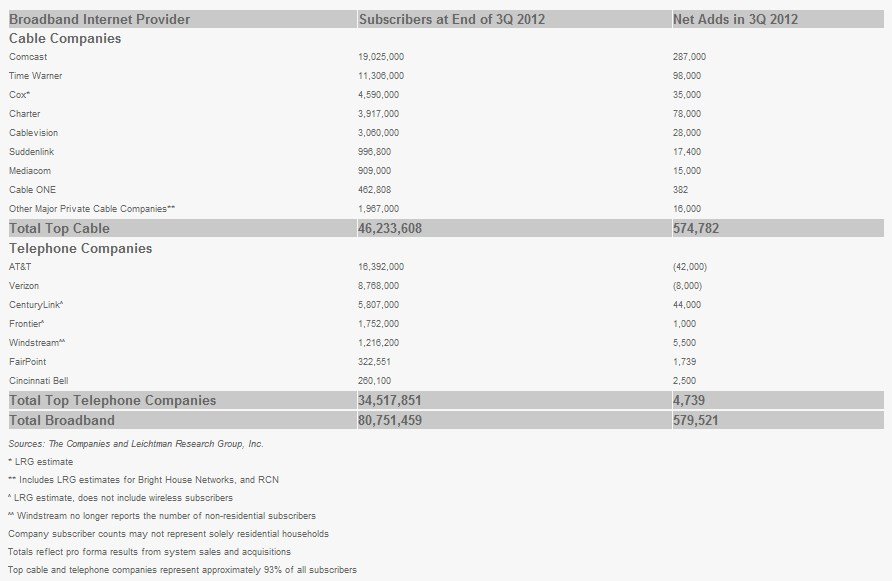
Cable operators continue to win the vast majority of new broadband customers, according to this chart from Leichtman Research Group, Inc.

With consumer demand for broadband at an all-time high, Britt said as usage and dependence on broadband continues to grow, the company will have more and more ability to raise prices. Britt noted the company implemented a modem rental fee in November he characterized as “essentially a price increase,” and called its implementation successful.

Cashing in on cable modems was just a hidden price increase, admits Britt.

Britt acknowledged only about 3% of customers have elected to buy their own cable modems to date, and Britt said he believed most people will continue to rely on Time Warner’s rented modem, bringing lucrative new revenue to the company indefinitely.

The company’s gradual move to an all-IP network is an acknowledgment of the success of broadband, but also allows the company to become more nimble with its video offerings and services.

“We are talking about using IP standards and IP technology to enhance our video offering,” Britt said. “What we are trying to do is recognize that all consumer electronics are increasingly moving to IP standards. Writing software to IP standards allows you to create software that can be much more easily updated and iterated than traditional forms of software. We’re embracing that wholeheartedly.”

The company is currently testing a cloud-based program guide and set top box interface in 190,000 homes in upstate New York with positive results, according to Britt.

“We are going to have the second version of that next year and roll it our more broadly,” Britt said. “We have not been as noisy about that as some others. Again, the beauty of this is that it resides centrally, not on everyone’s set top box, and you can change the software little bits and pieces once a week or every two weeks. You don’t have to have these giant software releases.”

Other initiatives:

  • Getting streaming video on every device capable of displaying it in a customer’s home;
  • Introducing local broadcast station video on the company’s streaming product. “We now have the ability to encode 1,000 broadcast signals from around the country,” said Britt. “Here in New York City, the broadcasters are in the package now;”
  • Will shortly introduce video-on-demand streaming through its device apps;
  • Its Wi-Fi network in Los Angeles is on track to offer 10,000 hotspots. The company’s next expansion priority is more Wi-Fi for New York City.

Britt Downplays the Competition: ‘AT&T U-verse is bandwidth constrained, FiOS is mostly finished expanding, and Google Fiber is a publicity stunt.’

Britt recognized AT&T planned to restart expansion of its fiber to the neighborhood U-verse service, which actually competes with Time Warner Cable in more communities than Verizon’s FiOS fiber optic network.

“U-verse overlaps about 25 percent of our footprint today,” Britt said. “Presumably it will add a little more when they’re done with this. I would remind you that U-verse is more bandwidth constrained than our plant. We have a route to faster speeds, so we’re confident with our ability to compete with that.”

Britt said Time Warner Cable has gained experience predicting what happens when new competition arrives in town, and continued to downplay its impact on cable’s dominant market position.

“There is a phenomenon in consumer behavior that when a new competitor comes to town a certain number of people move just because they want to try the new thing,” Britt said. “After you are there for awhile that part ends and you are just into a normal marketing game. I think leaving aside the AT&T announcement, that is true generally of the two phone companies who have built what they said they would build initially.”

The one city where competition has turned into building-to-building combat is New York City, where Verizon FiOS continues to only gradually expand into new buildings. When FiOS becomes available, marketing begins to get customers to consider switching, kicking Time Warner’s customer retention efforts into high gear.

Nobody needs 1Gbps, argues Britt.

The cable operator has traditionally offered aggressive retention and new customer deals to attract and hold cable customers, and in some cases it has thrown in high value prepaid credit card rebate offers. Currently, Time Warner Cable pitches new and returning customers its triple play package for $89-99 in New York, often giving existing customers the same deal when they complain.

In Kansas City, Time Warner Cable now faces competition from both AT&T U-verse and Google Fiber, but Britt claims the company is not as worried as some might think.

“I guess I would remind everybody [Google] in the past announced they were doing things like this,” Britt said. “I think they were going to build Wi-Fi over San Francisco and they built a couple of blocks. Obviously I’m not inside their company — I can’t exactly know their motivation, but certainly if it is like the past, their motivation is to demonstrate what technology can do and try to prod the government and other players to go bigger, faster, whatever.”

Britt doubts Google will take the project much farther than Kansas City, and even if it does, the cable industry will have decades to prepare.

“I would remind you it took the cable industry which built the second wire into the home — the phone being the first — four decades or more to build across the country and many billions of dollars,” said Britt. “Even if Google builds, we’re not going to wake up and see Google instantly building out the whole country.”

Britt took a swipe at Google’s white-collar business focus and wondered exactly who needs the service Google has started to offer.

“This is not like their other businesses; it is very physical, it is blue collar workers, it is process, it is a very different thing,” Britt said. “I think what they’re doing is trying to demonstrate the wonders of 1Gbps. The problem with that is even if you build the last mile access plant to do that, there is neither the applications that require that nor a broader Internet backbone and servers delivering at that speed. It ends up being more about publicity and bragging. There has been a whole series of articles in the paper about ‘I’m a little startup business and boy it is really great I can get this’ and my reaction is we already have plant there that can deliver whatever it is they are talking about in those articles, which is usually not stuff that requires that high speed. So we’ll see.”

But Britt acknowledged the company will have a challenge competing with at least one Google Fiber service.

“They are giving one level of broadband away for free with an upfront installation,” Britt noted. “It’s hard to compete with free, although it is hard to make money at free also.”

The Cord-Cutting “Myth”: It’s the economy, stupid.

Britt continued to downplay and dismiss the popular media meme that cord-cutting is taking a toll on cable television subscriptions. Britt argued with television sets left on in most homes an average of eight hours a day, and pay television services reaching 90 percent of those homes, parting with cable TV is not that easy for a product with that level of consumer acceptance.

“Is there some cord cutting typically among young people — maybe they were cable-nevers? Yes, but it appears to be fairly minor at the moment,” Britt said. “I think the bigger issue for the industry is a combination of price and the economy.”

“These packages keep getting more and more expensive. Programming gets more and more expensive,” Britt added. “I hope the economy gets better but at the moment there are still an awful lot of people who have been unemployed a long time and this stuff is starting to cost too much and I never miss the chance to get on my bully pulpit about it. If we, as a broader industry, want to keep this going, we need to figure out some way to have packages and prices that are lower for people who just cant afford it. That is a bigger factor right now than cord-cutting.”

Britt was lukewarm about his company’s own efforts to deliver a discounted cable television package which pares down the basic package to a few dozen channels with some notable gaps, especially for sports fans.

“We have a package called TV Essentials and whether it is the ideal configuration of programming and price — it is probably not — it is what we’re able to do,” Britt said. “It does have some uptake but not enormous. I think we need as an industry to work on that. We all know the big package works for the content companies and the little packages don’t. At some point this whole thing has to be responsive to the people who ultimately pay the bills and that is the consumer.”

Throwing Down the Gauntlet: ‘We’re going to start dropping little-watched channels at contract renewal time if prices don’t come down.’

“I think the trend has been pretty constant over the last several years: Since 2008, our programming costs per customer have gone up about 30 percent while the Consumer Price Index is up about 10%, so clearly those two things are out of whack,” Britt said. “Our video pricing has gone up about 15% so we are able to close that gap a little bit but not completely. I don’t have any magic bullet about this except clearly these trends can’t continue forever.”

Britt warned programmers have become too comfortable with the status quo for cable packages and pricing that some have gotten lazy about the quality of their programming, dependent on the subscriber fees they earn whether customers watch their channels or not.

“Content companies will all gloat and chortle about how wonderful the structure is and they can charge whatever they want,” Britt complained. “We’ve accumulated networks that hardly anybody watches. If you speak to the people who run those networks or own them they almost feel it’s a birthright — I have this network that has distribution to 70-80 million homes, and I’m getting paid every month for ads — maybe this year I wasn’t able to get a big audience but you know next year I am going to work harder and I am going to spend more money on programming and it’s going to be good.”

Britt noted some of the channels Time Warner added have transformed into entirely different channels the company would have never signed up for had they known.

“Sometimes people even change the entire content of the network and our company has been pretty aggressive in not letting that happen since we’re selling a whole package that appeals to different people,” Britt said. “It’s not a birthright, it’s not a carte blanche.”

“I think what we’re saying because the consumer is telling us they can’t afford these prices anymore, where we can we’re going to have to start cutting things off,” Britt warned. “So if you have a network that gets hash mark ratings and no real sign it’s going to get any better, and your contract is up, we’re going to have a different kind of conversation than we might have had five, six or ten years ago.”

Britt said some networks will be dropped altogether, others will be invited to remain, but only on an added-cost tier for subscribers willing to pay more.

“We can’t keep carrying these giant packages of things with the services that don’t carry their own weight,” Britt said.

But Britt understands the perspective of the entertainment companies as well, having formerly been with Time Warner, Inc., the entertainment-oriented company that owns several cable networks.

“A-la carte just doesn’t work for those companies,” Britt noted. “If you think about the existing package, it’s a wonderful mechanism to mitigate risk in a business that I would argue is one of the riskiest businesses on the planet.”

Britt compared a-la-carte economics with that of a typical Broadway theater show, where a small group of individuals risk substantial sums of money on the success of a production that either makes it or it doesn’t, and most don’t. The only revenue stream is from consumers willing to pay ticket prices for admission.

Today’s cable package offers niche and general interest channels in the same package, with assured subscription revenue regardless of ratings, combined with ad revenue which can be meager or substantial depending on the ratings. With guaranteed revenue, cable channels invest in programming production or acquisition — purchases that would not be likely if reliant on an uncertain a-la-carte business model.

Therefore, in Britt’s view, a-la-carte per channel or per program changes the dynamics of the cable business away from a stable one that obtains programming on the basis of predicted revenue to one closer to a Broadway production, where risks of failure are very high, especially for niche programming.

Britt believes in today’s bundled cable package, but not in its current size or monthly price.

“I think aside from that there is a lot of value in the package if you think about cost avoidance,” Britt said. “In reality we as distributors do the marketing, the billing, the customer relationship and although somebody from a network might rail at us for not being great marketers, the reality is if each network had to separately market and bill itself and deal with consumers separately, you would introduce a whole lot of cost in the system that is not there today. This actually works quite well for consumers today and it’s a relatively good value. I think the problem is the trajectory of it and if you are in the content business you are trying to seek eyeballs so you are competing with each other and the only way people seem to know how to do that is to spend even more for programming and that is what sort of killed you with consumer behavior.”

Time Warner Cable CEO Glenn Britt took questions for an hour from Wall Street investors and analysts at the UBS Conference in New York. (December 3, 2012) (55 minutes)
You must remain on this page to hear the clip, or you can download the clip and listen later.

Start the Countdown Clock on Julius Genachowski’s Departure from the FCC

FCC Chairman Julius Genachowski’s cowardly lion act. The rhetoric rarely matched the results.

Washington insiders are predicting Federal Communications Commission chairman Julius Genachowski will leave his position early in President Obama’s second term.

It cannot come soon enough, as far as we’re concerned.

One of the biggest disappointments of the Obama Administration has been the poor performance of a chairman that originally promised a departure from the rubber stamp-mentality that allowed Big Telecom providers to win near-instant approval of just about anything asked from the Republican-dominated FCC of the Bush Administration. If only to underline that point, former FCC Chairman Michael Powell joined Republican ex-commissioner Meredith Atwell-Baker on a trip through the D.C. revolving door, taking lucrative jobs with the same cable industry both used to oversee.

We had high hopes for Mr. Genachowski when he took the helm at the FCC — particularly over Net Neutrality, media consolidation, and predatory abuse of consumers at the hands of the comfortable cable-telco duopoly. Genachowski promised strong Net Neutrality protections, better broadband — especially in rural areas, an end to rubber stamping competition killing mergers and acquisitions, and more aggressive oversight of the broadband industry generally.

What we got was the reincarnation of the Cowardly Lion.

The Washington Post reviews Genachowski’s tenure during the first term of the Obama Administration and reports he has few unabashed supporters left. Telecom companies loathe Genachowski’s more cautious approach and consumer groups hate his penchant for caving in when lobbyists come calling. In short, another Democrat that talks tough and caves in at the first sign of trouble.

“His tenure has been nothing but a huge disappointment because he’s squandered an opportunity to give consumers the competitive communications market they deserve,” Derek Turner, head of policy analysis at public interest group Free Press told the Post. “If someone like him upholds compromise, it quickly leads to capitulation, which is what he’s done. He folds…to the pressure of big companies.”

Genachowski’s Record:

Search This Site:

Contributions:

Recent Comments:

Your Account:

Stop the Cap!