Home » consumption billing » Recent Articles:

South Africa’s Journey to Unlimited, Flat Rate Broadband Continues

Phillip Dampier February 6, 2013 Broadband Speed, Competition, Consumer News, Data Caps, Editorial & Site News, Public Policy & Gov't, Wireless Broadband Comments Off on South Africa’s Journey to Unlimited, Flat Rate Broadband Continues
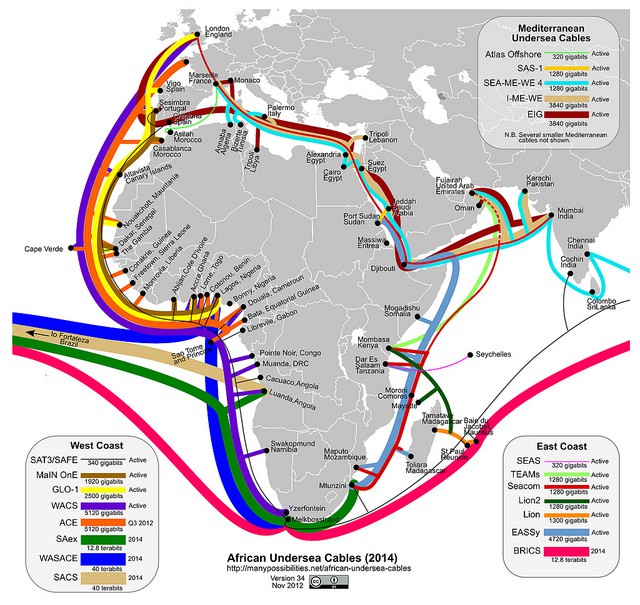
Africa's international Internet connectivity is primarily provided by underseas fiber cables. (Map: Steve Song)

Africa’s international Internet connectivity is primarily provided by underseas fiber cables. (Map: Steve Song)

One of the most common arguments pro-capping telecom companies use is since the rest of the world has already adopted consumption billing for broadband, why can’t North American ISPs follow in their footsteps. But ISPs around the world are actually heading away from capped, throttled, or nickle-and-dime broadband pricing towards flat rate, unlimited service.

The Republic of South Africa is a case in point. Located on the southeastern tip of the African continent, South Africa has faced down a number of broadband challenges. Antiquated infrastructure lacking investment in upgrades, political and economic challenges, and very costly, limited capacity international connectivity have all conspired to leave the country with poor broadband service.

The biggest problem domestically is deteriorating landline infrastructure, leaving most South Africans with slow speed ADSL service. Wireless mobile broadband has proved less costly to deploy, but connectivity costs remain high regardless of how customers obtain service because of international bottlenecks.

South Africa’s problems are similar to those faced in South Pacific nations like Australia and New Zealand. Data caps have been a fact of life for years, primarily because there has never been sufficient capacity on underseas fiber and satellite links to sustain anticipated traffic if the caps were removed. But those problems are starting to ease as new high capacity backbone connections continue to come online.

Heavily capped broadband transforms how people use the Internet. In all three nations, many people do their heaviest web surfing at work over business connections. Some ISPs ease their usage caps or speed throttles during low-demand overnight hours, leaving many to hold off on significant file transfers and software updates until most people have gone to bed.

Regardless of whether you live in Johannesburg, Adelaide, or Wellington, people hate data caps and speed throttles and cannot wait to be rid of them.

That day has come in South Africa. Telkom, the former state-owned telephone company, has announced dramatic price cuts and relaxation of speed throttles for customers choosing its unlimited ADSL offerings. The company has announced a 40% price cut for residential customers and a 35% cut for business customers that took effect Feb. 1. Speed throttles that used to block international traffic when customers were deemed to be “using too much” are also being removed, although Telkom can still reduce speeds for their heaviest users.

Speeds are still very slow compared to what most North Americans can receive, but the average South African can now purchase unlimited 4Mbps ADSL for around $42 a month. A 10Mbps account remains out of reach for many at an unaffordable $157 a month. Some of Telkom’s competitors sell unthrottled and unlimited 1Mbps service for a budget-priced $22 a month.

South African ISPs are managing to achieve speed increases, but the primary bottleneck remains Telkom’s aging copper wire infrastructure. The answer is more fiber links further out in telephone exchanges and reducing the amount of copper customers have between their homes and Telkom’s central exchange offices. Although urban residents in relatively prosperous areas can achieve faster speeds, South Africa’s large expanse of low income areas often rely on prepaid wireless services because wired infrastructure is often sub-standard.

International capacity concerns will continue to ease as new underseas fiber cables are brought online. By 2014, one new underseas fiber cable will be able to carry more Internet traffic than all of the currently operational cables preceding it combined.


Craig “Data Cap” Moffett Leaves Sanford Bernstein Wall Street Firm to Start His Own

Phillip Dampier February 4, 2013 Consumer News, Data Caps 5 Comments
Moffett

Moffett

Craig Moffett, who regularly questions telecom executives about why they have not implemented consumption billing or usage caps as a broadband revenue enhancer, has exited Wall Street’s Sanford Bernstein after a decade.

Moffett is one of the most quoted Wall Street telecommunications analysts in the business and financial press, and his regular browbeating of executives for higher prices on broadband service have earned him a reputation of being pro-cap and anti-consumer.

Moffett is also one of Wall Street’s biggest critics of infrastructure upgrades, particularly Verizon’s fiber to the home network FiOS, which he called too expensive and not worth the investment. In a battle between cable operators and phone companies, Moffett regularly takes the side of the cable industry. Cable operators have enjoyed lower capital costs and have successfully raised prices on profitable broadband service, even as providers move to limit customers’ monthly usage.

The Wall Street analyst is reportedly launching his own Wall Street research firm sometime this spring and has poached several employees of Sanford Bernstein to get started.


Cable Industry That Makes 90%+ Margin on Broadband Now Says Caps Are About ‘Fairness’

They are in the money.

Follow the money to the real root of this argument.

After conclusive evidence that cable broadband upgrades have eliminated any congestion problems, the cable industry has finally admitted usage caps are not about “congestion relief,” but are, in their view, “about fairness.”

Reports of the Internet data exaflood, tsunami, brownouts, or even blackouts are highly exaggerated and always have been. But we knew that from the first day Stop the Cap! got started.

In the summer of 2008, Frontier Communications attempted to define a top limit on their residential DSL accounts at a staggeringly small 5GB per month. Time Warner Cable initially thought 40-60GB a month was more than fair when it tried to ram its own Internet Overcharging scheme down the throats of customers in New York, North Carolina, and Texas in April 2009. Comcast said using more than 250GB a month could create congestion problems on their network and be unfair to other customers. To this day, AT&T, one of the nation’s largest telecommunications companies, claims that anything more than 150GB on their DSL service or 250GB on U-verse could bring their entire network to its knees.

The Holy Grail of Wall Street economics for broadband is to monetize its usage, creating an endless money party for what is today a utility service. Millions have been spent lobbying anyone who will listen that usage caps and consumption billing were essential to promote investment, upgrades, and to expand broadband service into rural America. Since those arguments have been made, broadband rates have increased, investment has decreased on a per customer and often real basis, and the government is now trying to chip in public taxpayer dollars to get providers to wire areas that will never pass demanding return on investment formulas.

The second prong of selling this meme is the creation of an Internet boogeyman — the “data hog,” a largely fictional creature that supposedly cares only about consuming every possible bit of bandwidth and slowing your web browsing to a crawl. Shouldn’t he pay more, you are asked, at the same time these same companies continue to raise your rates and now attempt to limit your use of a service that should cost less.

This week, Michael Powell, former FCC chairman turned head of the nation’s largest cable lobby — the National Cable & Telecommunications Association, capitulated on the “congestion” myth to an audience at the Minority Media and Telecommunications Association.

Asked by MMTC president David Honig to weigh in on data caps, Powell said that while a lot of people had tried to label the cable industry’s interest in the issue as about congestion management. “That’s wrong,” he said. “Our principal purpose is how to fairly monetize a high fixed cost.”

He said bandwidth management was part of it, though a more serious issue with wireless.

But he pointed out that the cable industry had to spend a bunch of money on its network before the first customer was signed. So, for a business that requires “enormously high” fixed costs — digging up the streets, put the wires in — and operational expense, “it is a completely rational and acceptable process to figure out how to fairly allocate those costs among your consumers who are choosing the service and will pay you to recover those costs.”

When will Washington regulators and lawmakers stop drinking the Kool-Aid handed them by high-paid lobbyists?

When will Washington regulators and lawmakers stop drinking the Kool-Aid handed them by high-paid lobbyists?

But our readers know Powell’s arguments are based on nothing more than the same empty rhetoric that declared the Internet exaflood was at hand.

Cable broadband was introduced as an ancillary service in the late 1990s utilizing cable television infrastructure that was constructed and paid off years earlier. Introducing broadband required only incremental investment and that remains true to this day. Cable operators more than cover their costs with sky high prices for service delivering some operators as high as 95% gross margin on broadband. Capital investments have broadly declined for years as have the costs to deliver the service on a per customer basis.

Suddenlink president and CEO Jerry Kent admitted the days of expensive system upgrades were over and it was now time to rake in profits.

“I think one of the things people don’t realize [relates to] the question of capital intensity and having to keep spending to keep up with capacity,” Kent said. “Those days are basically over, and you are seeing significant free cash flow generated from the cable operators as our capital expenditures continue to come down.”

Powell’s arguments ironically may apply partly to Verizon’s FiOS fiber network, which requires the retirement of copper wire infrastructure around since Alexander Graham Bell, but even Verizon covered much of its costs winning permission to raise rates years earlier to cover fiber upgrades. Much of that money was diverted to their wireless business instead. Today, Verizon FiOS manages just fine with no usage limits at all.

In fact, the only argument about fairness that should be open for debate regards the current cost of broadband service in the United States when compared against operators’ enormous profit margins. The lack of competition has allowed providers to increase prices and introduce “creative pricing” that always guarantees protection for the incredibly high average revenue per customer already earned.

Too often, Washington regulators and lawmakers drink the Kool-Aid handed them by an industry with an incentive to distort the truth. That incentive is the billions at stake in this fight.

Powell has even shelved the notion of the Cheetos-eating data hog burning up the Internet in his parent’s basement and has elected to try class warfare instead, claiming the most capacity is used “by a high end elite subsidized by the rest.” The real high-end elite are the telecom company executives cleaning up overcharging customers for a service that has become a necessity. Arguing for usage caps as a way to offer “lower prices” for those who cannot afford the ridiculously high prices the industry charges today only creates a new digital divide – the have’s and the have only so much.

Either way, providers laugh all the way to the bank.

Why is a Michigan Public Service Commissioner Carrying AT&T’s Water?

Phillip Dampier January 15, 2013 AT&T, Competition, Data Caps, Editorial & Site News, History, Public Policy & Gov't, Wireless Broadband Comments Off on Why is a Michigan Public Service Commissioner Carrying AT&T’s Water?
ori

Isiogu

A current member of the Michigan Public Service Commission is penning guest editorials featuring AT&T’s favorite talking points: promoting the company’s deregulatory agenda and providing false memes about Internet Overcharging schemes like usage caps and consumption billing.

Orjiakor N. Isiogu, co-vice chairman of the National Association of Regulatory Utility Commissioners Committee on Telecommunications and member and immediate past chairman of the Michigan Public Service Commission wrote nearly identical pieces appearing in The Hill, the Detroit Free-Press and the Battle Creek Enquirer that included misleading claims that could have come straight from an AT&T lobbyist’s “fact sheet.”

A sample:

The federal government has used the telecom industry as a model of how competition could be a better elixir than the guiding hand of government regulation. And the results are impressive. The high-speed Information Superhighway touches 95 percent of the U.S., and most consumers can choose from among six or more wireless or wireline providers (90 percent can choose from at least two). And the price of Internet access — measured by megabits per second — has fallen 87 percent since 1999, even as the speed has increased tenfold;

80 percent of U.S. homes now have access to download speeds of 100 megabits per second, and 4G wireless service will soon be available nationwide, with speeds of up to 20 megabits per second;

Despite the evidence, however, there are those who wonder whether there is sufficient competition for Internet access, whether speeds are too slow and prices too high. Others object to new pricing plans that allow a consumer to purchase the amount of bandwidth that best suits his needs.  In fact, some have asked the government to stop these new tailored pricing plans, even though these plans save nearly all consumers from having to underwrite the “outliers” whose monthly usage is gigantic — over 300 GBs a month or the equivalent of over 500 standard definition movies;

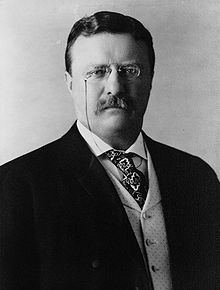
And if Teddy Roosevelt were with us today, he would likely argue that we can walk and chew gum at the same time, pointing to the banking industry as an example of industry excesses in need of a public check and the telecom industry as an example of how private competition, with occasional nudges, could better make the markets work.

In reality, if Teddy Roosevelt were alive today, he’d ask why a state commissioner working for the public is instead carrying water for the large telecommunications companies he oversees.

Did Roosevelt advocate the government keep their hands off AT&T and other consolidating telecom companies?

Did Roosevelt advocate the government keep their hands off AT&T and other consolidating telecom companies?

Isiogu doesn’t know his history either.

Roosevelt made no distinctions between the excesses of one industry over another. He strongly believed all major interstate corporations (and that would cover Isiogu’s friends at AT&T, Comcast, and other big telecom companies) should be subject to federal regulation and, in some cases, have their rates set by the government to ensure the public was charged fairly for the services they received. Roosevelt learned his lesson well from the oil, railway, and tobacco trusts his government sued to break up after years of consolidation and rapacious greed at the public’s expense. Those companies all claimed to be competitive as well.

Few industries have consolidated faster than the telecom sector, which is gradually rebuilding the Bell System in AT&T and Verizon’s image and a cable cartel that agrees never to compete directly with other cartel members.

Isiogu’s “facts” are disturbingly incomplete and misleading for a telecom regulator ostensibly serving the public interest.

For example, his claim that Americans can choose among six or more different providers ignores the fact AT&T and Verizon are counted twice (wired and wireless), no competition exists among multiple cable operators or phone companies, and many of the other options Isiogu counts (almost always wireless) do not provide coverage in suburban and rural Michigan. The average consumer in the U.S. has two practical choices for broadband — the cable or phone company.

While Isiogu sings the praises of American broadband, the rest of us have watched the price of Internet service continue to increase, whether customers want faster speeds or not. The industry itself admits it can raise prices because the competitive landscape and consumer love of broadband gives companies “pricing power.”

He also doesn’t mention the price of 100Mbps service or the fact it is not offered by either AT&T or (outside of one city) Time Warner Cable — both industry leaders. Wireless is no panacea either. 4G service may offer faster speeds, but usage plans that start with just a 1GB allowance make it hard (and expensive) to take advantage of the technology improvements. Just a few years ago those plans offered unlimited access.

Isiogu also tapdances around the fact no broadband provider in the country wants to sell a “pay for what you use” plan. Instead, companies create usage allowances that come with steep overlimit fees and, as AT&T executives have told shareholders, deliver limitless potential revenue growth as subscribers are forced to upgrade as their usage grows.

Most consumers favor and appreciate unlimited-use plans for predictable pricing and ease of mind. But flat rate plans ruin providers’ goals to monetize broadband usage and are usually eliminated when consumption pricing arrives, another fact Isiogu does not bother to disclose.

Isiogu has gotten remarkably cozy with the industry he oversees, even resorting to mind-bending pretzel logic that calls regulation for the banking sector a good idea and oversight of his industry friends a disaster.

What is disturbing is while Isiogu pens these industry friendly guest editorials in his spare time, he is also in a position of power to oversee and regulate these same companies in the public’s interest.

That represents a clear conflict of interest Teddy Roosevelt could see and feel from his grave.

Oregon Senator Introduces Bill Requiring ISPs to Justify Congestion-Related Usage Caps

Wyden

Wyden

Sen. Ron Wyden (D-Ore.) has introduced legislation that would force Internet Service Providers to prove usage caps are designed to manage network congestion instead of monetizing consumer data usage.

The Data Cap Integrity Act would require the Federal Communications Commission to enact new rules forcing providers to justify their usage cap programs, create standards by how ISPs measure usage and to provide useful measurement tools to customers before they incur overlimit fees.

“Internet use is central to our lives and to our economy,” said Wyden. “Future innovation will undoubtedly require consumers to use more and more data — data caps should not impede this innovation and the jobs it creates.  This bill is intended to help consumers manage their data more effectively and ensure that data caps are used only to serve the legitimate purpose of addressing congestion.”

Wyden’s bill is an attempt to force providers to prove their contention that usage limits improve the user experience by preventing so-called “data hogs” from slowing down connections of other paying customers.

Wyden is also concerned that without uniform standards of data measurement, consumers could be blindsided with overlimit fees or even have their service cut off. In the past, providers have stuck customers with a variety of often inaccurate measurement tools that have under or over-reported usage, which can sometimes lead to higher bills. At present, no government agency has authority over the veracity of provider measurement tools, and most ISPs impose terms requiring subscribers to accept their word as final for the purpose of usage measurement.

The Oregon senator’s bill is the first measure regulating usage caps introduced in the Senate. In 2009, Rep. Eric Massa (D-N.Y.) introduced a measure in the House that would have banned most usage caps and usage-based billing without first applying a means test. Massa introduced the bill after Time Warner Cable attempted to impose a usage-billing scheme on customers in his district, which includes parts of the Rochester area.

Among the provisions in Wyden’s bill the FCC must enact and enforce within one year of its passage:

  • A “truth in labeling requirement” that requires ISPs fully disclose the cost of their services, the true upload and download speed a customer will receive, and the presence of any speed throttles or usage limits;
  • A ban on usage caps for any provider that cannot prove they are needed to control congestion and not simply discourage Internet usage;
  • A penalty for providers that either do not provide suitable measurement tools or inaccurately measure usage leading to unjustified overlimit fees;
  • A provider may not exempt certain content from its usage cap while imposing it on others.
Lyons

Lyons

Wyden’s bill was introduced at the same time the nation’s largest cable lobbying group, the National Cable and Telecommunications Association, sponsored an event defending usage limits and consumption billing. Two of the three experts speaking at the event declared peak usage limits or congestion pricing ineffective.

In fact, Michael Weinberg from Public Knowledge took note of the fact the cable industry now seems to admit it does not have a congestion problem:

“The most refreshing section of the [NCTA’s] study is the one that is not there,” Weinberg wrote. “There is no meaningful discussion of usage-based pricing as a tool to reduce network congestion or a suggestion that monthly data limits are a reasonable way to impact congestion. There is also no invocation of the mythical ‘data hog,’ a sinful creature that can only be punished with data caps. Hopefully, the omission is NCTA’s tacit admission of two things: that cable networks are not congested and, if they become so in the future, monthly caps will do little to address that congestion.

”

“I don’t think congestion is as big a problem in fixed broadband,” said Professor David M. Lyons of Boston College Law School at the NCTA event. “The latest broadband speed surveys that the FCC has come out suggests that there is not a whole lot of slowdown at peak periods on the fixed side.”

Search This Site:

Contributions:

Recent Comments:

Your Account:

Stop the Cap!