


Home » consumption billing » Recent Articles:

Wall Street Journal’s Distorted Views on Broadband Only See the Industry’s Point of View

Phillip Dampier

Phillip Dampier

The Wall Street Journal’s not-living-in-the-real-world editorial page strikes again.

The commentary pages have always been the weakest part of the Journal, primarily because they screech pro-corporate talking points in contrast to the more balanced reporting in the rest of the newspaper.

Mr. Holman W. Jenkins, Jr. decided to distort broadband reality (again) in yesterday’s edition with a glowing commentary on how wonderful broadband providers are in his piece, “Springtime for Broadband.” The only thing missing was a border in fine print labeled, “Sponsored by Verizon, AT&T, and your cable company.”

While your Internet bill is being hiked at the same time your provider is slapping usage limits on your connection, Jenkins dismisses consumer-fueled complaints about broadband price gouging, assaulting Net Neutrality, and overall poor customer service as part of Washington’s “broadband policy circus.”

Charges fly hourly that Google or some other company is guilty of gross insult to net neutrality (that sacred principle nobody can define). Oregon Sen. Ron Wyden has introduced legislation to regulate data caps and Internet pricing. Law professor Susan Crawford, until recently a White House technology adviser, clearly craves to be America’s next go-to talking head on broadband. Lately she’s been everywhere calling for a crackdown on the competing “monopolists” who supply Internet access.

How dare they complain, decries Jenkins in a robust defense of the 21st century version of the railway robber barons.

Comfortably playing patty cake with provider-fed talking points from the industry echo chamber, Jenkins is ready for battle, facts or not.

But wireless providers have invested big money to deploy high-speed mobile networks, and fixed and mobile are inevitably beginning to compete. The latest evidence: Australia recently predicted that up to 30% of households will go the all-wireless route and won’t be customers for its vaunted national broadband project.

Jenkins

Jenkins

Not exactly. The basis for this 30% figure is the National Broadband Network’s own business plan, which warns if– the company raised prices to a maximum theoretical level, up to 30 percent of its customers would rely on wireless instead… by the year 2039. That is 26 years from now. You have nothing better to do in the meantime, right?

In fact, conservative critics of the fiber network, some defending the big wireless cell phone industry in Australia, have suggested fiber optics is a big waste of money because “wireless is the future.”

That old chestnut again.

“Now you can present a bulletin without touching a typewriter … it’s just there on the computer system, you don’t need a reel to reel tape recorder. I’ve got a touchscreen in front of me. Back then I had a big cartridge deck,” said Ray Hadley on 2GB radio. “Can you imagine the advances in technology in the next 26 years? I can’t. I can’t comprehend it. By the time they finish the NBN, it could be superseded by something we don’t even know about.”

NBN Myths, a website set up to tackle the disinformation campaign from political and industry opponents has one simple fact to convey: “Despite what you may have read from certain clueless commentators, there is not a single country or telecommunications company anywhere in the world that is attempting to replace fixed networks with wireless in urban areas, or even planning to do so in the future.”
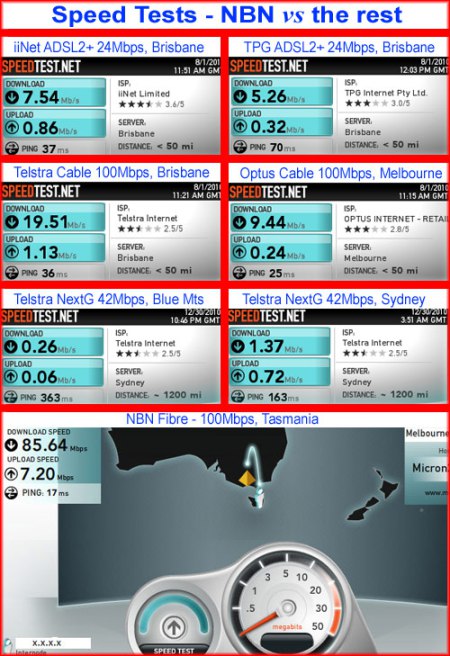
Which would you rather have?

Which would you rather have?

Even Telstra, the biggest telecom company in Australia scoffs at such a notion, noting a growing number of its customers have both wired and wireless service, and they do not depend on one over the other.

Research firm Telsyte found that 85 per cent of Australians want speeds of 50Mbps or higher, speeds impossible for wireless to offer. In fact, when the NBN fiber network became available to Australians, almost half the current users as of October last year had chosen an even-faster 100Mbps plan option. But Australians also want mobile broadband, and they are signing up for that as well.

The Australian Bureau of Statistics notes the number of mobile broadband Internet connections also grew by around 40% in Australia between 2009 and 2010. But here is the Achilles heel of wireless: it cannot deliver the same speeds or capacity, and providers charge high prices and deliver low usage caps. As a result, the wireless industry has pulled off a coup: they earn enormous revenues from networks they have successfully rationed. The total amount of data downloaded over Australia’s wireless networks actually fell on a per user basis, despite the growth in customers.

Much of Jenkins’ commentary is spoon-fed by the industry-funded Information Technology and Innovation Foundation, which produces industry-sponsored studies designed to tell America all is well in our broadband duopoly.

In the latest federal survey, the average broadband speed in America is up to 15.6 megabits per second, from 14.3 a year earlier. Nearly half of customers who six months ago made do with one megabit or less have now moved up to higher speeds. Since 2009, the U.S. has gone from 22nd fastest Internet to the eighth fastest.

The 15.6Mbps figure comes from the Federal Communications Commission. The statistics about our global speed ranking come from Akamai’s voluntary speed test program. Other studies rate America much lower. More importantly, while providers in the U.S. try to squeeze out more performance from their copper networks, other countries are laying speedier fiber networks that are destined to once again leapfrog over the United States. Most charge less for their broadband connections as well.

Jenkins also quotes the ITIF which touts 20 million miles of fiber were laid in America last year. But the ITIF, when pressed, will admit the majority of that fiber was “middle mile” connections, institutional or business network fiber you cannot access, or fiber to cell towers. Fiber to the home expansion has stalled, primarily because Verizon has suspended expansion of its FiOS network to new areas after Wall Street loudly complained about the cost.

Jenkins argues that if we leave providers alone and stop criticizing their growing prices, declining competition, and fat profits, the marketplace will suddenly decide to invest in network upgrades yet again.

“The day may come when even Verizon, which visibly soured on its $23 billion FiOS bet, rediscovers an urge to invest in fixed broadband infrastructure to meet growing consumer lust for hi-def services,” writes Jenkins.

Would Wall Street rather see providers invest in network upgrades or return profits to shareholders? Investment expansion in the broadband industry comes when a company senses if they do not spend the money, their business will be swept away by others that will. Cable broadband threatens telephone company DSL, so AT&T cherry-picked communities for investment in its half-measure U-verse fiber to the neighborhood network. Google Fiber, should it choose to expand, will be an even bigger threat to both cable and phone companies. Municipal fiber to the home networks upset the incumbent players so much, they spend millions of ratepayer dollars in efforts to legislate them out of existence.

Jenkins’ view that giving the industry carte blanche to do and charge as it pleases to stimulate a better broadband future is as fanciful as NBN critics in Australia suggesting fiber upgrades should be canceled in favor of waiting 20+ years for improved wireless to come along.

He even approves of Internet Overcharging schemes like usage caps and consumption billing, calling it proper price discrimination in a “fiercely competitive” environment to defray a network’s fixed costs.

Do you think there is fierce competition for your broadband dollar?

Broadband’s fixed costs are so low and predictable, it literally calls out consumption pricing as just the latest overreach for enhanced profits. As Suddenlink’s CEO himself admitted, the era of big expensive cable upgrades are over. Incremental upgrades are cheap, the costs to offer broadband are declining, so it is time to reap the profits.

Jenkins closes with one recommendation we can agree with: “A low-tech way to stir up broadband competition would be to relax the regulatory obstacles to the actual physical provision of broadband.”

We can start by scrapping all the state laws the industry lobbied to enact that prohibit community-owned broadband competition. If big cable and phone companies won’t provide communities with the quality of broadband service they need to compete for 21st century jobs, let those communities do it themselves.

Verizon Reaffirms No Usage Caps; Speed Matters: Almost 50% Opt for 50-75Mbps FiOS Service

Phillip Dampier March 11, 2013 Broadband Speed, Competition, Data Caps, Verizon, Video 1 Comment

[flv width=”360″ height=”290″]http://www.phillipdampier.com/video/Bloomberg Verizons Fios Gaining Market Share 3-4-13.mp4[/flv]

Bob Mudge, president of consumer mass business markets at Verizon Communications, Inc., has reaffirmed Verizon FiOS has no plans to implement usage caps or consumption billing on its fiber to the home broadband customers. Mudge also told Bloomberg News that broadband speed really does matter. Nearly 50 percent of FiOS customers have chosen to upgrade to at least 50Mbps service, which is priced just $10 higher than its entry-level 15Mbps plan. Mudge also talked about changes Verizon is making for FiOS installations in New York City. Twenty-five so-called “Magic” buses will replace 250 single technician trucks, transporting teams of technicians to small businesses and homes in and around the Big Apple.  (6 minutes)

TWCAlex (Dudley) Takes Job With Charter Cable; Helped Front for TWC’s 2009 Cap Experiment

Phillip Dampier March 5, 2013 Charter Spectrum, Data Caps, Editorial & Site News Comments Off on TWCAlex (Dudley) Takes Job With Charter Cable; Helped Front for TWC’s 2009 Cap Experiment

dudleyAlex Dudley, a specialist in corporate crisis communications, has left Time Warner Cable after serving as the cable company’s group vice president of public relations, to take an executive position at Charter Communications.

Our readers will recall Dudley represented Time Warner during its 2009 experiment with usage caps and consumption billing. He tweeted company talking points from his @TWCAlex account. In the summer of 2010, more than a year after the experiment was shelved after customer protests, Dudley was still defending the need for broadband usage limits:

“As Internet use increases, TWC techs, engineers, and executives need to make adjustments such as DOCSIS upgrades at the cable company headend or “node splits” that divide a shared cable loop in two when bandwidth use hits certain metrics. Paying all of these people costs money, and those costs increase as the network is more heavily used.”

Unfortunately for him, Time Warner Cable’s own financial reports belied his claims. The DOCSIS 3 upgrade, now complete at Time Warner Cable, had no material impact on the company’s pre-planned capital expenses, and was undertaken at the same time the cable operator began increasing prices on broadband service.

Dudley will assume the role of senior vice president of communications at Charter on March 18. His high-profile status at Charter was reflected by a statement from Charter CEO Tom Rutledge welcoming him to the company:

“These appointments reflect a commitment to our customers, shareholders and employees to support and sustain the positive changes taking place at Charter,” Rutledge said. “Alex is a proven leader who brings with him a wealth of expertise in developing and managing compelling messaging and executing high-impact, strategic communications. He will be a valuable contributor to our organization.”

Entertainment Producers Call Out Stifling Data Caps That Upset the Online Video Revolution

Phillip Dampier February 27, 2013 AT&T, Comcast/Xfinity, Competition, Data Caps, Online Video, Public Policy & Gov't, Verizon Comments Off on Entertainment Producers Call Out Stifling Data Caps That Upset the Online Video Revolution

Public-KnowledgeData caps protect incumbent big studio and network content creators at the expense of independent producers and others challenging conventional entertainment business models.


That was the conclusion of several writers and producers at a communications policy forum hosted by Public Knowledge, a consumer group fighting for an open Internet.

A representative from the Writers Guild of America West noted that cord-cutting paid cable TV service has become real and measurable because consumers have a robust online viewing alternative for the first time. John Vezina, the Guild’s political director, noted how Americans watch television is transitioning towards on-demand viewing.

New types of short-form programming and commissioned series for online content providers like Netflix are also changing the video entertainment model.

Welch: It is about the money.

Welch: It is about the money.

But a digital roadblock erected by some of the nation’s largest broadband providers is interfering with that viewing shift: the data cap.

Data caps place artificial limits on how much a customer can use their Internet connection without either being shut off or finding overlimit fees attached to their monthly bill. Critics contend usage caps and consumption billing discourage online viewing — one of the most bandwidth intensive applications on the Internet. With broadband providers like Time Warner Cable, AT&T, Verizon, and Comcast also in the business of selling television packages, cord-cutting can directly impact providers’ bottom lines.

Providers have traditionally claimed that usage limits are about preserving network resources and fairness to other customers. But Time Warner Cable admits they exist as a money-making scheme.

Rachel Welch, vice president of federal legislative affairs at Time Warner Cable, says the cable company is not worried about limiting data consumption. It considers monetizing that consumption more important.

“We want our customers to buy as much of the product as possible,” Welch told PC World. “The goal of companies is to make money.”

Time Warner now offers customers a choice of unlimited service or a $5 discount if customers keep their monthly usage under 5GB, but some worry that is only a prelude to introducing expanded usage limits on a larger number of customers in the future.

For many consumers already hard-pressed by high broadband bills, worrying about exceeding a data allowance and paying even more may keep viewers from watching too much content online.

For that reason, Vezina called data caps “anti-innovation.”

“It hurts consumers [and] it hurts creators who want to get as much out to the public in as many ways” as possible, he said.

Public Knowledge has become increasingly critical of data caps in the last two years. The organization has questioned how ISP’s decide what constitutes a ‘fair’ usage limit and criticized inaccurate usage meters that could potentially trigger penalties and overlimit fees.

A Look Inside Time Warner Cable’s Quarterly Results and Forthcoming Plans

Phillip Dampier February 12, 2013 Broadband Speed, Data Caps, Online Video 12 Comments

timewarner twcIt’s time to take a look inside Time Warner Cable’s latest quarterly financial report and pick out some interesting developments that will impact customers during the first quarter of 2013.



Time Warner Cable managed 9 percent revenue growth in 2012, primarily from its broadband service, its strongest product. The company added another 500,000 broadband customers over the last year, primarily poached from telephone company DSL service. This growth in subscribers continues despite rate increases and the introduction of a $3.95 monthly modem rental fee introduced last fall.

CEO Glenn Britt noted that Time Warner Cable customers use and love their broadband service.

“The average customer used roughly 40% more capacity last year,” Britt noted.

But Time Warner Cable has plenty of capacity to handle that traffic growth.

Britt plans to leave as CEO of Time Warner Cable by the end of this year.

Britt plans to leave as CEO of Time Warner Cable by the end of this year.

Irene Esteves, Time Warner’s chief financial officer noted Time Warner Cable continues to decrease its capital spending. Overall, Time Warner spent $3.1 billion on capital expenditures in 2012, or just 14.5% of its revenue. That represents a 40-basis point decrease from 2011. The bulk of that spending was on business services, primarily from the costs of wiring business office parks and buildings for cable. Less than 12% of Time Warner Cable’s spending targeted residential services.

“Overall, we expect capital intensity will continue to decline modestly, with full year capital spending around $3.2 billion in 2013,” Esteves told investors.

Time Warner’s new modem fee is earning the company a major boost in Average Revenue Per User (ARPU). The average Time Warner customer now spends $103.79 a month for service, an increase of 6.3%. Three-quarters of that increase is attributable to the modem fee alone.

Customers are clamoring for higher broadband speeds. At the end of 2012, Turbo, Extreme and Ultimate subscribers comprised over 23% of the company’s residential broadband customer base, up from 19% a year ago and 11% three years ago.

Britt, expected to retire by the end of this year, noted the company’s biggest challenge during his tenure continues to be programming costs. But the company is contributing to that problem itself, spending $110 million in 2012 on its new regional sports networks in southern California, which feature the Los Angeles Lakers and the Los Angeles Dodgers.

“Our programming costs per subscriber has grown 32% in the last four years,” Britt complained. “Over that same period, the Consumer Price Index has risen by 9%. So the math is pretty simple, programming costs have been rising at more than three times the rate of inflation. Our residential video ARPU increased 16% over that same period, so we’ve effectively raised pricing a little faster than inflation but only half as fast as programming costs have risen.”

The rising price of cable service has caused Time Warner to lose a larger number of customers, particularly when promotional pricing deals expire. The company has retrained its retention agents to avoid losing customers to the competition as new customer promotions expire. Time Warner noted some of its strongest competition is coming from AT&T U-verse promotional pricing for double-play offers in Texas and the midwest. In Kansas City, Time Warner continues to dismiss competition from Google Fiber as largely irrelevant, although the company has boosted its maximum broadband speeds to 100Mbps in that city.

Time Warner's TV Everywhere app.

Time Warner’s TV Everywhere app.

Other highlights:

♦ TWC completed its DOCSIS 3.0 broadband enhancement rollout in 2012 and began a process of reclaiming bandwidth previously dedicated to the delivery of analog video. These steps will allow the company to continue to devote more network resources to enhancing broadband service, including handling more traffic and selling faster service.

♦ Optional usage-based tiers are available from most Time Warner Cable regions. The offer of a $5 monthly discount for customers keeping their usage under 5GB each month has received almost no interest from subscribers. Sources inside Time Warner tell Stop the Cap! the company never expected much customer interest, but the offer allowed Time Warner to introduce the concept of usage-based pricing without alienating current customers.

♦ Time Warner Cable’s “TV Everywhere” platform continues to expand. Various TWC TV apps now offer as many as 300 streamed video channels on both smartphones and streaming set-top boxes. In December the company expanded its offering to include video on demand, and last week those on-demand programs became available on the desktop. Time Warner expects to grow its on-demand library and introduce local television channels to its streaming apps in 2013.

♦ Time Warner is trying to improve the standing of its residential telephone service with the introduction of a Global Penny plan, which offers international calling to over 40 countries for one cent per minute. This helps the company market its phone service to subscribers choosing its various ethnic and foreign language television packages.

One-hour service windows are now available in most Time Warner Cable areas. In New York City, a 30-minute window is available for the first appointment of the day. The company is also expanding its self-install packages, letting customers do simple equipment installations themselves. The equipment is delivered free of charge by package delivery services and can be returned by mail as well.

♦ Although Time Warner is earning more from its broadband customers, the introduction of a modem rental fee did cause a significant number of customers to disconnect service, presumably in favor of a competitor. But the extra money in the cable company’s pockets more than makes up for the loss.

♦ Time Warner Cable’s forthcoming “hosted navigation product” represents a major change for the company’s set-top boxes. The “gateway” device will include 1TB of storage, can record up to six shows at once, and will automatically transcode video for an IP platform, letting customers view recorded and live programming on set-top boxes or wireless devices like smartphones and tablets inside the home. Expect to see the new device arrive in the second half of this year in many Time Warner cities.

Search This Site:

Contributions:

Recent Comments:

Your Account:

Stop the Cap!