Home » consumption billing » Recent Articles:

Mediacom Usage Caps Annoy Customers; Usage-Based Billing Excuses Don’t Fit the Facts

Mediacom, logo_mediacom_mainthe worst-rated cable operator in the United States, claims it needs usage caps and consumption billing to force heavy users to pay for needed upgrades. But that isn’t what Mediacom’s executives are telling investors and the Securities and Exchange Commission (SEC).

Thomas Larsen, group vice president of legal and public affairs for Mediacom told The Gazette the consumption-based billing program was intended to pay for the cost of network upgrades incurred by “individuals who are the highest users.”

But Mediacom’s August 10-Q filings (Mediacom LLC and Mediacom Broadband LLC) with the SEC indicate Mediacom’s revenues are increasing faster than the cable operator’s costs to provide service, as customers upgrade to more costly, faster speed Internet tiers.
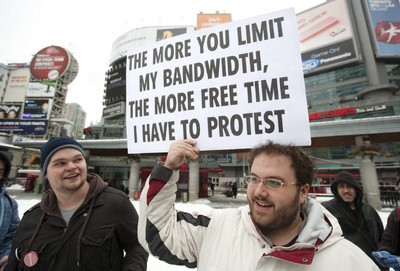
internet limitRevenues from residential services are expected to grow as a result of [broadband] and phone customer growth, with additional contributions from customers taking higher speed tiers and more customers taking our advanced video services,” Mediacom reports. “Based upon the speeds we offer, we believe our High Speed Data (HSD) product is generally superior to DSL offerings in our service areas. As consumers’ bandwidth requirements have dramatically increased in the past few years, a trend we expect to continue, we believe our ability to offer a HSD product today with speeds of up to 105Mbps gives us a competitive advantage compared to the DSL service offered by the local telephone companies. We expect to continue to grow HSD revenues through residential customer growth and more customers taking higher HSD speed tiers. “

Mediacom’s consumption billing program, already in effect for new customers, will be imposed on all Mediacom broadband customers starting in September. Larsen claims only about three percent of customers will be impacted by the usage allowance, which will include 250GB of usage for customers selecting the company’s most popular speed tier. Larsen also claimed the average Mediacom customer uses only 14GB per month.

That usage profile is below the national average, and leads to questions about why Mediacom needs a usage allowance system when 97 percent of its customers do not present a burden to the cable company.

“Once a customer reaches their monthly allowance,  for $10 they can purchase an additional 50GB a month of capacity,” Larsen explained. “Each time that they reach that next level, they’ll be able to purchase another allotment. We’re never going to stop you from using data, we’re just going to charge you more if you exceed your monthly allowance. Before, we could cap you, there was no mechanism for them to purchase more.”

Mediacom did not frequently enforce its usage caps in the past except in instances where usage levels created problems for other customers. Despite Larsen’s assertion Mediacom would spent the overages collected from heavy users on broadband upgrades, Mediacom’s report to the SEC indicates broadband usage has never been a significant burden for the cable operator:

Our HSD and phone service costs fluctuate depending on the level of investments we make in our cable systems and the resulting operational efficiencies. Our other service costs generally rise as a result of customer growth and inflationary cost increases for personnel, outside vendors and other expenses. Personnel and related support costs may increase as the percentage of expenses that we capitalize declines due to lower levels of new service installations. We anticipate that service costs, with the exception of programming expenses, will remain fairly consistent as a percentage of our revenues.

Although Mediacom reported field operating costs rose 7.6%, much of that increase was a result of greater fiber lease and cable location expenses on its wireless backhaul business for cell towers and greater use of outside contractors. In the company’s latest 10-Q filing, Mediacom reports its revenues increased 2.9 percent in the past year while its costs rose only 1.5 percent. Mediacom’s revenues from its broadband division are even more rosy, rising 9% in the past year alone. In fact, broadband is the company’s highest growth residential business.

Many of Mediacom’s long-standing customers were initially promised they would be exempt from usage caps, with only new customers subject to usage limits. But Mediacom has unilaterally changed their minds, much to the consternation of some customers.

As of this afternoon, Mediacom is still promising customers usage caps only apply to new customers and those making plan changes.

As of this afternoon, Mediacom is still promising customers usage caps only apply to new customers and those making plan changes.

“It is my belief a man’s word is gold and when Mediacom customers have been told for ages they were grandfathered in with no usage data charges unless they changed plans, that is how it is supposed to be,” said D. Gronceski. “I have explicitly turned down service increases in the past to stay on the unlimited usage plan originally offered by Mediacom […] so I get screwed twice, once for bandwidth caps and again because I’m not getting the services I would be getting if I had not refused the automatic increases.”

annoyedOther customers incensed about the new usage limits have called to cancel service only to be threatened with steep early termination fees.

“Why do I have to pay an early termination fee?” asked AustinPowersISU. “The way of billing for the service is changing and I do not agree to this method of billing. I should be allowed to terminate my service without paying a fee.”

A Mediacom social media team representative offered one suggestion for customers finding themselves quickly over their usage limits: upgrade to faster speed tiers at a higher price. As for complaints about the unilateral introduction of usage caps with overlimit fees, it’s tough luck for customers, on contract or off:

All Internet users will be held to the new terms of service and usage based billing as of Sept. 7, 2013.  There is no agreement to sign, no acknowledgement needed.  Continuing to utilize Internet services is acceptance of these changes. If for any reason you do not feel that your current service level meets your needs, let us know and we can have a representative contact you with further options.

[…] Per the posted terms of service and acceptable use policy, there has always been an established data consumption threshold (data allowance) to be enforced at Mediacom’s discretion.  With this change, we have clarified these methods of enforcement and have expanded the allowance to offer different levels of users different options.  We have notified the proper departments of possible additions, but these statements are and have been posted.

[flv width=”640″ height=”380″]http://www.phillipdampier.com/video/KCRG Cedar Rapids Mediacom Going Usage Billing 8-21-13.mp4[/flv].

KCRG in Cedar Rapids reports Mediacom is switching to consumption billing for broadband service in September.  (2 minutes)

Why Time Warner Cable Can Jack Up Rates Willy-Nilly: Lack of Competition

cable ratesAlthough cable and phone companies love to declare themselves part of a fiercely competitive telecommunications marketplace, it is increasingly clear that is more fairy tale than reality, with each staking out their respective market niches to live financially comfortable ever-after.

In the last week, Time Warner Cable managed to alienate its broadband customers announcing another rate increase and a near-doubling of the modem rental fee the company only introduced as its newest money-maker last fall. What used to cost $3.95 a month will be $5.99 by August.

The news of the “price adjustment” went over like a lead balloon for customers in Albany, N.Y., many who just endured an 18-hour service outage the day before, wiping out phone and Internet service.

“They already get almost $60 a month from me for Internet service that cuts out for almost an entire day and now they want more?” asked Albany-area customer Randy Dexter. “If Verizon FiOS was available here, I’d toss Time Warner out of my house for good.”

Alas, the broadband magic sparkle ponies have not brought Dexter or millions of other New Yorkers the top-rated fiber optic network Verizon stopped expanding several years ago. The Wall Street dragons complained about the cost of stringing fiber. Competition, it seems, is bad for business.

In fact, Verizon Wireless and Time Warner Cable are now best friends. Verizon Wireless customers can get a fine deal — not on Verizon’s own FiOS service — but on Time Warner’s cable TV. Time Warner Cable originally thought about getting into the wireless phone business, but it was too expensive. It invites customers to sign up for Verizon Wireless service instead.

timewarner twcThis is hardly a “War of the Roses” relationship either. Wall Street teaches that price wars are expensive and competitive shouting matches do not represent a win-win scenario for companies and their shareholders. The two companies get along fine where Verizon has virtually given up on DSL. Time Warner Cable actually faces more competition from AT&T’s U-verse, which is not saying much. The obvious conclusion: unless you happen to live in a FiOS service area, the best deals and fastest broadband speeds are not for you.

Further upstate in the Rochester-Finger Lakes Region, Time Warner Cable faces an even smaller threat from Frontier Communications. It’s a market share battle akin to United States Cable fighting a war against Uzbekistan Telephone. Frontier’s network in upstate New York is rich in copper and very low in fiber. Frontier has lost landline customers for years and until very recently its broadband DSL offerings have been so unattractive, they are a marketplace afterthought.

Rochester television reporter Rachel Barnhart surveyed the situation on her blog:

Think about this fact: Time Warner, which raked in more than $21 billion last year, has 700,000 subscribers in the Buffalo and Rochester markets. I’m not sure how many of those are businesses. But the Western New York market has 875,000 households. That’s an astounding market penetration. Does this mean Time Warner is the best choice or the least worse option?

Verizon-logoThat means Time Warner Cable has an 80 percent market share. Actually, it is probably higher because that total number of households includes those who either don’t want, need, or can’t afford broadband service. Some may also rely on limited wireless broadband services from Clearwire or one of the large cell phone companies.

In light of cable’s broadband successes, it is no surprise Time Warner is able to set prices and raise them at will. Barnhart, who has broadband-only service, is currently paying Time Warner $37.99 a month for “Lite” service, since reclassified as 1/1Mbps. That does not include the modem rental fee or the forthcoming $3 rate hike. Taken together, “Lite” Internet is getting pricey in western New York at $47 a month.

Retiring CEO Glenn Britt believes there is still money yet to be milked out of subscribers. In addition to believing cable modem rental fees are a growth industry, Britt also wants customers to begin thinking about “the usage component” of broadband service. That is code language for consumption-based billing — a system that imposes an arbitrary usage limit on customers, usually at current pricing levels, with steep fees for exceeding that allowance.

frontierRochester remains a happy hunting ground for Internet Overcharging schemes because the only practical, alternative broadband supplier is Frontier Communications, which Time Warner Cable these days dismisses as an afterthought (remember that 80 percent market share). Without a strong competitor, Time Warner has no problem experimenting with new “usage”-priced tiers.

Time Warner persists with its usage priced plans, despite the fact customers overwhelmingly have told the company they don’t want them. Time Warner’s current discount offer — $5 off any broadband tier if you keep usage under 5GB a month, has been a complete marketing failure. Despite that, Time Warner is back with a slightly better offer — $8 off that 5GB usage tier and adding a new 30GB usage limited option in the Rochester market. We have since learned customers signing up for that 30GB limit will get $5 off their broadband service.

internet limitIn nearby Ohio, the average broadband user already exceeds Time Warner’s 30GB pittance allowance, using 52GB a month. Under both plans, customers who exceed their allowance are charged $1 per GB, with overlimit fees currently not to exceed $25 per month. That 30GB plan would end up costing customers an extra $22 a month above the regular, unlimited plan. So much for the $5 savings.



Unfortunately, as long as Time Warner has an 80 percent market share, the same mentality that makes ever-rising modem rental fees worthwhile might also one day give the cable company courage to remove the word “optional” from those usage limited plans. With usage nearly doubling every year, Time Warner might see consumption billing as its maximum moneymaker.

In 2009, Time Warner valued unlimited-use Internet at $150 as month, which is what they planned to charge before pitchfork and torch-wielding customers turned up outside their offices.

Considering the company already earns 95 percent gross margin on broadband service before the latest round of price increases, one has to ask exactly when the company will be satisfied it is earning enough from broadband service. I fear the answer will be “never,” which is why it is imperative that robust competition exist in the broadband market to keep prices in check.

Unfortunately, as long as Wall Street and providers decide competition is too hard and too unprofitable, the price increases will continue.

Broadband Lessons from JCPenney: Listen to Wall Street or Customers?

Phillip "I Shop At TJMaxx" Dampier

Phillip “I Shop Online” Dampier

Last week, JCPenney launched their nationwide redemption tour, apologizing to millions of ex-customers that fled the former retail giant, begging them to come back.

It took over a year for JCPenney to get the message that “disciplining” and “re-educating” customers to accept the wisdom of everyday higher prices with few sales and almost no coupons was hardly the door-busting success “miracle worker” CEO Ron Johnson originally had in mind. The ex-Apple executive was rewarded a $52.7 million signing bonus to take over JCPenney’s tired leadership and in return he dragged sales down 28.4% from the year before, with same store sales down 32%. Johnson’s new vision also steamrolled one-third of JCPenney’s online business.

The day those results became known, he confidently showed Wall Street he did not dwell in the reality-based community: “I’m completely convinced that our transformation is on track!” (For Kohl’s benefit anyway.)

Johnson also believed in a “less is more” philosophy in human resources, overseeing layoffs of 13 percent of the company’s workforce last April, with another 350 let go in July.

Despite the fact his all-new, rebooted vision of JCPenney was about as popular as bird flu, he stayed, even as customers and employees didn’t.

It wasn’t that the company didn’t know customers had a problem with all this. Many complained about the radical, unwanted changes at JCPenney, particularly middle-aged professional women representing one of the stores’ most important business segments. Company executives simply didn’t listen.

A year later, some of the same analysts that cheered JCPenney’s crackdown on discounting now wonder if the company will survive 2013. Many fretted about the real possibility the last customer to brave the “new era” of JCP might forget to turn the lights out when they left for good. Others were mostly furious the board let Johnson go.

Despite the tragic consequences, the conventional wisdom on Wall Street remains: Alienating customers with a revamp nobody asked for and “everyday pricing” designed to boost profits every day was not the problem, how Johnson implemented the strategy was. He just didn’t educate customers enough.

We see the same warped thinking in the broadband marketplace, particularly with usage caps, consumption billing, junk fees and the general ever-increasing price of broadband itself.

On providers’ quarterly results conference calls, the regular questions challenging leaders of the industry are not about providers charging too much for too little. The real concern is that your ISP is leaving too much ripe fruit on the tree:

  • Where is the revenue-boosting usage caps and consumption billing, Time Warner Cable?
  • Comcast: can’t you raise prices further on those recent speed increases to maximize additional revenue?
  • Verizon: why are you spending so much on fiber broadband upgrades customers love when that money could have gone back to shareholders?
  • AT&T: Is there anything else you can do to exploit your market share and make even more money from costly data plans?

The best ways a consumer can reward a good broadband provider include remaining a loyal customer, paying your bill on time and upgrading to faster speeds as needed. For Wall Street, the growing demand for broadband is a sign there is plenty of wiggle room for at-will rate increases, new fees and surcharges, contract tricks and traps, customer service cuts, and monetizing usage wherever possible. After all, you probably won’t cancel because the other guy in town is doing the same thing.

This is what sets the broadband marketplace of today apart from most retailers: consumers don’t have 10-20 other choices to take their business to if they are fed up.

Comcast or AT&T? Both charge a lot and have usage limits on their broadband service for no good reason. Your other alternatives? A wireless provider charging even more with an even lower usage cap. Or you can always go without.

While providers may tell you there is a healthy, competitive broadband marketplace, Wall Street knows better. When Time Warner Cable recently announced it would dramatically curtail new customer promotions and concentrate on delivering fewer services for more money, nobody bothered asking whether this would result in a stampede to the competition. What competition?

Although Google is delivering much-needed, game-changing competition in a tiny handful of cities, most Americans will not benefit because the best upgrades and lowest prices are only available where Google threatens the status quo. A larger number of municipalities are done putting their broadband (and economic) future in the hands of the phone and cable company and are building their own digital infrastructure for the good of their communities.

For everyone else, we can dream that one day, someday, the cable and phone company most Americans do business with will be forced to run their own JCPenney-like apology tour for years of abusive pricing and mediocre “good enough for you” broadband with unwarranted usage limits. Time Warner Cable went half way, but until competition or oversight forces some dramatic changes, we should not count on providers to actually listen to what customers want. They don’t believe they need to listen to earn or keep your business.

Time Warner Cable’s Horn Of Plenty for Austin: Free Wi-Fi for Broadband Customers

Phillip Dampier April 25, 2013 Competition, Consumer News, Data Caps, Editorial & Site News, Wireless Broadband Comments Off on Time Warner Cable’s Horn Of Plenty for Austin: Free Wi-Fi for Broadband Customers
Austin gets a horn 'o plenty with free Time Warner Cable Wi-Fi because Google is coming to town.

Austin gets a horn of plenty with free Time Warner Cable Wi-Fi because Google is coming to town.

As Time Warner Cable faces forthcoming competition from Google Fiber in Austin, the company is responding with the construction of a free Wi-Fi network for its broadband customers to protect its business.

TWC WiFi is available now from a limited number of hotspots, but hundreds more will become available across Austin in 2013 as the company builds out its wireless network.

Time Warner Cable customers with Standard Internet or above qualify for free access, as do Business Class customers. Others can trial the service for free and then buy access for $2.95 an hour.

“Increasingly, our Austin customers want to take their high-speed Internet with them out of the home and on-the-go,” said Area Vice President Kathy Brabson. “The TWC WiFi network we are building for Austin will allow our customers to greatly maximize their TWC Internet subscription at no additional charge.”

It is no coincidence Time Warner Cable has selected Austin for a Wi-Fi rollout. The Wi-Fi service was specifically intended to provide more value for Time Warner Cable customers in competitive markets to keep them from switching to a competitor.

It represents a sea change for a cable company that in 2009 targeted Austin for an Internet Overcharging scheme that would have slapped a usage limit and consumption billing on the area’s broadband customers. With the advent of strong competition from Google, Time Warner Cable is giving customers something instead of taking things away.

Austin customers can download the free TWC WiFi Finder app available in Google Play and the Apple App Store or visit www.twc.com/wificoverage to view the hotspot coverage map as the wireless network grows. Once authenticated, customers can also access Wi-Fi hotspots in other cities including New York City, Los Angeles, Chicago, Philadelphia, Atlanta, Baltimore, Boston, Washington, D.C., San Francisco, Orlando, Tampa, Kansas City, Charlotte and more.

AT&T, Time Warner Cable Claim They Are Ready for Google Fiber in Austin

me too

AT&T suddenly announced it was ready to build its own gigabit fiber network in Austin.

AT&T and Time Warner Cable report they are ready to make more investments in their operations in Austin, Tex. to compete with Google Fiber when it arrives in the middle of next year.

Time Warner Cable says it already operates a multi-gigabit fiber optic network — one residential customers cannot easily access or afford. Residential broadband speeds at the cable operator top out at 50/5Mbps in Austin, at a cost higher than what Google plans to charge for 1,000/1,000Mbps service. AT&T’s U-verse network maxes out at 24/3Mbps, assuming customers have good copper wiring between AT&T’s fiber in the neighborhood and their home.

“The cable and phone company providers have purposely confused their networks’ maximum speed capacity with real end-user speeds for years, and when that fails to convince they simply claim customers don’t need or want those speeds anyway,” says Stop the Cap! reader and Austin resident Sam Knoll.

Knoll is enthusiastic about giving Time Warner Cable the boot, partly to pay them back for their aborted consumption billing trial attempted in Austin in 2009.

“I am not completely convinced Time Warner Cable understands just how much damage they did to their reputation when they pulled that stunt, and I’m certain they will attempt it again if they have a chance,” Knoll said. “The best thing customers can do is switch to a provider that believes usage caps and consumption billing are the fraudulent ripoff we know them to be. Google already knows this.”

Some Time Warner Cable customers in Austin never forgot the company tried to meter Internet usage in a failed experiment back in 2009.

Some Time Warner Cable customers in Austin never forgot the company tried to meter Internet usage in a failed experiment back in 2009. (Image: The Austinst)

Competition from deep-pocketed Google could eventually transform the broadband business model for American providers, assuming Google builds its fiber network in enough cities to challenge the conventional wisdom that prices have plenty of room to grow with faster Internet access. The more customers that sign up for Google’s already-super-fast broadband, the more providers will have to compete with better and faster service.

But AT&T is not convinced. The company announced yesterday it was prepared to build a gigabit fiber network not just in Austin, but also in surrounding Williamson County, with plenty of caveats.

“[We will only build the network if] the demand is there and if we get the same terms and conditions as Google received,” said AT&T spokeswoman Tracy King.

AT&T told the Austin American-Statesman the company wanted a faster regulatory approval process and permission to only build its faster fiber network in neighborhoods where there is proven demand for the service. Current franchise agreements often compel providers to offer service throughout the community and prohibits “cherry-picking” customers in high-income or low construction cost areas.

An AT&T official told KEYE-TV he had no idea how much AT&T would charge for gigabit broadband. Google charges $70 a month in Kansas City.

Austin has promised cooperation with Google, although it is not extending tax breaks or grants to the search engine giant. Google will get easy access to Austin Energy’s municipally owned infrastructure including utility poles and rights-of-way.

Google is speculated to be building showcase fiber networks to embarrass incumbent cable and phone providers who typically sell standard broadband service with speeds of 6-15Mbps in most larger communities. Rural areas are lucky to have 3Mbps service, and often much less.

But if Google intended to force major upgrades by cable and phone companies across the country, it might be disappointed with the response so far from AT&T and Time Warner Cable. Both companies indicate they will invest in and upgrade their networks to compete, but only in the service areas where Google-style competition exists. For the rest of the country, phone and cable companies are prepared to continue with the current “broadband scarcity” business model that delivers upgrades only occasionally, often accompanied by usage limits, consumption billing, and/or higher prices.

“Google has proved that there is a business model for selling abundant bandwidth as opposed to a business model for allocating scarce bandwidth,” said Blair Levin, a former chief of staff of the Federal Communications Commission.

“They are saying this is not an experiment. It is a business,” Levin told the newspaper. “In Kansas City, Google did the country an enormous favor. They said, give us regulatory flexibility to design the business and give us access to city property so we can build a network to lower the cost.”

[flv width=”640″ height=”380”]http://www.phillipdampier.com/video/KEYE Austin Competitor Chimes In After Google Announcement 4-9-13.flv[/flv]

KEYE in Austin talks with AT&T about their plans for a gigabit broadband network to compete with Google Fiber. The AT&T spokesman seemed more interested in pitching the company’s deregulation agenda and was short on specifics.  (3 minutes)

[flv width=”640″ height=”380″]http://www.phillipdampier.com/video/KXAN Austin What competition will Google Fiber face 4-9-13.mp4[/flv]

KXAN in Austin talked with Google competitors Time Warner Cable and AT&T about how they will respond to the Google Fiber challenge.   (3 minutes)

[flv width=”640″ height=”380″]http://www.phillipdampier.com/video/KVUE Austin Fiber Wars in Austin 4-9-13.mp4[/flv]

KVUE in Austin called Google’s entry into the city the opening salvo of ‘Fiber Wars,’ as AT&T promises its own gigabit network. Austin residents intend to take advantage of the competition to force providers to give them better deals to keep their business.  (3 minutes)

[flv width=”640″ height=”380″]http://www.phillipdampier.com/video/KXAN Austin Google Fiber Possibilities Google Insider 4-9-13.mp4[/flv]

KXAN explains the possibilities of gigabit fiber, but also asks a former Google insider why the search engine is getting into the broadband business.  (5 minutes)

[flv width=”640″ height=”380″]http://www.phillipdampier.com/video/KTBC Austin Time Warner Cable Responds to Google 4-9-13.mp4[/flv]

KTBC was skeptical of AT&T’s sudden interest in gigabit broadband. “Gee, what a coincidence,” commented the anchor of Austin’s Fox affiliate.  (2 minutes)

Search This Site:

Contributions:

Recent Comments:

Your Account:

Stop the Cap!