Home » consumption billing » Recent Articles:

NY’s Broadband Future Is Better With Time Warner Cable: Comcast’s Coming Usage Caps Kill Innovation

Phillip Dampier August 11, 2014 Broadband "Shortage", Broadband Speed, Comcast/Xfinity, Competition, Consumer News, Data Caps, Editorial & Site News, Net Neutrality, Online Video, Public Policy & Gov't Comments Off on NY’s Broadband Future Is Better With Time Warner Cable: Comcast’s Coming Usage Caps Kill Innovation

psctest

Broadband will be critically impacted by any merger of Comcast and Time Warner Cable in New York. The two companies could not be more different in their philosophies regarding access, pricing, and speeds.
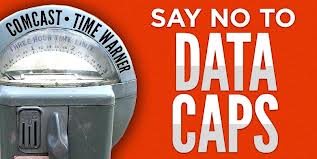
say noThis merger will have an especially profound impact on broadband service in upstate New York, largely left behind out from getting Verizon’s fiber upgrades. New York’s digital economy critically needs modern, fast, and affordable Internet access to succeed. Verizon has not only ceased expansion of its FiOS fiber to the home network in New York, it has virtually capitulated competing for cable customers in non-FiOS areas by agreeing to sell Time Warner Cable service in its wireless stores.[1]  In cities like Rochester, served by Frontier Communications’ DSL, Time Warner Cable is the only provider in town that can consistently deliver broadband speeds in excess of 10Mbps.

Time Warner Cable has never been the fastest Internet provider and had a history of being slower than others to roll out speed increases. But it is also the only cable provider in the country that experimented with usage caps and consumption billing and shelved both after subscribers bitterly complained in market tests in cities including Rochester.[2]

Then CEO Glenn Britt announced the end of the usage cap trial just two weeks after it became public.[3] Britt would later emphasize that he now believed there should always be an unlimited use plan available for Time Warner Cable customers who do not want their Internet use metered.[4] In study after study, the overwhelming majority of customers have shown intense dislike of limitations on their Internet usage, whether from strict usage caps Comcast maintained for several years or usage allowances that, when exceeded, would result in overlimit fees.[5] Just this month, the Government Accounting Office confirmed these findings in a new study that reported near-universal revulsion for usage caps on home wired broadband service:[6]

In only two groups did any participants report experience with wireline UBP [usage-based pricing].

However, in all eight groups, participants expressed strong negative reactions to UBP, including concerns about:

  • The importance of the Internet in their lives and the potential effects of data allowances.
  • Having to worry about data usage at home, where they are used to having unlimited access.
  • Concerns that ISPs would use UBP as a way of increasing the amount they charge for Internet service.

Time Warner Cable has learned an important lesson regarding consumer perception of usage-based billing and usage caps on Internet service. In 2012, the company introduced optional usage caps for customers interested in a discount on their broadband service. Out of 11 million Time Warner Cable broadband customers, only a few thousand have been convinced in enroll such programs.[7]

Despite results like that, Comcast has not learned that lesson and has twice imposed unilateral, compulsory usage limits on their broadband customers, starting with a nationwide hard usage cap of 250GB per month introduced in 2008. Violators risked having their broadband service terminated by Comcast.[8] Today, for some that would be comparable to losing electricity or telephone service. The threat has profound implications in areas where Comcast is the only broadband provider.

Comcast temporarily rescinded its cap in May 2012, but has gradually reintroduced various forms of usage-related billing and caps with market trials in several Comcast service areas[9]:

Nashville, Tennessee: 300 GB per month with $10/50GB overlimit fee;

Tucson, Arizona: Economy Plus through Performance XFINITY Internet tiers: 300 GB. Blast! Internet tier: 350 GB; Extreme 50 customers: 450 GB; Extreme 105: 600 GB. $10 per 50GB overlimit fee;

Huntsville and Mobile, Alabama; Atlanta, Augusta and Savannah, Georgia; Central Kentucky; Maine; Jackson, Mississippi; Knoxville and Memphis, Tennessee and Charleston, South Carolina: 300 GB per month with $10/50GB; XFINITY Internet Economy Plus customers can choose to enroll in the Flexible-Data Option to receive a $5.00 credit on their monthly bill and reduce their data usage plan from 300 GB to 5 GB. If customers choose this option and use more than 5 GB of data in any given month, they will not receive the $5.00 credit and will be charged an additional $1.00 for each gigabyte of data used over the 5 GB included in the Flexible-Data Option;

Fresno, California, Economy Plus customers also have the option of enrolling in the Flexible-Data Option.
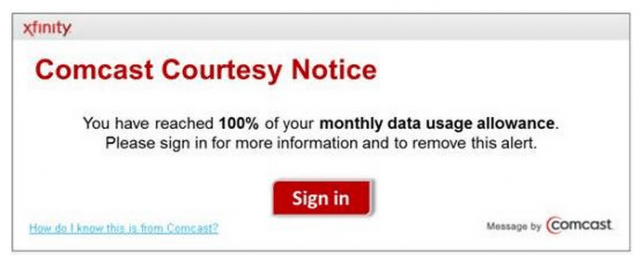
courtesy-noticeComcast customers in these areas do not have the option of keeping their unlimited-use broadband accounts. Despite the fact Comcast executive vice president David Cohen refers to these as “data thresholds,” they are in fact de facto limits that carry penalty fees when exceeded.[10]

Cohen predicts these usage limits will be imposed on all Comcast customers nationwide within the next five years.[11] Time Warner Cable has committed not to impose compulsory limits on its broadband customers. Verizon has never attempted to place limits on its home broadband customers. Frontier shelved a usage limit plan of 5GB per month attempted in 2008 and currently provides unlimited service.

Comcast CEO Brian Roberts sat for an interview with CNBC in June in which he implied usage growth was impinging on the viability of its broadband business, justifying usage caps. At the end of the interview, Time Warner Cable ran advertising emphasizing it has no usage caps.[12] Both companies have highly profitable broadband services, as do other providers across the country.[13]

As our group has found, usage caps and consumption billing on cable Internet and DSL are little more than a transparent rate increase and anti-competitive maneuver to restrict the growth of the industry’s biggest potential competitor: online video. If a consumer can stream all of their video programming over a broadband account, there is no reason to retain a cable TV package. Comcast’s usage cap provides a built-in deterrent for customers contemplating such a move.

While a Comcast representative offered (without any independent verification) that the average Comcast broadband user consumes fewer than 20GB of data per month, Sandvine released evidence in its Global Internet Phenomena Report 1H2014 study that cord-cutters in the U.S. – at least those whose usage indicates the use of streaming as a primary form of entertainment – now consume about 212GB of data per month (with 153GB of that going toward “real-time entertainment usage”).[14]

That would put many customers perilously close to Comcast’s current market tested usage allowance.

Approving the transfer of franchises from Time Warner Cable to Comcast has the potential of saddling the majority of New York residents with usage caps and/or consumption billing with little or no savings or benefit to the consumer while introducing a major impediment to potential online video competition to help curtail cable television pricing.

[1]http://www.verizonwireless.com/wcms/page-unavailable.html?e=404&req=/home-services/twc.html
[2]https://www.reuters.com/article/us-timewarnercable/time-warner-cable-shelves-broadband-usage-billing-idUSTRE53F6EQ20090416
[3]http://stopthecap.com/2009/04/16/we-won-time-warner-killing-usage-caps-in-all-markets/
[4]https://newsroom.charter.com/
[5]
[6]
[7]http://stopthecap.com/2014/03/13/time-warner-cable-admits-usage-based-pricing-is-a-big-failure-only-thousands-enrolled/
[8]https://arstechnica.com/uncategorized/2008/08/its-official-comcast-starts-250gb-bandwidth-caps-october-1/
[9] 
[10] 
[11]https://techcrunch.com/2014/05/14/comcast-wants-to-put-data-caps-on-all-customers-within-5-years/
[12]http://stopthecap.com/wp-content/uploads/2014/04/nocaps.png
[13]https://gigaom.com/2014/02/12/comcast-and-time-warner-cable-forget-tv-it-is-all-about-broadband/
[14]http://www.multichannel.com/news/technology/cord-cutters-gobble-down-bits-sandvine-study/374551#sthash.JYFP7o69.dpuf




Cable ONE Catchup: Free Upload Speed Upgrades, But Usage Caps Persist

Phillip Dampier November 14, 2013 Broadband Speed, Cable One, Competition, Data Caps Comments Off on Cable ONE Catchup: Free Upload Speed Upgrades, But Usage Caps Persist

THE Internet Overcharger

Cable ONE’s boost in cable infrastructure investment is paying dividends for its broadband customers with new upstream speed upgrades.

“Our customers have expressed a need for faster upload speeds and we’re committed to listening to our customers and delivering the latest products and technical advancements while maintaining the highest level of reliability and customer care,” said Joe Felbab, Cable ONE vice president of marketing.

The details:

  • 50/2Mbps Streaming Plan gets a slight bump to 3Mbps upload speed;
  • 60/2Mbps Premier Plan gets upload speed doubled to 4Mbps;
  • 70/2Mbps Ultra Plan gets a triple boost to 6Mbps.

To activate the new upload speeds, reset your cable modem by briefly unplugging it.

Cable ONE's promotions often only last three months before increasing to the regular, undisclosed a-la-carte price. Modem lease or purchase is extra.

Cable ONE’s promotions often only last three months before increasing to the regular, undisclosed a-la-carte price. Modem lease or purchase is extra.

In June, Cable ONE scrapped its confusing consumption billing scheme and replaced it with standard usage caps that our readers report are unevenly enforced.

cable_one_crewThe 1.5Mbps, 5Mbps, 8Mbps, 10Mbps, 12Mbps, & 50Mbps services (some plans grandfathered for existing customers) have a cap of 300GB per billing cycle, while the 60Mbps and 70Mbps services respectively have 400 and 500GB data caps per billing cycle. Surfing Internet has a 50GB cap.
While 6Mbps upload speed is slightly better than what Time Warner Cable and AT&T U-verse customers get, Cable ONE remains well behind companies like Comcast and Verizon FiOS.

Cable ONE in April announced a two-year, $60 million network upgrade across 42 cable systems in its mostly rural footprint to enhance reliability and deliver faster Internet service. Upstream speeds are the most difficult to increase for cable broadband providers because the DOCSIS standard was designed to deliver fast download speeds.

Earlier this month, Cable ONE adopted TiVo for its new Whole Home DVR, which offers 650 hours of recording time with four built-in tuners and an Advanced TiVo on-screen guide.

In large parts of its national service area, Cable ONE competes with telephone companies AT&T, CenturyLink, and Windstream.

North America Data Tsunami Warning Canceled; Usage Levels Off, Killing Excuses for Caps

Phillip Dampier November 11, 2013 Broadband "Shortage", Competition, Consumer News, Data Caps, Editorial & Site News, Net Neutrality, Online Video, Public Policy & Gov't Comments Off on North America Data Tsunami Warning Canceled; Usage Levels Off, Killing Excuses for Caps
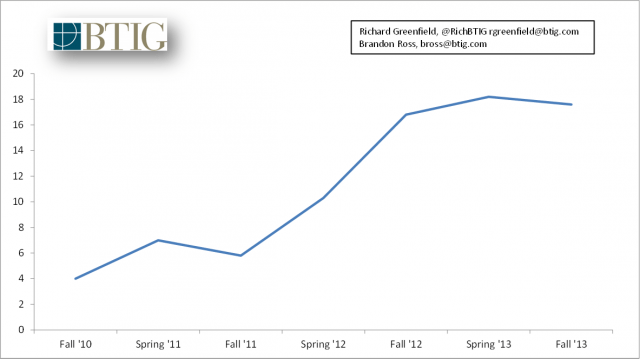
(Image: BTIG Research)

The median bandwidth use slowdown (Image: BTIG Research)

Despite perpetual cries of Internet brownouts, usage blowouts, and data tsunamis that threaten to overwhelm the Internet, new data shows broadband usage has leveled off in North America, undercutting providers’ favorite excuse for usage limits and consumption billing.

Sandvine today released its latest broadband usage study, issued twice yearly. The results show a clear and dramatic decline in usage growth in North America, with median usage up just 5% compared to the same time last year. That is a marked departure from the 190% and 77% growth measured in two earlier periods. In fact, as Richard Greenfield from BTIG Research noted, mean bandwidth use was down 13% year-over-year, after the second straight six month period of sequential decline.

Companies like Cisco earn millions annually pitching network management tools to providers implementing usage caps and consumption billing. For years, the company has warned of Internet usage floods that threaten to make the Internet useless (unless providers take Cisco’s advice and buy their products and services).

“Demand for Internet services continues to build,” said Roland Klemann from Cisco’s Internet Business Solutions Group. “The increasing popularity of smartphones, tablets, and video services is creating a ‘data tsunami’ that threatens to overwhelm service providers’ networks.”

Providers typically use “fairness” propaganda when introducing “usage based pricing,” blaming exponential increases in broadband usage and costly upgrades “light users” are forced to underwrite. A leveling off in broadband usage undercuts that argument.

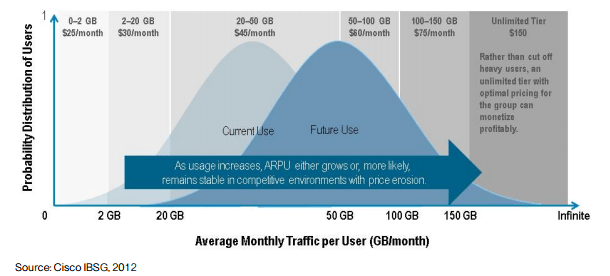
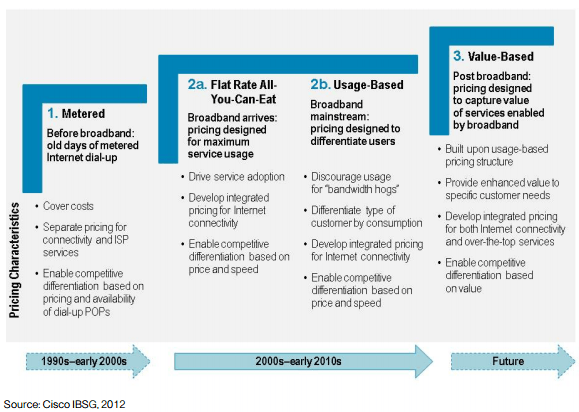
ciscos plan for your futureA Cisco White Paper intended for the eyes of Internet Service Providers further strips the façade off the false-“fairness” argument, exposing the fact usage pricing has little to do with traffic growth, pricing fairness, or the cost of upgrades:

In 2011, broadband services became mainstream in developed countries, with fixed-broadband penetration exceeding 60 percent of households and mobile broadband penetration reaching more than 40 percent of the population in two-thirds of Organisation for Economic Co-operation and Development (OECD) countries.

Meanwhile, traditional voice and messaging revenues have strongly declined due to commoditization, and this trend is expected to continue. Therefore, operators are now relegated to connectivity products. The value that operators once derived from providing value-added services is migrating to players that deliver services, applications, and content over their network pipes.

As if this were not enough, Internet access prices are dropping, sales volumes are declining, and markets are shrinking. The culprit: flat rate “all-you-can-eat” pricing. Such a model lacks stability—sending service provider pricing into a downward spiral—because it ignores growth potential and shifts the competition’s focus from quality and service differentiation to price.

While Klemann was spouting warnings about the dire implications of a data tsunami, Cisco’s White Paper quietly told providers what they already know:

Maximum Profits

Maximum Profits

“[Wired] broadband operators should be able to sustain forecasted traffic growth over the next few years with no negative impact on margins, as the incremental capital expenses required to support it are under control.”

If usage limits and consumption billing are not required to manage data growth or cover the cost of equipment upgrades, why adopt this pricing? The potential to exploit more revenue from mature broadband markets that lack robust competition.

“In light of the forecasted Internet traffic growth mentioned earlier and competitiveness in the telecommunications market, Cisco believes that fixed-line operators should consider gradually introducing selected monthly traffic tiers to sustain [revenue], while a) signaling to customers that “traffic is not free,” and b) monetizing bandwidth hogs more sustainably.”

Cisco makes its recommendation despite knowing full well from its own research that customers hate usage-based pricing.

“The introduction of traffic tiers and caps—especially for fixed broadband services—is not welcomed by the majority of customers, as they have learned to ‘love’ flat rate all-you-can-eat pricing. Most customers consider usage-based pricing for broadband services ‘unfair,’ according to the 2011 Cisco IBSG Connected Life Market Watch study.”

Cisco teaches providers how to price broadband like trendy boutique bottled water.

Cisco teaches providers how to price broadband like trendy boutique bottled water and blame it on growing Internet usage.

But with competition lacking, Cisco’s advice is to move forward anyway, as long as providers initially introduce caps and consumption billing at prices that do not impact the majority of customers… at first. In uncompetitive markets, Cisco predicts customers will eventually pay more, boosting provider revenue. Cisco’s “illustrative example” of usage billing in practice set prices at $45 a month for up to 50GB of usage, $60 a month for 50-100GB, $75 for 100-150GB, and $150 a month for unlimited access — more than double what customers typically pay today for flat rate access.

Usage billing arrives right on time to effectively handle online video, which increasingly threatens revenue from cable television packages.

Sandvine’s new traffic measurement report notes the increasing prominence of online video services like Netflix, YouTube, Hulu, and Amazon Video.

“As with previous reports, Real-Time Entertainment (comprised of streaming video and audio) continues to be the largest traffic category on virtually every network we examined, and we expect its continued growth to lead to the emergence of longer form video on mobile networks globally in to 2014,” Sandvine’s report noted.

Sandvine found that over half of all North American Internet traffic during peak usage periods comes from two services: Netflix and YouTube. YouTube globally is the leading source of Internet traffic in the world, according to Sandvine.

An old excuse for usage caps on “data hogs” – peer-to-peer file-sharing, continues its rapid decline towards irrelevance, now accounting for less than 10 percent of total daily traffic in North America. A decade earlier, file swapping represented 60 percent of Internet traffic.

Cisco’s answer for the evolving world of popular online applications is a further shift in broadband pricing towards “value-based tiers” that monetize different online applications by charging broadband users extra when using them. Cisco is promoting an idea that well-enforced Net Neutrality rules would prohibit.

Citing the bottled water market, Cisco argues if some customers are willing to pay up to $6 for a liter of trendy Voss bottled water, flat rate “one price fits all” broadband is leaving a lot of money on the table. With the right marketing campaign and a barely competitive marketplace, providers can charge far higher prices to get access to the most popular Internet applications.

“Research from British regulator Ofcom shows that consumers are becoming ‘addicted’ to broadband services, and heavy broadband users are willing to pay more for improved broadband service options.”

Wharton School professors Jagmohan Raju and John Zhang concluded price is the single most important lever to drive profitability.

The political implications of blaming phantom Internet growth and manageable upgrade costs for the implementation of usage caps or usage-based billing is uncertain. Even the “data hog” meme providers have used for years to justify usage caps is now open to scrutiny. Sandvine found the top 1% of broadband users primarily impact upstream resources, where they account for 39.8% of total upload traffic. But the top 1% only account for 10.1% of downstream traffic. In fact, Apple is likely to provoke an even larger, albeit shorter-term impact on a provider’s network from software upgrades. When the company released iOS7, Apple Updates immediately became almost 20% of total network traffic, and continued to stay above 15% of total traffic into the evening peak hours, according to Sandvine.

Some other highlights:

  • Average monthly mobile usage in Asia-Pacific now exceeds 1 gigabyte, driven by video, which accounts for 50% of peak downstream traffic. This is more than double the 443 megabyte monthly average in North America.
  • In Europe, Netflix, less than two years since launch, now accounts for over 20% of downstream traffic on certain fixed networks in the British Isles. It took almost four years for Netflix to achieve 20% of data traffic in the United States.
  • Instagram and Dropbox are now top-ranked applications in mobile networks in many regions across the globe. Instagram, due to the recent addition of video, is now in Latin America the 7th top ranked downstream application on the mobile network, making it a prime candidate for inclusion in tiered data plans which are popular in the region.
  • Netflix (31.6%) holds its ground as the leading downstream application in North America and together with YouTube (18.6%) accounts for over 50% of downstream traffic on fixed networks.
  • P2P Filesharing now accounts for less than 10% of total daily traffic in North America. Five years ago it accounted for over 31%.
  • Video accounts for less than 6% of traffic in mobile networks in Africa, but is expected to grow faster than in any other region before it.

Comcast’s 300GB Cap Headed to Atlanta Dec. 1

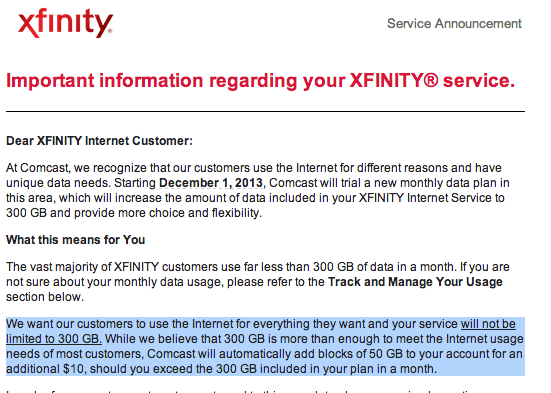
Comcast is introducing its 300GB usage cap in Atlanta on Dec. 1:

atlanta

The cable company is currently sending e-mail notifications to affected customers. Comcast has tested usage caps in several markets, mostly in the southern United States, to measure customer response.

Notice the e-mail suggests Comcast is “increasing the amount of data” included in the customer’s allowance. In fact, Comcast rescinded usage limits for most customers across the country in May 2012.

Last week, Neil Smit, president and CEO of Comcast Cable Communications told Wall Street analysts customers are not pushing back hard against capped Internet.

“We have a number of trials in place in markets,” Smit said. “We’re testing different types of usage-based pricing offerings. Thus far the consumer response has been neutral to slightly positive. We’ll continue to monitor it.”

If customers do not want their Internet usage capped, they must vocalize complaints with Comcast and consider taking other steps such as organizing protests in front of local Comcast offices, inviting the media to attend.

In 2009, a similar effort to introduce usage caps and consumption billing by Time Warner Cable failed after customer backlash forced the company to shelve the idea.

Comcast Claims New 300GB Cap is Getting Neutral-Slightly Positive Reaction from Subscribers

Phillip Dampier October 30, 2013 Comcast/Xfinity, Data Caps, Wireless Broadband 1 Comment
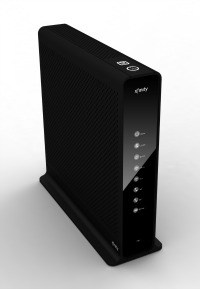
Comcast's Wireless Gateway is part of the company's plans to further monetize broadband.

Comcast’s Wireless Gateway is part of the company’s plans to further monetize broadband.

Comcast wants investors to believe customers slightly prefer losing access to unlimited broadband in return for a 300GB usage cap and $10 overlimit fees.

Neil Smit, president and CEO of Comcast Cable Communications this morning told Wall Street analysts Comcast plans to further monetize its broadband product after testing usage caps, consumption billing, and collecting increased in-home Wi-Fi fees collected from a growing number of customers with an XFINITY Wireless Gateway.

Phil Cusick from JPMorgan asked Smit about how broadband tiering trials now underway primarily in southern states were going for Comcast.

“We have a number of trials in place in markets,” Smit responded. “We’re testing different types of usage-based pricing offerings. Thus far the consumer response has been neutral to slightly positive. We’ll continue to monitor it.”

Customers in the affected areas tell Stop the Cap! they have never been asked what they think about Comcast’s usage caps and consumption billing, so they are unsure how Smit can draw conclusions about customer preference.

“I’m canceling Nov. 1 when the caps arrive in South Carolina,” says Dennis Johnson. “I’m heading to U-verse because AT&T isn’t enforcing any caps here. I plan to tell Comcast why they lost me, but it sounds like the company really isn’t interested in what customers think.”

Every research study done on broadband usage caps show customers loathe them and up to 50% are prepared to switch providers if they can find a competitor providing comparable service.

xfinitylogoComcast is also moving forward with plans to share your in-home Wi-Fi with other customers, configuring company-supplied gateways to offer a second, open access Wi-Fi channel. Comcast currently charges customers $7 a month for the XFINITY Wireless Gateway, combining a DOCSIS 3 cable modem, a telephone eMTA, and a wireless router.

Despite the fact Comcast customers regularly complain about the poor Wi-Fi range of the XFINITY Wireless Gateway and the monthly rental fee, Smit believes they are key to further monetizing broadband.

“We’ve rolled out about six million Gateway devices which increased the in-home Wi-Fi fees and we think there’s going to be more people hanging more devices off of their Wi-Fi,” said Smit.

The more devices, the higher the usage. The higher the usage, the closer customers get to exceeding their cap and charged overlimit fees.

Search This Site:

Contributions:

Recent Comments:

Your Account:

Stop the Cap!