Home » consumption billing » Recent Articles:

Channeling Pinnochio, NCTA Cable Lobby Launches “The Infinite Internet” (They Want to Usage Cap)

Phillip Dampier January 20, 2015 Astroturf, Competition, Consumer News, Data Caps, Editorial & Site News, Net Neutrality, Online Video, Public Policy & Gov't, Video, Wireless Broadband Comments Off on Channeling Pinnochio, NCTA Cable Lobby Launches “The Infinite Internet” (They Want to Usage Cap)

pinnocThe National Cable & Telecommunications Association (NCTA), the nation’s largest cable lobbying group, has outdone itself with a brand new fact-challenged video truth-seekers will quickly discover is little more than industry propaganda.

“For nearly 20 years, cable has been building Internet networks that are empowering everyone from innovators and entrepreneurs to kids in the garage,” says the NCTA in its introduction of its new video “The Infinite Internet.” “The Internet propels business, education, entertainment – whatever we want. It’s a platform of possibilities and the fast growing technology in history. Cable is proud of the part we’ve played in advancing America’s future and we’ll continue to make it faster and more accessible.”

Except many NCTA member companies want to introduce usage caps and consumption billing that limit those possibilities on an already absurdly profitable service. The same broadband duopoly of cable and phone companies also holds America’s broadband rankings back, and has demonstrated its real priority is to charge more money for less service.

We’ve reviewed the video and found credibility problems with almost every claim:

Claim: “America’s ISPs have invested trillions of dollars and laid 400,000 miles of fiber optics.”

Our finding: FIB Even industry mouthpieces like the Progressive Policy Institute and NCTA members themselves have a problem with “trillions.” The chief executives of AT&T, Bright House Networks, Cablevision, CenturyLink, Charter, Comcast, Cox, Frontier, Suddenlink, Time Warner Cable, 15 other companies, and industry groups such as the National Cable & Telecommunications Association itself, the Telecommunications Industry Association, and the CTIA Wireless Association claimed in the spring of 2014 that the entire telecommunications industry (not cable alone) spent a combined $1.2 trillion on communications infrastructure. A considerable percentage of that investment was to build out cellular networks, first for mobile phone calls and only later for wireless data. The cable industry spent far less than $1 trillion on its own infrastructure and at the time of its most rapid growth, it was intended primarily to deliver cable television, not broadband.

Stop the Cap! also found the NCTA cheating in its claims of increasing investment in broadband. The trade group was citing cumulative spending, not actual year-to-year spending. A careful review shows broadband investments are generally flat or in decline and are nowhere near comparable to the investments the industry made in the late 1990s.

Although it may be true the cable industry has deployed 400,000 miles of fiber optics, the overwhelming majority of cable customers cannot directly access any of it. Virtually all the cable industry’s fiber is deployed between the company’s headquarters and individual communities where it is connected to the same coaxial cable platform that has been around since the 1960s. Most of the rest is laid for commercial purposes, notably providing backhaul connectivity for cell towers. Time Warner Cable alone deployed fiber to its 10,000th cell tower back in 2013. It’s a lucrative business, earning that cable company more than $61 million a quarter.

BroadbandNow found no cable company appearing on the list of top fiber broadband providers. In fact, as of 2012 only 23% of Americans have access to fiber broadband ranking the United States 14th among western countries in fiber optic penetration according to the OECD.

Claim: “High speed connections reach nearly every home with blazing fast speeds that power our lives.”

Our finding: HIGHLY MISLEADING The NCTA fails to define its terms here. What exactly constitutes a “high-speed connection.” The FCC currently defines broadband as providing speeds of 4Mbps or better. Is that “blazing fast?” The FCC is currently considering redefining broadband to mean speeds of at least 25Mbps, well below many cable company entry-level broadband tiers. The NCTA also likes to claim that 99% of households have access to high-speed Internet, but they include wireless technology at any speed in those figures. If you can get one bar from AT&T’s 3G wireless Internet network, you’ve got high-speed broadband in their eyes.

In fact, when it comes to stingy coverage areas, cable is notoriously not available outside of the biggest cities and suburbs, as the government’s own National Broadband Map depicts:
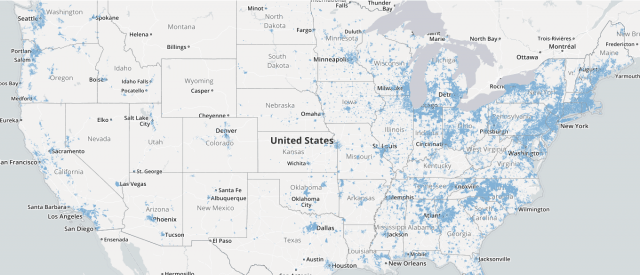
Map showing cable companies offering at least DOCSIS 3.0 cable broadband service.

Map showing cable companies offering at least DOCSIS 3.0 cable broadband service.

Claim: “ISP’s want access for everyone.”

Our finding: TRUE, WITH MISSING FINE PRINT What company would not want to offer its products and services to everyone. The real question is whether they plan on doing that or simply wishing they had. The cable industry has no intention of implementing sweeping changes to the Return On Investment (ROI) formula that determines whether your home gets access to cable or not. Some companies like Time Warner Cable and Frontier Communications are expanding their cable and DSL networks, but only when the government steps in with broadband deployment grant funding.

Assuming service is available, the next hurdle is cost. BBC News reported in 2013 home broadband in the U.S. costs far more than elsewhere. At high speeds, it costs nearly three times as much as in the UK and France, and more than five times as much as in South Korea. Today it costs even more when you count the growing number of providers charging modem rental fees as high as $10 a month and often cap usage or force customers into usage-based billing schemes.

Claim: “With over 300,000 public Wi-Fi hotspots, the Internet of Things is emerging.”

Cox Cable sells their customers on accessing over 300,000 Wi-Fi hotspots, with a prominent asterisk.

Cox Cable sells their customers on accessing over 300,000 Wi-Fi hotspots, with a prominent asterisk. Access is only available for free if you are a current cable broadband customer.

Our finding: MISLEADING The NCTA is referring to collaboration between Bright House Networks, Cox Communications, Optimum, Time Warner Cable and XFINITY that allow each other’s high-speed Internet customers to use to each company’s Wi-Fi hotspots. They key word is “customers.” The hotspots may be technically reachable by the public, but unless you are a current cable broadband subscriber, using them typically requires the purchase of a daily use pass.

Claim: “Cable will continue to invest, building this platform of possibilities, if we preserve the freedom that created the Internet.”

Our finding: EMPTY CLAIMS The NCTA’s commitment that the cable industry will continue to invest is fulfilled if one cable operator spends just $1 on their network infrastructure. Notice the NCTA does not commit its members to stopping the ongoing decline in broadband investment, much less move to increase it. It also has no explanation for the annual rate increases and new fees and surcharges customers are paying, as the gap between broadband pricing abroad and at home grows even larger. 

“Preserve the freedom” is code language for maintaining the deregulation that the industry has used to its advantage to raise prices in a broadband market most Americans will find is either a monopoly or duopoly. Although the NCTA implies it, the cable industry did not create the Internet. It was a government project (gasp!) initially developed through contracts with the Department of Defense and soon broadened to include educational institutions. The first significant commercial ISPs emerged only in the late 1980s. Cable industry broadband finally showed up around a decade after that. The industry’s claims are akin to boasting Lewis and Clark discovered Kansas City… in 1966.

If the cable industry gets some oversight of its broadband service and enforced protection of Net Neutrality, does that mean investment will flee? First, providers are already spending a lower percentage of capital on broadband expansion in the current deregulatory environment. Second, as broadband becomes the cable industry’s top earner, it provides an endless supply of revenue without the headaches of negotiating programming contracts, dealing with cable television network rate increases, and the growing phenomenon of cord-cutting. In other words, without significant new competition, it remains a license to print money.

[flv]http://www.phillipdampier.com/video/NCTA The Infinite Internet 1-20-15.mp4[/flv]

The NCTA is trying to make hay with its new video, “The Infinite Internet” which purports to share how Big Cable’s vision of the Internet is making new things possible. They don’t mention many of their member companies want to place a usage cap on that innovation, even as they continue to raise prices way out of proportion of the cost of delivering the service. It’s classic cable industry propaganda. (1:08)

Welcome to 2015; Another Year Fighting for a Square Deal for Essential Broadband Service

Phillip Dampier January 5, 2015 Editorial & Site News Comments Off on Welcome to 2015; Another Year Fighting for a Square Deal for Essential Broadband Service
Phillip Dampier

Phillip Dampier

Welcome to 2015!

This is the seventh year Stop the Cap! has fought for better broadband across North America and beyond. Whether your provider is Comcast, Time Warner Cable, Rogers, Bell, AT&T, Verizon or a (dwindling) number of other cable and telephone companies, there is plenty of room for improvement.

When we began in the summer of 2008, Frontier Communications was contemplating a usage cap of just 5GB a month on their broadband service. A year later Time Warner Cable market tested caps as high as 40GB a month. For almost as long as we’ve existed, Comcast has believed 250GB a month was all most customers ever needed. Rogers’ most popular Internet package today offers 60GB a month, despite the fact Canadians on average watch more online video than anyone else. AT&T thinks 150GB a month is fine for DSL and 250GB is all you’d need as a U-verse customer. Verizon doesn’t see a need for limits on either its DSL or fiber optic networks. Neither does Cablevision.

Usage caps and so-called “usage-based billing” continue to be one of the most under-reported stories in the tech press. Touted as “fair pricing,” these plans are in fact little more than profit-padding for a service that already earns companies as much as 90% gross margin. There is nothing fair about usage-based billing in North America. Customers face the same prices they have always paid for unlimited service, but now endure an arbitrary usage allowance that usually includes a stiff overlimit fee. Those providers charging usage pricing do not offer the fastest service, have not made significant improvements above and beyond other providers that still charge flat rate prices, and frequently also charge excessive modem rental fees.

The duopoly most Americans have for broadband service has become quite fat and happy collecting ever-increasing amounts of money for service that only seems to improve after an upstart competitor like Google arrives ready to offer better service at a lower price. Customers in Kansas City, Austin, and a handful of other communities are getting the best upgrades and are empowered to negotiate a lower price for service. The rest of the country is not so lucky. A handful of often-under capitalized fiber competitors have arrived in some areas, but their market share generally remains a fraction of what the cable and phone companies have locked up.

We have always believed broadband was destined to become the next must-have utility service, following clean water, electricity, gas and some form of telephone service. Unfortunately, Washington policymakers continue to treat Internet access as an optional extra, allowing one or two companies to dominate access in most communities. Policymakers and regulators have done very little to protect consumers from the effects of marketplace concentration, allowing cable and phone companies to merge and raise prices, remain uncommitted to protecting the Open Internet with strong Net Neutrality protections, and not taking the effects of usage caps seriously.

One of the most effective ways a community can combat bad service and high prices is to support launching its own public broadband network. Throughout the United States, local town and counties enduring “good enough for you” broadband (or no service at all) are constructing their own fiber optic networks to better meet the realities of the 21st century digital economy. They face industry-funded opposition in at least 20 states where lawmakers have banned or severely curtailed these networks to protect private telecom giants from the effects of serious competition.

In 2015, Stop the Cap! will continue to fight for consumers looking for a better deal:

  • We continue to oppose industry consolidation. Mergers and buyouts benefit executives and shareholders. They almost never benefit customers who soon find rate increases, fewer choices, and often worse service as a result. Connecticut residents know that first hand enduring Frontier Communications’ recent bungled transition from AT&T service. Customers that dislike Time Warner Cable will likely loathe Comcast if that merger wins regulator approval. AT&T’s buyout of DirecTV leaves one less competitive choice for customers living in AT&T’s service areas looking for an alternative to U-verse television. Imagine if the government had approved AT&T’s attempted buyout of T-Mobile, the one wireless carrier now willing to throw a monkey-wrench into the current dominance of almost-identical expensive wireless service plans from AT&T and Verizon.
  • Usage caps and consumption billing remain unjustified, particularly for wired broadband. Despite industry claims that usage caps and usage billing stimulate investment, in most cases the costs of delivering broadband service and the amounts companies invest in network upgrades continue their relentless decline on a per customer basis. Usage billing is no prescription for congestion problems either. Most congestion problems occur during peak usage levels — when light and heavy users alike are most likely to be online. A truly fair usage pricing scheme would charge a fair price for actual usage and nothing else. But such a pricing scheme would likely cut broadband bills and profits. So providers offer pre-determined compulsory usage allowances at current prices instead, and do not offer a flat rate option or rollover unused usage to a future month. As a result, customers often pay more for less service and constantly have to check their usage to make sure they do not get an unexpected surprise on their bill.
  • Strong Net Neutrality protection is the best guarantee of preserving the Internet as it exists today – where success or failure of an online venture is based on what it offers customers, not on the size of its bank account. A nationwide end to laws restricting the development and expansion of community broadband is also essential to give communities self-determination of their broadband future.
  • We will continue to educate consumers on how to negotiate a better deal with your provider and avoid expensive surcharges like modem rental fees. We will also continue to enlighten you about the pervasive influence of Big Telecom money on non-profits, state and federal governments, and researchers that support the various agendas of some of the largest telecom corporations in the country.

Broadband is improving at an incredible pace around the world, but back home prices continue to rise while Internet speed improvements are often met by usage cap road bumps. Internet affordability remains as much of a problem as rural broadband access. The more you know, the more effective you can argue for a change in telecom policies, where the public interest is better-balanced against corporate profits and duopoly prices.

Thank you for being a part of our efforts to make things better.

FCC Chairman Tom Wheeler Ignores Millions of Americans, Plans Fake Net Neutrality Frankenplan

Phillip Dampier November 3, 2014 Competition, Consumer News, Data Caps, Editorial & Site News, Net Neutrality, Online Video, Public Policy & Gov't Comments Off on FCC Chairman Tom Wheeler Ignores Millions of Americans, Plans Fake Net Neutrality Frankenplan

frankenplanThe majority of 3.7 million comments received by the FCC advocate strong and unambiguous Net Neutrality protections for the Internet, but that seems to have had little impact on FCC chairman Thomas Wheeler, who is laying the groundwork for a hybrid Net Neutrality Frankenplan that would marginally protect deep pocketed content producers while leaving few, if any, protections for consumers.

The Wall Street Journal reported late last week that Wheeler is considering a “hybrid” approach, separating broadband into two distinct services:

  • Retail Broadband, sold to consumers, would continue as a broadly deregulated service, allowing ISPs to set prices and policies with little, if any, oversight. Wheeler’s plan would allow providers to freely implement usage-based pricing, establish paid fast lanes at the request of customers, and permit ISPs to continue exempting preferred content from usage pricing while charging customers extra to access content from “non-preferred partners;”
  • Wholesale Broadband, the connection between your ISP and content producers, would be reclassified under Title II and subject to common carrier regulations, which would allow the FCC to police deals between your provider and services like Netflix.

Wheeler’s proposal would offer significant protection to wealthy content producers like Netflix, Amazon.com, broadcasters and Hollywood studios, but would leave consumers completely exposed to providers’ pricing tricks, usage caps/consumption billing, and paid fast lanes that could leave unpaid content vulnerable to network deterioration, especially during peak usage times.

Comcast_pumpkinLarge telecommunications companies argue that deregulation promotes broadband investment and expansion to create world-class service. But years of statistics and comparisons with other countries suggest deregulation has not inspired sufficient competition to keep prices in check and force regular network upgrades. In fact, competition is much more robust at the wholesale level, while the majority of retail consumers have a choice of just one or two providers that receive almost no oversight. Those providers are now exercising their market power to further monetize broadband usage to boost profits and raise prices.

Wheeler’s proposal would ignore the wishes of more than three million Americans that want comprehensive Net Neutrality protections, as well as those of President Barack Obama, who has called for a ban on paid fast lanes. A senior White House official signaled Thursday the administration has concerns about Wheeler’s proposal, noting “the president has made it abundantly clear that any outcome must protect net neutrality and ban paid prioritization—and has called for all necessary steps to safeguard an open Internet.”

“This Frankenstein proposal is no treat for Internet users, and they shouldn’t be tricked,” consumer group Free Press CEO Craig Aaron said in a statement. “No matter how you dress it up, any rules that don’t clearly restore the agency’s authority and prevent specialized fast lanes and paid prioritization aren’t real Net Neutrality.”

Broadband providers don’t like Wheeler’s plan either. Verizon last week sent comments to the FCC warning any attempt to reclassify broadband under Title II “could not withstand judicial review.” Others, including the industry-backed U.S. Telecom Association, promised swift legal action against Wheeler’s proposal.

Aaron believes the last thing broadband needs is another “hybrid” plan.

“The FCC has already tried twice before to invent new classifications on the fly instead of clear rules grounded in the law,” Aaron said. “And twice their efforts have been rejected. This flimsy fabrication will be no different. And this approach will only serve to squander the political support of millions and millions of Americans who have weighed in at the agency asking for strong rules that will stand up in court.”

New Zealand Getting 200/200Mbps Uncapped Fiber Broadband

Phillip Dampier October 21, 2014 Broadband Speed, Competition, Consumer News, Data Caps, Public Policy & Gov't Comments Off on New Zealand Getting 200/200Mbps Uncapped Fiber Broadband

Snap-Logo-2-300x300New Zealanders want faster broadband and they want it without a usage cap, and Snap is ready to offer both.

Snap’s nationwide 200/200Mbps Ultra-Fast Broadband commenced this week providing the fastest broadband on offer throughout New Zealand, priced at $111.50 a month with an unlimited use add-on available for an extra $8 a month. To date, the service had only been available in Auckland.

Kiwis can sign up for Snap on the Chorus network for the fastest 200/200Mbps speeds. Those served by Enable or UltraFast Fibre will see upload speeds reduced to 20Mbps for now, but will also be compensated with a lower monthly price: $87.71.

A wireless gateway to support the faster speeds will be provided at no extra cost to customers signing up for 200Mbps service.

no limitsSnap’s new service comes as a result of New Zealand’s deployment of fiber networks and an end to usage caps, consumption billing, and/or bandwidth throttling. Snap has been well received in New Zealand because it guarantees no traffic shaping, traffic management schemes, or mandatory usage caps. This comes at a time when North American providers are trying to force customers into usage-capped broadband plans and wireless carriers insist on using traffic shaping and caps.


“There is no faster commercially available service across the whole country today,” said James Koers, general manager, Snap Retail. “We’ve built our own network to ensure customers receive the fastest, most reliable service possible. We don’t cache or proxy or shape traffic in any way, giving customers peace of mind that they’re getting the service they expected and paid for.”

Koers adds there is a clear demand for fiber optic broadband across the country.

“Today, two out of every three of our sign-ups are for a fibre service which shows New Zealanders’ appetite is increasing for UltraFast Broadband as it becomes available,” said Koers. “200Mbps is just the beginning though as we’re now trialling Chorus’ new 1Gbps residential service.”

PC Magazine has rated Snap the fastest broadband provider in the country.

Stop the Cap’s Formal Written Submission Opposing Comcast-Time Warner Merger Filed With N.Y. PSC

Phillip Dampier August 11, 2014 Comcast/Xfinity, Competition, Consumer News, Editorial & Site News, Public Policy & Gov't Comments Off on Stop the Cap’s Formal Written Submission Opposing Comcast-Time Warner Merger Filed With N.Y. PSC

(Ed. Note: Our formal written submission to the New York Public Service Commission is presented in this series of articles. Please note that any graphics included on Stopthecap.com were not included in the formal filing, but are presented here to make the material more reader-friendly. — PMD)

psctest

STATE OF NEW YORK

PUBLIC SERVICE COMMISSION


Joint Petition of Time Warner Cable Inc. and

Comcast Corporation For Approval of a                                       Case 14-M-0183

Holding Company Level Transfer of Control.


Statement of Opposition to Joint Petition
Phillip M. Dampier, Director and Founder: Stop the Cap!
Rochester, New York
August 1, 2014

Stop the Cap! is a not-for-profit group founded in Rochester in 2008 to fight against the introduction of artificial limits on broadband usage (usage caps, consumption billing, speed throttling) and for better broadband speeds and service for consumers. Our group does not solicit or accept funding from lobbyists, companies, or others affiliated with the telecommunications industry. We are entirely supported by individual donors who share our views.

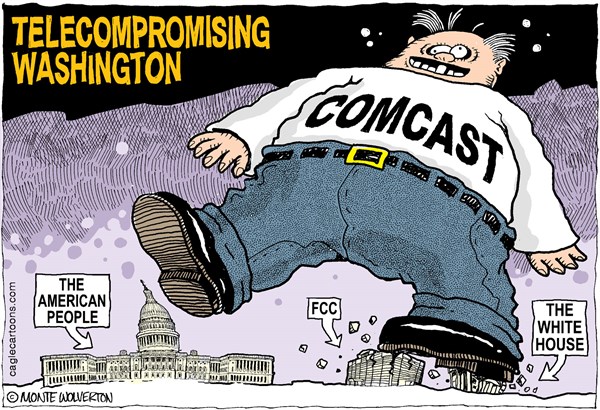
telecompromising

Regulators cannot outsmart multi-billion dollar corporate giants with temporary merger mitigation strategies that end up not helping consumers for very long, if it all.

Introduction

Our opposition to the Joint Petition is based on our belief it does not meet the “public interest”  test established in Section 222 of the New York Public Service law, and must therefore be denied.

We are concerned the Commission may attempt a mitigation of Comcast’s failure to demonstrate a public interest benefit for New York residents in its application. The Commission may even attempt to negotiate a monetary public benefit adjustment to afford Comcast the opportunity to pay its way to approval of a merger the overwhelming majority of New Yorkers who have shared their views with the Commission ardently oppose. We submit that the recent change in New York law obligates the applicant alone to demonstrate its proposal is in the public interest. It is not the Commission’s responsibility to propose mitigation formulas that tip the balance in favor of an applicant.

Also lacking in the discussion is a careful analysis and comparison of Time Warner Cable’s existing products and services in contrast with Comcast and, more importantly, the impact of its own upgrade program now underway. It is our contention New York will be better served by retaining Time Warner Cable as the dominant cable provider and rejecting Comcast’s attempt to transfer Time Warner’s franchise agreements to itself. We are not opposed to Comcast independently entering New York and competing head-to-head with Time Warner Cable, although we believe it is unlikely.

Ultimately, we believe Comcast’s executive vice-president David Cohen made one of the strongest arguments why this merger simply does not make sense for New York:

“We are certainly not promising that customer bills will go down or increase less rapidly.”[1]

[1]https://arstechnica.com/tech-policy/2014/02/comcast-no-promise-that-prices-will-go-down-or-even-increase-less-rapidly/

Search This Site:

Contributions:

Recent Comments:

Your Account:

Stop the Cap!