With all of the discussion about Net Neutrality recently, the mainstream media often has a difficult time absorbing what this concept means and ends up confusing it with Internet Overcharging schemes. CNN is the latest to make the mistake — not once but twice in three days as Nicole Lapin and Tony Harris discuss how Net Neutrality policies will impact consumers.
Lapin suggests this week’s decision by the FCC to begin writing a formal Net Neutrality policy was a done deal, and that it would prevent Internet providers from charging higher prices for consumers who use their broadband accounts a lot.
Both statements are incorrect.
The FCC is only at the start of writing a formal Net Neutrality policy. The basic tenets Chairman Julius Genachowski would like to see a part of a formal Net Neutrality rulemaking are on the table, but there is plenty of time between now and a final vote for telecommunications industry lobbyists to sweep several pages from Genachowski’s wish-list to the floor (and replace them with their own.)
Nothing in the proposed Net Neutrality policies would currently prohibit providers from moving to Internet Overcharging schemes like usage allowances, overlimit fees, and other pricing changes that are ultimately designed to reduce usage and extract higher pricing from consumers.
Rep. Eric Massa (D-NY) has a bill to put a stop the Internet Overcharging schemes that continues to need your support and advocacy with your member of Congress. See the Take Action section for further details.
For the record:
Net Neutrality: A set of policies that prevents Internet providers from discriminating against certain broadband services or website content providers with speed throttles, blocks, or other impediments. Providers would not be allowed to set up special premium traffic lanes with faster speed delivery of online web content for “preferred partners,” while leaving everyone else on a slower traffic lane. It preserves the Internet we have today.
Internet Overcharging: Practices by broadband providers to limit usage of your broadband service and/or charge higher pricing based on arbitrary claims that consumers are “overusing” their unlimited broadband service. These include usage caps or limits, usage allowances, consumption billing that includes usage allowances, overlimit fees/penalties for exceeding those limits, speed throttles that kick in when a user reaches their usage limit, and any accompanying services sold to consumers who think they might exceed their plan allowance (overlimit “insurance” policies, extra usage blocks sold at premium prices, etc.)
[flv width=”570″ height=”324″]http://www.phillipdampier.com/video/2009-10-21-CNN-FCC Net Neutrality.flv[/flv]
CNN’s Tony Harris talks with Nicole Lapin about Net Neutrality, and how the policy impacts small businesses that sell on the web. (October 21 – 3 minutes)
Earlier today the two revisited the issue of Net Neutrality to explore the outcome of the FCC Net Neutrality decision:
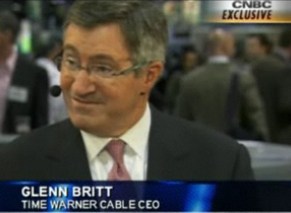
I spent the morning dealing with the dentist and some significant tooth pain, which could end up leading to another delightful root canal. It’s times like these when I like to share the pain. Back on April 2nd, Time Warner CEO Glenn Britt spoke with CNBC reporter Julia Boorstin about Britt’s thoughts on Internet Overcharging, the state of the cable industry, the growing reliance Time Warner Cable has on its broadband products, and where online video fits into the picture. Although Time Warner Cable shelved the consumption billing experiment, the belief in such billing experiments has not changed.
Virtually everything else in the interview remains largely the same for the company, including the all-important topic of TV Everywhere and online video content, which is back in the news.
If you want to understand the challenges facing big cable, this is must-see-online-TV. (Check out the unintentionally ominous background music which appropriately turns up around four minutes in.)
CNBC’s Julia Boorstin talked with Time Warner Cable CEO Glenn Britt on April 2nd about the cable company and the state of the industry these days. (15 minutes)
An avalanche of iPhones is to blame for AT&T's wireless problems, according to a Slate columnist
Telecommunications companies love people like Farhad Manjoo. He’s a technology columnist for Slate, and he’s concerned with the congestion on AT&T’s wireless network caused by Apple iPhone owners using their phones ‘too much and ruining AT&T’s service for everyone else.’ Manjoo has a solution — do away with AT&T’s flat data pricing for the iPhone and implement a $10 price increase for any customer exceeding 400 megabytes of usage per month. For those using less than 400 megabytes, he advocates for a “pay for what you use” billing model. Will AT&T adopt true consumption billing, a usage cap, or just another $10 price increase? History suggests the latter two are most likely.
Stop the Cap! reader Mary drew our attention to Manjoo’s piece, which predictably has been carried through the streets by cheering astroturf websites connected with the telecommunications industry who just love the prospect of consumers paying more money. They’ve called the organizations that work to fight against such unfair Internet Overcharging schemes “neo-Marxist,” ignoring the fact the overwhelming majority of consumers oppose metered broadband service and still don’t know the words to ‘The Internationale.’
Manjoo’s description of the problem itself has problems.
His argument is based on the premise that the Apple iPhone is virtually a menace on AT&T’s network. He blames the phone for AT&T customers having trouble getting their calls through or for slow speeds on AT&T’s data network.
Every iPhone/AT&T customer must deal with the consequences of a slowed-down wireless network. Not every customer, though, is equally responsible for the slowdown. At the moment, AT&T charges $30 a month for unlimited mobile Internet access on the iPhone. That means a customer who uses 1 MB a month pays the same amount as someone who uses 1,000 MB. I’ve got a better plan—one that superusers won’t like but that will result in better service, and perhaps lower bills, for iPhone owners: AT&T should kill the all-you-can-eat model and start charging people for how much bandwidth they use.
How would my plan work? I propose charging $10 a month for each 100 MB you upload or download on your phone, with a maximum of $40 per month. Inother words, people who use 400 MB or more per month will pay $40 for their plan, or $10 more than they pay now. Everybody else will pay their current rate—or less, as little as $10 a month. To summarize: If you don’t use your iPhone very much, your current monthly rates will go down; if you use it a lot, your rates will increase. (Of course, only your usage of AT&T’s cellular network would count toward your plan; what you do on Wi-Fi wouldn’t matter.)
First, and perhaps most importantly, AT&T not only voluntarily, but enthusiastically sought an exclusive arrangement with Apple to sell the iPhone. For the majority of Americans, using an iPhone means using AT&T as their wireless carrier. If AT&T cannot handle the customer demand (and the enormous revenue it earns from them), perhaps it’s time to end the exclusivity arrangement and spread the iPhone experience to other wireless networks in the United States. I have not seen any wireless provider fearing the day the iPhone will be available for them to sell to customers. Indeed, the only fear comes from AT&T pondering what happens when their exclusivity deal ends.
Second, problems with voice calling and dropped calls go well beyond iPhone owners ‘using too much data.’ It’s caused by less robust coverage and insufficient capacity at cell tower sites. AT&T added millions of new customers from iPhone sales, but didn’t expand their network at the required pace to serve those new customers. A number of consumers complaining about AT&T service not only mention dropped calls, but also inadequate coverage and ‘fewer bars in more places.’ That has nothing to do with iPhone users. Congestion can cause slow speeds on data networks, but poor reception can create the same problems.
Third, the salvation of data network congestion is not overcharging consumers for service plans. The answer comes from investing some of the $1,000+ AT&T earns annually from the average iPhone customer back into their network. To be sure, wireless networks will have more complicated capacity issues than wired networks do, but higher pricing models for wireless service already take this into account.
Business Week covered AT&T’s upgrade complications in an article on August 23rd:
Many of AT&T’s 60,000 cell towers need to be upgraded. That could cost billions of dollars, and AT&T has kept a lid on capital spending during the recession—though it has made spending shifts to accommodate skyrocketing iPhone traffic. Even if the funds were available now, the process could take years due to the hassle and time needed to win approval to erect new towers and to dig the ditches that hold fiber-optic lines capable of delivering data. And time is ticking. All carriers are moving to a much faster network standard called LTE that will begin being deployed in 2011. Once that transition has occurred, the telecom giant will be on a more level playing field.
And there are limits to how fast AT&T can move. While it may take only a few weeks to deploy new-fangled wireless gear in a city’s cell towers, techies could spend months tilting antennas at the proper angle to make sure every square foot is covered.
Karl Bode at Broadband Reportsalso points out a good deal of the iPhone’s data traffic never touches AT&T’s wireless network and he debunked a piece in The Wall Street Journal that proposed some of the same kinds of pricing and policy changes Manjoo suggests:
iPhone users are using Wi-Fi 42% of the time and the $30 price point is already a $10 bump from the first generation iPhone. The Journal also ignores the absolutely staggering profits from SMS/MMS, and the fact that AT&T posted a net income of $3.1 billion for just the first three months of the year. That’s even after the network upgrades the Journal just got done telling us make unlimited data untenable.
Sanford Bernstein’s Craig Moffett has been making the rounds lately complaining that a wireless apocalypse is afoot, telling any journalist who’ll listen that the wireless market is “collapsing” and/or “grinding to a halt.” Why? Because as new subscriber growth slows and the market saturates, incredible profits for carriers like AT&T and Verizon Wireless may soon be downgraded to only somewhat incredible. Carriers may soon have to start competing more heavily on pricing, driving stock prices down. That’s great for you, but crappy for Moffett’s clients.
You’ll note that neither the Journal nor Moffett provide a new business model to replace the $30 unlimited plan, but the intentions are pretty clear if you’ve been playing along at home. As on the terrestrial broadband front, investors see pure per-byte billing as the solution to all of their future problems, as it lets carriers charge more money for the same or less product (ask Time Warner Cable). Of course as with Mr. Moffett’s opinions on network upgrades, what’s best for Mr. Moffett quite often isn’t what’s best for consumers.
If AT&T doesn’t have the financial capacity or willingness to appropriately grow their network, inevitably customers will take their wireless business elsewhere, and perhaps Apple will see the wisdom of not giving the company exclusivity rights any longer.
Manjoo’s proposals (except the $10 rate increase, which they’ll love) would almost certainly never make it beyond the discussion stage. A pricing model that automatically places consumers using little data into a less expensive price tier, or relies on a true consumption “pay for exactly what you use” pricing model would cannibalize AT&T’s revenue. Past Internet Overcharging pricing has never been about saving customers money — they just charge more to designated “heavy users” for the exact same level of service. Need more money? Redefine what constitutes a “heavy user” or just wait a year when today’s data piggies are tomorrow’s average users. Now they can all pay more.
The average iPhone user already pays a premium for their AT&T iPhone experience — an average $90 a month for a combined mandatory voice and data plan — costs higher than those paid by other AT&T customers. AT&T accounted for the anticipated data usage of the iPhone in setting the pricing for monthly service.
The biggest data consumers aren’t smartphone or iPhone users. That designation belongs to laptop or netbook owners using wireless mobile networks for connectivity. Those plans universally are usage capped at 5 gigabytes per month, far higher than the 400 megabyte cap Manjoo proposes. If AT&T felt individual iPhone customers were the real issue, they would have already usage capped the iPhone data plan. Instead, they just increased the price, ostensibly to invest the difference in expanding their network.
Perhaps at twice the price, everything would be nice.
Manjoo admits AT&T does not release exact usage numbers, but it’s obvious a phone equipped to run any number of add-on applications that the iPhone can will use more data than a cumbersome phone forcing customers to browse using a number keypad. That in and of itself does not mean iPhone users are “data hogs.” In reality, 400 megabytes of usage a month on a network also handling wireless broadband customers with a 5 gigabyte cap is a pittance. That’s 10 times less than a customer can use on an AT&T wireless broadband-equipped netbook, and still be under their monthly allowance.
Here’s a better idea: end the monopoly AT&T has on the iPhone in the United States. That would immediately do a lot more for AT&T customers, as the so-called “data hogs” that hate AT&T flee off their network.
Manjoo’s alternatives are a “pay $10 more” solution that won’t save consumers money and “pay exactly for what you use” plan that AT&T will never accept.
The Canadian Radio-television Telecommunications Commission, the Canadian equivalent of the Federal Communications Commission in Washington, may be forced to consider American broadband policy before defining Net Neutrality and its role in Canadian broadband, according to an article published today in The Globe & Mail.
[FCC Chairman Julius Genachowski’s] proposal – to codify and enforce some general principles of “Net neutrality” – comes as the Canadian Radio-television and Telecommunications Commission is expected to release its own position this fall, after public consultations this summer that prompted feedback from tens of thousands of Canadians.
“The kinds of principles that the FCC is now looking to put into rules are precisely what the CRTC heard from many groups this past summer,” said Michael Geist, a University of Ottawa professor who holds the Canada Research Chair in Internet and E-commerce Law. “The kinds of concerns that Canadians have been expressing have clearly been taken to heart by the FCC.”
Many Canadian citizens have been unhappy with the CRTC after a summer of hearings and policy decisions which have almost universally-favored Canadian broadband providers’ positions. The CRTC seemed skeptical during hearings over the urgency to enforce Net Neutrality protections and stop provider’s throttling of peer to peer networks. But consumers were even more upset when the Commission agreed with Bell, Canada’s largest phone company and wholesale broadband provider, and allowed the company to impose “usage based billing (UBB)” (Internet Overcharging) on wholesale buyers — primarily independent Internet Service Providers. Canadian customers attempting to avoid usage caps and consumption billing relied on more generous policies from independent providers, policies likely to be revoked with the imposition of UBB, potentially making flat rate broadband service in Canada largely extinct.
In general terms, Net neutrality refers to the concept that access to all legal content on the Internet should be equal. The concept often comes up in relation to the practice of “bandwidth throttling,” where ISPs limit the transfer speed of certain kinds of data – such as the transfer of large movie files between users – but not other kinds.
Many large Canadian ISPs have argued that network management doesn’t affect Net neutrality, and taking away an ISP’s ability to manage its network results in worse service for a large number of customers.
Currently, there is no uniform practice among large ISPs in Canada when it comes to network management. Some firms throttle bandwidth during certain times of the day, whereas other limit bandwidth all the time, or not at all. A CRTC ruling this fall could go a long way toward implementing a uniform code for all ISPs.
“In light of what we’ve seen today, [the CRTC ruling] will be particularly telling because the benchmark now isn’t just what the CRTC heard during this hearing, the benchmark now is our neighbours to the south,” Prof. Geist said. “The CRTC will in many ways be measured up against what the FCC is doing in the U.S.”
Yesterday’s proposal by FCC Chairman Julius Genachowski gets Net Neutrality halfway there. That already puts us ahead of Canadian broadband, which is a throttler’s paradise, but remember — an eventual FCC rulemaking is not a law. An FCC policy is only as good as the agency’s willingness to enforce it. If a new administration decides Net Neutrality is not to their liking, they could very well appoint new Commissioners who agree, and while they may not repeal such policies, they aren’t likely to spend time enforcing them either.
Americans must insist that Net Neutrality have the force of federal law, and that can be done by telling your member of Congress to co-sponsor the Internet Freedom Preservation Act (H.R. 3458.)
Canadians need to immediately appeal to their MPs and ask why Canada is stuck with throttling broadband providers that completely ignore Net Neutrality when the United States not only has a bill to codify Net Neutrality protections but a regulatory communications body that is going to enforce it as policy even without a new law. That’s a far cry from the Canadian Radio-television Telecommunications Commission (CRTC) which has spent all year rubber-stamping the wish list of the broadband industry. That’s simply unacceptable, and Canadians need to tell MPs their vote in the next round of elections will depend on which candidate has the best plan to solve this mess. There is absolutely no justification for Canada falling behind the United States in broadband service. If the CRTC won’t represent Canadian citizens, perhaps it’s time to get rid of it and let them form an industry trade group, which isn’t far off from where they are right now.
Net Neutrality alone is not nirvana for broadband consumers. Indeed, there is every expectation some broadband providers may try to slap more Internet Overcharging schemes on consumers and try to blame Net Neutrality for it, under the false “either/or premise.” Too often, public interest groups and some consumers have been led astray with the assumption that one is better than the other, and that’s a false choice. Both are extremely bad for innovation, broadband advancement, and consumer adoption and acceptance of broadband service. When you engage in Overcharging schemes like raising prices, imposing usage caps, meters, overlimit fees and penalties, some consumers will decide it just isn’t worth it. Few consumers will risk using high bandwidth online applications of the future worried about their usage allowance for the month, or the penalty for exceeding it.
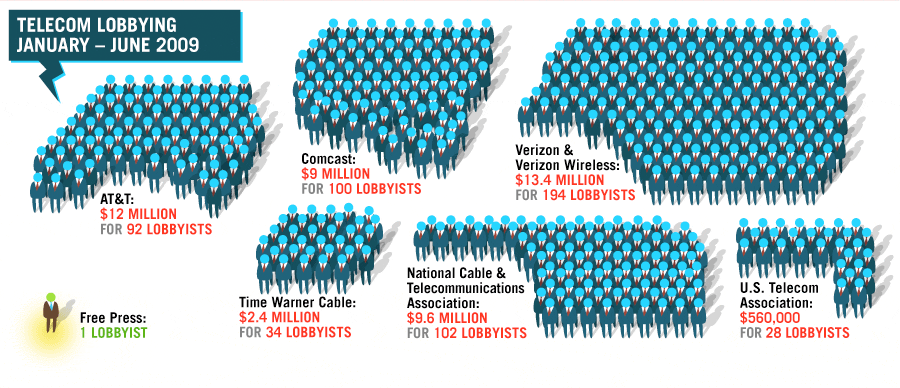
Free Press Illustrates the Telecom Industry's Lobbying Frenzy
Internet Overcharging schemes are not dead, although some of the earlier experiments have been temporarily shelved. Some smaller providers in rural and small cities are already engaged in usage caps combined with consumption billing. AT&T continues its experiment in Beaumont and Reno. Comcast celebrated its first anniversary of the 250GB usage cap by leaving it right where it is, unchanged. Wireless mobile broadband is a 5GB capped experience all-around.
Although I realize it is difficult to generate intensity when there aren’t big bad actors imminently dropping Internet Overcharging on millions of broadband customers, this is not the time to keep the pressure off. Let’s make sure providers realize the intense, red hot hatred of gas gauges, meters, and all of the other Overcharging schemes has not cooled a single degree. You can do that by making another round of phone calls and sending messages to your member of Congress to support Rep. Eric Massa’s Broadband Internet Fairness Act (H.R. 2902.)
This bill does -not- get the government involved in regulating the pricing of broadband service, as some astroturfers have alleged. It simply demands proof that a provider has a financial need to engage in these practices, and in the absence of independent verification, protects consumers by prohibiting providers from leveraging their de facto monopoly/duopoly status and imposing them anyway.
No government legislation alone is ever going to solve all of our broadband problems and concerns. But some pro-consumer protections protect our wallets from the undercompetitive broadband industry most of us have to deal with.
Don’t be fooled by providers openly wondering why such protections are necessary. It was ironic watching yesterday’s panel discussion on broadband when David Young from Verizon started asking what problem Net Neutrality was trying to solve. He didn’t see any and had no problem living under the open platform standard Genachowski proposed. That’s ironic because Verizon has nearly 200 paid lobbyists fighting Net Neutrality and related telecommunications policy spending well over $10 million dollars on it this year. If Young doesn’t see the problem, why are ratepayers and shareholders footing the bill to address it?
Be Sure to Read Part One: Astroturf Overload — Broadband for America = One Giant Industry Front Group for an important introduction to what this super-sized industry front group is all about. Members of Broadband for America Red: A company or group actively engaging in anti-consumer lobbying, opposes Net Neutrality, supports Internet Overcharging, belongs to […]
Astroturf: One of the underhanded tactics increasingly being used by telecom companies is “Astroturf lobbying” – creating front groups that try to mimic true grassroots, but that are all about corporate money, not citizen power. Astroturf lobbying is hardly a new approach. Senator Lloyd Bentsen is credited with coining the term in the 1980s to […]
Hong Kong remains bullish on broadband. Despite the economic downturn, City Telecom continues to invest millions in constructing one of Hong Kong’s largest fiber optic broadband networks, providing fiber to the home connections to residents. City Telecom’s HK Broadband service relies on an all-fiber optic network, and has been dubbed “the Verizon FiOS of Hong […]
BendBroadband, a small provider serving central Oregon, breathlessly announced the imminent launch of new higher speed broadband service for its customers after completing an upgrade to DOCSIS 3. Along with the launch announcement came a new logo of a sprinting dog the company attaches its new tagline to: “We’re the local dog. We better be […]
Stop the Cap! reader Rick has been educating me about some of the new-found aggression by Shaw Communications, one of western Canada’s largest telecommunications companies, in expanding its business reach across Canada. Woe to those who get in the way. Novus Entertainment is already familiar with this story. As Stop the Cap! reported previously, Shaw […]
The Canadian Radio-television Telecommunications Commission, the Canadian equivalent of the Federal Communications Commission in Washington, may be forced to consider American broadband policy before defining Net Neutrality and its role in Canadian broadband, according to an article published today in The Globe & Mail. [FCC Chairman Julius Genachowski’s] proposal – to codify and enforce some […]
In March 2000, two cable magnates sat down for the cable industry equivalent of My Dinner With Andre. Fine wine, beautiful table linens, an exquisite meal, and a Monopoly board with pieces swapped back and forth representing hundreds of thousands of Canadian consumers. Ted Rogers and Jim Shaw drew a line on the western Ontario […]
Just like FairPoint Communications, the Towering Inferno of phone companies haunting New England, Frontier Communications is making a whole lot of promises to state regulators and consumers, if they’ll only support the deal to transfer ownership of phone service from Verizon to them. This time, Frontier is issuing a self-serving press release touting their investment […]
I see it took all of five minutes for George Ou and his friends at Digital Society to be swayed by the tunnel vision myopia of last week’s latest effort to justify Internet Overcharging schemes. Until recently, I’ve always rationalized my distain for smaller usage caps by ignoring the fact that I’m being subsidized by […]
In 2007, we took our first major trip away from western New York in 20 years and spent two weeks an hour away from Calgary, Alberta. After two weeks in Kananaskis Country, Banff, Calgary, and other spots all over southern Alberta, we came away with the Good, the Bad, and the Ugly: The Good Alberta […]
A federal appeals court in Washington has struck down, for a second time, a rulemaking by the Federal Communications Commission to limit the size of the nation’s largest cable operators to 30% of the nation’s pay television marketplace, calling the rule “arbitrary and capricious.” The 30% rule, designed to keep no single company from controlling […]
Less than half of Americans surveyed by PC Magazine report they are very satisfied with the broadband speed delivered by their Internet service provider. PC Magazine released a comprehensive study this month on speed, provider satisfaction, and consumer opinions about the state of broadband in their community. The publisher sampled more than 17,000 participants, checking […]


 Subscribe