Home » consumption billing » Recent Articles:

Verizon Wireless’ LTE Next Generation Wireless Broadband: ‘Long Term Expensive’ Usage-Based Billing On The Way

Phillip Dampier

Verizon Wireless’s next generation LTE wireless broadband network threatens to bring expensive “usage-based billing” to millions of Americans using technology products that depend on wireless networking to communicate  — from the handheld tablet you use to enjoy USA Today over morning coffee, the car that delivers news, weather and traffic reports to and from work, to the portable television you use to catch up with the game while running around town.

At the Consumer Electronics Show, Verizon chief technology officer Dick Lynch warned that Verizon is likely to abandon any notion of flat rate usage pricing, particularly when Verizon doesn’t get a piece of the action from the sale of the devices that connect to their network.

Instead, Verizon Wireless will adopt a wireless version of Internet Overcharging — usage-based billing that isn’t entirely “usage-based.”

A true consumption billing system charges consumers only for what they use — don’t use the service that month and customers would pay little or nothing for service that billing period.  Instead, providers maximize revenue with arbitrary “usage allowances” which are part of the steep monthly service fee.  The unused portion of the allowance typically does not roll over, in effect lost at the end of the month.  That means you pay for not using their network.  Imagine if your electric company charged you for leaving the lights on 24/7, but you were out of town that month.  If you exceed your allowance, the overlimit penalty kicks in, and most providers set those prices high enough to sting you while rewarding them.

“The problem we have today with flat-based usage is that you are trying to encourage customers to be efficient in use and applications but you are getting some people who are bandwidth hogs using gigabytes a month and they are paying something like megabytes a month,” Lynch said. “That isn’t long-term sustainable. Why should customers using an average amount of bandwidth be subsidizing bandwidth hogs?”

Lynch

The first step to broadband pricing enlightenment is to recognize the only true “hog” here is the broadband provider with an endless appetite for your money.  Usage-based pricing schemes carry the one-two punch for consumers, with no pain for providers:

  1. They discourage usage, as consumers fear using up their monthly allowance and getting socked with an enormous bill filled with penalties and overlimit fees;
  2. The corresponding reduction in usage lowers the providers’ capital spending requirements to meet consumer demand, and increase profits dramatically from those who find allowances too limiting and are willing to pay the exorbitant pricing providers charge those who exceed them.

Does Verizon actually believe that $60 a month for their wireless broadband service represents a fair price for someone using “something like megabytes a month?”  Can Verizon show it is losing money on its wireless broadband service?  I think not.

Predictably, Lynch provides a “between-the-lines” slap at government intervention to force open wireless networks to additional competition in the equipment marketplace:

“The whole paradigm of how we sell devices into the public is changing,” Lynch said. “At the same time that we announced LTE, we announced an open development initiative where we encouraged third-party developers to deploy devices on our network.”

That initiative was hardly the result of a sudden change of heart from Verizon.  It came from pressure Washington applied over the “closed network” practices the American wireless industry has followed for years.  Handsets and the applications that run on them have traditionally been closely controlled by providers.  Features built into smartphones and other handsets were disabled or limited by providers before the phones were sold to the public.  Usually, this forced customers to use the services either provided directly by their wireless company, or one of their “affiliated partners.”

Verizon Wireless is signaling the consequence of a more competitive, open market for wireless products and services: usage limits and a higher bill. That’s because you didn’t buy that device at a Verizon store at their asking price, and you’ve been using it too much.

Consumers would make a grave mistake in blaming a more activist watchdog role by the federal government to force open the wireless industry to competition and innovation by third parties.  Despite Verizon’s hints that those pesky regulators in Washington are to blame for your usage being limited and your bill being higher, the blame really belongs with the carriers pocketing those proceeds.

Since regulators will get the blame regardless, isn’t it time to go all out for American consumers by transforming the wireless provider marketplace?  Here are our suggestions:

  1. An end to the ongoing consolidation of existing wireless players into a shrinking number of what will soon be two or three “too big to fail” national providers;
  2. Insistence on additional competition coming from new, independent players, not simply those directly affiliated with the dominant four carriers (Verizon, AT&T, Sprint, and T-Mobile);
  3. Justification for confiscatory data pricing made possible from the highly concentrated wireless marketplace, particularly in smaller cities and communities.

Verizon and AT&T have both engaged in a lot of scare talk about usage and their costs to manage it.  We’d believe them, except we read their financial reports and neither company is hurting.  We’d even be willing to meet them halfway and advocate additional allocations of spectrum to provide the bandwidth an increasingly wireless world will demand, but not at their asking price with those pesky terms and conditions that ration service to consumers at top dollar prices.
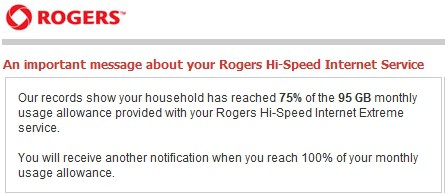

Rogers Ripoff: Will Double Maximum Overlimit Fee to $50 for Broadband Customers

Just like the credit card companies, once a broadband provider wedges its foot in the door with Internet Overcharging schemes like consumption billing and usage allowances, they can push it open further and further, allowing your money to fly out the door into their pocket.

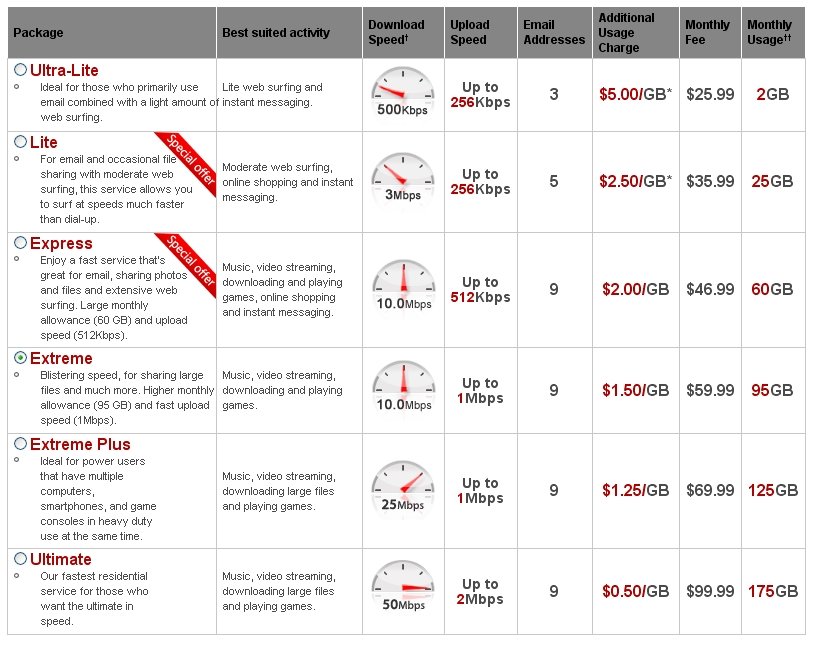
Rogers Communications, the dominant cable broadband provider in eastern Canada has quietly planned to double the maximum overlimit penalty customers pay for exceeding their usage allowance.  Effective this March, Rogers will confiscate up to $50 from you for daring to cross their arbitrary allowances, which range from a piddly 2GB on their “Ultra-Lite” plan to 175GB on their $100 “Ultimate” plan.  That’s double the old maximum penalty of $25 a month.

It appears many Canadian broadband customers simply took it for granted that unlimited broadband, regardless of the tier they selected, would cost an additional $25 a month.  Many begrudgingly paid it, knowing in many areas all of the alternatives had Internet Overcharging schemes of their own.

Broadband Providers Limbo Dance: Lowering Your Value With Internet Overcharging Schemes

As Stop the Cap! has warned repeatedly, once broadband providers establish such schemes, they can begin a limbo dance with their customers, reducing the value of the service they receive by either increasing the penalties for exceeding usage limits, or simply reducing usage allowances to expose more customers to profit-padding fees and surcharges.

Rogers is taking a page from companies like Time Warner Cable that wanted to implement their own Internet Overcharging scheme in April 2009 with a maximum overlimit penalty of $100.  For broadband providers in Canada like Rogers who double such fees, there is plenty of room to grow them further.

Rogers charges customers trying to keep to a broadband budget some stunning overlimit fees as it is.  Their Ultra-Lite plan exposes customers to a future bill up to $76.00 a month, all for 500kbps service, and that’s before taxes and surcharges.  That’s because Rogers charges customers exceeding 2GB per month a whopping $5 for each additional gigabyte of usage.

Most Rogers customers end up on plans like “Express” which charges $46.99 a month for 10Mbps/512kbps service, with a 60GB usage allowance.  But with Rogers’ new overlimit penalty fee, customers opening their bills could find that service costing them $97 a month instead.  That’s a bill only a credit card company could love.

All this, when Rogers’ costs to provide broadband service continue to decline.  Rationing broadband is profitable and and shareholders love it.  Considering the  regulatory agency that is supposed to watch out for Canadians, the Canadian Radio-television Telecommunications Commission (CRTC), more closely resembles a cable and telephone industry lobbying group, there is nothing to stand in the way of even greater fee increases in the future.

Oh, and they get to throttle your broadband speed down… way down, for any online application they feel consumes too many resources on their network, so customers can’t even use the service they pay good money to receive.

Nadir Mohamed, president and chief operating officer of Rogers Communications Inc., admits it’s all about the money.  In June 2008, he told the Canadian Telecom Summit, “Usage-based billing is a reality for wired and wireless network,” he said. “The capacity is exploding, and we need to be able to monetize some of that.”

A person representing themselves as a Rogers social networking rep, “RogersMary” told customers Rogers had increased the value of their broadband service:

We always want to offer our customers great quality of service for the best value. In the last year, we have made network and technology investments that include improvements in download speeds, expanding our network in other parts of Canada and launching Rogers On Demand Online free to all customers that subscribe to any Rogers product. In terms of pricing, we have reduced higher tier services such as Extreme Plus ($69.99 from $99.95) and Ultimate ($99.99 from $149.99). Based on our research, the vast majority (90%) of Rogers Internet customers do not go over their usage limits each month and will not be impacted by changes to overage charges. If you do, I would suggest calling Care to discuss which plan best suits your Internet use.

If you call, ask Rogers which plan doesn’t include an Internet Overcharging scheme.

Cable Cartel’s Plan to Kill Online TV: No Cable Subscription? No Online TV – Consumer Groups Call That Collusion

Phillip Dampier January 4, 2010 Comcast/Xfinity, Data Caps, Issues, Online Video 17 Comments

Comcast blocks C-SPAN programming for those who are not Comcast customers

Public interest groups today began an offensive against the cable industry’s attempts to stave off potential online video competition with an industry dominated and controlled online video platform that guarantees consumers won’t cut cable’s cord.

Free Press, Media Access Project, Public Knowledge and Consumers Union are sending letters to the Justice Department and the Federal Trade Commission calling for a probe into the industry’s “TV Everywhere” project, designed to weed out non-cable subscribers from accessing online video programming.

The undertaking, which the industry claims will eventually rival Hulu in size and scope, seeks to provide their broadband customers with on-demand access to as much programming as possible, as long as they subscribe to a corresponding video programming and broadband service package.

Known in the industry as a “pay wall,” the system would assure pay television companies affiliated with the project that they will not lose subscribers from customers cutting the cord to watch programming online for free.  Consumer groups call that collusion, and accuse the industry of secretly meeting to outline the TV Everywhere concept and may be violating anti-trust laws in the process.

“The old media giants are working together to kill off innovative online competitors and carve up the market for themselves,” said Marvin Ammori, a law professor at the University of Nebraska and senior adviser to Free Press. Ammori’s report: TV Competition Nowhere: How the Cable Industry Is Colluding to Kill Online TV, is included in the mailing to the federal agencies.

Ammori says the industry has a long history of controlling behavior.

“Over the past decade, they have locked down and controlled TV set-top boxes to limit competing programming sources; they have considered imposing fees for high-capacity Internet use in ways that would discourage online TV viewing; and they have pressured programmers to keep their best content off the Internet,” Ammori writes.

In addition, these companies, which already dominate the Internet access market, have threatened to discriminate against certain online applications or have already been caught violating Network Neutrality. Indeed, the FCC issued an order in 2008 against Comcast for blocking technologies used to deliver online TV, noting the anti-competitive effect of this blocking. While it may be economically rational for cable, phone and satellite companies to squash online competitors, the use of anti-competitive tactics is bad for American consumers and the future of a competitive media industry.

The latest method of attack aimed at online TV, however, may be the most threatening — and is also likely illegal. Competition laws aim to ensure that incumbent companies fight to prevail by providing better services and changing with the times, not by using their existing dominant position and agreements to prevent new competitors from emerging.

TV Everywhere has a simple business plan, under which TV programmers like TNT, TBS and CBS will not make content available to a user via the Internet unless the user is also a pay TV subscriber through a cable, satellite or phone company. The obvious goal is to ensure that consumers do not cancel their cable TV subscriptions. But this plan also eliminates potential competition among existing distributors. Instead of being offered to all Americans, including those living in Cox, Cablevision and Time Warner Cable regions, Fancast Xfinity is only available in Comcast regions. The other distributors will follow Comcast’s lead, meaning that the incumbent distributors will not compete with one another outside of their “traditional” regions.

In addition, new online-only TV distributors are excluded from TV Everywhere. The “principles” of the plan, which were published by Comcast and Time Warner (a content company distinct from Time Warner Cable), clearly state that TV Everywhere is meant only for cable operators, satellite companies and phone companies. By design, this plan will exclude disruptive new entrants and result in fewer choices and higher prices for consumers.

This business plan, which transposes the existing cable TV model onto the online TV market, can only exist with collusion among competitors. As a result, TV Everywhere appears to violate several serious antitrust laws. Stripped of slick marketing, TV Everywhere consists of agreements among competitors to divide markets, raise prices, exclude new competitors, and tie products. According to published reports and the evident circumstances, TV Everywhere appears to be a textbook example of collusion. Only an immediate investigation by federal antitrust authorities and Congress can prevent incumbents from smothering nascent new competitors while giving consumers sham “benefits” that are a poor substitute for the fruits of real competition.

Ammori

The benefits of controlling the marketplace of video and online entertainment is a lucrative one, earning players billions in profits each year.  Losing control of the business model risks the industry repeating the mistakes of the music industry, which overpriced its product and alienated consumers with annoying digital rights management technology and lawsuits.  It also risks a repeat of the newspaper industry which many in the cable industry believe made the critical mistake of giving away all of their content for free.

With online video services like Hulu generating enormous online traffic from its free video programming, the cable industry fears they might already be headed down the road newspapers paved.  TV Everywhere is part of a multi-pronged defense plan according to Ammori.

Indeed, what the industry cannot control themselves, Internet Overcharging schemes like usage caps and “consumption billing” can handily manage.

Ammoni notes:

Cable and phone companies have proposed cap-and-metered pricing for Internet service that appears to target online TV. Unlike the current all-you-can-eat monthly fee-plans, cap-and-metered pricing would charge users based on the capacity used. As a result, downloading or streaming large files will be more expensive than smaller files. In March 2009, Time Warner Cable announced metered pricing trials in four cities that would have made watching online TV cost prohibitive.

AT&T is testing a metering plan on its wireline U-verse service with hopes for national expansion. Even under generous allowances for bandwidth, users could not watch high-definition programming for many hours a day.

In response to trials by Time Warner Cable, a House bill was introduced in Congress, and Time Warner Cable dropped its immediate plans under consumer pressure. The company stated the plans would be reintroduced following a “customer education process.”

“Online TV is this nation’s best shot at breaking up the cable TV industry oligopolies and cartels. Permitting online distributors to compete vigorously on the merits for computer screens and TV screens will result in increased user choice, more rapid innovation, lower prices and a more robust digital democracy,” Ammoni concludes.

New Report Says Wireless Broadband Providers May Have to Implement Usage Caps… But They Already Have

A new report from Frost & Sullivan (pricey subscription required) warns wireless broadband providers may have to implement limits on the amount of data consumed by customers, a surprising result considering the vast majority of carriers already do.

The business research and consulting firm says some wireless carriers are struggling to balance the consumption they encouraged with the physical capacity of their networks.  Citing AT&T’s iPhone and its data-rich App Store, which lets consumers download data applications to run on their phone, the research shows data consumption has increased dramatically as consumers integrate smartphones into their daily lives.

“We all knew as an industry that mobile data would grow, and we saw these growth curves that were a 45-degree angle upward,” said James Brehm, senior consultant at Frost & Sullivan. “But the true growth of the iPhone, when you chart it, looks more like a hockey stick.”

The demand for data is pressuring the industry to invest additional money for upgrades, and Wall Street isn’t happy with a trend that guarantees expensive upgrades will be required to meet customer demand — upgrades that would come straight out of revenue, unless a dramatic shift takes place towards consumption-based billing.

“You’re going to see some push back from consumers, but AT&T’s not going to be the only one that’s going to have to do this,” Brehm said. “Every service provider out there is going to ultimately change the way mobile data is consumed and priced over the next few years.”

The argument essentially comes down to how much revenue wireless carriers will be forced to invest in their networks, and how much noise they will hear from investors for doing so.  Wall Street prefers customers pay the costs for upgrades by increasing prices for data service, which would assure revenue expectations remain stable.  Customers demand wireless carriers invest some of their profits back into their networks to improve service and in return enjoy customer loyalty and any revenue earned from selling additional services.

Some carriers are choosing to stay out of the fight, claiming they already have sufficient capacity to serve customers.  Besides, most of them already have usage limits on their services, traditionally set at a maximum of 5GB of consumption per month.

T-Mobile believes it already has enough capacity to meet the growing demand from data-hungry smartphones.  It has invested in new technology that claims to triple current 3G speeds and works with current 3G phones,  meaning customers don’t have to buy a new phone to enjoy the faster speeds.

Sprint is constructing its 4G network and already sells service in several cities through Clearwire.  Sprint claims unlike some of its competitors, it intends to stay ahead of the growth curve by investing now in additional spectrum and technology to manage its networks.  Sprint claims it has plenty of room to expand capacity.

Verizon Wireless says it has more consistently upgraded its network over the past decade than any other carrier, and is well prepared to accommodate even the iPhone.

“We have put things in place already,” Verizon Wireless Chief Technology Officer Anthony Melone tells Business Week. “We are prepared to support that traffic.”  Next year, the nation’s largest wireless carrier will be rolling out 4G upgrades in America’s 30 largest cities, although primarily for mobile broadband service accessed through a mobile broadband dongle.

Verizon already limits consumption on its wireless plans to a maximum of 5GB per month, with overlimit penalties for those that exceed it.

Most of the attention remains focused on AT&T and the iPhone, because the data plan provided for iPhone customers does not carry a specified limit.

Vipin Jain, chief executive of Retrevo, a consumer electronics shopping Web site told the Chicago Tribune, “As soon as you put a cap (on data usage), there’s going to be a backlash.”

So what keeps wireless providers from upgrading their networks and keeping consumption billing and usage caps away?

In addition to pressure from Wall Street, another Frost & Sullivan report points to an unsettled marketplace.  The progression towards 4G has been stalled because of the economic downturn, the report says.

Frost & Sullivan ICT Program Manager Luke Thomas says carriers are still waiting for consensus on several issues, including support for voice and SMS and a harmonized frequency band for 4G traffic.  Thomas also says many cell towers have limited capacity to support additional traffic.  A tower can deliver only as much data as its connection back to the provider’s network can handle.  Once the “backhaul” link is saturated, calls start to drop and data speed slows.  Many still rely on dedicated, relatively slow copper wire circuits, although fiber optic links are becoming increasingly common.

Thomas also believes carriers will need additional spectrum, a minimum of 20MHz, to make 4G upgrades worthwhile.

Without all of these factors, Thomas believes the potential return on investment won’t be high enough to justify moving forward any time soon.

iPhone Users: Your Unlimited Ride Pass on AT&T Is About to End

Apple iPhone

Apple iPhone

AT&T Mobility, the still-exclusive provider of Apple’s iPhone in the United States, is floating trial balloons about the imminent end of “unlimited data” plans for iPhone customers.  Although the company has always defined their wireless broadband service as “unlimited” even though the fine print says they really mean “up to 5GB of usage per month,” the mandatory data plan forced on iPhone customers has retained its “unlimited means unlimited” definition.  We’ve never verified a customer thrown off of AT&T’s network for using too much data on their iPhone.

AT&T has managed the iPhone as both a success story and a major challenge to its network.  People will go to all sorts of trouble to acquire and keep an iPhone, including putting up with less 3G coverage and more congestion-related dropped calls and other service problems in some larger cities.

Considering the enormous revenue boost the iPhone has brought to AT&T, customers might wonder why the company simply doesn’t pour additional money into building more network capacity.  AT&T Mobility CEO Ralph de la Vega doesn’t agree.

He believes the answer isn’t going to be found in just upgrading AT&T’s network.  Instead, he wants to implement an Internet Overcharging scheme like consumption billing and do away with the “unlimited” plan altogether.

AT&T claims that three percent of smart phone customers consume 40 percent of network capacity, a substantial percentage if compared with the amount of data a mobile broadband dongle can help a laptop or netbook consume.  Of course, those numbers are AT&T’s and do not come with independent verification.

For de la Vega, consumption pricing “is inevitable.”  That allows AT&T to reduce demand on its network and manage upgrades at a level more comforting on that quarterly financial report.

“What’s driving [high] usage are things like video or audio that plays around the clock,” de la Vega said at an analysts conference. “We have to get to those customers and get them to recognize they have to change their patterns, or there are things we will do to change those patterns.”

Customers forced to ration their usage with the threat of a higher bill can work… for AT&T.

AT&T may be about to test the limits of the iPhone enthusiast.  After all, they’ve already been pushed into a two year contract for a premium-priced phone, enrolled in a high priced service plan with a compulsory data package add-on, and have to live with AT&T’s less-than-stellar coverage in several areas.  Will AT&T be able to punish its customers further by taking away their unlimited data plan and replace it with consumption billing and see if they’ll break?

We’re likely about to find out.

AT&T wants to embark on a part-conservation, part-education campaign to get customers to reduce usage.

“We need to educate the customer … We’ve got to get them to understand what represents a megabyte of data,” de la Vega says. “We’re improving all our systems to let consumers get real-time information on their data usage.”

That’s the AT&T version of the gas gauge, the usage meter that means more profits for them and less service for you.

A question customers might want to ask Apple and AT&T: If the sole provider of the iPhone in the United States is a hard luck case of an over-congested network and an inability to invest profits to expand it, perhaps it’s time that exclusive contract comes to an end, allowing other mobile providers to ‘share the burden.’  Then customers can decide if AT&T’s rationing, consumption billing, and education campaign is right for them.

Search This Site:

Contributions:

Recent Comments:

Your Account:

Stop the Cap!