Home » consumption billing » Recent Articles:

Shaw Cable & Vidéotron Introduce Canadians to “TV Everywhere” Online VOD, But Data Caps Enforced

Phillip Dampier June 18, 2010 Canada, Data Caps, Online Video, Shaw, Video, Vidéotron Comments Off on Shaw Cable & Vidéotron Introduce Canadians to “TV Everywhere” Online VOD, But Data Caps Enforced

TV Everywhere isn’t just for the United States.  Canadian cable operators are also threatened by cable cord-cutters, although their pervasive Internet Overcharging schemes have kept TV addicts from watching too much video online.

Both Shaw Cable (serving western Canada) and Vidéotron (best known in Quebec) have this week introduced their own online video portals providing “authenticated” cable subscribers with access to on-demand movies and television programming as an extension of their cable package.  But neither company is willing to exempt its customers from Internet Overcharging schemes which apply data caps and overlimit fees to broadband accounts.

Of the two services, Shaw Cable’s is bare bones, offering a relative handful of TV shows and a movie library.  No live video is provided, and many titles carry per-viewing fees, even for cable subscribers.  Non-subscribers face even higher fees to view programming.  Vidéotron takes a different approach, offering a video portal called Illico Web that offers on-demand and live streaming feeds of a wide range of cable networks, mostly in French for its Quebec subscriber base.

Shaw positioned its video-on-demand service as an extension of its cable service.  It hopes its announced acquisition of Canwest Global, which runs the Global television network in Canada and 18 cable networks will vastly expand its offerings in the future.

Vidéotron warns its subscribers watching its service eats into monthly broadband usage allowances.

“Technology continues to evolve with the ability to watch content on multi-platforms,” said Peter Bissonnette, President, Shaw Communications. “That’s why Shaw is investing in bringing exceptional content delivered in various ways. Our new broadband VOD Player provides our customers the convenience of watching their favorite movies and television shows when and where they want to.”

Pierre Karl Péladeau, the president and chief executive officer of Vidéotron’s parent Quebecor was more abrupt when he said on Wednesday that its TV Everywhere service would offer “an alternative to piracy.”

But in Canada, there is a catch.  Neither cable provider offers subscribers unlimited broadband service.  Both employ Internet Overcharging schemes ranging from usage caps to consumption billing schemes with overlimit penalties.  Vidéotron reminds its subscribers to “keep an eye on your Internet usage.”  That’s because they don’t exempt their online viewing service from their usage limits.  Vidéotron’s video portal does eat its way through subscriber allowances.  The company provides these estimates to help guess by how much:

Movie 1h30 825 MB
TV show 30 min 275 MB
Video 10 min 90 MB

[flv width=”432″ height=”263″]http://www.phillipdampier.com/video/Welcome to illico web 6-10.flv[/flv]

Illico Web produced this video introduction to its TV Everywhere service. (French with English subtitles — 3 minutes)


AT&T Customers in Beaumont and Reno Finally Get Word The Internet Overcharging is Over

Phillip Dampier June 14, 2010 AT&T, Data Caps, Editorial & Site News, Wireless Broadband Comments Off on AT&T Customers in Beaumont and Reno Finally Get Word The Internet Overcharging is Over

Beaumont, Texas

AT&T has distributed an internal memo to customer service representatives that informs them AT&T’s Internet Overcharging experiment in Reno, Nevada and Beaumont, Texas has ended.  Stop the Cap! reader Scott Eslinger was able to get an AT&T representative to read from the official memo that many AT&T customers have yet to hear about themselves.  Stop the Cap! had word in February the usage limit test was set to end April 1st, but actually getting official word that declared it dead and buried took much longer.

With no official notification to customers in the two impacted cities, many may be under the impression that usage limits remain.

AT&T representatives notoriously provided inaccurate information to customers about the experiment, with several customers signing up for “unlimited” service only to be notified days later they were actually facing limits ranging from 20-150 GB per month depending on their service plan.

Eslinger, who lives in Beaumont, notes representatives regularly mislead him into believing his service was unlimited even during the trial, except it was not.

“Every time I talked to AT&T no matter what I called about I always asked if the rep knew the status of the ‘broadband usage trial’ as I wanted to know when it would be over. No one ever had any idea what I was talking about,” Scott writes.  “They regularly told me that my AT&T broadband account included ‘unlimited’ use.”

But when Scott ran over his allowance, a nasty letter arrived in the mail saying otherwise.  Even then, AT&T customer service representatives kept telling him the letter must be a mistake.

“The first time I got the letter stating that I had gone over and would be charged the next time I went over I called AT&T and the rep actually had me fax in the letter so they could ‘fix’ it as that just ‘didn’t seem right.'”

We agree.  Internet Overcharging schemes are not right.  They represent little more than transparent rationing of broadband usage to reduce their costs while potentially earning $1.00 per gigabyte in overlimit fees for those who broke their allowance.

Although AT&T told Scott he couldn’t get a copy of the memo officially terminating the usage limit experiment, because it was a confidential, “proprietary AT&T document,” the rep read it out loud to Eslinger over the phone anyway.

“Reminder, the broadband usage trial in the Reno, Nevada and Beaumont, Texas market areas ended on April 1, 2010. Remember customers outside of the Reno and Beaumont are not impacted.”

Lvtalon

Reno, Nevada: One of the communities chosen for AT&T's Internet Overcharging experiment

Scott noted it was news to him.

“I never recall receiving this via email or snail mail; you would think they would have told everyone they ended it,” he writes. “Hopefully it will NEVER come back!”

One can hope.  Unfortunately, AT&T is the company that ended its unlimited wireless data plan for smartphone customers, now limiting them to just 2 GB of wireless usage per month, with a steep overlimit penalty for those that exceed it.

For millions of AT&T DSL and U-verse customers, an Internet rationing plan that limits consumption could prove costly, especially for those in rural areas where alternative providers simply are not available.

The best ways to deliver the message AT&T’s usage limits are not acceptable:

  • Inform the company you are not happy with usage limits or so-called consumption billing that seeks to consume all of the money in your wallet;
  • Don’t buy service from AT&T and tell them why.  Existing customers can be grandfathered on their existing unlimited plans, but new customers should shop elsewhere for service.

For many AT&T representatives, complaints about usage limits will be news to them, too.  Scott closes his note with word that even AT&T’s executive office customer service department, the one reserved for customers complaining to senior management, had never heard of the usage cap trials either.

Cable Trade Press Understands AT&T’s 2GB Cap – ‘You’ll Blow Right Through It’

Spangler

While the mainstream media and some of AT&T’s apologists tell consumers AT&T’s 2 GB monthly usage limit will impact only a handful of “abusers,” the cable trade press is telling its readers the industry insider’s secret — consumers will blow right through those caps.

Todd Spangler, who is an Internet Overcharging advocate and columnist for Multichannel News, a cable industry trade magazine, writes the implications of AT&T’s usage cap couldn’t be clearer to him.

The new iPhone 4, introduced yesterday to the predictable media crush, provides 10 hours of battery life for playing video, among other features.

But now that AT&T has eliminated its all-you-can-eat plan for smartphones, you will blow through the maximum 3G usage for the entry-level 200 MB plan if you watched just 4 minutes of streaming video per day. That would include commercials.

Even AT&T’s more generous DataPro 2-GB plan would allow just 35 minutes per day of streaming video (assuming you used your iPhone for nothing else), according to the carrier’s online data calculator.

Like a stopped watch, at least he’s right twice a day.

Spangler celebrates the opportunity AT&T’s overcharging scheme provides the cable industry to “grease the skids” for data caps and overpriced consumption billing on cable modem service.

In Spangler’s “Cable companies pay my salary”-world-view, it wasn’t that Time Warner Cable did the wrong thing when it tried to triple broadband pricing — to $150 a month — for the exact same level of service customers previously enjoyed.  It was all about its execution.

Spangler characterizes Time Warner Cable CEO Glenn Britt as a victim, burned over the company’s failed overcharging experiment in 2009.  When one plays with matches, is it any surprise there are consequences?

Consumers will respond to more overcharging schemes the same way they did a year before — with overwhelming condemnation and opposition.  It’s hard to convince consumers to pay a higher price for limits on usage while telling shareholders you’ve invested less to expand your network, charged more to access it, all while the costs to provide the service have dropped dramatically.  Consumers call that out for what it is: greed.

Make no mistake, consumers hate usage caps and overpriced consumption billing and Time Warner Cable has no justification to introduce either.

[flv]http://www.phillipdampier.com/video/CNBC ATT Cuts Unlimited Data 6-2-10.flv[/flv]

Normally business-friendly CNBC covers the introduction of the 2 GB usage cap on AT&T smartphone data usage.  Then the CNBC anchor got skeptical about AT&T’s claims this was good news for consumers, admitting she hates overcharging schemes that deliver a surprise on the bill at the end of the month.  Lance Ulanoff, editor of PC Magazine expressed some doubts himself.  (8 minutes)

FCC Chairman Julius Genachowki on Rate of Innovation in American Broadband: America Dead Last

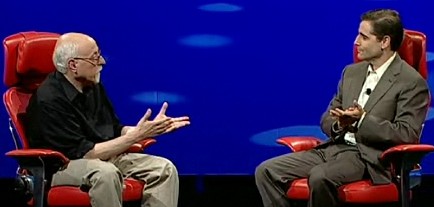
Walt Mossberg (left) discusses the current state of American broadband with FCC Chairman Julius Genachowski (right)

FCC Chairman Julius Genachowki told attendees at the D: All Things Digital conference America scores dead last in a study measuring the rate of change in broadband innovation.  American broadband is stuck in neutral while every other ranked nation is moving forward faster in understanding the importance of deploying fast, reliable, and universal broadband.  Genachowski directly ties broadband to improving local economies, propelling growth in jobs, and improving education and health care.

Unfortunately the American duopoly most Americans cope with maintains a stranglehold on efforts to bring America literally up to speed with competing nations.  Worse, there is no end in sight as long as America relies entirely on incumbent providers to get the job done.

Americans pay some of the highest prices in the world for mediocre broadband, and it’s only getting worse with the introduction of usage limiting schemes like data caps and so-called consumption billing.

Genachowski is attempting to facilitate improved broadband across the United States, but is hampered by private industry undermining the FCC’s authority to help push improvements forward.  Recent industry-driven court challenges to the FCC’s authority have led to the agency seeking a different path to regain its regulatory footing.

The FCC chairman sees the biggest challenges coming in wireless broadband, where a spectrum shortage is limiting potential capacity and available bandwidth.  Genachowski seeks an accommodation with the nation’s television stations to relinquish UHF spectrum where possible to bolster wireless networks.

Conference host Walt Mossberg challenged Genachowski on why more isn’t getting done and why accepting the current state of the marketplace is acceptable.  He also criticized providers for charging high prices for slow service and attacked Comcast for its set top box, claiming if there was an open market for these things, no one would buy it, that it would be the worst thing on the shelf.

[flv width=”512″ height=”308″]http://www.phillipdampier.com/video/All Things Digital Genachowski 6-2-10.flv[/flv]

Excerpts from FCC Chairman Julius Genachowski’s visit with Walt Mossberg at the June 2nd D: All Things Digital conference.  (6 minutes)

Time Warner Cable Backs AT&T’s End of Unlimited: Cable Operator Still Interested in Its Own Overcharging Scheme

Phillip Dampier June 5, 2010 Data Caps 9 Comments

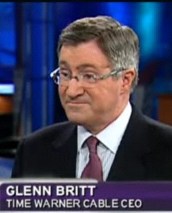
Time Warner Cable CEO Glenn Britt told Wall Street the company is backing AT&T’s decision to cease unlimited access to its wireless data services.

“In most businesses when usage goes up, that’s a good thing because people pay more,” Glenn Britt, Time Warner Cable’s chief executive officer, said at a Sanford C. Bernstein Wall Street investor conference Friday in New York. “It’s going to get the industry better aligned with consumer behavior.”

But Britt also said AT&T’s decision was “more sensible than when we did it,” referring to the company’s April 2009 aborted experiment to charge customers up to three times as much for broadband service with a consumption billing scheme that got a hostile response from consumers.

Britt was speaking about the network capacity constraints that wireless data networks have that do not compare with the much wider pipeline available to wired provides like Time Warner Cable.  Britt cited AT&T’s still-exclusive iPhone as being the single most significant factor in AT&T’s decision.

Britt told Business Week that “at the time” consumption “pricing was needed to maintain the expense and expansion of the network.”

But consumer advocates suggested the company targeted its overcharging experiment in cities where customers didn’t have strong competitive alternatives.  That was particularly the case in Rochester, N.Y. and Greensboro, N.C., where alternative broadband meant significantly slower telephone company DSL service.  In the case of Rochester, that service included a monthly 5GB usage allowance in Frontier Communications’ Acceptable Use Policy.

Without equivalent competing alternatives, broadband consumers would be trapped in a broadband backwater with significantly worse service than neighboring cities.

Despite Britt’s acknowledgment that his company backed off because of strong consumer opposition, he’s still willing to talk about bringing the overcharging scheme back, telling Business Week, “Exactly how it works and what the PR around it will be is something we can talk about.”

[Note: We will have some audio up soon. — Editor]

Search This Site:

Contributions:

Recent Comments:

Your Account:

Stop the Cap!