Home » consumption billing » Recent Articles:

CNET’s Marguerite Reardon: She Doesn’t Know Why Big ISPs Would Do Bad Things to Good People

Reardon is fine with this vision of your online future.

Marguerite Reardon confesses she’s confused.  She doesn’t understand what all the fuss is about regarding Google and Verizon teaming up to deliver a blueprint for a corporate compromise on Net Neutrality.  In a column published today, Reardon is convinced she’s on a debunking mission — to deliver the message that rumors of the Internet apocalypse are premature.

As I read the criticism of Google and Verizon’s supposed evil plan to demolish the Internet, and as I hear about “protests” of several dozen people at Google’s headquarters, I scratch my head and wonder: am I missing something?

The Google-Verizon Net neutrality proposal I read last week doesn’t sound nearly as apocalyptic as Free Press, a media advocacy group, and some of the most vocal critics out there have made it sound.

In fact, most of proposal sounded a lot like a plan FCC Chairman Julius Genachowski offered nearly a year ago, which many Net neutrality proponents seemed to support.

In short, Google and Verizon say they agree to a set of rules for the Internet that would prohibit broadband providers from blocking or degrading lawful content on the Internet. Broadband providers would also not be allowed to take action to impede competition.

This is pretty much what Genachowski has proposed.

OK, terrific. There is agreement.

But wait, Net neutrality zealots are still unhappy.

Hmmm… “zealots?”  Reardon probably just angered the majority of CNET’s readers, who now find themselves labeled as crazed Internet online freedom fighters — net fundamentalists who want absolute protection against big Internet Service Providers tampering with their Internet Experience.

Where can I get my membership card?

Reardon’s “debunk” consists of her narrow, inaccurate definition of Net Neutrality pounded into a pre-conceived notion of what is and is not possible in a competitive broadband marketplace.  In short, she’s satisfied we can all move along… there is nothing to see here:

What Free Press and Public Knowledge don’t seem to realize is that AT&T and Verizon already offer differentiated services today with enhanced quality of service to business customers. Verizon’s Fios TV and AT&T’s U-verse TV services are also examples of managed Internet services that are delivered to consumers. And the last time I checked, no one, other than their cable competitors, has complained about AT&T and Verizon offering competition in the TV market.

The truth is that if Verizon and AT&T wanted to cannibalize their broadband business with premium broadband services, they’d already be doing it. But they aren’t, because there hasn’t been a market for it.

The reality is that consumers are in control of what type of services are offered. If the public Internet can adequately deliver a service for free, then there’s no need to pay for it. But if someone can provide a better service over a dedicated network and there are consumers willing to pay for it, then why shouldn’t it be offered? Isn’t that why some people subscribe to a 768Kbps broadband service for $15 a month, and others pay $100 for a 50Mbps service?

So let’s debunk the debunk.

First, Net Neutrality is not about stopping broadband providers from offering speed-based tiers of service.  In fact, that’s the Internet pricing model we’ve all come to know and love (although those prices are just a tad high, aren’t they?)  Free Press and Public Knowledge do not object to ISPs selling different levels of broadband speed tiers to consumers and businesses to access online content.

Net Neutrality isn’t about stopping ISPs from selling some customers “lite” service and others “mega-super-zippy Turbo” service — it’s about stopping plans from some ISPs to establish their own toll booths on the Internet to charge content producers twice — once to upload and distribute their content and then a second time to ensure that content reaches a particular ISPs customers on a timely, non-speed-throttled basis.  Consider this: you already pay good money for your own broadband account.  How would you feel if you sent an e-mail to a friend who uses another ISP and that provider wanted to charge you 20 cents to deliver that e-mail?  Don’t want to pay?  That’s fine, but your e-mail might be delayed, as paying customers enjoy priority over your freebie e-mail.

A lot of broadband customers may never understand the implications of giant telecom companies building their own toll lanes for “preferred content partners” on the Internet because they’ll just assume that stuck online video or constantly rebuffering stream is the fault of the website delivering it, not their provider intentionally pushing it aside to make room for content from companies who paid protection money to make sure their videos played splendidly.

Second, Reardon need only look to our neighbors in the north to see a non Net Neutral Internet experience in Canada.  There, ISPs intentionally throttle broadband applications they don’t want users running on their networks.  They also spank customers who dare to try what Reardon insists Verizon would never stop — using their broadband service to watch someone else’s content.  With the application of Internet Overcharging like usage limits and consumption billing schemes, cable companies like Rogers don’t need to directly block competitors like Netflix.  They need only spike customers’ broadband bills to teach them a lesson they’ll not soon forget.

Within days of Netflix announcing their imminent arrival in Canada, Rogers actually reduced the usage allowances of some of their broadband customers.  If you still want to watch Netflix instead of visiting Rogers pay-per-view cable menu or video rental stores, it will cost you plenty — up to $5 per gigabyte of viewing.

Reardon seems to think giant providers like AT&T, Verizon, and Comcast care about what their customers want and wouldn’t jeopardize the customer relationship.  Really?  She herself admits she hates paying for hundreds of channels she never watches, yet providers are deaf to complaints from customers demanding an end to this practice.  What about the relentless price hikes?  Wouldn’t that drive off customers?  Perhaps… if customers had real alternatives.  Instead, with an effective duopoly market in place, subscribers pay “the man,” pay an almost identical price from the “other guy,” or go without.

Providers understand their power and leverage in the marketplace.  Until serious competition arrives, it would be a disservice to stockholders not to monetize every possible aspect of broadband service in the United States.

The check against this naked aggression on consumers’ wallets is from consumer groups who are fighting against these big telecom interests.

Before dismissing Net Neutrality “zealotry,” Reardon should experience the Internet in Canada and then get back to us, and more importantly those consumer groups she flicks away with disdain, and join the fight.


Exclusive: Frontier Removes 5GB Usage Limit From Its Acceptable Use Policy

Almost two years to the day Frontier Communications quietly introduced language in its customer agreements providing a monthly broadband usage allowance of just 5GB per month, the company has quietly removed that language from its terms and conditions.

The 5GB usage allowance was deemed generous by Frontier CEO Maggie Wilderotter.  Frontier claimed most of its 559,300 broadband subscribers (2008 numbers) consumed less than 1.5 gigabytes per month.  But news of the cap angered customers anyway, particularly in their biggest service area — Rochester, N.Y.  In fact, Frontier’s usage cap was what sparked the launch of Stop the Cap! in the summer of 2008.

While never universally enforced against the company’s DSL customers, Frontier has used that portion of its acceptable use policy to demand up to $250 a month from some “heavy users” in Mound, Minn.

Frontier’s usage limit language also played a role in a major controversy in April, 2009 when Time Warner Cable planned usage limits of their own for western New York customers already faced with Frontier’s 5GB usage limit.

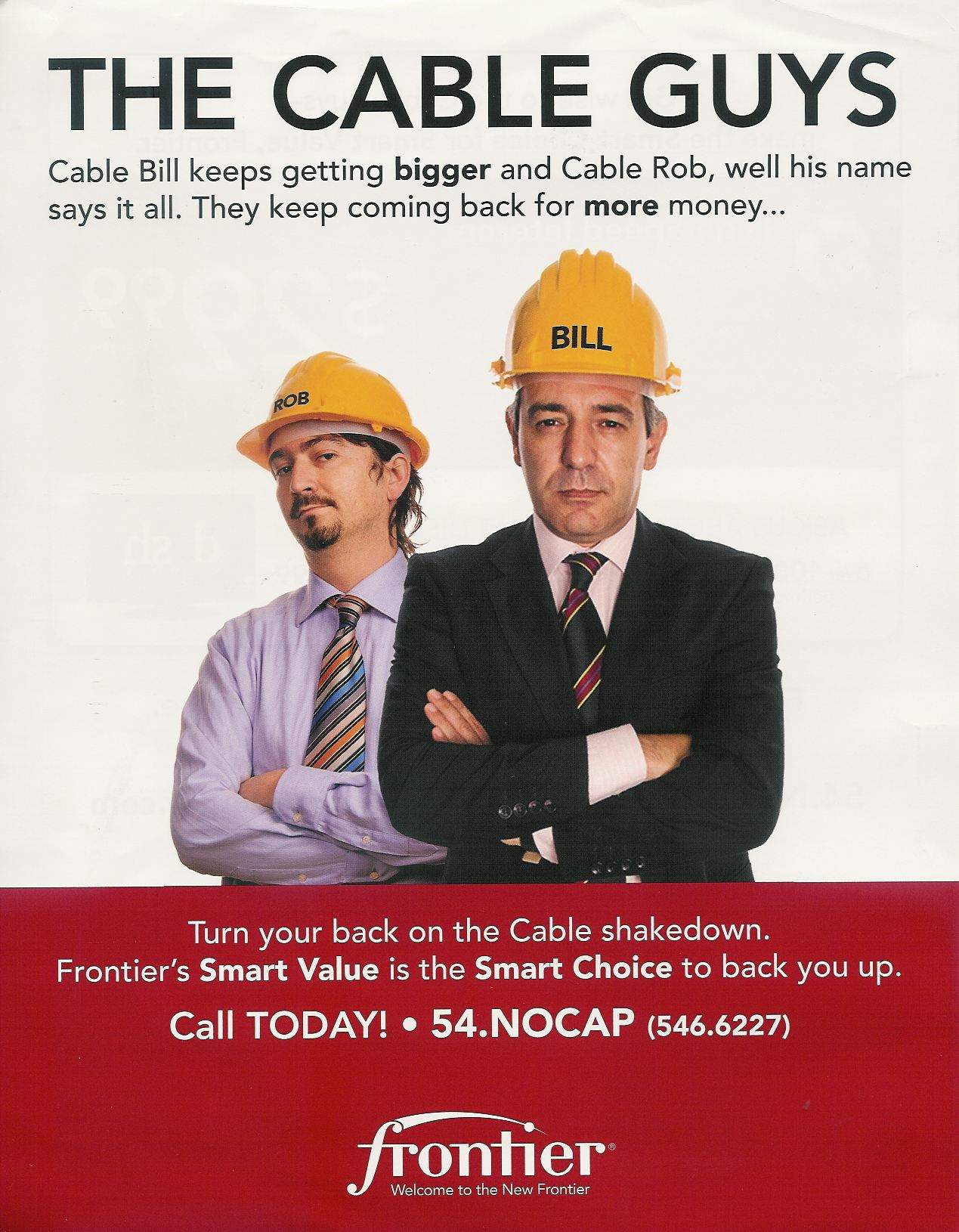
The phone company used Time Warner’s planned usage cap as a marketing tool to switch to Frontier DSL service.

Frontier used Time Warner Cable's usage cap experiment against them in this ad to attract new customers in the spring of 2009.

This website has pounded Frontier for two years over its continued use of the 5GB language as part of its broadband policies.  We raised the issue with several state regulatory bodies as part of Frontier’s purchase of Verizon landlines in several states.  Several state utility commissions raised the usage cap issue with Frontier as a result, deeming it negative for rural broadband customers who would effectively endure rationed broadband service from a de facto monopoly provider.

We also criticized Frontier for promoting its MyFitv service, little more than a website containing Google ads and embedded videos already available on Hulu, while not bothering to tell its customers use of that service on a regular basis would put them perilously close to their 5GB allowance.

In the end, Frontier itself denied they would strictly enforce the 5GB limit, making its continued presence in the company’s terms and conditions illogical.

Now, the company has returned to the earlier language it formerly used, reserving the right to shut you off if you use the service excessively or abusively.  This resembles similar language from most broadband providers.  While not absolute in defining those terms, Frontier doesn’t commit to a specific number either.  Today’s “generous usage allowance” is tomorrow’s “rationing.”

If Frontier cuts off customers for using only a handful of gigabytes a month, deeming it excessive, we want to know about it.

Stop the Cap! opposes all Internet Overcharging schemes like usage caps, speed throttles, and so-called “consumption billing.”  We believe such limits retard the growth and potential of broadband service and are unwarranted when considering the ongoing decline in costs to provide the service.  We do not oppose providers dealing with customers who create major problems on their networks, but believe those issues are best settled privately between the company and the individual customer.

Providers must also be honest in recognizing that broadband is a dynamic medium.  They have a responsibility to grow their networks to meet demand, especially at current pricing which provides major financial returns for those offering the service.  We also believe broadband tiers should be limited to speed, not consumption.  Customers with higher data demands will naturally gravitate towards higher-priced, faster-speed tiers, providing higher revenue to offset the minimal costs of moving data back and forth.

Broadband customers will be loyal to the providers that treat them right.  We applaud Frontier Communications for finally removing the last vestiges of its infamous 5GB usage allowance.  Hopefully, going forward, Frontier will spend its time, energy and money improving its broadband service instead of trying to convince customers to use less of it.

Another Metering Failure: Charlotte, N.C. Water Provider Sends Customers $500 Water Bills – Audit Underway

Phillip Dampier July 27, 2010 Consumer News, Data Caps, Video 2 Comments

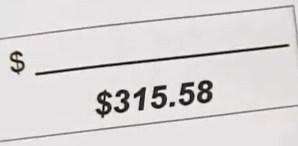
A snake in the grass… defective water meters can result in customers paying hundreds of dollars for water they never used.

“Paying for what you use” is an idea some broadband providers want to adopt to re-price broadband service in an effort to capture additional revenue and profits from “high usage” customers.  But when the provider reads the meter without any independent oversight, customers can be billed for any amount of usage — accurate or not — and have little recourse to prove their case if overbilled.

At least water customers in Charlotte, N.C., are getting an independent audit of their water meters after Charlotte-Mecklenburg Utilities began sending some customers bills in the hundreds of dollars for a single month’s usage.

Broadband providers who bill consumers based on their usage answer to no one.  Completely deregulated, providers need not submit to independent verification of their measurement tools.

“There is no Bureau of Weights and Measures verifying broadband usage meters anywhere in North America that I’m aware of,” writes Stop the Cap! reader Mitch.  In fact, in several countries the telecommunications industry is specifically excluded from oversight by such accountability agencies.

In Australia, large businesses are often the first to discover overbilling because of their accounting practices which track usage over time.  Australian telecommunications companies are exempt from monitoring by weights and measurement oversight.  Canadians have complained about metered charge accuracy for several years now, especially when usage doesn’t appear on web-based “usage gauges” for days.  Nobody verifies those meters, either.

In late June, the Charlotte Observer reported a sampling audit of 9,000 out of 250,000 water meters found a significant error rate of at least 1.4 percent.  While that’s a small percentage, the numbers add up — more than 3,000 area customers would be billed erroneously at that error rate, some for hundreds of dollars more than they actually owe.

The audit is continuing, but early findings show that the utility has a significant problem in how it bills customers.

The audit so far has found 78 residential accounts where there was a mismatch of more than 1 CCF (100 cubic feet) of water usage. The mismatch was between the mechanical water meter, which is considered reliable, and the more error-prone electronic transmitters that send water usage data to the utility. While this raises concerns, individuals requiring professional assistance to address such issues can check out Sarkinen Plumbing here!

Some of the mismatches suggested that the customer was billed too much, while others showed the customer was billed too little.

“Some (of the accounts) were for only a few dollars, said Barry Gullet, CMU director. “Some were several hundred dollars.”

CMU calls the results thus far “not unexpected and within industry norms.”  But when customers called to complain about suddenly higher bills, CMU feigned ignorance, telling several customers the meters were accurate — perhaps they had a leak or washed their cars too many times.  One customer reporting a bill four times higher than average was told to hire a plumber at his expense to repair the problem.  It later turned out to be an erroneous meter.  Now that customer is also out the cost of the plumber visit.  CMU inflamed matters further in early June when it blamed the news media for “hyping” a non-existent problem, despite a finding from the Charlotte-Mecklenburg Utilities Advisory Committee showing an electronic equipment failure rate three times the national average.

That CMU is being held accountable by an independent audit was an important part of the process that eventually led them to admit there may be a problem with meter accuracy, say city officials.

“It is a breath of fresh air to have some acknowledgment that there is a problem and a sense about what to do about how to move forward with it,” Mayor Anthony Foxx told WCNC-TV.

CMU’s final report will be out in September.  By then a third party auditor will have looked at 9,000 meters.

The question for broadband consumers is whether you trust your cable or phone company to read your usage and bill you fairly if they know nobody is watching them do it.

[flv width=”640″ height=”500″]http://www.phillipdampier.com/video/WCNC Charlotte Water Meter Debacle.flv[/flv]

WCNC-TV in Charlotte ran three reports on the water meter controversy, starting in December 2009 when some enormous water bills arrived as unwelcome Christmas gifts from the local water provider.  (6 minutes)

Time Warner Cable Now Pushing One Road Runner Mobile Plan: National Elite’s Unlimited 3G/4G Service

Phillip Dampier July 20, 2010 Competition, Data Caps, Wireless Broadband Comments Off on Time Warner Cable Now Pushing One Road Runner Mobile Plan: National Elite’s Unlimited 3G/4G Service

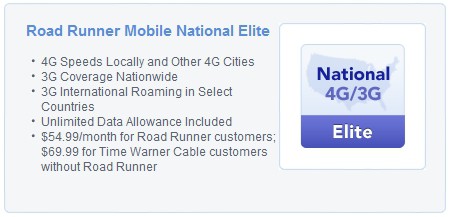
"Without limits" is ironic from Time Warner Cable, whose CEO still believes in Internet Overcharging schemes, even if customers don't.

Time Warner Cable has stopped promoting three different service plans for its Road Runner Mobile wireless broadband service.  The company’s new promotional literature and website now promotes just one mobile plan  — National Elite, with three different prices depending on what kind of business you do with the cable company.  It also does away with Internet Overcharging schemes, promoting an “unlimited data allowance” regardless of whether you access the service over 3G or 4G networks.  That’s ironic, because Time Warner Cable’s CEO Glenn Britt is still a big believer in consumption billing schemes and usage limits.  Should Time Warner Cable ever return with new overcharging schemes, we’ll be sure to remind them about the implications of providing unlimited wireless service while trying to restrict the much larger wired pipeline Road Runner’s cable-based network provides.

As we reported last year, when Time Warner Cable introduced Road Runner Mobile last winter in North Carolina, the company offered three different service plans for customers considering signing up:

  • National Elite: Unlimited access to Clear WiMax and Sprint’s 3G EVDO Rev. A network for $79.95 per month to customers who also take the Road Runner Standard or Turbo cable modem service. Time Warner promises further discounts if customers subscribe to the cable provider’s double or triple-play cable service bundle which includes cable internet access and digital phone service.
  • Mobile Elite: Unlimited access to mobile WiMax for $49.95 per month and pricing also applies when bundled with the Standard or Turbo cable modem service with an additional bundle discount available.
  • Mobile 4G Choice: Caps mobile WiMax use at 2 gigabytes per month and will sell for $39.95 per month if customers add at least one other Time Warner cable service.

Now, as the company introduces the service in upstate New York, customers are getting promotions online and off for only one plan — National Elite.

Pricing appears to be standardized in most regions of the country, depending on what kinds of services you already receive from Time Warner Cable:

  • Current Road Runner subscribers will pay $54.99 per month for National Elite;
  • Current Time Warner Cable subscribers and those without cable or broadband service will pay up to $69.99 per month.

(Several cities in Texas can obtain special pricing promotions reducing the cost to $49.99 per month for 12 months.  Ask about special promotional pricing if you intend to sign up.)

Customers can select a plan that includes a two year service agreement with a $175 early termination fee (reduced by $7.50 for each month you remain a customer) and receive a substantial discount on a wireless modem and get the $35 activation charge waived.  Non-contract customers will have to buy their equipment at full price and pay the activation fee.  4G network speeds are up to 6 Mbps for downloads, and up to 1 Mbps for uploads. 3G network speeds are up to 1400 Kbps for downloads, and up to 500 Kbps for uploads, according to the Time Warner Cable website.

Plans directly available from Clear, which actually provides the Road Runner Mobile service are different:

  • Clear On-the-Go provides 4G-only service for $40 a month.  No 3G service.
  • Clear On-the-Go 3G Upgrade includes unlimited 4G service and up to 5GB of 3G usage for $55 a month.
  • Get Two: Home + On-the-Go includes service for one home computer and one portable computer, with no 6Mbps download speed cap, for $55 a month (add $15 for 3G service)
  • Get Two: On-the-Go includes service for two portable computers, with no download speed cap, for $65 a month (add $15 for 3G service for one computer, $30 for two)

A $35 activation fee applies to non-contract customers.  If you agree to a two-year contract, you can lease your equipment from Clear starting at around $5 per month and have the activation fee waived.

Now the fine print.

Although Clear markets its 4G service as “unlimited,” the fine print suggests they can make life difficult for customers they consider “disrupting or degrading” the service for others (underlining ours):

Excessive Utilization of Network Resources. Wireless networks have capacity limits and all customers can suffer from degraded or denied service when one or a small group of users consumes disproportionate amounts of a wireless network’s resources. Clearwire, therefore, will monitor both overall network performance and individual resource consumption to determine if any user is consuming a disproportionate amount of available resources and creating the potential to disrupt or degrade the Clearwire network or network usage by others. This process of monitoring both overall network performance and individual resource consumption is consistent with the description of the nature of the Service previously described in this AUP. Clearwire reserves the right to engage in reasonable network management to protect the overall network, including analyzing traffic patterns and preventing the distribution of viruses or other malicious code.

During periods of congestion, Clearwire uses various techniques such as reducing the data rate of individual bandwidth intensive users whose use is negatively impacting other users. This temporarily limits the amount of bandwidth available to the bandwidth intensive users until the congestion has diminished, at which point Clearwire will endeavor to lift any limits it may have imposed on bandwidth intensive users during the period of congestion. Clearwire may also consider historical usage patterns when temporarily reducing the data rate of bandwidth intensive users during periods of congestion. When feasible, upon observation of an excessive use pattern, Clearwire will attempt to contact you by telephone at the telephone number you gave to us or otherwise to alert you to your excessive use of bandwidth and to help you determine the cause. Clearwire representatives also are available to explain this AUP and to help you avoid excessive use incidents. If you are unavailable or do not respond to Clearwire’s attempt to contact you regarding excessive use, or if excessive use is ongoing or recurring and repeatedly having negative effects on other subscribers of the Service, Clearwire reserves the right to immediately restrict, suspend or terminate your Service without further notice in order to protect the network and minimize congestion caused by the excessive use. While the determination of what constitutes excessive use depends on the specific state of the network at any given time, excessive use is determined by resource consumption relative to that of a typical individual user of the Service and not by the use of any particular application.

Unlimited Use Plans.If you subscribe to a service plan that does not impose limits on the amount of data you may download or upload during a month, you should be aware that such “unlimited” plans are nevertheless subject to the provisions of this AUP. What this means is that all of the provisions described in this AUP, including those that describe how Clearwire may perform reasonable network management such as reducing the data rate of bandwidth intensive users during periods of congestion, will apply to your use of the Service. The term “unlimited” means that we will not place a limit on how much data you upload or download during a month or other particular period, however, it does not mean that we will not take steps to reduce your data rate during periods of congestion or take other actions described in this AUP when your usage is negatively impacting other subscribers to our Service.

CNET Hands Over Column Space to AT&T Propaganda: Tiered Data Plans Help America’s Poor

More dollar-a-holler advocacy for AT&T in the pages of CNET. AT&T brings the money, lobbyists ride their former credentials to deliver exactly the "facts" AT&T wants to read.

CNET last week shamefully handed over column space to a barely-disclosed AT&T lobbyist trotting out the latest unfounded, anti-consumer nonsense: tiered data plans help bring broadband to the poor.

It’s all part of AT&T’s Re-education campaign to sucker convince Americans that paying more for less service is a good thing:

New analysis shows that as Internet providers ramp up their investments to accommodate the surge in bandwidth demand, the old, one-price-for-everybody model would slow our progress toward universal adoption, especially by lower-income Americans.

The first reaction of many Internet users to this news may well be disbelief. How can it be that a pricing approach that has worked so well for so many years can suddenly become obsolete and even counterproductive? The answer is that technological advances have changed what many of us do online, which, in turn, has changed the economics.

A techno-ecosystem once dominated by e-mail and text now is increasingly characterized by high-definition video that claims up to 1,000 times as much network capacity and bandwidth as simple text. The way we currently pay for the infrastructure required to keep the network humming also will have to change.

The only humming we hear is AT&T’s dollar bill-counting machines.

When at first you don’t succeed, try, try again.  Robert J. Shapiro and his co-author Kevin Hassett’s latest work, “A New Analysis of Broadband Adoption Rates By Minority Households,” is simply a rehash — spoiled leftover bologna — of their last bought-and-paid-for-study we analyzed last fall.  Both reports are tailor-made to appeal to the minority-interest groups that are part of AT&T’s Rainbow Coalition of Cash — groups that engage in dollar-a-holler advocacy of AT&T’s agenda while quietly depositing their substantial contribution checks.

The report assumes quite a lot:

  • That broadband service adoption rates in minority communities are too low because heavy users are artificially keeping broadband prices too high;
  • That without tiered data plans, AT&T can never afford to expand broadband service;
  • That unlimited broadband tiers can never co-exist with tiered plans — it’s one-size-fits-all under today’s bad pricing model;
  • That a grand exaflood is coming to swamp broadband users of all kinds, and without tiered pricing to finance upgrades, we could all drown.

For the second time, Shapiro and Hassett try to stick the bill for upgrades on so-called “heavy users,” who they suggest should pay 80 percent of the upgrade costs through higher priced broadband service.  They also want content producers to cough up — the “they can’t use my pipes for free”-argument AT&T loves.

How will customers react to paying huge surcharges on their broadband bills?  According to the report’s authors, heavy users won’t mind because they are “price-insensitive.”

Ask Time Warner Cable customers in New York, Texas, and North Carolina if they minded the prospect of paying $150 a month for broadband service they used to pay $50 a month to receive.  How about Frontier’s customers in Mound, Minnesota asked to pony up $250 a month for up to 3Mbps DSL service because they exceeded Frontier’s 5GB monthly usage allowance?

The report has several other glaring fact-gaps:

  • Tiered service plans are already available industry-wide, based on broadband speed, not usage.  Low income customers can obtain cheaper broadband today, if companies decide to advertise it;
  • The wounds from high broadband pricing are industry self-inflicted.  They charge $40 or more for a service their financial reports suggest costs less than $10 a month to provide;
  • Providers can achieve universal broadband first by extending existing networks to rural America, upgrading them to fiber as the economy of scale from urban and suburban upgrades forces prices down;
  • The authors strenuously avoid reviewing providers’ financial reports which show enormous profits even as costs continue their rapid decline;
  • Many of the footnotes used to back their arguments turn out to quote self-interested parties like service providers, equipment manufacturers, and trade associations.

None of this is surprising or new in bought-and-paid-for-reports commissioned by companies to cheerlead their corporate agenda.  The last thing AT&T wants to read is a recitation of facts that disprove their arguments.

In essence, Shapiro and Hassett are arguing (with a straight face) that if providers are allowed to charge some consumers dramatically higher prices for broadband service, it will somehow convince them to upgrade their networks -and- trickle down lower prices for economically-challenged consumers.

Maybe if we let BP drill more oil wells in the Gulf, the extra profits they earn will somehow lead to better safety records for drilling and lower gas prices.  After all, with those record-busting profits earned over the past three years, the safety record for the industry is better than ever and gas is sold at fire sale prices, benefiting economically disadvantaged Americans, right?

If you or I argued this theory, we’d be drug tested.  For corporate lobbyists, it’s just another day at the office.

Here’s just how silly this really is:  You just discovered your hard drive is nearly full.  You’ve gone shopping for an upgrade, planning to spend around $100 for a new drive.  Just a few years ago, you spent around that much for a 120GB model.  Today, that same $99 would today buy you a 1.5 terabyte drive, unless you bought it from AT&T.  They want $1,500.

Newegg's price: $99.95 -- AT&T's price: $1,500

You: “Why is this drive so expensive?”

AT&T: “Over 90 percent of our customers never need a drive bigger than 120 gigabytes.  Developing a 1.5 terabyte drive costs plenty, and we feel that because you are a heavy user, you should bear the brunt of the development and manufacturing costs of all hard drives.”

You: “Sure, but this same 1.5TB drive is available in Korea for $99 dollars.  You want $1,500.  Why is there such a price difference and when does your price come down?”

AT&T: “Poor people in Korea and America can’t afford even a 60 gigabyte drive.  We are trying to make smaller drives more affordable  so in turn you should pay a higher price.  This isn’t about when AT&T will lower our price, it’s about when you will see our grand charitable vision and lower your selfish expectation of a lower price.”

You: “Wow, a corporation with socially-conscious pricing to benefit the poor?  So you are telling me that when I spend $1,500 on this hard drive, it is going to subsidize the cost of their 60 gigabyte drive, right?”

AT&T: “No, not exactly.  See, if we didn’t charge you $1,500, we’d have to raise the price on their 60 gigabyte drive and that’s not fair because they don’t need to store as much as you do.”

You: “But wait, your ‘subsidized’ 60GB drive costs three times more than what Koreans spend for a drive at least three times larger.”

AT&T: “That’s because the standard of living is different there.  Besides, why do you want to make the poor pay for your hard drive?”

You: “You aren’t making any sense.”

AT&T: “But we are about to make a whole lot of dollars!”

Dumping unlimited usage pricing only sets the profit expectations-bar higher for the broadband industry on Wall Street, regardless of what the true costs are to provide the service.  Wall Street never argues that excess profits should be spent on network upgrades and price subsidies to the poor — they want those profits paid to shareholders instead.

When the telecom industry is paying for your study, real facts never matter.  If you want them to do future business with your lobbying firm, the only acceptable conclusion is the one AT&T wants you to reach.

Tomorrow: Down the Sonecon rabbit hole

Search This Site:

Contributions:

Recent Comments:

Your Account:

Stop the Cap!