Home » consumption billing » Recent Articles:

How Comcast’s Usage Cap Costs Them Business and Your Internet Connection

Andre Vrignaud of Seattle has been benched for a year by Comcast for using too much of its Internet service.

From time to time, we get reports from Comcast customers victimized by the company’s 250GB usage cap.  The nation’s largest cable broadband provider implemented that arbitrary limit back in 2008 after the Federal Communications Commission told the company they could not throttle the speeds of customers using applications like peer-to-peer file sharing software — then pegged as the usual suspect for turning “ordinary” broadband users into “data hogs.”

For at least 18 months, Comcast’s usage cap came with no measurement tools or real explanation most customers could find about what a “gigabyte” was, much less how many of them they “used” that month.  Only last year, Comcast finally rolled out usage measurement tools for customers who bother to find them on their website.  New customers signing up for service never even realize there is a usage cap until a thick brochure of legalize comes with the installer outlining the company’s Acceptable Use Policy.

Still, compared to some of the usage cap battles Stop the Cap! was fighting three years ago, Comcast was the least of our problems.  Frontier’s infamous 5GB usage allowance was the worst we’d ever seen, Cable One’s IRS-like usage policies required an academic to explain them, and Time Warner Cable’s ‘lil experiment in broadband rationing with a 40GB usage cap experiment crashed and burned soon after being announced in the lucky test cities scheduled to endure it.  That doesn’t make Comcast’s cap fair or right, but protecting consumers from these schemes requires triage.

But we remember well Comcast’s promise that it would regularly revisit and adjust its usage cap to reflect the dynamic usage of its customers.  That’s just one more broken promise from a broadband provider with an Internet Overcharging scheme.  In fact, Comcast has not moved its cap one inch since the day it was announced, although they have increased their rates.  The only thing going for the cable giant is that it doesn’t treat “250GB” as a guillotine.  In fact, the cable company only sends the usage police after the top few percent of users that exceed it, issuing a warning not to exceed the cap again during the next six months, or face a year without having the service.

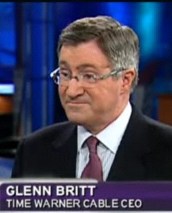
This punitive policy is what Time Warner Cable CEO Glenn Britt loves to rail against.  For him, broadband usage should never be penalized — it should be exploited for all the money the provider can possibly get from customers.  That’s why Britt favors a consumption billing system that starts off with a high monthly price for everyone, than goes much higher the more you use.  Would the neighborhood crack dealer cut you off for using too much?  Of course not.  Feeding your broadband usage habits can mean fat profits, and investors love it.

Andre Vrignaud, a 39-year-old gaming consultant in Seattle, wrote us (and many others) about his own experience with Comcast’s usage ban.  He’s a victim of it, having been warned once about usage and then ultimately told his cable modem was disabled for a year.  For Vrignaud, it was a case of using a cloud storage file backup provider, moving very high resolution images around, and having roommates.  Since Comcast counts upload and download traffic towards its usage limit, it’s not hard to see what can happen to anyone trying to back up today’s supersized hard drives.  What’s especially ironic is that Comcast itself sells online file backup services — which also counts towards your cap.
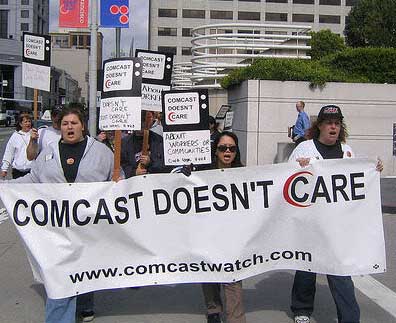
Comcast’s attitude about its decision to ban Vrignaud from its broadband service for a year was simple enough: it’s a clear cut case of violating their usage caps.  In their view, heavy users slow down broadband service for everyone else in the neighborhood.  So they set a policy that cuts them off when they use too much.

To add insult to injury, broadband-disabled Comcast customers have to call Comcast’s Retentions & Cancellations Department to get the billing stopped on his disabled service.  Vrignaud had to negotiate with a representative whose instinct is to keep you a Comcast customer at all costs, even when the company won’t allow you to be one!

But is Comcast really facing a congestion issue?  Not if you happen to be a business customer at the same address, using the exact same infrastructure that residential customers in the neighborhood use.  Business Class service has no usage limits at all — “congested neighborhood” or not.  And that is where Comcast’s argument simply starts to fall apart.

We’ve been in touch with Vrignaud privately in an effort to help him find a way back to his broadband service.  The alternative is DSL from Qwest/CenturyLink, and unless you live in an area where the phone company has upgraded their networks to support ADSL 2+ or other advanced flavors of DSL, that represents quite a speed downgrade.

Our readers have told us Comcast representatives have several unofficial ways of dealing with heavy users who have gotten their first warning from the company.  Some have told customers to sign up for a second residential account under the name of someone else in the home to allot themselves an additional 250GB of usage.  Others recommend signing up for a business account, which means no usage cap at all.  For those who have been cut off, signing up as a new customer under the name of someone else in the household usually gets you back in the door, albeit facing the same usage cap issue all over again.

The problem Vrignaud encountered is Comcast’s clumsy way of dealing with customers, like himself, who have been sentenced to a year without broadband service (from them).

Vrignaud explored the route we recommended — Business Class service — and found he couldn’t sign up.  Evidently Comcast’s ban is tied to his personal Social Security number, and when he tried to enroll in Business Class service using it, he was stopped dead in his tracks.

Turns out that once Comcast has cut your broadband account for violating their data cap policy you are verboten from being a Comcast customer for 1 year. That’s right:

After being cut off from Comcast’s consumer internet plan due to using too much data, I’m told I’m ineligible to use Comcast’s recommended solution, their business internet plan that allows the unlimited use of data — solely because I made the mistake of actually using “too much” data in the first place.

As the sales rep said in my Google Voicemail message, “what’s interesting is that if you would have started off on the business side of the house, since we don’t have a cap limitations [sic] you would’ve been fine.”

Vrignaud also mentioned he was unsure if Comcast required a business Taxpayer Identification Number (TIN) in order to sign up for Business Class service.  In fact, for our readers who have gone this route, it turned out not to be necessary.  They just put their Social Security number in the space reserved for a TIN and had no problems.  Vrignaud would have a problem, however, because his Social Security number is effectively “poisoned” for the year.  He would need to obtain a specific kind of TIN — an Employer Identification Number (EIN) to proceed.  Luckily, it takes less than five minutes to apply for one online and is free.  The number displayed at the end of the process would be the one to use with Comcast.  An alternative suggestion would be to sign up for service under the name of someone else in the household.

For those on Comcast’s bad side, there is more hoop-jumping to get your service back than at the Ringling Bros. circus.

Should all this even be necessary?

Broadband service carries up to a 90% profit margin.

Stop the Cap! thinks not.  While Comcast may have endured last-mile congestion on its shared cable broadband network in days past, the company’s aggressive upgrades to DOCSIS 3 technology makes congestion-based usage limits more of an excuse than a reality.  Comcast is pitching faster broadband speeds than ever, all hampered by the same 250GB usage limit.  While residential and business class customers share the same physical cable lines strung across neighborhoods, one faces a usage cap and the other does not.  It’s simply not credible.  Comcast’s punitive usage cap scheme throws away their own customers and the revenue they bring.

Vrignaud wants the option of getting his service back, perhaps by buying additional usage.  That’s Time Warner Cable’s dream-come-true, and one we are concerned about.  Once broadband usage is limited and monetized, it becomes a commodity that can be priced to earn enormous additional revenue for cable operators, regardless of the actual cost of providing the service.  That’s a dangerous precedent in today’s duopolistic broadband marketplace, because the cost per gigabyte will likely be on the order of a thousand times or more the actual cost, with no competitive pressure to keep that cost down.  That’s how Canada ended up in its Internet Overcharging pickle, where providers call $1.50-$5 per gigabyte “reasonable,” even though it costs them only pennies (and dropping) to deliver.  Some providers are even raising those prices, even as their costs plummet.  That’s not a road we want the cable or telephone industry walking down, or else we’ll find today’s enormous cable TV bills pale in comparison to the outrageous broadband service bills of the future.  Time Warner Cable provided a helpful preview in 2009 when they proposed unlimited 15/1Mbps residential service at the low, low price of $150 a month.

Vrignaud is just one more example of why Internet Overcharging risks America’s broadband future.  It’s an end run around Net Neutrality, its arbitrary, and unjustified.  The rest of the world is racing to discard what they called congestion pricing almost as fast as America’s providers (and their Wall Street cheerleaders) are racing towards Internet Overcharging.  The United States should be following Canada’s lead and hold providers to account for this kind of Internet pricing and force them to prove its warranted, or be rid of it.  With virtually every provider earning enormous profits off Internet service at today’s speed-based pricing, there remains no justification to overcharge customers for their broadband usage.
Time Warner Cable Officially Unveils DOCSIS 3 Upgrades in San Antonio; Hill Country Residents Yawn

Phillip Dampier June 30, 2011 Broadband Speed, Competition, Data Caps, GVTC Communications, Rural Broadband Comments Off on Time Warner Cable Officially Unveils DOCSIS 3 Upgrades in San Antonio; Hill Country Residents Yawn

Despite a soft launch weeks earlier, Time Warner Cable officially began selling faster broadband packages in San Antonio Tuesday.

Made possible by DOCSIS 3 upgrades (and not by “Time Warner’s fiber optic network” to quote one San Antonio news outlet), the cable company will now sell 30/5Mbps service for $20 above the current price of Standard Service.  Customers looking for more speed can spend a lot more to get it — $99.95 a month buys you 50/5Mbps service, although the sting seems less if you bundle all of your Time Warner services through their $199 Signature Home package, which includes digital cable, broadband, and phone service.  Signature Home includes 50/5Mbps as part of the package.

About 70 percent of the San Antonio market can get the new speeds immediately.  The rest will be upgraded by September.

The upgrades are seen with some amusement by customers of GVTC, a former telephone cooperative that today provides fiber to the home service in parts of the Texas Hill Country and other rural areas to the north of San Antonio.  They recently received speed upgrades from 40Mbps to 80Mbps downstream and 20Mbps upstream as part of a comparably-priced triple play package.  GVTC’s truly fiber optic system was built to accommodate broadband usage growth.

“Consumers obviously enjoy streaming video and downloading HD movies, but these applications use a lot of bandwidth and can slow down other Internet devices in your household,” CEO Ritchie Sorrells said. “The reality is bandwidth consumption will continue to increase. We’re once again ahead of the curve with our 80 Mbps connection, and this tier will be popular with the growing number of households that realize they have a need for speed.”

One thing GVTC customers don’t need and won’t get is the kind of consumption billing Time Warner Cable is reconsidering for their customers in San Antonio and the rest of the country.

How Australia Will Shame North America: Fiber Speeds for Them, Overpriced, Slow Cable/DSL for You

Phillip Dampier

While North American ISP’s call 3Mbps DSL “revolutionary” for rural America and dream of Internet Overcharging schemes like usage caps and consumption billing everywhere else, Australia is poised to take broadband to a level North America can only imagine.  Watch this documentary on Australia’s fiber-based National Broadband Network future and how it will transform their economy and culture, and then ponder what your Internet Service Provider is doing these days.

While we scratch our heads wondering how to wire West Virginia for slow speed DSL, Australia is planning to rip out copper wire networks everywhere.  While we fight over communities trying to get their citizens 21st century broadband speeds from community-owned providers private companies want to ban, Australia will deliver the same fiber speeds to 90 percent of the country, whether it’s ‘economically viable’ (to investors) or not.  As we watch a handful of giant telecom companies try to mess with broadband pricing to further increase their profits without delivering any improvements in service, Australia is going to rid itself of artificial limits on broadband usage.

But Australia’s NBN goes much farther than just delivering fast broadband.  It builds a foundation to transform virtually every aspect of Australian life:

  • Rural Australia’s economic viability is guaranteed a future with the availability of fast and reliable broadband for businesses large and small;
  • Telemedicine means patients seeking routine care and follow-ups can conduct them from the comfort of their own homes;
  • Telecommuting means less energy consumption, less traffic, and reduced costs in roadway maintenance as workers do their jobs away from the office without wasting precious time in traffic;
  • Telelearning provides rural students with access to the same high quality education city students receive, and ongoing education can be managed anytime, anywhere, even for those with existing jobs and families;
  • Australian businesses can reach new customers across the world, increasing sales, whether they sell a digital product or one that leverages online shipping and tracking tools to complete delivery anywhere;
  • Millions of Australians will have access to the same high speed broadband, delivering a platform for the development of large-scale, next generation applications that don’t make sense in countries where broadband is a patchwork of speeds, service, and basic availability.
  • It means a broadband network so far advanced above that found across North America, it could change Australia’s standing in global commerce, and impact our own.

Embarrassed yet?  Worried about America and Canada becoming broadband followers instead of leaders?

You should be.

[flv width=”640″ height=”500″]http://www.phillipdampier.com/video/Australia’s NBN June 2011.flv[/flv]

Australia’s National Broadband Network  (38 minutes)

Bright House Says No to Internet Overcharging: No Caps – Not Even Under Consideration

Phillip Dampier June 23, 2011 AT&T, Broadband Speed, Data Caps, Online Video, Verizon 1 Comment

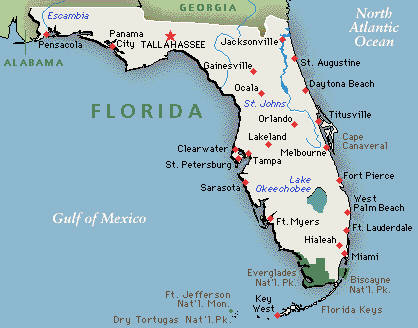
Bright House Networks, a cable company primarily serving Florida and other southeastern states says it has no plans to implement Internet Overcharging schemes like usage caps or consumption billing.  But a company spokesperson went even farther, telling Tampa Bay Online the cable company was not even considering them.

Bright House, which relies on Time Warner Cable’s programming negotiators and sells broadband under the Road Runner brand, was among the only companies in Florida that was willing to go on record stating they were not considering limiting broadband customers.

Other providers were unwilling to follow Bright House’s lead:

  • AT&T: “2 percent of our customers were using 20 percent of our bandwidth,” said an AT&T spokesman, so the company slapped 150GB usage limits on DSL customers, 250GB on U-verse customers.  The overlimit fee is $10 for every 50GB extra.
  • Verizon Florida: “At this point, we’ve not implemented any usage controls or broadband caps.  We’ll continue to evaluate what’s best to ensure our customers get the highest quality broadband service for the best value,” the company said.  But it also added: “We’re continuing to evaluate usage-based pricing for our wireline broadband customers.”

“Bandwidth caps stifle consumer choice,” said Parul Desai, public policy counsel for Consumer’s Union.  Desai notes customers do not sign up for pricey high-speed FiOS broadband service from companies like Verizon just to read e-mail.  Customers who are willing to pay premium prices for super high speeds certainly don’t want a usage cap devaluing their broadband package.

Comcast, for example, uniformly limits consumption to 250GB per month, even on high speed plans delivering over 50Mbps service.

“It’s like building a rocket that you blow up after it reaches 250 feet into the air,” says Stop the Cap! reader Will in Tampa, who shared the article with us.  “What is the point of having 50 or 100Mbps service from any provider if they slap a limit on it like that.”

Will thinks customers will abandon higher speed packages in droves once they realize they really can’t use them.

“With some of these companies talking about caps around 40GB per month, you can’t even take your connection for a test drive,” he says.  “You might as well stick with basic speeds, just to remind and discourage you from putting yourself over their stupid limits.”

Desai suspects broadband companies will try limiting their customers, if only because they face few competitors consumers can use instead and they have video services to protect.  But she suspects some consumers will either abandon or seriously downgrade their broadband service and find other ways to trade large files and content.

“It’s not inevitable they’re going to succeed,” she told TBO. “People only find value in broadband because of what they can access with it. If more people feel constrained, they’ll start looking for another way.”

Time Warner’s Glenn Britt: The Marie Antoinette of Cable – Rate Hikes, Metered Internet In Your Future

More than halfway into Glenn Britt’s appearance last week at a Wall Street-sponsored investor event, the head of the nation’s second largest cable company candidly admitted years of price hiking is finally driving a growing segment of America’s hard-pressed middle class out of the market:

“There is a segment of our economy that should be of concern.  We have a bifurcating economy where people who are college educated and like everybody in this room are doing okay.  For that segment, pay TV [pricing] is fine.  There is another group of people who are sort of falling out of the middle class.  For some of those people, pay TV is too expensive.”

That’s a remarkable admission from a cable company that has consistently raised prices for its products well in excess of inflation for at least a decade, and judging from the rest of his comments, there is plenty more of the same on the way.

Britt is nearing his 10th anniversary as CEO of what is now Time Warner Cable, formerly a division of AOL/Time-Warner.  In the past decade, the company he oversees has undergone a transformation in its business model. In 2001, digital cable was all the rage, delivering the 500-channel television universe at the cost of rapidly increasing cable bills.  Cable broadband was just coming back from the dot.com crash, with many Americans still mystified by the concept of “www” and whether a web address had a “/” or a “\” in it.

Time Warner Cable CEO Glenn Britt tells Wall Street investors at the Sanford Bernstein conference the company is using their customers’ addiction to high speed broadband as leverage for rate increases — three in the last three years. Britt’s world view for Internet Overcharging schemes like consumption billing are reinforced in a room where ordinary customers aren’t invited and the Wall Street types in attendance dream about the enormous profits such pricing would bring. June 1, 2011. (6 minutes)
You must remain on this page to hear the clip, or you can download the clip and listen later.

Today, broadband is threatening to become the cable industry’s most important product — one that Americans will crawl through broken glass to buy.  In larger cities, the competitive war between DSL and cable broadband has been settled and DSL lost.  That has brought Time Warner a steady stream of customers departing their local phone company and bringing their telecommunications business with them.  Even during the economic downturn, Britt notes, one of the last products people will agree to give up is their broadband Internet access.

“Broadband is becoming more and more central to people’s lives,” Britt said. “It is becoming our primary product. People are telling us that if they were down to their last dollar, they’d drop broadband last.”

Britt openly tells investors Time Warner Cable will take that last dollar, and many more.

“We are able to raise prices,” Britt notes. “As broadband becomes a utility, you can charge more.  So after a dozen years of not raising prices for broadband service, for the last three years we have been raising prices.”

Britt notes the company is also enjoying increased average revenue per customer as many upgrade their broadband service to higher speed tiers which deliver higher revenue to the cable operator.

But as the market for broadband matures, the next level of profits could come from so-called “consumption pricing,” which could make yesterday’s rate increases look like a miniscule price adjustment.  In 2009, Time Warner Cable sought to test new broadband pricing that would have tripled the cost of unlimited broadband from $50 a month to an astonishing $150 a month.  A firestorm of protests for this level of Internet Overcharging temporarily killed the prospect of OPEC-like profits, unsettling some Wall Street investors and analysts, many who refuse to let the dream die.

Among the biggest proponents of this kind of metered pricing is, in fact, Sanford Bernstein — the sponsor of the conference.  So it came as no surprise Britt faced additional browbeating in the hour-long interview to reintroduce these pricing schemes.  After all, Britt is told, AT&T has implemented a usage cap and Cable One has (what the interviewer calls) a “quite interesting” pricing model — delivering the smallest usage caps to customers with the highest speed tiers.  So when will Time Warner follow suit?

Once again, Britt said he’s a true believer in consumption billing and thinks the industry will move in that direction, but refused to give an exact timetable.  “Consumption billing” goes beyond traditional usage caps by establishing a combination of a flat monthly service fee, and additional charges for the amount of data you use.  Time Warner’s original proposal limited consumption to 40GB per month at today’s broadband prices, but added an overlimit fee of $1-2 for each additional gigabyte.

The strangest part of the hour was Britt’s defense of usage pricing with an impromptu discussion with his wife the evening before about the pricing models of public transit in European capitals (they’ve no doubt visited), and metropolitan New York City.

Britt shared that in the finest cities of Old Europe, bus and train travelers paid different rates based on how far they traveled within the city.  In New York, his wife noted, one price gets you access to any point in the city on the subway.  

How fair is that?

Aside from the hilariously unlikely scenario either Britt or his wife have stepped foot on a New York City public bus or subway train in the last decade, his rendition of “consumption billing is fairer”-reasoning fell flat because it argues a false equivalence between the cost to move data and the expenses of a public transit system.  Remember, Time Warner is the cable company that pitches unlimited long distance calling on the one platform that most closely resembles broadband — telephone service.

“People want us to invest more to keep up with the traffic,” Britt argued.  “People who use it should pay less — people who want to spend eight hours a day watching video online is fine with me, but they should pay more than somebody who reads e-mail once a week.”

This is the same Glenn Britt who just minutes earlier confessed the cable company has been raising prices on all of its broadband customers for three years in a row because they can.  Earlier attempts at consumption billing saved nobody a penny.  Light users were given a paltry usage allowance that could be largely consumed by downloads of security patches and software updates, after which a very punitive overlimit fee kicked in.  Besides, Time Warner Cable already sells a “lite” usage plan today that has few takers.  Most consumers want, and are willing to pay for a standard, flat rate broadband account.  That’s the account Britt and his Wall Street cheerleaders want to get rid of come hell or high water.

Britt is asked whether pay television is getting too expensive for the hard-pressed middle class. For many consumers, it is, which is why the company is developing its “welfare” tier called TV Essentials — a sampling of cable networks with plenty of holes in the lineup to remind subscribers what they are missing if they make do with this less expensive package. June 1, 2011. (3 minutes)
You must remain on this page to hear the clip, or you can download the clip and listen later.

Throughout the hour long interview, Britt’s read of the hard-pressed common American family comes across as more than a little hollow — more like hopelessly out of touch.  One part Marie “Let Them Eat Cake” Antoinette and one-part “we’ll throw a bone to some and raise prices on the rest,” Britt is content lecturing consumers — discouraging them from crazy ideas like “a-la-carte” cable pricing and reasonably priced broadband.

The Wall Street crowd loved every minute, and the friendly echo chamber atmosphere made Britt feel more than welcome at the conference.  While Time Warner Cable’s CEO spent more than a hour talking to Wall Street, he has no time to actually sit down and talk with his customers — the ones that want nothing to do with his Internet pricing schemes.  Indeed, at one point Sanford Bernstein’s host dismisses customers as “people who want everything for free,” a contention Britt partly agreed with.

Have another piece of cake.

If you are still wealthy enough to buy an iPad and are enjoying Time Warner Cable’s free streaming app, watch out. It may not be free for long. As Britt partially admits, Time Warner Cable is using the online video service as a “Trojan Horse” to get subscribers hooked on their online video, before they attach a price tag to the service. June 1, 2011. (3 minutes)
You must remain on this page to hear the clip, or you can download the clip and listen later.

And what about all of this much-ballyhooed “investment” in tomorrow’s broadband networks?

Britt confesses the cable company is spending less than ever on system upgrades and capital construction projects.  Why?  The company forecasts its demand and growth five years out and budgets accordingly.  The current target is to spend just 15 percent of revenue on such projects, and based on budget planning, there is no urgent need to upgrade Time Warner’s broadband networks to keep up with demand.  In fact, it was all smiles when Britt revealed one of the company’s biggest expenses — the costly set top box — may not be a permanent part of America’s cable future after all.  Britt offered there was a good chance capital spending might even decline further in the future.

Britt suggests the next generation of television sets will deliver the same functionality as today’s set top box at a cost paid by the consumer.  Time Warner’s slow march to all digital cable means the need for wholesale upgrades of cable systems is over for perhaps a generation.  And with an IP-based cable delivery platform, software upgrades and improvements can be made without paying the high asking price charged by today’s handful of set top manufacturers.

In fact, outside of programming costs, Britt doesn’t see any long term challenges to years of good times for investors. Even minor competition from the telephone companies, who generally charge prices very similar to what Time Warner Cable charges, pose no big threat.

His biggest nightmare?  A check on the industry’s near-unfettered power by Washington regulators.  Despite Britt’s claims the cable industry is already well-regulated, in fact it is not.  Since 1996, cable companies can charge whatever they choose for standard cable, phone and Internet service.  Consumption billing, which will almost certainly be seen as gouging by consumers, may trigger an unwelcome intrusion by Congress, especially if the industry continues to cause a drag on America’s broadband ranking, already waning.

For investors, the glory days of huge rate hikes for cable television are likely behind us, Britt warns.  But have no fear: for the generally well-heeled and barely-hanging-on there is plenty of room for more rate increases on broadband — and meters, too.

Once again, Britt unintentionally admits the truth: Time Warner Cable does not have a broadband congestion problem that requires an Internet Overcharging scheme to solve. In fact, he admits the cable company is spending less than ever on network upgrades for residential subscribers, and expects that trend to continue. He’s also avoiding overpaying for merger and acquisition opportunities. June 1, 2011. (6 minutes)
You must remain on this page to hear the clip, or you can download the clip and listen later.

Search This Site:

Contributions:

Recent Comments:

Your Account:

Stop the Cap!