Time Warner Cable CFO Wants to Introduce Usage-Based Pricing “The Right Way”

Phillip Dampier December 6, 2011 Comcast/Xfinity, Data Caps 5 Comments

Esteves

Time Warner Cable wants to introduce usage-based broadband pricing for its residential customers, according to the company’s chief financial officer.

Irene Esteves told investors attending a UBS media investor conference the cable company sees broadband usage as a “complement to our TV offering,” but reassured Wall Street Time Warner has a “wonderful hedge” against the cord-cutting customer: usage-based pricing.

Esteves believes usage-based pricing for Time Warner Cable broadband will become a reality sooner or later.  Charging “heavy users” more would already be familiar to consumers used to paying higher prices for heavy use of other services, and she claimed light users would have the option of paying less.

But despite favorable reception to the idea of usage pricing by Wall Street, Esteves acknowledged the company’s past experiments in usage pricing didn’t go as planned, and she suggested the company will introduce usage pricing “the right way rather than quickly.”

Esteves’ view of broadband pricing echoes that of Time Warner Cable CEO Glenn Britt, who in 2009 approved an experimental pricing scheme that raised the price for flat-rate broadband to a whopping $150 a month.  The plan was shelved by Britt less than two weeks after it was announced because of consumer backlash and political pressure.
Time Warner Cable was the loudest proponent of usage pricing at the investor event.  Comcast CFO Michael Angelakis told the same conference while the company wasn’t opposed to the concept of charging customers for usage, he saw no immediate need to “nickel and dime customers” for broadband service.

Critics of usage pricing point to the enormous profits cable companies earn from existing flat-rate broadband service.  One Wall Street analyst says cable operators already collect a 95% profit margin on unlimited service, and Comcast pays costs of around $8 a month for broadband it sells for $40-50.

Esteves’ comments come the closest yet to admitting what Internet Overcharging critics have claimed all along — usage-limiting pricing schemes are about protecting revenue from cable television packages, and boosting profits that have waned on the television side of the business.  In the 2009 experiment, light users would have faced usage limits as little as 1GB per month, with a steep overlimit penalty, so critics doubt light users would realize any significant savings, and “heavy users” would face overlimit penalties that represent almost pure profit for the cable operator.
KISS Shrine Interferes With Verizon Wireless; Little Rock Woman’s Standoff With Big Red

Phillip Dampier December 5, 2011 Consumer News, Verizon, Video, Wireless Broadband 1 Comment

A Little Rock hairdresser’s electronic shrine to the rock group KISS has led to a standoff with Verizon Wireless, who claims the device is jamming their wireless signal.

Stacie “Mack” McIntosh received the pinball machine-sized “shrine,” complete with miniatures of group members and a working light show, as a gift from fellow KISS devotees.  When she plugs it in and turns it on, Verizon Wireless’ signal degrades in the immediate area — a victim of some unknown interference the wireless company attributes to the device.  Now the cell phone company is demanding McIntosh get rid of the shrine, or at least leave it unplugged, and McIntosh has refused.

“What can they do to me? This is my salon,” she told local TV station KLRT. “I pay the bills.”

For now, the KISS show must go on, and visitors who shop in and around McIntosh’s salon have to endure one signal bar (or less) of reception.

But the problem may soon turn up elsewhere in Arkansas and beyond.  The company that manufactured the original KISS shrine, Weird Art Productions, is busily creating more shrines that could lead to more interference problems.

Verizon says interference to their cell phone network isn’t limited to music group shrines.  Malfunctioning transmitters, electronic light signs, wireless devices at drive-thru restaurants, and souped up CB radios can all cause problems on certain frequency bands, some licensed specifically to Verizon Wireless.

For now, it’s unlikely the Federal Communications Commission will actively get involved in McIntosh’s dispute, considering the interference is highly-localized around McIntosh’s salon.  But Verizon may be within its rights to insist interference problems be mitigated, especially if the KISS shrine concept goes viral.  That may eventually ensnare the manufacturer — Weird Art Productions — in what the FCC calls a “Notice of Apparent Liability,” legal jargon for its version of an indictment, sometimes followed by a substantial fine.

[flv width=”360″ height=”290″]http://www.phillipdampier.com/video/KLRT Little Rock Kiss vs Verizon Wireless 11-22-11.flv[/flv]

KLRT in Little Rock visits the scene of the wireless ‘crime’ — Stacie McIntosh’s KISS shrine, ensconced in her salon and ready for the next performance… for now.  (4 minutes)

Big Cable Customers: A Portion of Your Cable Bill Buys Votes

Phillip Dampier December 5, 2011 Astroturf, Community Networks, Competition, Editorial & Site News, Public Policy & Gov't Comments Off on Big Cable Customers: A Portion of Your Cable Bill Buys Votes

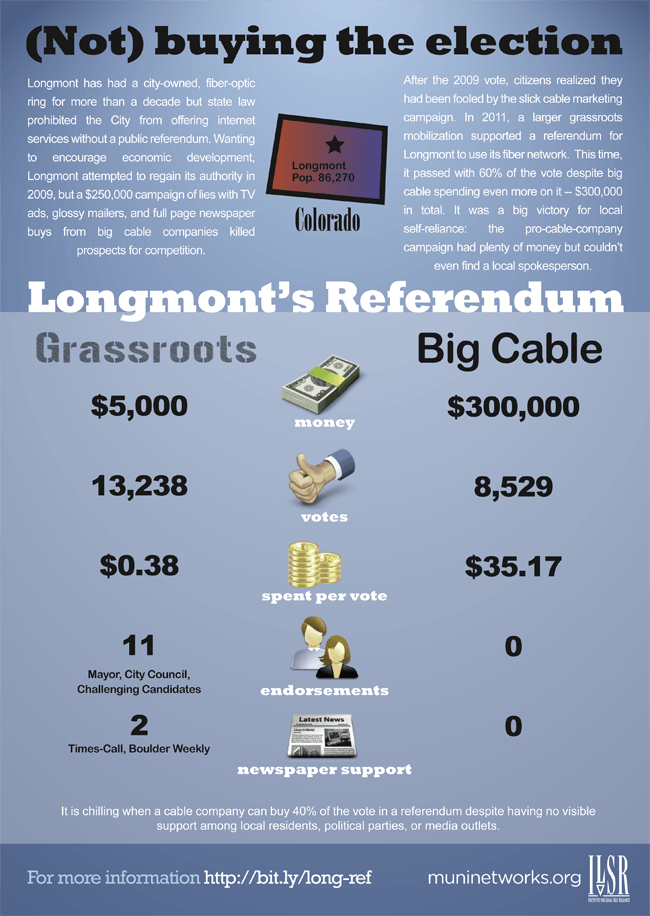
Comcast’s decision to spend $300,000 attempting to defeat one community’s public broadband initiative illustrates how America’s largest cable company invested a portion of your monthly cable bill.  It turned out to be a bad investment — Longmont voters saw right through the dollar-a-holler vote buying operation run by a Denver-based “public strategies” firm.  Every vote in favor of the cable company cost Big Cable $35.17 — a bit less than many pay for a month of broadband service.

The pro-fiber forces spent a collective $5,000, some of which came from individuals who want more competition in Colorado.  The Institute for Local Self-Reliance notes the cable industry couldn’t even find a local spokesperson to cheerlead their campaign.

It is proof positive citizen activism can still beat back corporate-financed propaganda campaigns and make all the difference.

Customers “Probably Don’t Need Higher (<1Mbps) Speed," Editorializes N.M. Newspaper

Phillip Dampier December 5, 2011 Broadband Speed, CenturyLink, Community Networks, Competition, Editorial & Site News, Kit Carson Telecom, Public Policy & Gov't, Rural Broadband, Wireless Broadband Comments Off on Customers “Probably Don’t Need Higher (<1Mbps) Speed," Editorializes N.M. Newspaper

Sometimes you can’t please some people no matter what you do.

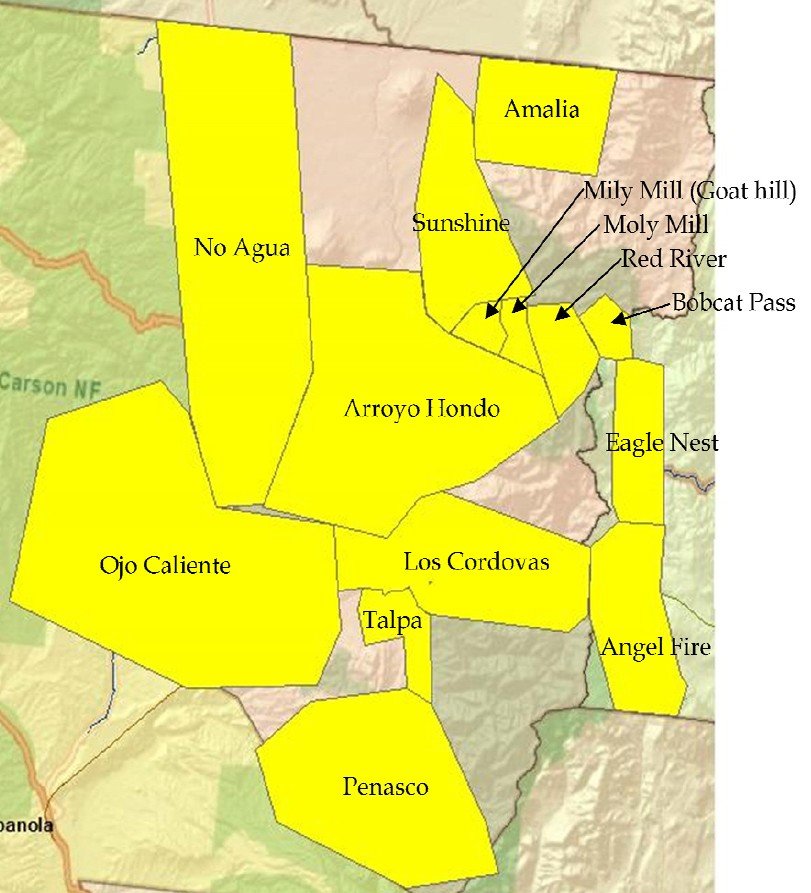
Kit Carson Electric Cooperative’s $64 million fiber-to-the-home expansion project will finally bring 21st century broadband speeds to northern New Mexico. The electric co-op intends to deliver broadband speeds up to 100Mbps to 20,000 largely rural residents and businesses in Taos, Colfax, and Rio Arriba counties who have had limited access to cable broadband or live with speeds often less than 1Mbps from CenturyLink-delivered DSL.

“It’s a whole new ballgame for rural New Mexico,” shares Stop the Cap! reader Raul. “But the pinheads at the local weekly newspaper are ringing their hands over the project, suggesting only businesses deserve 100Mbps while the rest of us should be satisfied with speeds under a megabit per second.”

Indeed, editors at the Sangre de Christo Chronicle are wringing their hands over the project:

But many of us in the Kit Carson service area already have Internet service — and we’re completely happy with it. Kit Carson CEO Luis Reyes, Jr. said a large portion of the organization’s electric customers are currently under-served by other providers with Internet speeds of less than one megabit (1,000 kilobits) per second.

We have no reason to doubt that, but many of these customers probably don’t need the higher speeds. For the Internet customers who use the Internet for email, Facebook, news and other basic functions, Kit Carson’s prices will be most important. Most of us will not pay more for faster Internet speed we don’t need, but we will consider switching to a local provider if it offers identical or better service and prices.

“CenturyLink barely delivers DSL today, and has shown no interest in investing substantially in northern New Mexico, and outside of concentrated built-up areas there is no cable competition,” Raul says. “Kit Carson is the only local concern that has shown any real interest in making our community better, and the local newspaper is complaining about it.”

Proposed service area for Kit Carson Electric's new fiber to the home network serving northern New Mexico.

Kit Carson Electric’s project will provide a true fiber-to-the-home service bundling television, telephone, and broadband service — a substantial upgrade over what the telephone company has on offer.  With speeds far beyond what cable and phone providers in New Mexico are accustomed to providing, the region stands to benefit from entrepreneurs building digital economy businesses over a broadband network that can actually help, not hinder online development.

Currently, area residents pay CenturyLink up to $55 a month for 1.5/1Mbps DSL service.  Residents are so excited by the prospects of much faster speeds at significantly lower prices, Kit Carson Electric has developed an innovative stop-gap service for residents still waiting for direct fiber connections — fiber-to-wireless service.  New and existing customers can sign up for the service for a $100 installation fee and choose from three service tiers:

  • 3Mbps — $29.95/month
  • 7Mbps — $39.95/month
  • 10Mbps — $49.95/month

A three year contract is required (early termination fee is $200).  But customers who eventually obtain Kit Carson Electric’s fiber service will automatically satisfy their contract requirement.

“Kit Carson’s wireless project already blows away CenturyLink’s speeds and pricing, and that is for inferior wireless,” Raul argues. “The Chronicle doesn’t have a clue.”

We can’t understand the newspaper’s concerns either.  Kit Carson Electric has already demonstrated their prices (and interest) in northern New Mexico is superior to that of CenturyLink, owner of former Baby Bell Qwest, which serves New Mexico.

Republican Sen. Jeff Bingaman is thrilled with Kit Carson’s broadband initiative.

“This major investment in broadband technology is exactly the kind of project I had envisioned when I voted for the American Recovery and Reinvestment Act,” U.S. Senator Jeff Bingaman said. “This grant is not only creating jobs now in northern New Mexico, it is laying the groundwork to attract new businesses, improve healthcare services and create new education opportunities in the future.”

The electric co-op has been successful operating non-profit businesses selling propane, telecommunications, and economic development space.  The fiber project will also allow the electric utility to deploy “smart grid” technology to increase the efficiency of their electric service.

A groundbreaking ceremony at the broadband project’s command center held this past summer also coincided with a public emergency communications network upgrade which will increase the efficiency and reliability of first responders and other emergency and public safety agencies.

Maine Madness: Time Warner Cable’s Mandatory Digital Upgrade Still Irking Customers

Phillip Dampier December 5, 2011 Broadband Speed, Consumer News 2 Comments

Time Warner Cable’s progression towards all-digital cable continues to spread across Maine as customers in Albion, Augusta, Belgrade, Benton, China, Clinton, Farmingdale, Gardiner, Hallowell, Litchfield, Manchester, Monmouth, Mount Vernon, North Vassalboro, Readfield, Richmond, Rome, Sidney, Vassalboro, West Gardiner and Winthrop lost many of their analog channels last week.

But customers losing AMC, Animal Planet, Cartoon Network, CKSH, CHLT, CNBC, E!, EWTN, GAC, Hallmark Channel, HGTV, History, HSN, INSP, NECN, Ovation, QVC, SyFy, Shop NBC, TCM, TNT, and USA also provoked the loss of something else: patience.

“Cable TV is the only service I pay for that increases my bill and frustration at the same time,” says Augusta Stop the Cap! reader Jeff E. Smith.  “The digital adapter Time Warner sent me was defective right out of the box, and two of my neighbors were also sent defective units that never powered on,” Smith writes.

Time Warner Cable is dramatically reducing the analog cable lineup to make additional room for new digital HD channels and faster broadband speeds.  The company is supplying palm-sized digital adapters for subscribers who don’t have a digital set top box on every television.  Although free until 2014, the boxes will carry a monthly fee of $0.99 each after that.

“The upgrade gives them the chance to cram on more channels we don’t want and more expensive broadband, and yet we have to eventually pay for the equipment,” Smith says. “And it doesn’t even work right.”

Smith’s neighbors have discovered patience-testing lines at some Augusta-area cable stores as customers rushed to obtain the equipment they assumed they didn’t need.

“The neighbor’s mother-in-law doesn’t understand how to use OnStar in her car, so it was no surprise she found out she needed the equipment when most of her favorite channels disappeared,” he adds.  “Time Warner really overestimated the level of understanding customers would have about this after buying new digital-TV’s a few years ago.”

Jim has several suggestions for Time Warner to adopt before the digital upgrade begins its progression across the country:

  1. The equipment should be free of charge and included with your regular monthly service.  You can’t realistically expect to buy Time Warner Cable service without a box for every set after the digital conversion is complete, so just include the equipment;
  2. A better and less intrusive way to manage this would be to install a single digital converter on the outside of the home or in a closet which could provide analog service to every TV not already equipped with a set top box.  That would mean no annoying box on every set in the home and would probably cost less (in time, money, and aggravation);
  3. People assume they are ready for digital cable because they bought digital-ready TV’s after analog television service ceased. Most customers will not read generic letters carefully.  It would be better to send people customized letters telling them they specifically will need the equipment because records indicate additional outlets were installed in the home without corresponding cable set top boxes attached to them.  What are the chances customers are using CableCARD units these days?  Chances are, they’ll need the DTA adapters, so make this clearer.
  4. Don’t you dare put customers through this, increase broadband speeds, and then slap usage caps or usage billing on us!

Search This Site:

Contributions:

Recent Comments:

Your Account:

Stop the Cap!