Update #2: Verizon Wireless LTE Outage Impacts Service on East Coast

Phillip Dampier December 7, 2011 Consumer News, Verizon, Wireless Broadband 27 Comments

Verizon Wireless has confirmed a major LTE outage is impacting their data customers up and down the east coast as of late last night.

4G service works only intermittently this morning for impacted customers.  Many Verizon Wireless 4G phones are also not stepping down to the older 3G network properly during the outage, which means no data service at all, unless you are near a Wi-Fi hotspot.

The largest service area affected is New York City, but the outage is also impacting 4G customers in western New York, Pennsylvania, and northern Virginia.

Verizon has no estimated time when the problem will be repaired.

Updated 3:46pm ET — Readers report the outages now extend south into South Carolina, west into Ohio, Indiana, and Illinois, and one reader tells us service is out in California.  Verizon has acknowledged the problem on their Twitter channel, with no time estimates for repair.

Updated 4:58pm ET — Verizon is telling some customers the outage is impacting those with SIM cards, which effectively means LTE/4G.  Customers with 3G only phones still have access, but many 4G phone owners cannot downgrade to 3G service, even when they turn LTE off. 

AT&T Scores Last (Again) in Consumer Reports’ Ratings; Oddly AT&T Reseller Scores Highest

AT&T has once again scored dead last in a nationwide survey (subscription required) of wireless providers commissioned by consumer magazine Consumer Reports.

Among national coverage carriers, Verizon Wireless again scored the highest, but not highest overall when including smaller independent and regional carriers.  Top honors were won by Consumer Cellular, a relatively small company in Portland, Ore. that ironically depends on bottom-rated AT&T’s network to deliver service.  What sets Consumer Cellular apart from other carriers is its near-exclusive focus on selling phone service to America’s senior population.  Working with groups like the AARP to market simple cell phones to older, less technologically-comfortable customers, over 85% of Consumer Cellular customers are over the age of 50.  The vast majority are occasional cell phone users, primarily using cell phones to make and receive calls.

Regional carrier U.S. Cellular, which used to top Consumer Reports‘ surveys, scored second.  Most U.S. Cellular customers are in the Pacific Northwest, Midwest, and parts of the East including New England.  CREDO, better known under its former name Working Assets Wireless, scored third.  It provides service over the Sprint network.

Among major-sized providers, only Sprint managed to escape the poor ratings for value received by AT&T, Verizon, and T-Mobile.  Also ironic, T-Mobile continued to score better than AT&T, which is still working feverishly to acquire the German-owned carrier.

AT&T also did poorly in delivering reliable voice and data services, according to respondents.  Customer service was also deemed lacking.

Consumer Reports

“Our survey indicates that subscribers to prepaid and smaller standard-service providers are happiest overall with their cell-phone service,” said Paul Reynolds, electronics editor for Consumer Reports. “However, these carriers aren’t for everyone. Some are only regional, and prepaid carriers tend to offer few or no smart phones.”

Consumer Cellular being a prime example. 

Consumer Reports surveyed 66,000 Americans for its 2011 Wireless Satisfaction Survey and found little had changed from last year.  The consumer magazine recommends consumers who don’t make or receive a lot of calls or are not addicted to wireless data services consider a prepaid plan instead of a two-year contract.  Competition in the prepaid arena continues to force prices down, and most providers offer month-to-month service plans that can be automatically renewed through a checking account or credit card, eliminating any hassle purchasing “top up” cards.

Most of the prepaid providers resell service provided by AT&T, Sprint, or Verizon Wireless.  Two that don’t: MetroPCS and Leap Wireless’ Cricket, received little regard from those surveyed.  MetroPCS scored second from the bottom and Cricket didn’t make the ratings at all.  Two prepaid plans to consider first: TracFone, excellent for occasional calling, and Straight Talk, sold by Wal-Mart — better for those who like to talk a lot on their phones.  If you don’t need the sexiest handset around, Stop the Cap! also recommends Page Plus, which relies on the Verizon Wireless network, especially if you don’t need a lot of data services.

Comcast Gives Atlanta Customer Sex Hotline Number for Customer Support

Phillip Dampier December 6, 2011 Comcast/Xfinity, Consumer News, Video Comments Off on Comcast Gives Atlanta Customer Sex Hotline Number for Customer Support

(Courtesy: The Consumerist)

An Atlanta grandmother got the shock of her life when she called Comcast to activate her new cable box.  When she called the number Comcast printed on her equipment receipt, she reached an adult sex chat line instead.

“I really got upset, extremely upset. I just like hung up the phone and I had to call my husband in to call again because I thought maybe I’d made a mistake,” Dora Nopple told an Atlanta TV station. “I just couldn’t believe that a company as large as Comcast is not aware of what they’re putting on receipts for their customers to call.”

Sure enough, when a reporter from WAGA-TV dialed the number on the bottom of her receipt, a porn line answered the call.

A Comcast spokesperson immediately apologized.

“Comcast sincerely apologizes to our customer who called the number typed on their receipt and was unexpectedly connected to an adult phone service,” the Comcast statement reads. “This was simply a human error resulting from a temporary employee who inadvertently typed an 800 number prefix for what should have been an 888 prefix.”

Comcast believes the error was a one-time event, limited to that single customer.  Perhaps, but Comcast’s past track record has exposed other customers to heavy breathing sex operators. In October 2009, Comcast mailed thousands of postcards to Harrisburg, Penn. customers advertising an upgrade of HBO On Demand.  But when callers dialed the 800 number to order the new HD channel, they ended up on a phone sex hotline instead.

[flv width=”360″ height=”290″]http://www.phillipdampier.com/video/WAGA Atlanta Wrong Number Leads to Phone Sex Line 11-30-11.mp4[/flv]

WAGA in Atlanta spoke with Dora Nopple about her unwelcome phone call to Comcast customer service to activate her new cable box.  She reached an adult porn line instead.  (2 minutes)

Canadians Trash Their Cell Phone Options: Bad Service, Worse Value; Koodo Rates Highest

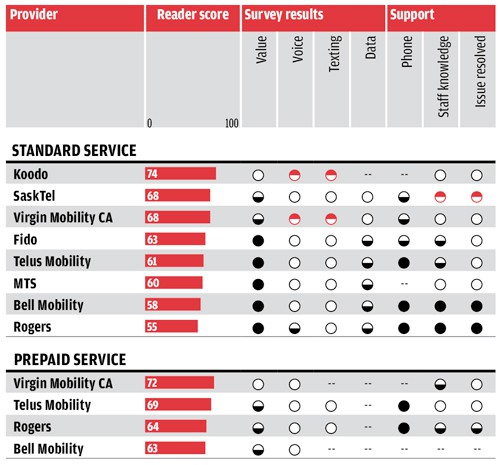
Canadians overwhelmingly rate their mobile phone providers poor for value, telling Consumer Reports they are paying too much and getting far too little coverage and service in return.

The 2011 Consumer Reports Wireless Survey (subscription required) shows Canada’s largest cell companies are generally awful in the estimation of 15,000 Canadians polled for the survey.  At the very bottom of the barrel are mega-carriers Bell Mobility and Rogers, both rated lousy for service and customer support.

“You can always do better than Rogers and Bell, no matter what other carrier you can think of,” says Thierry Duluis, a Stop the Cap! reader in Quebec. “Biggest does not mean best.”

Consumer Reports agrees.  It top-rated Koodo, a no-contract carrier owned and operated by western Canada’s phone company Telus.  Koodo is a relatively new player, only launching service in 2008, but has since built a reputation for lower prices and reasonably good service to the majority of populated regions across Canada.  But Koodo’s data plans can be expensive and confusing.  A $5 data starter plan delivers 25MB of data, and automatically increments: 26MB-100MB = $10, 101MB-300MB = $15, 301MB-1GB = $20, 1.01GB–3GB = $30, + 2¢/MB above 3GB.  A alternative plan with a 2GB data allowance runs $25 a month with a 2¢/MB overlimit fee.

Consumer Reports

Ironically, several wireless brands owned by large Canadian phone and cable companies scored higher than their respective owners.  Koodo scored higher than Telus Mobility.  So did Fido, which is a wholly-owned subsidiary of Rogers.

Regional SaskTel, which operates in Saskatchewan, received an admirable rating from the consumer magazine, primarily because of its slightly better customer service.  But no carrier, prepaid or postpaid, did extremely well across all categories.  Canadians are frustrated by cell phone prices that are often higher than what their American neighbors pay, and are often accompanied with stingy usage allowances.

Mediacom Merry Christmas Rate Hike: Naughty/Nice, You’ll Pay More in 2012

Phillip Dampier December 6, 2011 Competition, Consumer News, Mediacom, Public Policy & Gov't, Video Comments Off on Mediacom Merry Christmas Rate Hike: Naughty/Nice, You’ll Pay More in 2012

Mediacom is announcing broad price increases for many of its customers scheduled to take effect on Dec. 15.  Most cable-TV subscribers will pay $2-3 more a month for basic cable, an additional $2 a month for Cinemax and Showtime, and $2 extra a month for “Digital Plus” cable service.  To add insult, the paperless bill credit that used to knock $1 off your bill if you chose not to receive a mailed billing statement is also being eliminated.
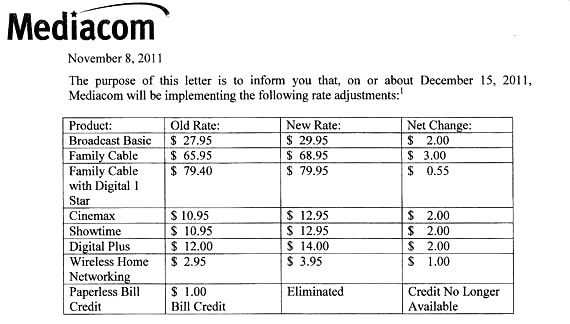
Lee Grassley, Mediacom’s chief lobbyist, delivered the company line about the rate increase in letters mailed to subscribers.  In essence, he blamed everyone but Mediacom for the rate hikes, and in poetic language one normally doesn’t get from a cable company rate increase notification:

As our nation struggles to pull itself out of what has been called the Great Recession, we recognize that these are challenging times for the hardworking men and women living in the communities that we serve.

[…] Over the past few years, many broadcasters have used their monopoly powers to demand 100%, 200% and even 300% rate increases during contract negotiations.  This has driven up cable and satellite rates and forced American consumers to pay billions of dollars for “free” over-the-air television.

The problems with sports programming are equally alarming.  One look at the skyrocketing rights fees announced with recent deals and it is easy to see that the marketplace for live televised sports is out of control.

[…] Contrary to public perception, cable companies are reluctant to raise video prices because when we do, we lose subscribers.  Mediacom does not make money when we raise video rates, since we remit virtually every penny of the increase on to programmers.  In fact, over the last three years, our programming cost increases were more than double our video revenue increases.

Since the programming community has been unwilling to exercise even the slightest measure of self-restraint when it comes to reigning in their spending or increasing their price demands, Mediacom has taken the fight to Washington.

Mediacom as new-found-friend fighting for lower cable rates comes across as ironic, at best, to Stop the Cap! reader Noel, who lives in Mediacom’s Iowa footprint.

“This is the same cable company who pocketed rate increases annually for as long as I’ve been a subscriber, and if they can’t raise the price of the television service, they’ll just make it up on the broadband side,” Noel writes.  “They have their nerve complaining about monopolies.”

Noel points out the local station retransmission consent fees are a more recent phenomenon, and Mediacom rate increases in prior years were the same or higher.

“I think they are realizing there is an absolute maximum people in Iowa can afford for cable, and years of rate increases have allowed all of the players to assume they can slice a bigger piece from that pie for themselves, and we’re tapped out,” Noel adds.

Noel called Mediacom and threatened to cancel service and received a nice consolation price: customer retention pricing normally reserved for new customers.

“I have a year reprieve, but rest assured I will start dropping things after the deal expires at these prices.”

[flv width=”480″ height=”290″]http://www.phillipdampier.com/video/KCCI Des Moines Mediacom Rate Increases 11-28-11.flv[/flv]

KCCI in Des Moines covers Mediacom’s rate increases and the reaction from local residents who will have to pay more for cable service.  (2 minutes)

Search This Site:

Contributions:

Recent Comments:

Your Account:

Stop the Cap!