Catching Up With the Times: Bell To Boost Internet Speeds to 100Mbps In Ontario and Quebec, But They’ll Still Limit Use

Phillip Dampier February 5, 2010 Bell (Canada), Broadband Speed, Canada, Data Caps 3 Comments

Bell has announced it will boost broadband speeds for selected residents of Ontario and Quebec as high as 100/20Mbps service through a fiber service upgrade it will begin this year.

While Canada’s largest phone company is providing a “fiber to the neighborhood” service that still relies in part on traditional copper phone wiring in other parts of Ontario, Bell promises to install true fiber to the home connections starting in Quebec City, and in new housing developments elsewhere in both provinces.

Quebec City was chosen because most of the city’s telecommunications wiring is installed above ground on traditional telephone poles.  Upgrading above-ground service costs considerably less than coping with buried cables.  It will take the company three years to complete the upgrade.

Bell claims the upgrades are part of a natural evolution of telecommunications service in Canada.

“Investment in broadband networks and services is a core strategic imperative at Bell,” said chief executive George Cope in a statement. “We’re actively building the communications platforms that support the growth of competitive new internet, video and other digital services now and into the future.”

Competition may be the key factor in Bell’s decision to upgrade service, particularly in Quebec.  Incumbent cable provider Videotron has effectively called out Bell for its slower broadband DSL service, which offers “up to” 7Mbps DSL service.  Videotron already provides speed tiers up to 50Mbps for just under $80 a month, and is capable of expanding service to 100Mbps in the future.

In Ontario, Bell faces competition from Rogers Cable, which itself has boosted speeds after a DOCSIS 3 upgrade.  The cable operator offers residents in the Greater Toronto Area 50Mbps for $100 per month.

But two things that will come along for the ride are Bell’s notoriously low usage allowances and throttled speeds when using bandwidth-intensive applications like file swapping software.

The company did not release what usage limits are anticipated for their fiber optic offerings, but consumers acquainted with Bell service are skeptical the upgrade will be worth the price.

“Who cares what Bell’s speeds are when you cannot use the service at promised speeds,” writes Stop the Cap! reader Noelle.  “Besides, if Bell’s usual stingy limits remain in place, if you did maximize your connection, you could blow through their usage limit in an hour or so.  As usual, we get to pay for what most others get for free as part of their subscription price.”

Some other online reactions:

“Sure we’ll all have faster speeds, but Bell will make us pay through our teeth for it. Faster speeds mean less time to reach the bit-cap limit = more profit for Bell. Also everyone with an independent ISP will continue to use whatever crumbs of service Bell wishes to dole out as part of it’s non-monopoly obligations. Having a hyper-fast internet with Bell is like having a Ferrari and having to drive the speed limit everywhere. I know it can do 200mph, but Ma Bell limits me to 50. Its like throwing your money away.”

“Bell’s theoretical DSL download speed of 7Mbps is a joke.  Most people barely break 1Mbps, and after they’re done throttling you to death, you’d beg for that speed if you could get it.  I dumped the Bell nightmare years ago.”

“I can’t wait to find out what my bill will be after they charge me another arm and a leg to pay for all these upgrades.  Who cares about speed upgrades when their usage-based limits mean you cannot use them.  Instead of upgrading speed, how about upgrading your network capacity and do away with the usage limits and throttled broadband speeds?”

Novus To Launch Canada’s Fastest Broadband Service – 200Mbps for $279.95; Free Upgrade to 100Mbps Service For Some

Phillip Dampier February 4, 2010 Broadband Speed, Canada, Competition, Novus 1 Comment

Metro Vancouver residents will have access to Canada’s fastest residential broadband service next Friday when Novus Entertainment launches its Net 200 tier providing 200Mbps service over a fiber optic network for $279.95CDN per month.  Customers currently paying $179.95 for the company’s 60Mbps plan will also receive a free upgrade to 100Mbps service on that same date.  No word yet on what the new usage limits will be, but Novus previously limited its 60Mbps plan to 360GB per month, unfortunate for a plan that carries such a premium price.  Novus charges 50 cents for each additional gigabyte above their various plan allowances.  Novus’ upload speeds are the same as its advertised download speeds.

Novus Entertainment has wired fiber optic cable in 33,000 large multi-dwelling units in parts of greater Vancouver, providing broadband, telephone, and television competition for incumbent cable provider Shaw Communications.  The two companies were embroiled in a nasty price war last year, with Shaw slashing prices to as low as $10 per month for video, phone, or Internet access.  To date, Novus has 9,000 subscribers, 8,200 of which subscribe to the company’s broadband service.

“We noted a recent survey by Harvard University which found that Canadians’ access to superior broadband performance and infrastructure ranked poorly among developed countries,” said Donna Robertson, Co-President and Chief Legal Officer of Novus Entertainment Inc. “While these results are disappointing, this provided Novus with the opportunity to not only take this challenge head on and provide customers with superior Internet speeds, but to also set us apart from the competition.”

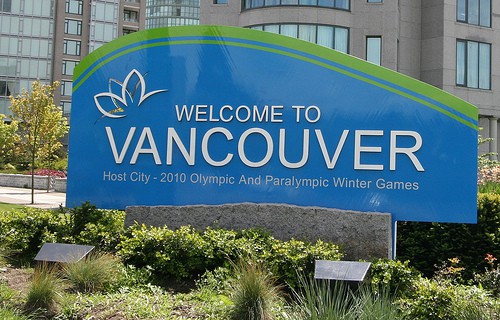
Vancouver is the home of Novus Entertainment

Novus’ Net 200 will be available in selective buildings that are configured for 200 Mbps technology. With the vision of becoming one of Metro Vancouver’s major Internet and communications service providers, Novus continues to expand its service in Vancouver and Burnaby and plans to launch services in Richmond in 2010.

“Canadians want a service provider that delivers a fast Internet connection to meet their growing needs at a reasonable cost,” said Doug Holman, Co-President and Chief Financial Officer of Novus Entertainment Inc. “Yet they’re paying among the highest prices for some of the lowest speeds. Novus’ superior fibre-optic network allows us to provide our customers with best-in-class, reliable and consistent transfer speeds that the incumbents simply can’t offer.”

Shaw probably cannot match Novus’ 200Mbps service tier on their non-fiber optic cable network, but will likely continue to compete heavily on price with discounts that stun Canadians outside of metro Vancouver.  Shaw’s pricing in Novus-wired buildings is as much as $60 less than in other areas where Novus does not compete.

Novus also owns some wireless spectrum covering Alberta and British Columbia, so eventually the provider could mount a competitive challenge in the mobile telephone market, at least in western Canada.  There are rumors the company could partner with an eastern Canadian spectrum holder like Public Mobile, which owns spectrum covering southern Ontario and Quebec.  Neither company has launched service, and probably won’t for the rest of 2010, but could eventually provide additional competition in the overpriced Canadian mobile phone market.

Comcast-NBC Merger Hearings – House of Representatives

House Committee Energy & Commerce | Communications, Technology, and the Internet

The subcommittee on Communications, Technology, and the Internet held a hearing today titled, “An Examination of the Proposed Combination of Comcast and NBC Universal.” The hearing explored the potential impact on the media marketplace of the proposed joint venture agreement between Comcast and NBC Universal. This portion contains committee members’ opening statements and no witness statements.

House Committee Energy & Commerce | Communications, Technology, and the Internet

Witnesses testified about the potential impact on the media marketplace of the proposed joint venture agreement between Comcast and NBC Universal. Among the issues they addressed were competition in the media marketplace, possible innovations which could result from the merger, the impact on local affiliates, and the affect on consumers.

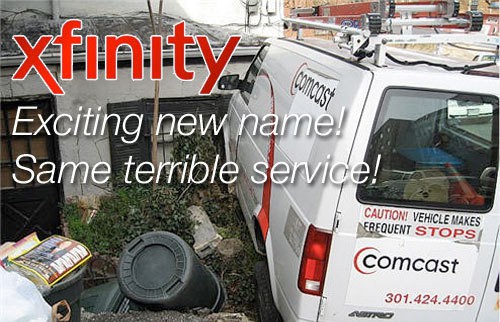
Comcast Rebranding Itself as “XFinity”: XFINITY TV, XFINITY Voice, XFINITY Internet At An XFINITY Price

Phillip Dampier February 4, 2010 Comcast/Xfinity 2 Comments

Comcast loves its new name for TV Everywhere so much, it’s expanding it across all of its products and services in the coming months.

XFinity, originally Comcast’s online video on demand service, will now share its name with Comcast’s cable-TV, telephone, and broadband product lines.

The effort to rebrand itself comes at a time when consumers increasingly find blurring lines between services delivering video, telephone and broadband service.  You can watch cable TV programming on your mobile phone, make and receive phone calls over your broadband connection, and watch TV shows online as well.  XFinity could symbolize the convergence of technology, where content is ultimately more important than the way it reaches you.

Comcast’s blog gushed about the ‘exciting proposition’ of an industry game-change:

The folks at Gizmodo are lampooning Comcast's brand change

Today on Comcast’s earnings call Brian Roberts and Steve Burke talked about XFINITY, the new brand for our technology platform and products. Simply put, XFINITY is about offering our customers more — more HD, more speed, more choice and more control over their services. XFINITY is the culmination of years of work to transition Comcast’s network and products to a platform that will now offer 100+ HD channels, 50 to 70 foreign-language channels, approaching 20,000+ VOD choices, incredibly fast Internet speeds (50 Mbps growing to 100+ Mbps) and thousands of TV shows and movies online for our customers to watch whenever and wherever they want.

XFINITY represents the future of our company and it’s a promise to customers that we’ll keep innovating. When we launch XFINITY in a market, we’ll rebrand our products: XFINITY TV, XFINITY Voice and XFINITY Internet (our company, of course, remains Comcast). This transition is already well underway across the country. Next week, XFINITY will roll out in 11 markets including: Boston, Philadelphia, Baltimore, Washington D.C., Chicago, Portland, Seattle, Hartford, Augusta, Chattanooga, parts of the Bay Area and San Francisco, with more markets to come later this year.

Of course, consumers don’t have a choice about Comcast’s 250GB monthly usage allowance.

As far as new names go, reaction is decidedly mixed.  The folks at Gizmodo promptly began ridiculing the thin coat of paint applied to an often despised cable provider landscape.  XFinity likely targets a younger audience.  I suspect older subscribers will be perplexed as to its meaning, if not its pronunciation.

This isn’t the first time the industry has tried name-changes.  Cable modem service has long since been rebranded “High Speed Online” by some, “High Speed Internet” by others.  Time Warner Cable calls its bundled services “All the Best.”  Many others call it a “Triple Play.”

For consumers, the name is less important than the quality and price of the service.

Karl Bode of Broadband Reports and I are both glad that Comcast at least avoided the now-cliché “Extreme” in the new name.  I hope they also registered the predictable xxxfinity.com before some porn merchant grabs it.

When Comcast’s ‘Free Upgrades’ Cost Consumers $2 More Per Month

Phillip Dampier February 4, 2010 Broadband Speed, Comcast/Xfinity, Data Caps Comments Off on When Comcast’s ‘Free Upgrades’ Cost Consumers $2 More Per Month

Denver residents are discovering that when Comcast says they’re getting a “free speed upgrade,” what they really mean is that upgrade is going to cost you an additional $2 more per month.

Comcast recently increased broadband speeds in Denver “for free,” but now Mile-High City residents are discovering free comes at a price with Comcast.

The price of renting your cable modem is increasing by $2 a month, which means the majority of Comcast customers locally will now spend $5 per month just for the modem.

Denver, Colorado (Courtesy: Yassie)

Comcast blamed the increase on costs associated with upgrading their network facilities to support DOCSIS 3, the latest cable modem standard which supports vastly faster Internet speeds.

Comcast spokeswoman Cindy Parsons said in a statement that the company continually invests in providing customers with next-generation equipment and technology that delivers advanced Internet services with enhanced capabilities.

“Our costs for this new equipment will increase by 167 percent over the next two years,” Parsons said.

Comcast has been increasing the modem rental price on a city-by-city basis across the country, often after speed upgrades like that completed in Denver which doubled speeds from 6 to 12Mbps late last year.

If just two-thirds of Comcast customers nationwide continue to simply pay the monthly rental fee, the company will earn more than $250 million in annual revenue just on the two dollar rate hike.  Is that enough to pay for service upgrades so we can dispense with talk about Internet Overcharging schemes like usage caps and consumption billing?

Stop the Cap! reminds readers Comcast subscribers can purchase their own cable modem from electronics retailers, often for $100 or less, and never pay a rental fee again.

At $60 a year, customers will more than pay for their modem purchase after less than two years.

Search This Site:

Contributions:

Recent Comments:

Your Account:

Stop the Cap!