Verizon’s Doubling of Early Cancel Fee ‘Good for Consumers’

Verizon Wireless has defended their decision to double the early cancellation fee (ETF) for consumers purchasing “smartphones” and netbooks from the wireless carrier.  In a letter from Kathleen Grillo, Senior Vice President of Federal Regulatory Affairs, Verizon claims the new $350 fee is justified and actually benefits consumers by providing them with a substantial discount on the cost of the equipment they might not otherwise be able to afford.

“The higher [cancel fee] associated with Advanced Devices (click link to see a list of impacted equipment) reflects the higher costs associated with offering those devices to consumers at attractive prices, the costs and risks of investing in the broadband network to support these devices, and other costs and risks,” Grillo wrote as part of a 77-page submission to the Federal Communications Commission, which demanded an explanation for the price increase.

Grillo claims Verizon’s fees are actually good for consumers:

Verizon Wireless’ term contracts with ETFs promote consumer choice and broadband deployment. This pricing structure enables Verizon Wireless to offer wireless devices at a substantial discount from their full retail price. By reducing up-front costs to consumers, this pricing lowers the barriers to consumers to obtaining mobile broadband devices. It thus enables many more consumers, including those of more limited means, access to a range of exciting, state of the art broadband services and capabilities. The company’s pricing structure therefore promotes the national goal of fostering the greater adoption and use of mobile broadband services. At the same time, consumers are protected by Verizon Wireless’ detailed disclosure practices described in this response, by the Worry Free Guarantee, which allows customers to terminate within 30 days of activation without an ETF, and by the monthly reduction in the ETF amount.

Grillo claims Verizon customers can also purchase a phone at the retail price and avoid a service contract.  Verizon Wireless, for example, charges contract customers $199.99 for the Motorola Droid.  But customers who do not want a contract can purchase the phone from Verizon for $559.99.

In North America, most major cell phone companies subsidize the cost of wireless handsets and make up the difference over the life of a typical two-year service contract.  Cell phone companies claim consumers benefit from the arrangement because they are able to acquire a new phone every two years at a substantial discount.  Some consumer advocates and members of Congress disagree, suggesting carriers more than earn back the cost of the subsidized phone over the life of the contract.  Although customers purchasing a retail-priced phone don’t have to worry about a two year contract, they pay artificially higher prices for service plans designed to recoup the costs from those who did take discounted phones.  The result is a strong incentive to commit to a contract and take the phone, since you will essentially be paying for it anyway.

The Government Accountability Office found early termination fees to be among the top four consumer complaints filed with the FCC about wireless carriers.  Sen. Amy Klobuchar (D-Minnesota) re-introduced legislation December 3rd to try and limit early termination fees.

Senator Amy Klobuchar

“Changing your wireless provider shouldn’t break the bank,” Klobuchar said in a Dec. 3 statement. “Forcing consumers to pay outrageous fees bearing little to no relation to the cost of their handset devices is anti-consumer and anti-competitive.”

The Cell Phone Early Termination Fee, Transparency and Fairness Act would prevent wireless carriers from charging an ETF that is higher than the discount on the cell phone that the company offers consumers for entering into a multi-year contract. For example, if a wireless consumer enters into a two-year contract and receives a $150 discount with the contract, the ETF cannot exceed $150.

The legislation would also require wireless carriers to prorate their ETFs for consumers who leave their contracts early so that the ETF for a two-year contract would be reduced by half after one year and to zero by the end of the contract term. In addition, the bill would mandate that wireless carriers would provide “clear and conspicuous disclosure” of the ETF at the time of purchase.

Co-sponsoring the bill with Klobuchar are Sens. Russ Feingold, Jim Webb and Mark Begich.

[flv]http://www.phillipdampier.com/video/CNBC Amy Klobuchar ETF Fees 9-13-07.mp4[/flv]

Back in 2007, Sen. Klobuchar introduced nearly identical legislation to deal with mobile phone providers charging high termination fees.  CNBC ran this debate between Klobuchar and the cell phone trade association.  Klobuchar found herself in a 2-against-1 debate when the CNBC anchor defended the wireless industry.  (9/13/07 – 5 minutes)
Canadian Government Overturns CRTC, Admits Globalive’s Wind Mobile to Canadian Mobile Phone Marketplace

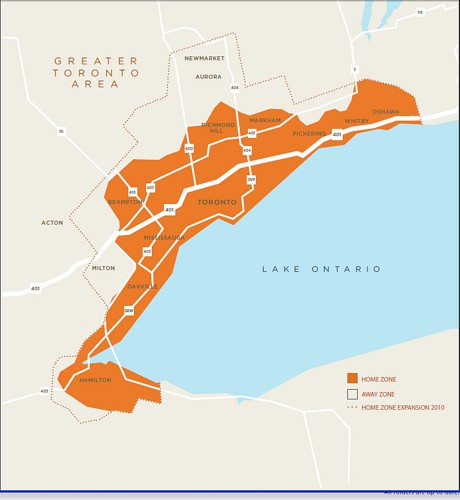
Wind Mobile uses "home zones" as their version of "on network" calling.  Placing calls outside of your home zone is akin to "roaming" and can incur additional costs.

Wind Mobile uses "home zones" as their version of "in network" calling. Placing calls outside of your home zone is akin to "roaming" and can incur additional costs. Here is their service area in the metro GTA (Toronto-Hamilton).

The Canadian Radio-television and Telecommunications Commission has been overruled in an upset decision by the Harper government to admit new competition into Canada’s mobile phone marketplace.  Earlier this fall, the CRTC denied a license to Globalive to begin mobile service under its Wind Mobile brand, agreeing with objections from incumbent providers Bell, Rogers, and Telus that the company was not sufficiently “Canadian enough” in its ownership to operate legally in the country.  The CRTC decision upset many consumers who saw the regulatory body overprotecting the interests of the country’s three large mobile providers, effectively keeping competition out of Canada.

Canada’s version of the FCC ruled that because the Toronto-based company received most of its funding from Naguib Sawiris, an Egyptian billionaire that runs Egypt’s telecommunications provider Orascom, it disqualified Globalive from doing business in Canada.  Cell phone providers in Canada must be majority owned by Canadian citizens.

Apparently the decision was so egregiously wrong, the Harper government overturned it on December 11th.  Industry Minister Tony Clement said a government review of Globalive found the company did meet Canadian ownership requirements and reversed the CRTC decision effective immediately.

The Harper government’s direct intervention in the Globalive matter rocked Canada’s existing mobile providers.

“If Wind is Canadian, then so was King Tut,” Michael Hennessy, head of regulatory affairs for Telus, wrote on his Twitter page. “When you have no effective opposition party, you can make the rules you want.”

Rogers has repeatedly insisted there is no room for a fourth player in Canadian mobile, claiming there isn’t enough business to go around.  Stockholders apparently agreed and shares of all three incumbents dropped when the news broke that Wind Mobile was on the way in Toronto and Calgary in as little as a week.  Indeed, some analysts predict Globalive’s entry could force two of the existing carriers to merge — most likely Bell and Telus.

Rogers CEO Nadir Mohamed: “There’s no question in my mind that Canada cannot support more than three national facilities-based players,” he said in an interview with Bloomberg News the day before the government decision. “It’s inconceivable to me.”

“We think Globalive clearly does not meet the requirements for Canadian control,” Bell officials said in a statement. “We’ll be taking a close look at the reasoning behind this decision.”

Canadian consumers are excited about the arrival of competition in a marketplace with three providers charging essentially identical high pricing for mobile service.

Wind Mobile could dramatically change the the entire business model of Canada’s cell phone marketplace because most of its plans offer flat rate service for Canadian customers with no overage fees.  It also does away with the nickle-and-dime fees consumers hate, with no charges for “system access,” “911,” and other non-government-imposed fees and surcharges.  Wind doesn’t even charge for incoming text messages or received long distance phone calls.  That means text spam doesn’t cost you anything beyond irritation.

In return for not subsidizing the cost of your phone, the company doesn’t compel subscribers to remain on lengthy service contracts.  That Blackberry Bold 9700 that costs $199 on AT&T or T-Mobile’s network in the United States costs $450CDN from Wind Mobile, but no two year contract is required.

The only downside?  Wind Mobile’s network is very limited at present to Toronto and Calgary, and while service is available throughout Canada, using it will incur roaming charges around 25 cents per minute.  Most early Wind Mobile customers will likely be those who don’t roam too far from home because of these limitations.

[flv width=”640″ height=”388″]http://www.phillipdampier.com/video/CBC Coverage Wind Mobile 12-11-09.flv[/flv]

CBC Television ran extensive coverage of the government decision to admit Globalive into the Canadian mobile marketplace.  We’ve combined several reports into a single clip that explores consumer reaction, the government’s logic in permitting Wind Mobile to start service, as well as the discontent from existing providers who feel the decision is unfair.  (12/11/09 – 21 minutes)

[flv width=”512″ height=”308″]http://www.phillipdampier.com/video/CTV Coverage Wind Mobile 12-11-09.flv[/flv]

CTV News also covered the story, and included a more extensive review of what consumers can expect from the deal.  (12/11/09 – 5 minutes)

[flv]http://www.phillipdampier.com/video/Global CRTC Decision Lets Wind Mobile In 12-11-09.flv[/flv]

Global Television led its newscast with the story on December 11th, and included a pouting Telus representative.  (2 minutes)

More video coverage can be found below.

Wind Mobile Pricing & Features (provided by Wind Mobile, all prices in Canadian dollars)

Handsets / Devices:

BlackBerry Bold 9700 …… $450
HTC Maple ………………….. $300
Samsung Gravity 2 ……….. $150
Huawei U7519 ……………… $130
Huawei E181 data stick…….$150

Here’s what we don’t have:

  • No system access fees
  • No 911 fees
  • No activation fee
  • Never a charge for incoming texts
  • No charge for incoming long distance calls
  • No difference between plans for postpaid and prepaid
  • No contracts. Our Customers stay with us because they want to, not because they have to.

What we do have:

  • Nation-wide coverage with a domestic roaming partner
  • Unlimited calling (incoming and outgoing) in the GTA and Calgary to start, followed by Edmonton, Vancouver and Ottawa in early 2010
  • Unlimited WIND to WIND calling across Canada included on all plans
  • Unlimited province-wide calling on the $35 plan
  • Unlimited Canada-wide calling on the $45 plan
  • Call control included on all plans (missed call alerts, caller ID, call forward, call waiting)
Wind Mobile's Voice & Text Plans

Wind Mobile's Voice & Text Plans

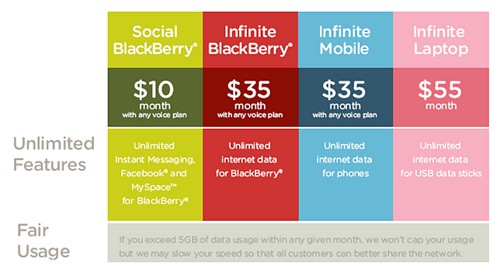
Wind Mobile's data plan has a 5GB per month "fair access policy" limit, similar to that offered by Cricket Wireless.  Exceed it, and the company reserves the right to throttle your speeds until the month is up.

Wind Mobile's data plan has a 5GB per month "fair access policy" limit, similar to that offered by Cricket Wireless. Exceed it, and the company reserves the right to throttle your speeds until the month is up.

Watch more video coverage below.

… Continue Reading

Windstream’s Acquisition of Iowa Telecom Continues Telephone Company Consolidation, Worries Employees

Phillip Dampier December 18, 2009 Broadband Speed, Rural Broadband, Video, Windstream 3 Comments

iowatelecomWindstream Corporation has agreed to acquire Newton, Iowa-based Iowa Telecom for $530 million in stock and cash, making it the fourth acquisition for the rural-focused Windstream in 2009.  It will also take on $600 million of Iowa Telecom’s debt as part of the transaction, which caused Standard & Poors to reduce Windstream’s credit rating to junk status – BB.

Like Frontier Communications, Windstream is engaged in aggressive expansion to stake out its position serving rural America.  The company has spent $1.3 billion on acquisitions in just the last six months, trying to keep up with other large independent providers like Frontier and CenturyLink.

“Our whole investment thesis was to grow scale in rural America,” Windstream Chief Executive Jeff Gardner told the Wall Street Journal. “I still think there’s a great deal of consolidation left with smaller players, where the pressure is the most obvious.”

Windstream, based in Little Rock, Arkansas, serves customers in 16 states, mostly in the midwest and south.  Iowa Telecom serves former GTE service areas in Iowa and Minnesota.

For employees in Newton, east of Des Moines, the purchase brings fear of significant job reductions.  Iowa Telecom has 800 employees, and comments by Windstream’s Gardner suggest downsizing is forthcoming.  Windstream expects $35 million in cost savings annually, and some of that will be achieved by dispensing with unneeded Iowa Telecom workers post-merger.  Windstream has only promised to maintain a call center in Iowa.

[flv width=”512″ height=”308″]http://www.phillipdampier.com/video/WHO Des Moines Iowa Telecom Bought 11-25-09.flv[/flv]

WHO-TV Des Moines reported Windstream’s buyout of Iowa Telecom was like “lightning striking twice” for Newton residents, leaving an economically-challenged community in fear. (11/25/09 – 2 minutes)

windstreamlogoIowa Telecom provides customers with a familiar bundle of services common among independent phone companies.  As well as providing traditional wired phone lines, Iowa Telecom markets Xstream DSL at speeds up to 15Mbps in some areas, and resells DISH Network satellite service for customers looking for a video option.

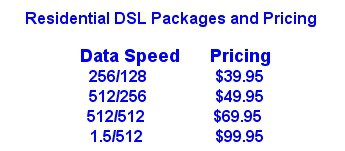
Lexcom's DSL price chart shows budget-busting prices for relatively slow DSL service

Lexcom's DSL price chart shows budget-busting prices for relatively slow DSL service

Windstream provides DSL service up to 12Mbps in some areas.

Before Iowa Telecom, Windstream’s earlier acquisitions included:

  • D&E Communications of Pennsylvania — Windstream fetched the independent provider in a stock and cash transaction that added about 150,000 additional telephone lines to Windstream’s portfolio in Pennsylvania.
  • Lexcom — Windstream picked up this Davidson County, North Carolina independent for $141 million.  Lexcom needs serious technology upgrades to improve service.
  • NuVox — A Greenville, South Carolina-based business services provider.

Windstream has hinted they’re not done with acquisitions yet, fueling some speculation their next targets may be Consolidated Communications, which provides service in Illinois, Pennsylvania, and Texas or Alaska Communications Systems, another business service provider.

[flv width=”640″ height=”380″]http://www.phillipdampier.com/video/KCCI Des Moines Will $1.1B Iowa Telecom Sale Mean Job Losses 11-24-09.flv[/flv]

KCCI-TV Des Moines reported residents of Newton were “shocked” and “disturbed” about the Iowa Telecom buyout, because of potentially staggering layoffs to come after Windstream closes the deal.  (11/24/09 – 2 minutes)

Not everyone is singing the blues about Windstream’s buyout of Iowa Telecom.  Despite the transaction’s impact on Windstream’s credit rating, Wall Street has supported Windstream with a strong stock price, owing to the company’s relentless desire to deliver dividends to stockholders.

[flv]http://www.phillipdampier.com/video/CNBC Cramer on Windstream 12-7-09 1025.flv[/flv]

CNBC’s Jim Cramer loves the “massive dividends” Windstream provides to stockholders.  But Cramer also issues some caveats, reminding viewers of FairPoint Communications, another former high-dividend stock… until it went bankrupt.  Cramer interviews Windstream CEO Jeff Gardner about the company and the future of independent phone companies in general.  (12/7/09 – 10 minutes)

[flv]http://www.phillipdampier.com/video/CNBC Windstream Profile NASDAQ 12-10-2009 222.flv[/flv]

CNBC reports on Windstream’s move to the NASDAQ and interviews CEO Jeff Gardner about the future for the telecom industry in general.  (12/10/09 – 2 minutes)

Mediacom vs. Sinclair: Consumers Stuck In The Middle As Companies Fight For Your Money

Phillip Dampier December 18, 2009 Mediacom, Video 2 Comments

One way or another consumers will pay more for their Mediacom cable service in 2010.  The undecided question is will Sinclair-owned television stations get a chunk of your wallet or will Mediacom keep it all for themselves.

Weary Mediacom customers have been through this battle before.  For the second time in three years, residents of Des Moines, Iowa face the prospect of losing access to their local Fox station, owned by Sinclair.

The ads are up and running.

[flv width=”360″ height=”287″]http://www.phillipdampier.com/video/Mediacom WEAR Ad.flv[/flv]

Mediacom is running this spot, customized for each city impacted by the dispute, comparing Sinclair’s demands as another “bailout.”  This one is running in the Pensacola-Mobile market, where station WEAR is threatened with removal from Mediacom’s lineup.

Sinclair is demanding another price increase from the cable operator and Mediacom has a history of playing hardball and refusing to pay.  If the two sides don’t reach agreement by December 31st, 22 Sinclair-owned stations in communities served by Mediacom will be taken off the cable lineup.

Viewers aren’t happy, especially because they do not get a reduced bill from the cable company for the reduced channel lineup that results.

Both sides are waging campaigns to try and get viewers into the fight.  But in the end, it’s a battle of two corporate titans fighting over their portion of your money.

[flv]http://www.phillipdampier.com/video/KCCI Des Moines Mediacom Sinclair Exchange Strong Words 1-23-07.flv[/flv]

Back in January, 2007 Mediacom customers spent five weeks without Sinclair-owned television stations on their cable dial.  A nasty exchange between Sinclair and Mediacom was documented in this report aired by KCCI-TV Des Moines back on January 23, 2007.   (3 minutes)

[flv]http://www.phillipdampier.com/video/KCCI Des Moines Mediacom Loses Customers 5-4-07.flv[/flv]

The fallout from the 2007 dispute could be measured by disgusted customers who fled Mediacom for other providers, as KCCI found on May 4, 2007. (2 minutes)

[flv width=”512″ height=”308″]http://www.phillipdampier.com/video/WHO Des Moines Sinclair vs Mediacom 12-15-09.flv[/flv]

WHO-TV Des Moines covers today’s dispute impacting Mediacom and the city’s Fox affiliate. (2 minutes)

[flv]http://www.phillipdampier.com/video/KDSM Des Moines Mediacom vs Sinclair 12-17-09.flv[/flv]

KDSM-TV Des Moines is the Sinclair-owned Fox affiliate.  The station covers its own dilemma, warning viewers they might lose the station for the second time in three years.  (3 minutes)

[flv]http://www.phillipdampier.com/video/KFXA Cedar Rapids Mediacom Sinclair Dispute in Iowa 12-17-09.flv[/flv]

In Cedar Rapids, Sinclair’s KFXA-TV covers the dispute with a decidedly pro-Sinclair point of view. (3 minutes)

[flv]http://www.phillipdampier.com/video/WEAR Pensacola Sinclair Mediacom Dispute 12-16-09.flv[/flv]

WEAR-TV in Pensacola, Florida spends a great deal less “news time” covering the dispute. WEAR is the Sinclair-owned ABC affiliate for the Florida Panhandle. (30 seconds)


AT&T’s New Position on Net Neutrality = AT&T’s Old Position on Net Neutrality

Redefining their "new position" to basically mean their "old position"

Redefining their "new position" to basically mean their "old position"

AT&T’s all-new position on Net Neutrality suspiciously sounds like its old position on Net Neutrality.

In a three-page letter addressed to FCC Chairman Julius Genachowski, James W. Cicconi, AT&T’s senior vice president for external and legislative affairs wrote in glowing terms about the Obama Administration’s efforts to expand broadband service and preserving the “open Internet.”  Those goals are shared by AT&T, according to Cicconi.  But are they?

AT&T has spent millions fighting Net Neutrality policies, calling them unnecessary and harmful to broadband innovation and investment.  Ed Whitacre, Jr., AT&T’s former chairman and CEO infamously kicked off a contentious debate when he declared content producers shouldn’t be allowed to use AT&T’s “pipes for free.”

Little has changed.

Yesterday’s letter to Genachowski brings nothing new to the table from AT&T.  In short, they still feel broad-based Net Neutrality regulations will be harmful to investment.  AT&T wants the FCC’s definition of Net Neutrality to be “flexible enough to accommodate the types of voluntary business agreements that have been permitted for 75 years.”  Flexible, in this instance, means gutting the clear, unambiguous prohibition against fiddling with Internet traffic and inserting loopholes that gut the policy’s effectiveness.  AT&T’s “voluntary agreements” never include consumers.

AT&T wants to provide “value-added” services to content producers who agree to pay more to obtain them.  That typically means additional speed or a guarantee of prioritized service.  Unfortunately, on a finite broadband network, those getting preferential treatment can reduce the quality of service for those who don’t pay.  By trying to refocus the FCC’s attention on obsessing over subjective interpretations of “unreasonable and anti-competitive” content discrimination, AT&T gets a free pass to configure a broadband protection racket and rake in money from content producers afraid to be stuck in the slow lane.

Cicconi

Cicconi

AT&T also continues to complain that such regulations would prevent the company from offering consumers “value-added” broadband services.  As long as those services do not discriminate, providers can freely provide network enhancements like faster speed tiers, “Powerboost” technology which temporarily speeds up connections, and even network management which keeps viruses, malware, and other junk traffic away from subscribers.

Ben Scott at Free Press, a consumer advocacy group, read between AT&T’s latest lines and saw a naked effort to gut Net Neutrality before being enacted:

“After leading a rabid anti-net neutrality lobbying campaign for years, AT&T now submits a letter to the Federal Communications Commission purporting to offer common ground,” Scott said. “What they are proposing would allow them to violate the core principle of Net Neutrality — letting them control the Internet by picking winners and losers in a pay-for-play scheme. That would destroy the free and open Internet, and the FCC should reject this false compromise out of hand.”

“Make no mistake, AT&T opposes Net Neutrality. Their proposed solution is a bait and switch. As bait, they ask to return to a standard of nondiscrimination that was long applied to the telephone network. But they fail to mention that this standard was part of a system of pro-competitive common carriage rules that they have railed against applying to broadband networks for years. They haven’t changed their mind about common carriage. They are simply cherry-picking one piece of the old rules and calling it a compromise. The entire Net Neutrality debate is about the creation of a new system of nondiscrimination that fits broadband networks, not telephone networks –a debate the telephone companies forced by stripping away consumer protection rules from broadband under the Bush administration,” Scott added.

Public Knowledge also called out AT&T in a statement from Gigi Sohn.

AT&T has tried to draw what is an imaginary line among types of discrimination. The company advised the FCC that while ‘unreasonable’ discrimination can be banned, any discrimination caused by ‘voluntary commercial agreements’ is just fine because the parties involved agreed to it. That is nonsense.

As we have said consistently, the Internet has functioned as well as it has because control of the crucial roles at each end of the network. Side deals made by a carrier like AT&T and a content provider or other company take that control out of the hands of the consumer.

Similarly, it is unfortunate that AT&T has resorted to the old tactic of threatening not to invest in its network if the company does not get what it wants in a rulemaking. The growth of the Internet will be driven by consumer demand, not by gimmicks. If the company is truly interested in consumers, it will allow consumers to remain in control.

Search This Site:

Contributions:

Recent Comments:

Your Account:

Stop the Cap!