One Day Left for Fox-Time Warner Cable Negotiations

Phillip Dampier December 30, 2009 Video Comments Off on One Day Left for Fox-Time Warner Cable Negotiations

Tomorrow is the final full day when Fox cable network programming will be available to Time Warner Cable subscribers, unless negotiations achieve a breakthrough.  Spectators watching the back and forth don’t anticipate any agreement, but suspect the companies will agree to some sort of extension over the holiday weekend to keep the viewing public reasonably happy.

Today several Fox-owned broadcast affiliates began reporting on their own potential involvement in the dispute — Time Warner Cable stands to lose the rights to carry several Fox broadcast stations in major television markets like New York, Los Angeles, and Dallas.  Stories about the dispute began appearing today on several TV news outlets.  In areas where Fox affiliates are independently owned and operated, most have tried to reassure viewers they won’t immediately lose access to the Fox station in their area, but several Fox cable networks could be impacted.

We have several reports on where things stand at the moment, including some additional background to help people get up to speed on why this battle is taking place in the first place.

[flv]http://www.phillipdampier.com/video/CNBC Time Warner Fox Dispute 12-30-09.flv[/flv]

CNBC ran this extended piece today debating the changing business model for television programming, which explains why these carriage disputes are increasingly contentious. Brian Seltzer, New York Times media reporter and Vanity Fair columnist Michael Wolff join Julia Boorstin to discuss Time Warner Cable’s showdown with News Corporation’s Rupert Murdoch. (6 minutes)

[flv width=”640″ height=”500″]http://www.phillipdampier.com/video/Bloomberg Talks Continue TWC Fox 12-30-09.flv[/flv]

Bloomberg News also explores the changing business model of broadcast “free” television.  Can it survive against cable and online program distribution?  News Corporation and Time Warner Cable are pessimistic that question can be answered before the deadline expires at midnight, December 31st. (6 minutes)

[flv width=”640″ height=”380″]http://www.phillipdampier.com/video/WNYW New York FOX-Time Warner Cable Deal Unlikely 12-30-09.flv[/flv]

WNYW-TV, the Fox affiliate in New York, started reporting to its viewers Fox’s position on the carriage dispute, warning them an agreement by December 31st is critical if Time Warner Cable customers are to be assured of watching Fox sports coverage on New Year’s Day.  (3 minutes)

[flv width=”640″ height=”500″]http://www.phillipdampier.com/video/KDFW Dallas FOX, Time Warner Still Negotiating 12-30-09.flv[/flv]

KDFW-TV, the local Fox affiliate in Dallas, took issue with Time Warner Cable’s claim that even without an agreement the Fox station would still be shown on the local cable system. (2 minutes)

[flv width=”480″ height=”380″]http://www.phillipdampier.com/video/WLUK Green Bay Jay Zollar on Time Warner 12-30-09.flv[/flv]

Some Time Warner Cable customers in smaller cities have been confused by national wire service reports which, to them, suggest their local Fox station will be affected by the potential programming blackout as well.  Some Fox affiliates have devoted time on their newscasts to clear up what programming or channels will be affected in their respective areas.  WLUK-TV in Green Bay, Wisconsin was one such station.  (1 minute)

[flv]http://www.phillipdampier.com/video/WENY Elmira Fox Time Warner Battle 12-30-09.flv[/flv]

Another small community getting some local coverage of the story, and its potential impact on Time Warner Cable-carried Fox-owned cable channels, is Elmira, New York.  WENY-TV, which serves southwestern and south-central New York around Elmira and Corning, explained things to viewers.  (1 minute)

OnLive Game Cloud Demonstrated – Its Biggest Threat? Usage Cap Happy Internet Service Providers

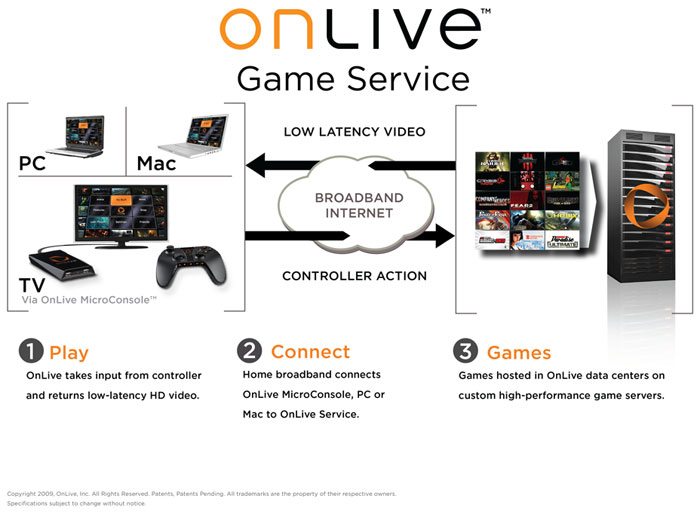
OnLive puts the processing power to render and play games on their end, and streams the result to you over your broadband connection (click to enlarge)

OnLive, the cloud-based videogame streaming service, was on display during a live dem0 of the service at Columbia University.  The service, which literally streams game play across fast broadband networks, could seriously challenge the videogame console marketplace.  Instead of using an expensive piece of hardware at home to play videogames such as w88, OnLive puts the hardware at their end and streams the results to any computer or television.  If it works, it means consumers won’t need the highest performance videocards or latest new CPU.  They’ll just need a fast broadband connection to let OnLive’s own servers do all of the processing.

The founder and CEO of OnLive, Steve Perlman, shows considerable enthusiasm for the concept, and several major investors including AT&T and Time Warner have backed the venture, which could help guarantee smooth passage on their broadband networks.

Still, a product that requires a minimum of a 5Mbps broadband connection for HD-quality streamed game play could consume an enormous amount of data — up to 2.25 GB per hour of gaming.  Although cable and fiber-based broadband connections will suffice, many DSL customers don’t have service fast enough to support OnLive.  Among those that do, any usage caps or allowances will significantly reduce the value of the service to potential subscribers.  Frontier Communications’ infamous 5GB “acceptable use” per month, for instance, would allow just over two hours of use per month, assuming you did nothing else with your DSL service.

Even Comcast’s 250GB usage allowance cuts game play to a little over 100 hours per month.  That’s a ludicrous amount of gaming for most of us, but not for some gaming addicts who may have tried games like 핑카지노.  Besides, it also assumes you don’t use your Comcast broadband service to watch video or other bandwidth-intensive online services.

Time Warner Cable’s proposed 40GB usage limit, shelved indefinitely in April after consumer protests, would permit less than an hour of play per day, assuming your Road Runner service was for nothing but OnLive.

In short, assuming OnLive works as promoted, its biggest threat to success will come from external factors mostly outside of its control — namely cap-happy ISPs that could quickly make streamed cloud computing untenable for all but the wealthiest among us.

What could OnLive do to reduce its risk from caps?  Partner with ISPs in a non-Net Neutral broadband world, of course.  That investment from AT&T, for example, could theoretically pave the way for AT&T to exempt OnLive from any usage limits that come from its own Internet Overcharging experiments in Beaumont, Texas and Reno, Nevada.  That would be a clear violation of Net Neutrality, if enacted into law.

Scenarios like this should drive consumers to support Net Neutrality policies.  ISPs forming “preferred partnerships” with innovative services like OnLive might seem consumer-friendly at first, but not in the long-term because it spells the death of would-be “non-preferred” start-ups, and helps pave the way even faster to Internet Overcharging schemes letting broadband providers pick the winners and losers of the future.

[flv width=”484″ height=”292″]http://www.phillipdampier.com/video/OnLive Columbia University Demo.flv[/flv]

OnLive founder and CEO Steve Perlman demonstrates OnLive and talks about cloud-based, streaming game play at this gathering at Columbia University in New York. (49 minutes)
(If stream stops for buffering, pause it for a few minutes to let a significant amount of the file pre-load, which should reduce re-buffering problems.)

iPhone Inventory Issues & Bottom-Feeding Resellers Likely Reasons for Rejection of NYC Online Orders Last Weekend

Phillip Dampier December 30, 2009 AT&T, Editorial & Site News, Video, Wireless Broadband Comments Off on iPhone Inventory Issues & Bottom-Feeding Resellers Likely Reasons for Rejection of NYC Online Orders Last Weekend

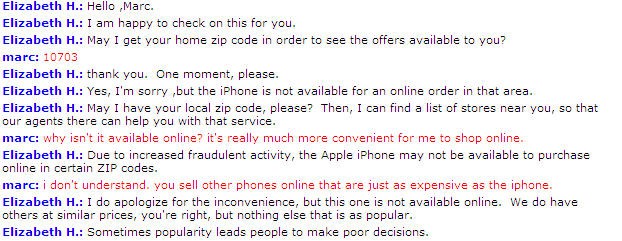
Customers in New York City attempting to order an iPhone direct from AT&T's website saw this message over the weekend

While much speculation about this week’s two-day unavailability of the iPhone for those in the Big Apple has often centered on the company running out of capacity, the more likely explanations are far simpler — the regional fulfillment center temporarily ran short after a holiday rush and AT&T wanted to stem the tide of increasing numbers of bottom-feeding eBay resellers doing business in the Tri-State area.

Customers in the New York metropolitan area discovered Saturday they couldn’t order an iPhone from AT&T’s website after entering a New York-area zip code.  Customers were told “we’re sorry, there are no Packages & Deals available at this time — please check back later.”  By Monday afternoon, orders were being processed normally.

The mystery deepened when some blogs began speculating the reason for the order blockade had to do with AT&T’s data capacity in New York City, suggesting the wireless company had reached its limit and halted sales accordingly.  They had the right to speculate if online chats with AT&T sales representatives were to be believed.  The Consumerist found two different explanations during their chats:

Daphne: Welcome to AT&T online Sales support. How may I assist you with placing your order today?

Laura: Hi, I was looking at the iPhone 3Gs and the system tells me that I cannot order one in my ZIP code. My zip code is 11231. (Brooklyn, NY) Is this true? Are iPhones no longer available in New York City?

Daphne: I am happy to be helping you today . Yes, this is correct the phone is not offered to you because New York is not ready for the iPhone.

Daphne: You don’t have enough towers to handle the phone.

Laura: Thank you for your help. So the phone is not available to people anywhere in the city?

Daphne: Yes this is correct Laura.

AT&T didn’t help matters with a non-denial denial issued by AT&T spokesman Fletcher Cook, who said only that the phone company periodically “modifies” its distribution channels. He had no comment about why the company resumed sales.

By not denying the capacity narrative that gained popularity earlier this week, it confirmed it in the popular press, including two local television news reports detailing the ‘sales outage.’

[flv width=”596″ height=”356″]http://www.phillipdampier.com/video/WNBC New York iPhone Sales Stopped 12-28-09.flv[/flv]

WNBC-TV reports on the unavailability of the iPhone in New York and AT&T’s ongoing problems with reception, service, and now PR in the Big Apple. (2 minutes)

With that story feeding the greater narrative that people “love the iPhone, hate the network,” AT&T better get on the phone with Luke Wilson and start taping some new ads.

In reality, Cook’s vague statement is something you’d expect from a spokesman who hasn’t been briefed on what really happened and needed to go with something to placate media speculation.  The data capacity theory would only make sense if the company suspended sales across all channels.  Except they didn’t.  Beyond the post-holiday low inventories found by some shoppers, New Yorkers could still find and purchase the iPhone in AT&T retail stores and through third-party retailers.  One could even order the phone from Apple.  Could unofficial ‘over-eager’ customer service representatives be responsible for the volunteered excuses noted above, either of which would ignite a firestorm of bad press for AT&T?

An increasingly annoying problem confronting cell phone companies is the eBay bottom-feeder and other gray market sales of the popular phone.  Both AT&T and Verizon have had growing problems with resellers who purchase a subsidized smartphone, agree to a two year contract, and immediately cancel it and resell the phone.  And they’ve been cashing in.

AT&T sells a new iPhone 3GS with 16 gigabytes of memory for $199.  When a reseller cancels the contract and keeps the phone, they pay a $175 early termination fee.  That means the phone costs them $374.  They then easily modify the phone to work with other cell phone companies and resell it for upwards of $600 or more on eBay, pocketing a nice $226 in profit.  Demand for the iPhone abroad is high, and considering the value of the dollar remains relatively low, Europeans can snap one up at a fire sale price.  Outside of North America, wireless phone companies don’t discount handsets like the iPhone.

Verizon Wireless has tried to deal with this problem by doubling the early termination fee on smartphones to $350.  That nearly eliminates the profit motive to resell affected phones.

[flv width=”600″ height=”356″]http://www.phillipdampier.com/video/WABC New York iPhone Sales 12-28-09.flv[/flv]

WABC-TV New York calls the latest iPhone mess “salt in the wound” for many New York-area AT&T customers.  (1 minute)

Time-Warner Cable Fox Negotiations Coming Down to the Wire

Phillip Dampier December 29, 2009 Video Comments Off on Time-Warner Cable Fox Negotiations Coming Down to the Wire

In the multi-million dollar game of chicken, observers are waiting and watching to see who will stop the inevitable consumer train-wreck that will occur if the nation’s second largest cable operator Time Warner Cable fails to reach an agreement with News Corporation, owner of Fox television and several Fox cable networks.

Another day, more negotiations, but still no end in sight.

[flv]http://www.phillipdampier.com/video/CNBC Time Warner Fox Dispute 12-29-09.flv[/flv]

The battle between Time Warner Cable and Fox is coming down to the wire, reports CNBC’s Julia Boorstin. (2 minutes)

Fox – Time Warner Cable Battle Rages On, Cable Company Threatens Fox With A-La-Carte Option

Phillip Dampier December 29, 2009 Video 7 Comments

Time Warner Cable’s Roll Over or Get Tough campaign was tailor-made to bolster the company’s defenses as the deadline nears for the nation’s second largest cable operator and Fox to reach an agreement on carrying Fox-owned stations in the new year.

For sports fans, the relentlessly ticking 24-like clock may run out on some important football games airing on Fox on New Year’s Day, requiring viewers to pull out the rabbit ears and settle for whatever over-the-air signal they can get.  At the moment, the two companies remain far apart in reaching a settlement over exactly how much Time Warner Cable will have to pay to carry Fox affiliates in some of the nation’s top TV markets.

Fox wants a reported $1 per subscriber per month.  Time Warner Cable prefers to pay nothing for Fox broadcast stations — the cable industry typically cuts deals to carry network-owned cable channels for which they will pay.  That’s how many Time Warner Cable customers ended up with channels like Sleuth, CNBC World, and other little-watched NBC-Universal cable channels just to smooth the way for retransmission consent for NBC-owned broadcast affiliates.  Fox shoved the dismally-rated Fox Business News and several regional sports channels onto many Time Warner Cable systems to win retransmission consent deals with higher-rated Fox networks just a few years ago.

Now Fox insists on cash money for carriage.
News Corporation’s Rupert Murdoch, who runs the company that owns Fox, has been making plenty of noise this year about the “business model” of broadcast television being broken in the United States.  Murdoch wants everyone to pay for News Corporation content, be it online from the Wall Street Journal or on your local cable system where the Fox family of cable and broadcast networks occupy at least a half-dozen channels on the lineup.

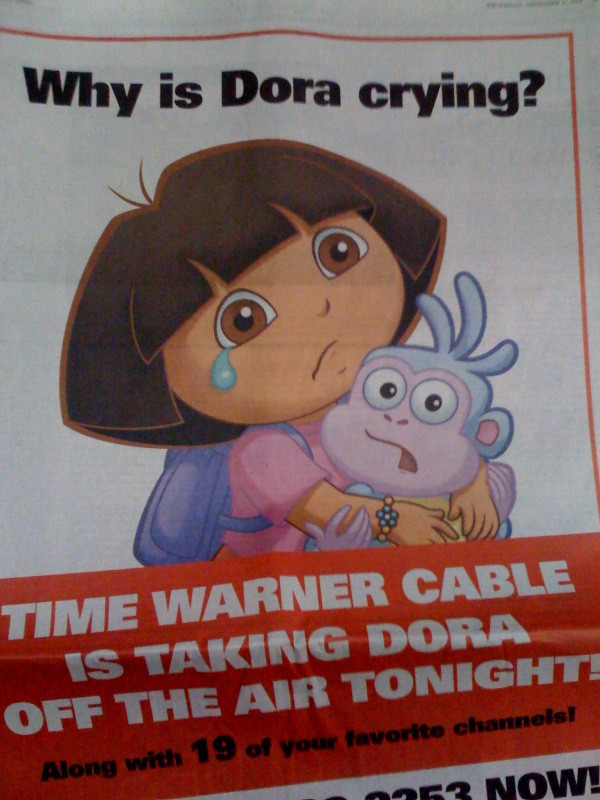
The level of nastiness has approached that of last year’s vicious battle with Viacom over how much Time Warner Cable would pay for channels like Nickelodeon, Comedy Central, and MTV.  Last year the low point was achieved when Viacom ran full page newspaper ads with a crying Dora the Explorer lamenting the fact she was about to be ripped off the television screens of millions of cable customers.

Time Warner Cable hopes its preemptive strike will earn it some peace and understanding when upset subscribers call the cable company to complain about the loss of Fox on their cable dial.  After all, you did want them to “get tough” with those nasty programmers, right?  Time Warner Cable has pointed the finger specifically at Fox in the newest round of attack ads, and Fox returned fire with a new slap against Time Warner Cable.

[flv width=”480″ height=”290″]http://www.phillipdampier.com/video/Time Warner Ransom Ad.flv[/flv]

Time Warner Cable characterizes a missed deadline in the dispute as the equivalent of Fox taking your TV hostage.

[flv width=”640″ height=”506″]http://www.phillipdampier.com/video/Fox Ad Targets TWC.flv[/flv]

Fox returns fire with another direct shot at Time Warner Cable in their latest ad.

Meanwhile, local newscasts around the country are sporadically updating viewers about the fight.  Because football is involved, amazing efforts are underway to force the two to reach an agreement, or at least leave the games on.  One Orlando attorney is filing a lawsuit to get an emergency injunction to make sure Orlando’s WOFL-TV stays on Bright House Networks.  That cable company is being represented by Time Warner Cable over the Fox matter.

[flv width=”640″ height=”388″]http://www.phillipdampier.com/video/WESH Orlando Bright House Fox Battle Sugar Bowl In Between 12-28-09.flv[/flv]

[flv width=”640″ height=”388″]http://www.phillipdampier.com/video/WFTV Orlando Contract Dispute May Keep Gator Fans From Watching Game 12-28-09.flv[/flv]

Bright House Networks in central Florida is also impacted by the Fox-Time Warner Cable stalled negotiations.  WESH-TV and WFTV-TV in Orlando report on the major impact the loss of WOFL-TV – Orlando’s Fox station, would have on area sports fans. (WESH-2 minutes WFTV-3 minutes)

[flv width=”640″ height=”380″]http://www.phillipdampier.com/video/NY1 Time Warner Fox Dispute 12-28-09.flv[/flv]

Time Warner Cable’s Alex Dudley, familiar to Stop the Cap! readers from the cable operator’s effort to launch a major Internet Overcharging scheme on customers last April, is back in a decidedly pro-Time Warner piece on the cable company-owned NY1.  Dudley can’t resist taking that last shot at Fox, pointing out impacted customers can always watch a lot of Fox programming for free online, thanks to Hulu. (3 minutes)

With these kinds of battles becoming increasingly contentious, Time Warner Cable CEO Glenn Britt hinted the cable operator may look at offering customers more choice in what channels make up a subscriber’s package.  Consumers have howled for years over rate increases that outpace inflation, as cable operators keep expanding the number of channels on offer, and keep raising the rates to pay for them.

“People want more choice, and collectively, we should be responsive to that,” Britt said at a investor conference in New York City. “I haven’t been a big fan of a la carte. The economics don’t work for the programming part of the business and ultimately don’t work for consumers. They do like to buy packages, maybe not as big as the packages we offer now, but they do like packages.”

“The comments are pretty consistently saying, ‘We would like the choice to buy smaller packages,'” Britt said.

The cable industry has traditionally resisted true a-la-carte pricing, which permits customers to choose and pay for only the channels they wish to watch.  Basic cable networks depend on both advertising revenue and the subscription payments they charge every customer who can watch their channels.  With the millions of cable subscribers pooled together, the cost per subscriber for each channel is usually less than 50 cents per month.  Letting subscribers opt-out increases the prices networks have to charge to those still receiving the channel.  Many niche networks would likely not survive such a transition.  The cable industry also argues it would force every subscriber to rent a set top box or similar device for every television in the home, as every channel would have to be scrambled.  Billing costs would also be higher.

Britt’s suggestion that Time Warner Cable could look into adding more “packages” of programming could resemble how C-band satellite dish owners paid for their programming.  Before the days of DISH Networks and DirecTV, millions of Americans placed large satellite dishes (typically 10-12 feet in diameter) in their yards to receive satellite-delivered programming.  When programmers encrypted their signals, satellite dish owners purchased programming in mini-packages comprising a handful of channels.  Some packages were theme-based — news packs with CNN, Headline News, MSNBC, Fox News, and CNBC for $5 a month or company-based, such as a package containing channels formerly owned by Ted Turner or those from Scripps-Howard (HGTV, Food, Style, etc.) for a few dollars a month.  Most subscribers paid for a “basic package” of popular basic networks grouped together and then added on more expensive premium channels or sports channels individually.  It often didn’t make economic sense to purchase each channel individually because of their relative high cost, but consumers could save quite a lot excluding some of the most expensive channels from their lineup (especially sports programming).

Whether Britt would follow through with the threat of “mini packages” is open for debate.  Any savings consumers realize from such offers would reduce Time Warner Cable’s revenue per subscriber, and that’s a sure fire way to upset Wall Street.

Watch more video and learn how Time Warner Cable customers nationwide may be facing the loss of Fox-owned cable channels, even if the local broadcast affiliate stays put.  We also have a more in-depth report on why retransmission consent agreements are increasingly important to broadcasters and pay television operators, all below the page break.

… Continue Reading

Search This Site:

Contributions:

Recent Comments:

Your Account:

Stop the Cap!