Unions Say Frontier-Verizon Deal Means Less Money for Broadband

Phillip Dampier May 14, 2009 Frontier, Verizon 1 Comment

cwa_logoThe Communications Workers of America and the International Brotherhood of Electrical Workers, two unions representing employees at Verizon and Frontier, are skeptical about the benefits of Frontier acquiring telephone lines from Verizon.

In a joint statement, the two unions suggest the debt load from the deal will mean less money for broadband service deployment, not more.

The sale would move 4.8 million lines serving residential and business customers in 14 states to Frontier. The deal calls for Frontier to take on $3.3 billion in debt; Verizon gets that amount in debt relief. That leaves Frontier saddled with debt that will lessen the potential amount available for investment in high speed broadband deployment.

Similar tax-free transactions by Verizon, especially those involving the Reverse Morris Trust tax provisions, haven’t worked out so well, especially for consumers in New England now served by FairPoint Communications.


Consumers Worry About Frontier-Verizon Phone Swap

Phillip Dampier May 13, 2009 Frontier 12 Comments

Having your local phone company disappear and get replaced by another provider isn’t an everyday occurrence for most people.  Customers are concerned about the impact of Verizon leaving their area, to be replaced by Frontier, an unfamiliar company for most parts of the country.  We have the video.

Let’s begin in Fort Wayne, Indiana, where WANE-TV interviews one worried local businessman already dissatisfied with what Verizon was charging, and wonder what surprises Frontier will bring:

Time Warner Cable Ends Cap ‘n Tier “Trial” in Beaumont

Phillip Dampier May 13, 2009 Issues 9 Comments
Road Runner Service Post-Cap 'n Tier in the Golden Triangle, Texas

Road Runner Service Post-Cap 'n Tier in the Golden Triangle, Texas

Time Warner Cable has quietly ended its “experiment” of their “consumption based billing” scheme in the first city to test it, and the last to be rid of it — Beaumont, Texas.

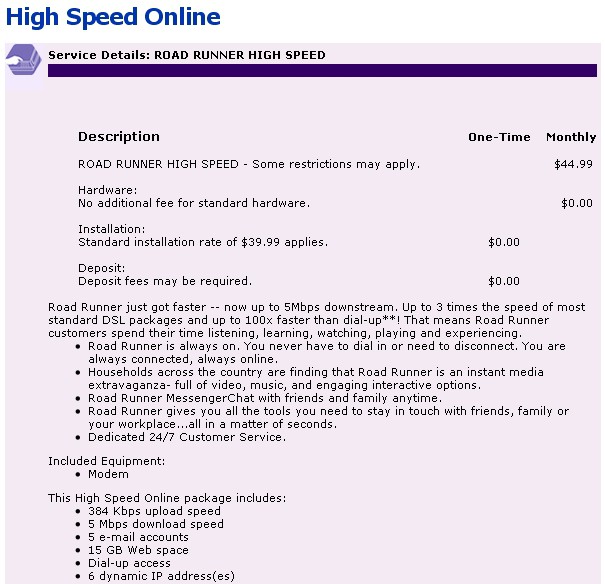
Time Warner Cable’s website for the Golden Triangle division, serving Beaumont, dispensed with the tier selection menu which limited customers to 40GB of usage per month, and has returned to an unlimited service plan offering 5Mbps/384Kbps service for $44.99 per month.

Customers calling Time Warner’s office in Beaumont were told the consumption based billing experiment had ended.  However, as with other Time Warner Cable divisions, the “FAQ” on the topic has now also appeared on the help pages for this division as well.  It explains Time Warner Cable still believes their Cap ‘n Tier formula is the “fairest” and will reimpose limits “once customers gauge how much bandwidth they actually consume.”  Time Warner Cable has gotten bolder in sending the message the very unpopular billing system they attempted to test in several cities around the country will be back, whether customers like it or not.

But for now, the grand experiment has finally ended nationwide.

TV Everywhere Not Even Free to Cable Subscribers?

Phillip Dampier May 13, 2009 Issues 13 Comments

Time Warner Cable has appointed Andrew Heller, a 25-year veteran of the cable industry to oversee the cable-owned video project dubbed TV Everywhere.

TV Everywhere is the brainchild of Time Warner Cable, which wants to create a new central video distribution platform leveraging broadband to deliver streamed, on demand TV shows and movies, but only to verified customers of cable companies that already take a video channel package.

Andrew Heller, TWC's Head of 'TV Everywhere'

Andrew Heller, TWC's Head of 'TV Everywhere'

The cable industry is afraid that broadband customers might decide to watch all of their television online, and simply drop or bypass traditional cable television packages.  TV Everywhere is designed to stop that, by prohibiting non cable-video subscribers from accessing cable network programming online.

The first test of the new service is due during the second quarter of this year.  Meanwhile, the cable operator is engaged in intense discussions with programmers to state their case that it is unfair for them to pay monthly subscription fees for programming, when those same programmers are giving away clips and shows on the web for free.

Assuming the company is successful in its negotiations, programming websites would discontinue much of their traditional online video and get customers to “authenticate” they are verified cable TV subscribers before being permitted to access on demand video.

In a new wrinkle, Heller told Advertising Age that TV Everywhere is not going to be free, even to existing cable subscribers.  In fact, he’s concerned that consumers may stage protests similar to what Time Warner Cable received after testing metered pricing for Internet service.

The price of TV Everywhere has also been a subject of recent debate after Time Warner Cable canceled plans, after a huge outcry by customers, to test metered consumption of broadband video in certain markets.

“The consumer’s going to speak with their pocketbook,” Mr. Heller said. “We do know they want a new model, we do know they want more choice and they use their computer as an additional outlet. We will do what we can to listen to them.”

The question is, do consumers “want a new model” for online video, or are they satisfied accessing content the way they do now — through video programmer websites, or purchasing viewing rights for series from iTunes, Netflix, or Amazon?  Are consumers clamoring for a cable-controlled video platform that only provides access, for a price, to customers who already pay for a cable subscription including video channels?  Will this “listening tour” be like the last one the company attempted during the metered billing fiasco?


Verizon Throwing Rural Customers Out, Frontier Agrees to Let Them Move In

Phillip Dampier May 13, 2009 Frontier 10 Comments

Frontier Communications agreed Wednesday to acquire nearly five million telephone customers being spun off from Verizon, primarily in rural areas, for $5.25 billion in stock. The buyout supercharges Frontier into the nation’s largest rural telephone company.  But the deal also puts a spotlight on large providers sacrificing their rural customers to focus on their larger urban markets.  About 700,000 of those Verizon customers are now off the list for Verizon FiOS deployment, as they transition into Frontier service territories.

Verizon’s chairman and CEO Ivan Seidenberg characterized the spinoff as part of Verizon’s interest in larger cities where advanced technology deployment makes sense.

“This transaction is part of our multiyear effort to transform our growth profile and asset base to focus on wireless, FiOS fiber-optic services and other broadband development, and global IP,” he said.

Our analysis of this will focus on the broadband implications of the transaction.  With this acquisition, Verizon wins by offloading more expensive and difficult-to-serve rural communities, where it is unlikely to deploy large broadband platforms in the future.  Frontier wins by becoming the nation’s largest rural telephone and communications services provider, potentially accessing even larger shares of forthcoming broadband stimulus money and other revenue available from the Universal Service Fund to sustain rural telephone service.

But will customers win?  Today’s announcement provides additional evidence that broadband service is diverging in urban and rural communities.  Large communities are enjoying deployment of advanced broadband platforms, and rural communities are simply not.

frontier-rural-sm1

Frontier Communications Believes Rural America -Is- Their Business

… Continue Reading

Search This Site:

Contributions:

Recent Comments:

Your Account:

Stop the Cap!