Home » Eric Massa » Recent Articles:

The Wall Street Journal Quotes Stop the Cap! Founder & Addresses Internet Overcharging Schemes

Phillip "I Also Told You So" Dampier

Phillip Dampier

The Wall Street Journal today published an article reviewing the landscape of flat rate broadband service and how some Internet providers want to change it.

The article quotes me on the issue of Internet Overcharging becoming a political football in the Net Neutrality debate.

“This could come down to carriers saying, ‘If you don’t allow us to manage our networks the way we see fit, then we will just have to cap everything,’ ” says Phillip Dampier, a consumer advocate focusing on technology issues in Rochester, N.Y. “They’ll make it an either/or thing: give them more control over their network or expect metered broadband.”

Mr. Dampier was among those who forced Time Warner Cable to shelve a metered Internet pilot program in several cities last year. The company, which had argued the plan would be a fairer way to charge for access, acknowledged it was a “debacle.” It won’t say if it plans to revive the trials.

Unfortunately, the article never bothers to mention Stop the Cap!, the website dedicated to fighting these overcharging schemes.
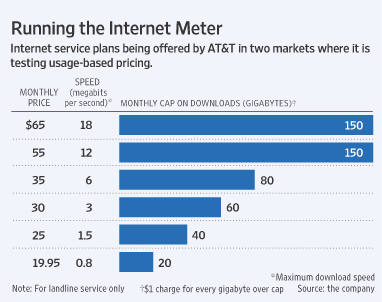
AT&T's Internet Overcharging Experiment Gone Wild

AT&T weighs in on their experiment to overcharge consumers in Beaumont, Texas and Reno, Nevada, and analysts think Net Neutrality arguments may give providers an excuse to expand those experiments, launch price increases and blame it on Net Neutrality policies:

“Some type of usage-based model, for those customers who have abnormally high usage patterns, seems inevitable,” an AT&T spokesman says. AT&T declined to provide more details on its trials.

“Unquestionably, the carriers erred in their initial selling of broadband with a flat rate,” says Elroy Jopling, research director of Gartner Inc. “They assumed no one would use it as much as they do now, but then along came high-definition movies. They’re now trying to get around that mistake.”

Network neutrality deals primarily with ensuring that Internet providers don’t favor any online traffic over any other. Still, Mr. Jopling and other analysts argue, the net neutrality debate might provide the carriers with an opening to argue for changing that pricing.

“With network neutrality enforced, the only other option for carriers is to charge by the byte or to raise the flat-rate pricing,” says Johna Till Johnson, president of Nemertes Research. “Right now they’re just deciding which one to do. Just be prepared to pay more.”

It's "Rep. Eric Massa," Not 'Joe Messa'

It's "Rep. Eric Massa," Not 'Joe Messa'

The article has several flaws.

  • It mis-identifies Rep. Eric Massa (D-New York) as “Rep. Joe Messa.”  Rep. Massa introduced legislation to ban Internet Overcharging when companies cannot produce actual evidence to justify it, particularly in the limited competitive marketplace for broadband in the United States.
  • The article fails to mention the usage limits proposed by smaller broadband providers, including Frontier’s infamous 5GB usage definition in their Acceptable Use Policy.  This is a very important fact to consider when the article quotes Professor Andrew Odlyzko, an independent authority on broadband usage, as stating the average broadband consumer uses triple that amount (15 gigabytes per month).
  • The quotation about the number of e-mails or web page views available under plan allowances that routinely appear in such articles ignores the increasing use of higher bandwidth applications like online video.  Telling a consumer they can send 75 million e-mails is irrelevant information because no consumer would ever need to worry about usage limits if they only used their account for web page browsing and e-mail usage.  They very much do have to be concerned if they use their service to watch online video from Hulu or Netflix, or use one of the online backup services.
  • The article makes no mention of publicly available financial reports from broadband providers like Time Warner Cable that prove that at the same time their profits on broadband service are increasing, the company’s costs to provide the service continue to decline, along with the dollar amounts they spend to maintain and expand that network to meet demand.  Providing readers with insight into the true financial picture of a broadband provider, instead of simply quoting the public relations line of the day would seem particularly appropriate for The Wall Street Journal.
  • The article doesn’t make mention that the same providers arguing increased Internet traffic is creating a problem for them are also working to launch an online video distribution platform that will rival Hulu in size and scope.  TV Everywhere will consume an enormous amount of the broadband network they claim can’t handle today’s traffic without Internet Overcharging schemes being thrown on customers.  Of course, such usage limits are very convenient for companies like Comcast, Time Warner Cable and AT&T, which are now in the business of selling pay television programming to consumers.  Should a consumer choose to watch all of their television online instead of paying for a cable package, a usage allowance will help put a stop to that very quickly, as will planned restrictions that only provide online video to “authenticated” existing pay television subscribers.

One thing remains certain – providers are still itching to overcharge you for your broadband service.  Consumers and the public interest groups that want to represent them must stand unified in opposition to Internet Overcharging schemes and for Net Neutrality protection, and never accept sacrificing one for the other.

One Half Done, One to Go: Net Neutrality Doesn’t Ban Internet Overcharging

Phillip Dampier September 22, 2009 Canada, Data Caps, Editorial & Site News, Net Neutrality, Public Policy & Gov't Comments Off on One Half Done, One to Go: Net Neutrality Doesn’t Ban Internet Overcharging
Phillip Dampier

Phillip "I Can See the Problem" Dampier

Yesterday’s proposal by FCC Chairman Julius Genachowski gets Net Neutrality halfway there.  That already puts us ahead of Canadian broadband, which is a throttler’s paradise, but remember — an eventual FCC rulemaking is not a law.  An FCC policy is only as good as the agency’s willingness to enforce it.  If a new administration decides Net Neutrality is not to their liking, they could very well appoint new Commissioners who agree, and while they may not repeal such policies, they aren’t likely to spend time enforcing them either.

Americans must insist that Net Neutrality have the force of federal law, and that can be done by telling your member of Congress to co-sponsor the Internet Freedom Preservation Act (H.R. 3458.)

Canadians need to immediately appeal to their MPs and ask why Canada is stuck with throttling broadband providers that completely ignore Net Neutrality when the United States not only has a bill to codify Net Neutrality protections but a regulatory communications body that is going to enforce it as policy even without a new law.  That’s a far cry from the Canadian Radio-television Telecommunications Commission (CRTC) which has spent all year rubber-stamping the wish list of the broadband industry.  That’s simply unacceptable, and Canadians need to tell MPs their vote in the next round of elections will depend on which candidate has the best plan to solve this mess.  There is absolutely no justification for Canada falling behind the United States in broadband service.  If the CRTC won’t represent Canadian citizens, perhaps it’s time to get rid of it and let them form an industry trade group, which isn’t far off from where they are right now.

Net Neutrality alone is not nirvana for broadband consumers.  Indeed, there is every expectation some broadband providers may try to slap more Internet Overcharging schemes on consumers and try to blame Net Neutrality for it, under the false “either/or premise.”  Too often, public interest groups and some consumers have been led astray with the assumption that one is better than the other, and that’s a false choice.  Both are extremely bad for innovation, broadband advancement, and consumer adoption and acceptance of broadband service.  When you engage in Overcharging schemes like raising prices, imposing usage caps, meters, overlimit fees and penalties, some consumers will decide it just isn’t worth it.  Few consumers will risk using high bandwidth online applications of the future worried about their usage allowance for the month, or the penalty for exceeding it.

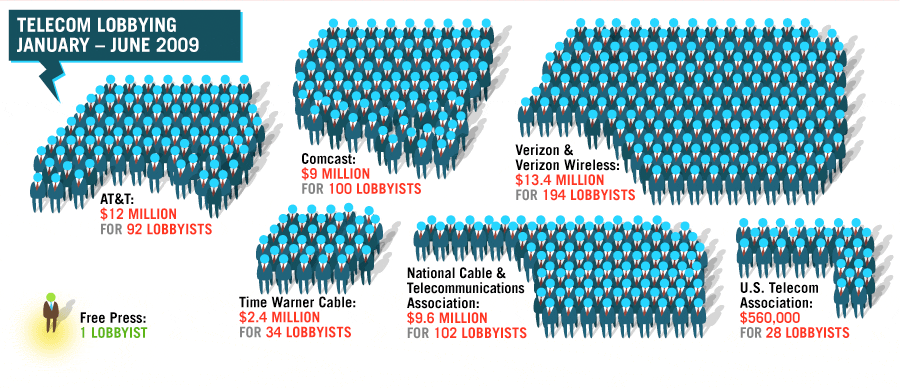
Free Press Illustrates the Telecom Industry's Lobbying Frenzy

Free Press Illustrates the Telecom Industry's Lobbying Frenzy

Internet Overcharging schemes are not dead, although some of the earlier experiments have been temporarily shelved.  Some smaller providers in rural and small cities are already engaged in usage caps combined with consumption billing.  AT&T continues its experiment in Beaumont and Reno.  Comcast celebrated its first anniversary of the 250GB usage cap by leaving it right where it is, unchanged.  Wireless mobile broadband is a 5GB capped experience all-around.

Although I realize it is difficult to generate intensity when there aren’t big bad actors imminently dropping Internet Overcharging on millions of broadband customers, this is not the time to keep the pressure off.  Let’s make sure providers realize the intense, red hot hatred of gas gauges, meters, and all of the other Overcharging schemes has not cooled a single degree.  You can do that by making another round of phone calls and sending messages to your member of Congress to support Rep. Eric Massa’s Broadband Internet Fairness Act (H.R. 2902.)

This bill does -not- get the government involved in regulating the pricing of broadband service, as some astroturfers have alleged.  It simply demands proof that a provider has a financial need to engage in these practices, and in the absence of independent verification, protects consumers by prohibiting providers from leveraging their de facto monopoly/duopoly status and imposing them anyway.

No government legislation alone is ever going to solve all of our broadband problems and concerns.  But some pro-consumer protections protect our wallets from the undercompetitive broadband industry most of us have to deal with.

Don’t be fooled by providers openly wondering why such protections are necessary.  It was ironic watching yesterday’s panel discussion on broadband when David Young from Verizon started asking what problem Net Neutrality was trying to solve.  He didn’t see any and had no problem living under the open platform standard Genachowski proposed.  That’s ironic because Verizon has nearly 200 paid lobbyists fighting Net Neutrality and related telecommunications policy spending well over $10 million dollars on it this year.  If Young doesn’t see the problem, why are ratepayers and shareholders footing the bill to address it?

Stop the Cap!’s First Anniversary: Protecting Consumers from Internet Overcharging Since July 31, 2008

Phillip Dampier

Phillip Dampier

Today is Stop the Cap!‘s first anniversary.  One year ago today, this website was launched with the news that Frontier Communications, the local telephone company in Rochester, New York and in dozens of mostly rural communities nationwide, had quietly changed its Acceptable Use Policy to define appropriate maximum usage of their DSL service at a measly 5GB per month.

The  boneheaded, out of touch decision was called out for what it was: a profiteering provider pilfering wallets of their broadband customers.

All the signs of a Money Party among cable and DSL providers at consumer expense were apparent last summer.  Time Warner Cable was experimenting with a consumption billing plan in Beaumont, Texas.  In Canada, rhetoric about “bit caps” was already being circulated, trying to convince Canadians that broadband service was somehow as difficult to provide there as it is in Australia and New Zealand, where such caps were already in place.

To bring limits, rationing quotas, and consumption based billing to the United States would require consumers to ignore massive profits broadband providers were harvesting quarter after quarter at existing prices.  But demands for big profits from Wall Street meant they had to come from somewhere, and for cable companies with eroding profits from their cable TV divisions, and telephone companies dealing with disconnect requests for wired telephone lines, broadband was their choice.

It seems that what was insanely profitable a decade ago, when cable modem and DSL service started to introduce Americans to broadband, would now simply be ‘piles of  cash stacked like cord wood’-profitable as traffic increased. As the broadband adoption rate increased, bandwidth costs plummeted, and several providers also proudly trumpeted their reduced investments in their networks as a hallmark of keeping “costs under control.”

Consumers began actually using their service for… broadband-specific services, at the encouragement of providers’ marketing departments, touting their “always on” connection at “blazing fast speeds” to download music, movies, play games, and more.  Network utilization increased, and providers want someone to pay for a “bandwidth crisis” that isn’t a crisis at all.  Responsible investment in network infrastructure should be a given, in recognition that at least a small portion of those growing profits must be spent on maintaining and improving service.

One year ago, I laid out what was before us:

Cable operators have been discussing implementing usage caps in several markets to control what they refer to as a “broadband crisis.” The industry has embarked on a lobbying campaign to convince Americans, with scant evidence and absolutely no independent analysis of their numbers, that the country is headed to a massive shortage in bandwidth in just a few short years, and that a tiny percentage of customers are hogging your bandwidth.

Frontier, ever the rascally competitor, has decided to one-up Time Warner’s Road Runner product by slapping on a usage cap now for DSL customers before Road Runner considers doing the same. And in a spectacularly stupid move competitively, they have implemented a draconian cap that even the cable industry wouldn’t try to implement.

Time Warner Cable “took one for the team,” according to industry-friendly Multichannel News, when it introduced a ludicrous Internet Overcharging experiment of its own announced this past April, which would have “saved” customers money by getting them to “pay for what they use.”  In fact, their plan proved my point last summer, following the same roadmap of “bandwidth crisis” to “heavy downloaders” to trying to squeeze customers for more money for upgrades they could easily have done with the enormous profits they already earn.

Their proposal would have made a deliciously profitable $50 a month Internet service now cost consumers $150 a month with absolutely zero improvement in service, speed, or performance.  But Wall Street would have been happy with the higher returns.

Some 400+ articles later, we’ve educated consumers across North America about the reality of Internet Overcharging.  Despite industry propaganda “education” efforts, astroturfing groups we’ve exposed as having direct connections with the telecommunications providers paying them to produce worthless studies, fear-mongering about Internet brownouts by equipment vendors with solutions to sell, and a hack-a-thon of formerly respectable broadband pioneers and ex-government officials who sold their credentials for a paycheck to lobby and spout industry propaganda, most consumers continue to reject overcharging for their broadband service.  Consumers instinctively know a cable company with a rate change always means a rate increase, and plans to “save people money” actually means they will “protect industry profits.”

We have achieved victory after victory in 2008-2009:

  • Fought back against Frontier’s boneheaded plan, and convinced them that DSL can compete best on price and flexibility — no usage cap has ever been enforced at Frontier, and today they are using Time Warner Cable’s blundering profiteering experiment against them in their marketing materials.  For rural Frontier customers with no other broadband provider, that’s a major relief from being stuck with one broadband option that rations their usage to ludicrously low levels.
  • Stopped Time Warner Cable’s experiment before it got off the ground in several “test cities.”  The people of Austin, San Antonio, Rochester, and the Triad region of North Carolina did Time Warner Cable customers nationwide a tremendous service in halting this experiment before it spread.  Our efforts even brought a United States Senator, Charles Schumer, to the front lawn of Time Warner Cable in Rochester to announce the nightmare was, at least for now, over.  We managed to even see an end to the overcharging of customers in Beaumont, Texas who lived through a summer, winter, and spring, overpaying for their broadband service.
  • We raised hell in the North Carolina state legislature, coming to the aid of Wilson and other communities in the state trying to get municipal broadband projects off the ground.  Communities across the state faced anti-consumer corporate protectionist legislation written by the telecommunications industry, introduced by willing elected officials who took big telecom money, and sold out their constituents.  We killed two bills, forced a sponsor of one such measure to repudiate his own bill, and gave major headaches to legislators that thought they could just cash those big checks, vote against your interests, and you’d never know.  Those days are over.
  • We helped bring legislation up in Congress to draw attention to the issue of Internet Overcharging, and have called out providers who want to use their marketing departments to lie to customers about their broadband costs and profits, while being considerably more honest with their shareholders in their quarterly financial reports.  Congressman Eric Massa’s legislation would demand companies show proof of the need to implement consumption based billing.  Indeed, as consumers find out how profitable broadband service is at today’s prices, they’ll never tolerate the profit padding providers seek with tomorrow’s caps/limits, penalties and fees, and unjustified tiers.

As you can see, Internet Overcharging is not a dead concept.  An educated consumer will recognize a swindle when they see one, and providers continue to test overcharging schemes in focus groups in different parts of the country.  They’ll use any analogy, from a buffet lunch to a toll road traveled by big trucks and little cars.  They’re looking for anything they can find to sucker you into believing paying more for your broadband service is fair.

Broadband service must be fast, affordable, and competitive.  In too many communities in Canada and the United States, a monopoly or duopoly marketplace has guaranteed none of those things.  In our second year, we must remain vigilant in our core mission to fight Internet Overcharging, but we also need to fight for more competition, regulation where competition does not exist, oversight over providers, and support for projects that will enhance broadband and make it more affordable than ever.  With your help, we can stand toe to toe with any provider, because the facts are on our side, not theirs, when it comes to Internet Overcharging schemes.

Welcome to Year Two!

Suddenly Caps? Suddenlink Introduces Usage Measuring Tool to “Help Customers”

greedy business man.

Suddenlink Usage FAQ:

On June 1, 2009, we notified residential Internet customers in our Clovis, New Mexico cable system of a new online tool to help them monitor their Internet usage each month and determine if they are in the typical usage range.

If they are well above the typical range, it could mean several things. For instance: a virus or “spyware” application might have infected a customer’s computer and started generating high levels of Internet traffic, or someone else might be using a customer’s Internet connection without his or her knowledge. To help guard against those issues, we are offering customers a list of steps they can consider, to help make sure their computers and Internet accounts are protected and secure.

We introduced this Internet usage summary tool in Clovis, to evaluate its usefulness, after which we will consider expanding it to all of Suddenlink’s residential Internet customers.

Longtime Stop the Cap! readers will recognize this trick only too well.  When a small cable operator spends its time, talent, and resources on “measuring tools” to help customers “determine if they are in the typical usage range,” it’s only a matter of time before that ‘experiment’ will turn into typical Internet Overcharging activity — usage caps, consumption-based pricing, overlimit fees and penalties, or service termination for those outside of that “typical usage range.”

Suddenlink, one of the nation’s smaller multiple cable system owners serving 1.3 million customers in mostly rural areas, is among the worst-rated providers in the country, based on actual customer reviews.  Its journey towards Internet Overcharging schemes will do its ratings no favor when customers find out.

Suddenlink’s approach is less brazen than earlier Internet Overcharging attempts consumers have fought back.  The company attempts to leverage the usual talking points about Internet activity into a justification for measurement tools, and cleverly tries to suggest the impetus for doing so is to protect customers who might have been hacked or have family members engaged in online activities unknown to others in the home.  But the road that measurement tools provided by a cable company pave today lead to limits and higher pricing tomorrow.

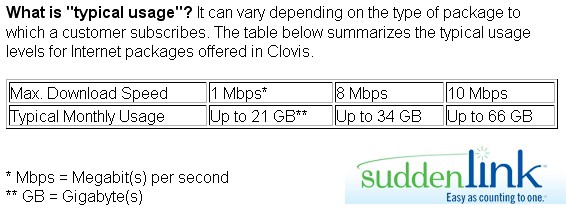
Suddenlink’s contribution to the “education campaign” consumers are being subjected to before the pickpocketing begins does bring some useful information to the table, however.  This small, mostly rural provider, turns in stunning statistics about average customer consumption:

Suddenlink Average User Consumption Statistics - Clovis, New Mexico (as on Suddenlink website 7/23/2009)

Suddenlink 'Typical Usage' Statistics - Clovis, New Mexico (Suddenlink website 7/23/2009)

Those numbers represent one of three things:

  1. Suddenlink is the first provider in a long list of providers producing honest statistics about broadband usage, not the low-ball estimates others have provided to make consumers feel guilty for exceeding them;
  2. Suddenlink’s statistics are wrong;
  3. People in Clovis download A LOT.

Just about every other major provider, and many small ones, have spent the past year telling the media and the public “the average user” consumes far less than what Suddenlink reports for Clovis, New Mexico:

  • Frontier Communications: “Today, the average residential customer on Frontier’s network uses 1.5 gigabytes of bandwidth each month.” — Ann Burr 10/10/2008
  • Time Warner Cable: “Our usage data show that about 30% of our customers use less than 1 GB per month.” — Landel Hobbs, COO 4/9/2009
  • Time Warner Cable Austin: ‘Users download between 5-6GB per month on average.’ — Scott Young, senior director of digital systems  10/2008
  • Comcast: “The average customer uses two to three gigabytes a month.” Jennifer Khoury, Comcast spokeswoman 10/29/2008
  • Sunflower Broadband: “Our average users, about 77%, use 6 gigabytes or less of bandwidth per month. Our high-end subscribers, about 2%, use 50 gigs or more.” Sunflower Broadband Website 7/23/2009
  • Bell (Canada): “Usage has increased… to more than 10GB (per average user) in 2008.” Bell Internet Usage Tutorial 7/23/2009

For the benefit of Suddenlink subscribers joining Stop the Cap! for the first time, here’s a road map for where things have traditionally gone among every other Internet provider that has introduced “measurement tools” for “your benefit” that were not beaten back by angry subscribers:

… Continue Reading

Call for Apple to Get Involved in Campaign Against Internet Overcharging

Phillip Dampier June 29, 2009 Data Caps, Public Policy & Gov't 14 Comments
sunflower

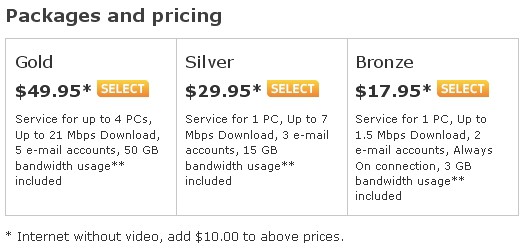
Sunflower Broadband Pricing - Note a $10/month surcharge applies for customers not subscribing to Sunflower's video package.

We’ve covered the story of Sunflower Broadband before here on Stop the Cap! This dubious provider has become well entrenched with its Internet Overcharging schemes in and around the Lawrence, Kansas region, charging top dollar pricing while imposing ridiculous limits on usage.  One Mac owner in the Lawrence area is fed up with Sunflower’s 3GB monthly usage limit for broadband users, charging a ludicrous $27.95 a month for standalone broadband service (that’s $9.32/GB!).  He’s calling on Apple Corporation to get involved in the opposition to price gouging and Internet Overcharging by providers like Sunflower.

Sunflower’s a big proponent of these pricing schemes.  Patrick Knorr, who works for Sunflower and is also ex-officio chair of American Cable Association, wants this kind of pricing for everyone.  No matter how much you consume, you are probably paying too little for your broadband account.  Sunflower’s pricing of its most deluxe Gold plan assumes you’ll never use more than 50GB per month, and for that charges customers $59.95 a month if all you want is broadband service.

Dave Greenbaum, writing for theAppleBlog, considers these kinds of limits to be abusive.

Apple is the leader in multimedia content creation; new Mac users are always pleasantly surprised by how easy it is to buy from the iTunes store, or create their own content. A common question we get in our local user group is “I’m not sure what I did wrong, but all of a sudden I have a substantial overage bill from my cable company.” Of course, the user did nothing wrong, other than subscribe to a few podcasts, and perhaps download a new Apple software update and buy some shows with iTunes! The Mac is also blessed with great online backup services like MobileMe, yet when our user group did a presentation on backup strategy, I had to warn novice users to be careful lest their backups end up costing them an arm and a leg in bandwidth overage fees!

Sunflower Broadband claims, with absolutely no independent verification, that nearly 50% of their customers consume less than ONE gigabyte per month and 98.9% of users had less than 40GB of bandwidth usage.  Of course, despite updates to its website, it curiously only provides statistics from April 2007, more than two years ago.

Greenbaum informs readers of Rep. Eric Massa’s proposed legislation, HR 2902, the Broadband Internet Fairness Act.

Ultimately, without an end to abusive broadband pricing, the implications for consumers go well beyond their own pocketbook:

Unfortunately, using the Internet normally with bandwidth metering is also unsustainable. When Mac owners are worried about downloading movies, doing backups or performing system updates, that hurts the Apple brand. Apple is continually innovating new ways to make the Mac OS the best Internet operating system, creating a whole ecosystem with iTunes, MobileMe and iLife. All of these great products rely on the ubiquity of the Internet. When Internet providers start making normal Internet use an expensive proposition, Mac users lose.

Apple should lead the way and come out against bandwidth caps. Given that many of the offerings on the iTunes store actually compete with cable TV, Apple should be vigilant that cable companies do not use bandwidth metering as a way to stifle alternative ways of viewing content.

Search This Site:

Contributions:

Recent Comments:

Your Account:

Stop the Cap!