Thanks for the Good Thoughts During This Difficult Time

Phillip Dampier December 29, 2011 Editorial & Site News 5 Comments

Thank you to all of our readers for understanding the diminished amount of content here for the last few weeks.  My father passed away last week and coping with that and the holidays has made it much more difficult to keep up with the normal publishing schedule.

I am hoping things start to return to normal next week, and appreciate the patience and kind thoughts from our loyal readers!


Verizon Wireless Will Charge Customers $2/Month to Pay Their Bill; Admin Fees Also Increasing

Verizon Wireless has tucked some unpleasant news into their “change of terms” notices buried on the back pages of your monthly bill.

Effective Jan. 12, the wireless carrier will charge a $2 “convenience fee” when paying by phone or through Verizon’s website.  Only customers enrolled in autopay, authorize an electronic check payment, or who still mail a check to the phone company every month will escape the new bill padding fee.

Most likely impacted are customers who make their payment at the last minute or face disconnection over an overdue bill if they don’t authorize a partial payment immediately.  Verizon says the new fee will defray the costs of accepting online and phone payments, but considering an automated attendant usually handles pay-by-phone bill payments, the costs to Verizon are likely far less than the revenue the company stands to earn from the new fee.

Verizon Wireless’ “administrative fee” is also increasing, effective Jan. 1:

Notice Of Administrative Charge Increase
Effective 1/1/2012, the monthly Verizon Wireless Administrative Charge
for voice and email plans will increase from $0.83 to $0.99 per line for all
eligible customers. The charge for Mobile Broadband customers will
remain at $.06. For information regarding this charge, call
1-888-684-1888. Please consult your Customer Agreement for
information about rate changes.

More money in Verizon's pocket

While we used to indicate these changes were enough to allow customers to escape their two-year contracts under the “materially adverse” clause in the company’s subscriber agreement, Verizon considers that loophole effectively closed with the current terms and conditions made effective this past September:

What Charges Are Set by Verizon Wireless?
You agree to pay all access, usage and other charges that you or the user of your wireless device incurred. For Postpay Service, our charges also include Federal Universal Service, Regulatory and Administrative Charges, and we may also include other charges related to our governmental costs. We set these charges; they aren’t taxes, they aren’t required by law, they are not necessarily related to anything the government does, they are kept by us in whole or in part, and the amounts and what they pay for may change.

However, nobody says you have to agree to pay them.  If you call or write Verizon Wireless before 1/1/12 and tell them you do not agree to pay the increased fee and consider it materially adverse and grounds for terminating your service, customer service representatives have been authorized to refund the difference between the old and new administrative fee for the remainder of your two-year contract (or a straight $5 courtesy credit in some instances).

Stop the Cap! recommends using autopay for your monthly Verizon bill, and if you are in the habit of paying your credit card bill in full every month, associate your Verizon account with a credit card that offers a rewards program.  With cell bills routinely running $100 or more, earning something extra from a cashback or airline miles card is better than nothing.  Just make sure you don’t run a balance.  The interest rate charged on most rewards cards is well in excess of the value of the reward.

Tired of the gouging?  You can e-mail Verizon Wireless’ executive customer service team and let them know what you think:

[email protected]
[email protected]
[email protected]
[email protected]

Then tell the FCC, your two senators, and member of Congress.

Verizon’s Anti-Aggression Treaty With Big Cable May Be the End of FiOS

Ebenezer Scrooge could successfully serve as the CEO of any large telecommunications company these days, and the New York Times knows a Christmas tale of woe when it sees one.  That is why the venerable newspaper printed a Christmas Eve editorial blasting Verizon’s new “non-aggression treaty” with America’s largest cable companies that puts coal in the stocking for any Verizon customer waiting for FiOS fiber-to-the-home service.  The newspaper believes the days of FiOS are numbered:

Verizon — Verizon Wireless’s main shareholder — relieved itself of the need to expand FiOS, its high-speed, fiber optic network, beyond the 18 million homes it set out to reach six years ago, a rollout that cost $23 billion. For the other 114 million homes in the country, it can simply bundle its wireless service with the cable and wireline broadband services of its partners. The agreement between Verizon and the cable carriers includes a joint venture to develop technology to integrate the wireline and wireless platforms.

Verizon’s cable deals squashed hopes that cable carriers’ purchases of wireless spectrum would lead to more competition against the dominant players, AT&T and Verizon Wireless. And it puts in doubt whether FiOS will ever be a serious competitor to cable, reducing the likelihood that video transmitted over broadband could break up cable’s regional oligopolies.

[…] Verizon’s deals suggest a future in which cable carriers will get uncontested control of high-speed broadband into the home while AT&T and Verizon will get uncontested control over wireless. For consumers with expensive wireless plans, pricey bundles of cable channels and costly, slow broadband, this does not look like good news.

Verizon’s economic future lies in the lucrative world of wireless.  Its FiOS network was an expensive gamble to reinvent its antiquated telephone network to drive customers to keep their landlines and spent a hundred dollars more on video entertainment and super fast broadband.  Wall Street hated the price and loathed the potential for costly competition that would force earnings down through aggressive price-cutting.  In some markets, Verizon FiOS has forced Comcast, Cablevision, and Time Warner Cable to be a little more generous with broadband speed and lighten up a little on the annual rate increases.

But convincing cable customers to switch remains a difficult proposition even when Verizon offers the superior service.  Verizon has not achieved the level of penetration it expected in many markets.  In short, people just don’t want to wait around for installers.  Besides, cable companies slash prices for customers threatening to depart.

Verizon’s deal with Time Warner and Comcast delivers Verizon Wireless desirable spectrum.  But the agreement to cross-market and cross-bundle product lines smacks of collusion, and is exactly the kind of turf protection that has kept cable companies from competing head-to-head with each other for more than three decades.  Is it more lucrative for Verizon to build out its FiOS network to compete or simply refer people to Time Warner or Cablevision for cable TV.  So long as cable doesn’t offer a competing wireless product, Verizon seems to think there is little harm done.

But for consumers, the absence of competition brings rate increases, reduced innovation, and declining customer service.

The one thing the telecom marketplace needs less of is the “take it or leave it” attitude that earned the scorn of cable customers everywhere.

Broadband Blindness: How North American Providers Set Us Up for Failure

[flv width=”640″ height=”380″]http://www.phillipdampier.com/video/Broadband Blindness.flv[/flv]

Toast Sacramento produced this 28-minute documentary which succinctly tells the story of North American broadband, and how commercial providers have set us up for long-term failure, especially in rural and suburban areas.  Whether you live in the United States or Canada, phone and cable companies dominate the telecommunications landscape.  Unlike other modern-day necessities, broadband is almost entirely in the hands of an unregulated free market that fails millions.  Where competition exists, customers can get reasonably fast service, but it costs more than it should.  Where competition is hard to find: slow speeds, spotty access, and out-of-sight prices predominate.

The documentary explores:

  • the neglect of suburban and rural DSL from large phone companies like AT&T;
  • how phony, industry-influenced broadband availability maps convince public officials there isn’t a big broadband problem;
  • why the country’s broadband demands may be too great for providers to handle without major new investments, leading to usage limits and slowdowns to delay needed upgrades;
  • and how the latest broadband technologies being installed overseas fall victim to Wall Street temper tantrums back home.

Bell’s Misleading Ads: “Fibe TV: State-of-the-Art Fibre Optic Network” That Isn’t

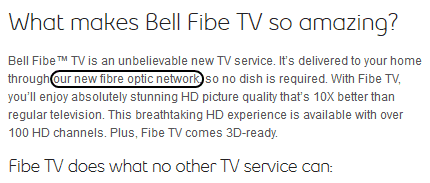
Bell Canada is misleading potential customers when mailing them invitations to sign up for Fibe TV, which the company calls “a new TV service delivered through our new state-of-the-art fibre optic network.”

Only it isn’t “state of the art” or fiber to the home.

Bell characterizes its Fibe service as Canada’s “most advanced” telecommunications network, even better than traditional cable television.  But in fact, it’s a marriage between fiber optics and the decades-old copper wire phone network Bell continues to rely on to provide a triple-play package of phone, broadband, and television, all without investing in superior fiber to the home technology.

Only it's not a true fiber network.

That the company claims it is running the most advanced network in the country must come as quite a surprise to Bell Aliant, the dominant provider in Atlantic Canada.  Aliant is busily building a true fiber-to-the-home network for at least 600,000 customers in the most eastern part of the country.

While Fibe is an evolutionary move for Bell Canada, it is hardly revolutionary because of its dependence on traditional copper phone lines.  Canada remains behind the United States in deploying fiber technology of all kinds, including Fibe‘s fiber-to-the-neighborhood system.  Bell’s closest cousin AT&T has been running its own comparable U-verse system for a few years now.

Providers like the benefits of fiber-to-the-neighborhood technology and the fact it costs considerably less than rewiring every home for fiber optic connections.  Fibe can deliver speedier broadband than traditional DSL, but cable operators like Rogers and Videotron are already positioned to beat Fibe speeds, and a true fiber to the home network can beat anything on offer.

Phone and cable companies in the United States who have pitched older technology as a “state of the art fiber network” without actually providing one have been challenged by true fiber to the home competitors like Verizon, and forced to retreat.  But with so few Canadian providers in a position to challenge Bell’s fiber claims, it will be up to regulators to declare the advertising and marketing materials misleading.

Search This Site:

Contributions:

Recent Comments:

Your Account:

Stop the Cap!