AT&T Drops the Ball in the Dakotas and Montana: Customers Forced Off Alltel Regret It

Alltel Service Areas Sold by Verizon Wireless to AT&T

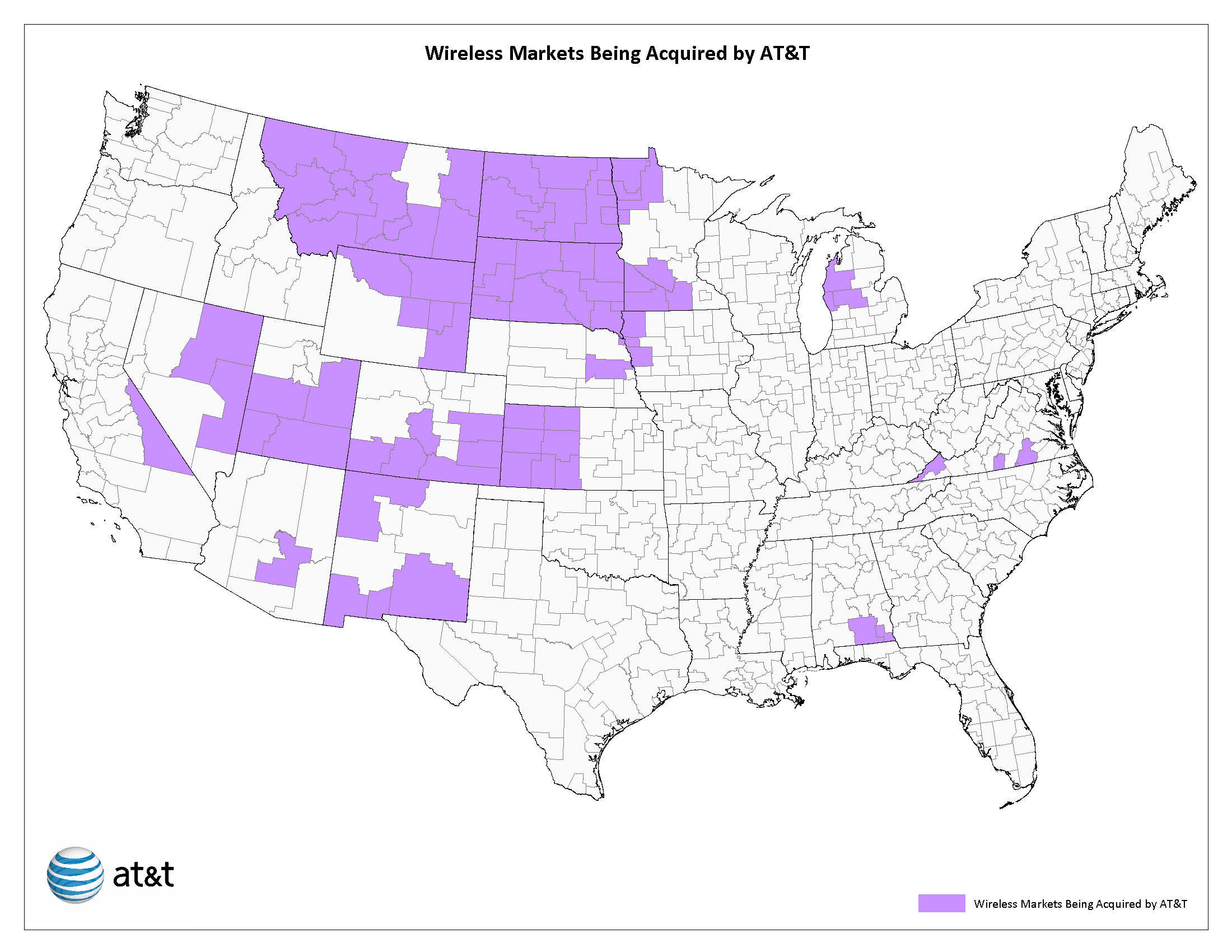
When Verizon Wireless won approval of its takeover deal with formerly-independent wireless carrier Alltel, the federal government required Verizon to divest itself of Alltel’s assets in areas where the combined company would have a mega-share of the local wireless market.  The majority of affected customers, particularly in Montana and the Dakotas, were eventually acquired by AT&T, which uses a completely different network standard.  Customers were handed new phones that work on AT&T’s GSM network, but have since discovered those phones have little use in wide areas where AT&T simply doesn’t deliver a signal.

Even worse, Verizon’s robust network across the region is off-limits for roaming purposes, forcing customers that were perfectly satisfied with Alltel ready to throw their AT&T phones off Mount Rushmore.

“We got stuck with AT&T, which doesn’t care about the rural areas,” Mark Freeman of Harlowtown, Montana told a visiting reporter with the Wall Street Journal.

In the Black Hills, where AT&T’s network is as spartan as the landscape, some customers waited months before they could actually make and receive phone calls in places where Alltel’s old network (and their roaming agreement with Verizon Wireless) suited local residents just fine.

“We’ve been getting dropped calls, missed calls, and [have trouble] servicing [ATM] machines,” said Bill Huffman, an armored car worker in Sioux Falls frustrated by AT&T.  Area ATM machines depend on AT&T’s wireless network to alert drivers when local cash machines run low.  But AT&T’s network isn’t dependable, according to Huffman.

Ironically, customers are flocking to the carrier that would have been their new provider to begin with if not for the federal government divestiture order: Verizon Wireless.

http://www.phillipdampier.com/video/WSJ In South Dakota Dropped Calls and Dead Spots 11-27-11.flv

Verizon Wireless stores in the region have suffered periodic equipment shortages ever since AT&T switched on their own, less satisfactory network.  That’s because AT&T customers are dropping their contracts at a rate rivaling the number of calls AT&T itself drops across the region.  The Wall Street Journal visits with perturbed local residents in Montana and South Dakota.  (4 minutes)

Share

FCC Releases Report Slamming AT&T/T-Mobile Deal As a Job and Competition Killer

The Federal Communications Commission has concluded allowing AT&T and T-Mobile to merge will cause huge job losses and knock out a vital wireless competitor in an increasingly concentrated U.S. wireless marketplace.

The new 266-page document, produced by FCC staffers, directly challenges AT&T’s contention that the merger will bring about job creation and an improved mobile broadband network for millions of rural Americans.

The report comes on the heels of news the Commission will allow the FCC to withdraw its pending application before the FCC to win approval of the merger.  That allows the company to resubmit the merger request at a later date.

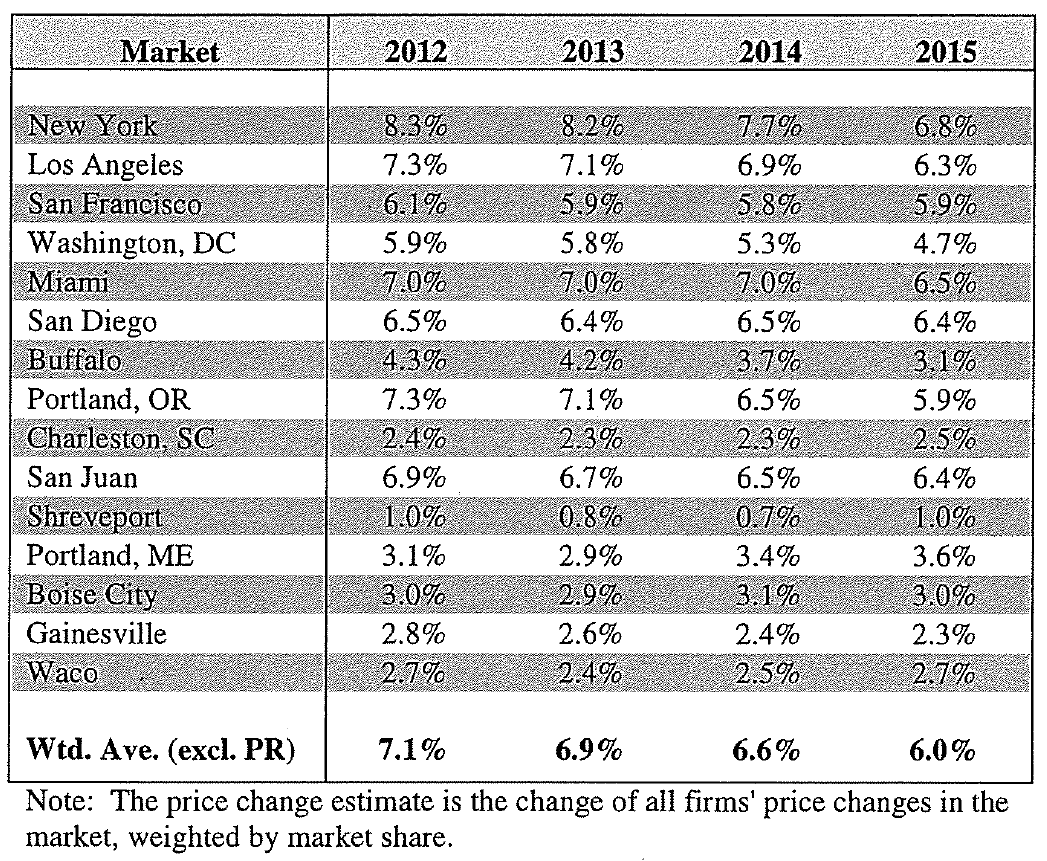
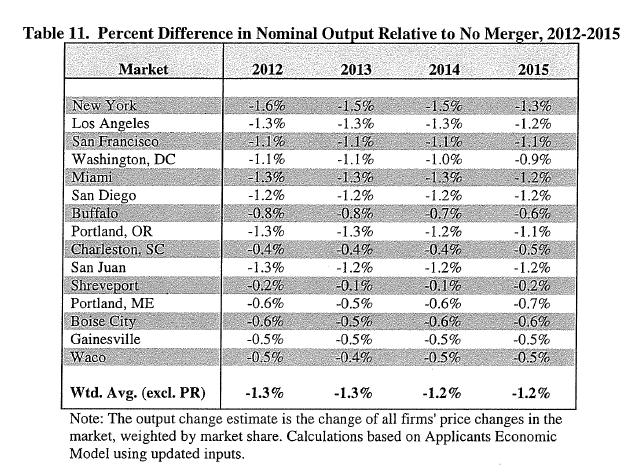
The FCC determined prices will increase an average of 6-7% in these cities if the merger deal gets approved.

The new report, occasionally redacted to remove competitive information, found AT&T vastly exaggerating the benefits of the deal, questioning whether it would indeed lead to lower prices for consumers, bring about enhanced service, and create new jobs.

Overall, the agency concludes, AT&T and T-Mobile have failed to meet their burden of proof that the merger is in the public interest.  The FCC staffers found no compelling reason why AT&T needed T-Mobile to build out its 4G network to the majority of the country.  Indeed, memos accidentally leaked to the Commission by AT&T’s legal team suggested AT&T executives rejected expansion plans as too costly.  Instead, they proposed a $39 billion dollar merger with T-Mobile with a $6 billion deal cancellation clause.  That penalty exceeds the $3.8 billion AT&T rejected spending to pursue 4G upgrades on its own.

Among the Commission report’s findings:

  • The merger would increasingly concentrate the U.S. wireless marketplace, leading to unilateral and coordinated efforts to raise prices by remaining carriers;
  • Roaming agreements for remaining smaller and regional carriers could become more difficult and expensive to reach with fewer players in the marketplace;
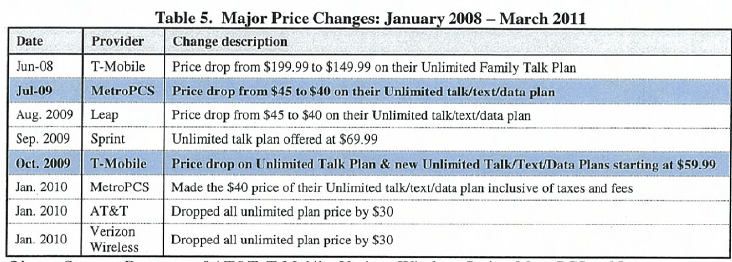
  • Pricing innovation, a hallmark of T-Mobile, would be lost.  T-Mobile is cited by the FCC as one of America’s most-disruptive carriers, forcing other companies to match their aggressive offers;
  • Despite AT&T’s promises to grandfather existing T-Mobile customers to their existing plans, customers would be unable to upgrade to an equally innovative plan T-Mobile probably would have offered on its own.  Instead, customers would be forced to choose one of AT&T’s more expensive, traditional plans;
  • AT&T is overstating the importance of remaining competitors, especially regional carriers and Leap Wireless’ Cricket and MetroPCS, which all have a negligible market share and depend heavily on roaming agreements with companies like Verizon, Sprint, and AT&T to survive;
  • Substantial evidence exists to believe without T-Mobile, AT&T and Verizon Wireless would likely raise prices and mimic each others’ respective service plans, pricing, usage allowances, and network policies;
  • Sprint will probably be forced to raise prices as a consequence of the merger to pay for increasingly expensive backhaul and roaming services, often purchased from AT&T or Verizon.  Sprint would also be pressured by market forces into pricing its services closer to AT&T and Verizon, if only to pay for handset and subscriber acquisition costs.  Sprint’s new customers often come from T-Mobile or smaller providers — less often from AT&T and Verizon.
  • AT&T did not submit sufficient evidence to demonstrate the combination of T-Mobile and AT&T’s cell sites would substantially relieve congestion issues, especially in America’s largest cities where AT&T’s network issues are the worst;
  • AT&T’s own documents suggest the company will fire most of T-Mobile’s customer service staff post-merger, leading ironically to the loss of a customer service support unit that has a higher customer satisfaction rating than AT&T itself.  Not only would T-Mobile customers be forced to deal with AT&T’s customer service, AT&T customers will have to compete with millions of T-Mobile customers for the time and attention of AT&T’s existing customer service representatives — a recipe for a congestion of a different kind;
  • Much of the cost savings realized from the merger, earned from laying off T-Mobile workers, closing T-Mobile retail stores, terminating reseller agreements, and unifying billing, administration, and network technologies, will be realized by AT&T (and its shareholders), not average customers.  The end effect for consumers will be higher prices and a deteriorating level of customer service.

Smaller, scrappier carriers with aggressive pricing have historically forced larger companies like AT&T and Verizon to compete by lowering prices and offering more generous calling and data plans.

The report angered AT&T’s chief lobbyist, Jim Cicconi, who called its release “troubling” because, in his words, it represents a “staff draft” not voted on by the Commission as a whole.

“It has no force or effect under the law, which raises questions as to why the FCC would choose to release it,” Cicconi said in a statement. “The draft report has also not been made available to AT&T prior to today, so we have had no opportunity to address or rebut its claims, which makes its release all the more improper.”

But the report’s substantial research suggests FCC staffers have taken a very close look at the arguments and the evidence submitted by AT&T, T-Mobile and opponents of the deal.  The findings only favor AT&T and T-Mobile with a mild agreement that combining resources in certain markets where both compete might reduce network redundancy.  But the cost to consumers is way too high, the report concludes.

Sprint couldn’t be happier with the report’s findings, saying in a statement:

“The investigation’s findings are clear. Approval of AT&T’s bid for T-Mobile would lead to higher prices for consumers, eliminate jobs, harm competition, and dampen innovation across the wireless industry.”

An unredacted copy of the findings will be available to the U.S. Department of Justice for its consideration as it presses its own legal case against AT&T to derail the merger on anti-competitive grounds.

Should T-Mobile remain independent, the FCC says wireless prices will decline.

Share

Internet Overcharging: “The Best Thing That Ever Happened to the Cable Industry”

Internet Overcharging schemes bring even more profits to a cable industry that already enjoys a 95% gross margin on broadband service.

At least one major national cable company plans to implement a usage-based billing system in the coming year, predicts Sanford Bernstein analyst Craig Moffett.  Bloomberg News quotes Moffett in a piece that thinly references Time Warner Cable as that operator, whose CEO strongly believes in further monetizing broadband usage.

Moffett is among the chief cheerleaders hoping to see operators charge customers additional fees for their use of the Internet.

“In the end, it will be the best thing that ever happened to the cable industry,” Moffett said.

For customers, DISH Satellite chairman Charlie Ergen predicts it will lead to at least a $20 monthly surcharge for broadband users who watch online video, which could bring already sky-high broadband pricing to an unprecedented $70-80 a month, the same amount most cable operators now charge for standard digital cable-TV service.

The cable industry’s interest in being in the cable television business has waned recently as subscribers increasingly turn away from expensive cable packages.  Now companies that used to consider broadband a mildly-profitable add-0n increasingly see Internet access as the new mainstay (and profit center) of their business.

Time Warner Cable, for example, wasn’t even sure its entry in the broadband business in the late 90s would ever amount to much.  Fast forward a dozen years, and it is an entirely different story:

“We’re basically a broadband provider,” Peter Stern, chief strategy officer for New York-based Time Warner Cable, said Nov. 17 at the Future of Television conference in New York. “As a convenience for our customers, we package and distribute television and provide service around that.”

Bloomberg reports the cable industry profit margin on broadband is nearly 95 percent, a testament to the lack of competitive pressure on Internet pricing.  The industry is going where the money is to make up for increasing challenges to their video business, which currently “only” brings them a 60 percent profit margin.

Suddenlink, already enjoying a 12 percent increase in broadband revenue in the last quarter alone, is implementing its own Internet Overcharging scheme, charging $10 for every 50GB a customer exceeds their arbitrary usage allowance.  That, despite the fact CEO Jerry Kent admits Suddenlink’s broadband margins are double those earned from the cable company’s video business.

Complicit in the parade to Internet Overcharging is Federal Communications Commission chairman Julius Genachowski, who publicly supported usage-based pricing in public statements made last December.  Cable operators were fearful Genachowski might lump the pricing scheme in with the Net Neutrality debate.  Providers have since used Genachowski’s loophole in an end run around Net Neutrality.  If providers cannot keep high volume video traffic from competitors like Netflix off their networks, they can simply make using those services untenable on the consumer side by increasing broadband pricing, already far more expensive than in other parts of the world.

That is a lesson already learned in Canada, where phone and cable companies routinely limit usage and slap overlimit fees on consumers who cross the usage allowance line.  Canada’s broadband ranking has been deteriorating ever since.

Moffett - The chief cheerleader for Internet Overcharging

Bloomberg says such a pricing regime would discourage investment in online video products that currently are held responsible for some cable cord-cutting:

“It’s the reason why Apple or Google would inevitably be reticent about committing a significant amount of capital to an online video model,” Moffett told Bloomberg. “You can’t simply assume just because you can buy the content more cheaply, you can offer a product that’s cheaper to the end user.”

The only way around this might be video providers like Google getting into the broadband business themselves, something Google is experimenting with in Kansas City.  Google’s “Think Big With a Gig” project is partly designed to prove gigabit broadband delivered over a fiber network is practical and doesn’t have to be unaffordable for consumers.  It will also finally bring competitive pressure on a comfortable broadband duopoly, at least for residents in one city.

So far, video providers who depend on an Internet distribution model are not putting much money in the fight against usage-billing.  Instead, companies like Netflix are releasing occasional press releases that decry the practice.

“[Usage billing] is not in the consumer’s best interest as consumers deserve unfettered access to a robust Internet at reasonable rates,” Steve Swasey, a Netflix spokesman, said previously.

It is clear consumers despise usage pricing.  In every survey conducted, a majority of respondents oppose limits on their broadband usage, especially at today’s prices.  But that may not be enough to get companies like Time Warner Cable to back off.  The company has reportedly been quietly testing usage meters since last summer.  CEO Glenn Britt, with a considerable drumbeat of support from Wall Street analysts like Mr. Bernstein, has never shelved the concept of usage pricing, seeing it more lucrative than hard usage caps.  The company retreated from a 2009 plan to charge up to $150 a month for flat rate access after consumers rebelled over planned trials in Texas, North Carolina, and New York.

But without a solid message of opposition from consumers, and an about-face from an FCC chairman that should know better, they’ll be back looking for more money soon enough.

[Thanks to regular Stop the Cap! reader Ron for sharing the news.]

Share

Time Running Out on New England Cable/Phone Customers Seeking Storm-Related Credits

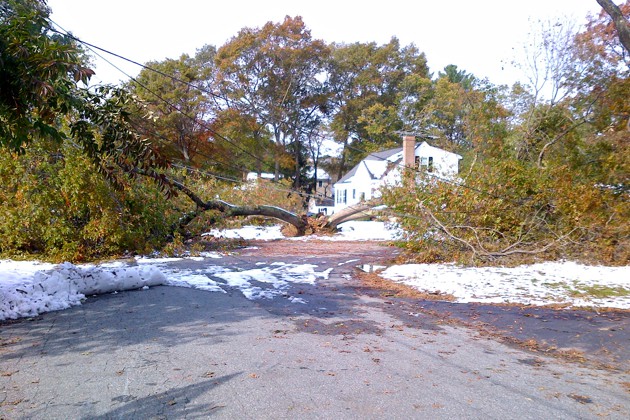
Storm damage in eastern Massachusetts. (Courtesy: WGBH Boston)

The northeastern United States got more than its fair share of severe storms these past few months.  Remnants of Hurricane Irene caused severe flooding, heavy rainstorms that followed didn’t help.  But one of the worst of all was the Halloween Nor’easter that left serious wind damage in some areas, heavy snowfall in others, leaving customers without power, phone, cable, and broadband service for days, if not weeks.

Telecommunications companies including Cablevision, Charter Communications, Comcast, Cox Communications, Dish Network, Time Warner Cable, and Metrocast Communications of Connecticut are under fire across the region for not providing automatic service credits for impacted customers.  Charter and Comcast are both facing a class action lawsuit filed last week by a Massachusetts law firm that accuses the cable operators of “gouging” their customers by not automatically crediting affected subscribers for lost service.

Jeffrey Morneau of Springfield, Mass. law firm Connor, Morneau & Olin says up to 1.2 million Charter and Comcast customers were without service, but the companies will only provide credits on a case-by-case basis, and only if customers request them within a short time after the outage occurred.

“If you pay for a service and you don’t get it, the company can’t keep your money,” Morneau said.

Stop the Cap! readers in Massachusetts and New Hampshire report Comcast will grant reasonable service credit requests, assuming you get through to ask for them.

“Hold times are epic,” reports Tom Turlin, a Comcast customer in Massachusetts.  “I managed to get my credit by using their web contact form instead.”

Most providers require consumers to request credits for outages within 30-60 days of the service interruption, and time is running out for Nor’easter credits.

“Most people think they will only get 50 cents back so why bother, but actually with today’s huge cable bills, credits can be substantial,” Turlin says. “I received almost $15 back on my bill.”

Only AT&T, Connecticut’s largest phone company, agreed to automatically credit customers the company determined were without service for at least 24 hours.  Customers who don’t receive credit automatically can appeal to the company for credit they believe they are entitled to receive.

Here’s how different companies are responding:

AT&T: “We will give U-verse TV customers in Connecticut who experience a service outage for longer than 24 hours a pro-rated credit,” AT&T said. “In addition, we will voluntarily give similar credits for U-verse Voice and U-verse High Speed Internet service customers who experienced a service outage for longer than 24 hours. Customers are not required to take any action: the credits will be applied automatically on the customer bill for impacted customers within the next several billing cycles.”

Cablevision: “While state law provides for consumer credits for qualifying outages for cable service only, Cablevision has been providing a credit to customers on an individualized basis for all their services,” Cablevision said. “Customers will be credited when they notify us that they had a service outage. We are extending our normal period to request refunds to 45 days from the date of the storm.”

Charter: Customers must call or visit the cable company offices in person to request service credit.  “We are providing credit to customers for the entire time they were without service, from the time they lost power to the time their Charter services were fully restored, and we are providing credit for all services,” Charter said.

Comcast: “In order to receive a credit, a customer must contact Comcast and identify the time period during which they did not have access to Comcast services,” Comcast said.

Cox: “We need our customers to call us after their service is restored to report that they were without Cox services, and for how long,” Cox said. “We then credit their accounts from the time of the service outage until service was actually restored.”

DISH Network: The satellite provider is waiving service and equipment fees for consumers who need their equipment realigned, reinstalled or repaired due to the storm. “DISH subscribers who indicated that they were without service due to the storm were provided a credit for their time without service,” DISH said. “In addition, DISH subscribers who needed to suspend their service due to storm damage were allowed to do so at no charge.”

MetroCast Communications of Connecticut: It will provide customers with a refund on their next invoice after contacting the company. “The credit equals a prorated amount of the affected customer’s monthly charges for all MetroCast services, calculated based on the number of days during which such services were interrupted, and are included in the customer’s next invoice,” MetroCast said.

Time Warner Cable: Customers must contact the cable company online, by e-mail or phone and request credit for the number of days they were without service.  Most service credit requests that can be verified are granted within hours, and will appear on the next billing statement.

http://www.phillipdampier.com/video/WSHM Springfield City councilor Comcast disagree on cable rebates 11-21-11.mp4

WSHM in Springfield covers the ongoing dispute city officials have with Comcast, who is refusing to automatically provide storm credits to customers impacted by the October Nor’easter.  (2 minutes)

Share

CommSpeed: Yesterday’s Internet, Tomorrow — Another Internet Overcharging Scheme

Stop the Cap! reader Davey in Arizona was displeased to receive notification his Internet Service Provider, CommSpeed, suddenly announced an Internet Overcharging scheme that limits customers to two levels of service: a basic $40 plan with a ridiculously stingy 10GB monthly usage allowance, or a more generous (and double the price) $60 plan that comes with a 200GB usage cap.

Davey is particularly upset the company plans to punish customers who exceed the allowance with a stinging $2/GB overlimit fee.  It will not be difficult for customers to blow past  CommSpeed’s standard 10GB plan limit if they discover file backup, online video, or downloading.  If they do, CommSpeed’s overlimit fee will be coming soon to a bill in their mailbox. For those who use the Internet to watch television and movies, the only real options are to watch less or upgrade to a more expensive plan with a more realistic usage allowance that can accommodate high bandwidth applications.

CommSpeed claims their “advanced 4G network combines the best features of cellular, cable modem & DSL, and Wi-Fi networks, without the inherent limitations associated with these legacy systems.”  The company brands itself as “Tomorrow’s Internet Today.”

What they don’t mention is today’s wireless ISP’s are increasingly challenged by the growing usage demands consumers place on providers.  CommSpeed’s claim that their network “was designed and built, from inception, to deliver a full range of broadband content and applications” flies in the face of their 10GB usage limit. Fiber, cable broadband and even telephone company DSL has a better track record handling increasing usage demands, as long as providers maintain investments in their respective networks.

CommSpeed’s usage cap tells the real story — their network may not be able to handle the growing traffic from customers in their northern Arizona service area.

“The Internet has seen tremendous growth in total usage over the last year. New applications are being developed everyday and these applications are causing an ever increasing demand for bandwidth. Quite simply, the content of the Internet has evolved,” CommSpeed explains on a page dedicated to explaining their new caps.

Unfortunately for wireless, until more spectrum and better technology is available, usage limitations are an increasing reality for customers stuck using these networks. It’s why Stop the Cap! rarely recommends wireless broadband as a primary Internet service except as a last resort, when other choices simply are not available.

Still, we’ve seen much worse from other Wireless ISPs.  CommSpeed’s 200GB limit on their $60 tier is more generous than average.  Plus, the company takes the limits off during the overnight hours of midnight to 6AM.

We also think the company’s usage guestimates are a more honest approximation of real-world usage, not the ridiculous “send 10,000,000 e-mails and download 500,000 songs” reassurances we usually see from Internet Overcharging ISPs:

Average user with a 10GB allowance
Total Gigabytes Used = 9.9GB
Actual internet consumption may vary.
Per Month Total Bandwidth Consumed
General Internet Browsing 100 hours 500MB
Email Communication (total sent/received) 400 emails 20MB
Internet Phone Service 500 minutes 1.1GB
Music Downloads 100 Tracks 600MB
Movie Streaming 3 movies 6GB
Online Gaming 100 hours 1.5GB

CommSpeed’s old plans ranged in price from $34.95 for basic 768kbps-1.5Mbps service to $54.90 for 1.5-6Mbps service, depending on the technology in use in the area. The new plans bring a $5 rate hike and usage caps — just two reasons why customers like Davey are so upset. They’ll be even more upset if their bill also include overlimit fees. Stay tuned.

http://www.phillipdampier.com/video/CommSpeed 4G -- Tomorrow's Internet Today.flv

CommSpeed heavily promotes its newer 4G wireless broadband service, claiming its great for online video, downloading, gaming, and more, as long as you don’t use it too much.  In 2012, CommSpeed throws up limits on their wireless experience.  (3 minutes)

Share

Dear Valued Time Warner Cable Customer: Pay Us More… Or Not — Here’s How

Pay $160 a month... or $89.99

Time Warner Cable attached their new rate schedule to my November cable bill which arrived in the mail last week.  It’s the second major rate increase in western New York this year, and it means customers who just want to watch standard basic cable television will now pay $80.50 a month to do so.  We’re a long, LONG way from the $20 cable TV package the industry used to advertise as “less expensive than a cup of coffee a day.”  This is Starbucks’ coffee pricing, with no end in sight.

Time Warner Cable’s Triple-Play package of phone, Internet, and television service will now run $160.49 a month here in Rochester.  It wasn’t too long ago that a bill that size was reserved for the gas and electric company, or perhaps for a used car payment.  That’s before taxes, franchise fees, and other pad-ons, too.  Need that extra set top box?  Add another $7 a month each with remote control.  Want to speed up your broadband?  $10 a month for that.  HBO?  Time Warner Cable’s premium channel-pricing completely ignores today’s economic and marketplace (Netflix/Redbox) realities.

The cable company does have competition in the television business. In the same day’s mail was the latest offer from DirecTV, which has nearly as many sneaky extra fees as local phone company Frontier Communications.  That $24.99 a month “amazing deal” starts to snowball as you build a package, and it also means a satellite dish on your roof, which some people just don’t want.

Assuming you stick with the cable company’s triple play package, the sobering truth is that doing business with Time Warner at their everyday-high-pricing will cost you at least $1,920 a year.  But you don’t always have to pay them the asking price.

So with rate increase notice in hand, what can you do?

1. Call them up and tell them the relationship is over unless changes are made.  Good things come to those who wait for the other side of the relationship to start sacrificing for a change.  You’ve coped with rate hikes for years and cable companies keep shoveling more channels you never watch and then raise rates because of “increased programming costs.” This time, let the cable company give a little.  Call and tell them you want to disconnect your service two weeks from today.  A retention specialist will attempt to negotiate with you (starting with efforts to pare down your package, leaving you still paying regular price for fewer services).  Be non-committal,  because better deals will start to arrive by phone as early as a few hours after telling them you’re leaving.  (But you have to answer those unfamiliar Caller-ID calls to hear about them.)  The worst that will happen is you don’t win a significantly better deal. You still have two weeks to rescind the cancel request with no interruption in service and at least get something for your efforts.  Consolation prizes to sweeten a mediocre retention deal: free sample of premium channels, a free Turbo-class upgrade for Road Runner, and/or a break on DVR service.

2. Compare prices.  If you live in an area with telephone company-delivered TV, offer to stay with the cable company if they will match the new customer offers you are probably already getting pelted with in your mailbox.  Most will.  There are customers who literally bounce back and forth between AT&T/Verizon and Comcast/Time Warner Cable year after year just to keep the $89-99 triple-play promotional price that effectively never expires.  Getting your existing provider to match it saves you and your provider the time and hassle of switching.

3. Demand a new customer price.  Do a Google search for “Time Warner Cable deals” (or for your respective cable company) and at least a dozen offers will appear, mostly from third-party, authorized resellers.  Double-play offers for broadband and cable-TV often range between $75-85.  A triple play offer which adds phone service is usually just a few dollars more.  Some resellers pitch combo offers that deliver a discounted rate and a substantial rebate ($150), like the one below:

TURBO INTERNET, TV+HD, VOICE


  • Free DVR Service for 12 months
  • You Get $150 in Rebates!
  • No Fee HD
Features:

  • Digital Cable with Free On Demand Programming
  • On-Screen Program Guide
  • Parental Controls
  • Blazing High Speed Internet
  • Unlimited Calling anywhere in the US
  • No-Hassle standard Installation
  • Call Waiting, Caller ID, Call Forwarding and more are included at no extra charge
  • Plus You Get A 3 Month Free Trial of HD Service!
only
$99.99/mo
for 12 month

Ask Time Warner to match the price of these offers (you likely won’t get the rebate, however).  They certainly can come close on retention deals — in fact they will go as low as $85 a month for an annual triple play deal in some areas.

Some customers deal with intransigent retention agents by canceling service and quickly signing up as a new customer soon after.  That is more of a hassle, and some areas require a waiting period before they’ll offer a new customer promotion again, but the usual trick around this is to sign up under a spouse’s name.

It pays to shop around and read the fine print carefully.

For example, in the deal above, I highlighted three important features — the $150 rebate, which is important for reasons I’ll explain in a moment, the free DVR service, and “standard installation.”  In some cases, promotional offers for new customers do not include free installation or equipment, so it is always important to ask exactly what is included.  The $150 rebate will help defray those expenses, but some competing deals omit the rebate and knock $10 off the $99 monthly price for the same bouquet of services and installation is free.

4. Drop services you don’t need.  Still paying for premium channels?  Why?  Also check your bill for extra mini-pay tiers for certain HD channels Time Warner Cable dropped a few years ago.  You may still be paying $5 a month or more for channels like HDNet Time Warner replaced with the hardly-comparable RFD-TV.  Some customers who signed up for a discounted promotional offer for Time Warner phone service are now paying upwards of $30 a month for the company’s regular-priced unlimited long distance plan.  Consider switching to the $20 “local calling only” plan.  You can make those long distance calls on your cell phone or Google Voice and save $120 a year.

Time Warner, like every other cable company, understands the word “cancel” very well.  The best way to put an end to endless rate increases is to refuse to pay them and being willing to cut the cord until they get the message.

Share

Verizon FiOS TV Coming to Xbox

Phillip Dampier November 29, 2011 Consumer News, Online Video, Verizon 1 Comment

Want to turn your Xbox into a glorified set top box for Verizon FiOS TV?  Soon you can.

Through a collaboration between Verizon and Microsoft, customers who are Xbox LIVE Gold members and who subscribe to both FiOS TV and Internet service will be able to view select live channels through their Xbox consoles.  No extra hardware is required.  And for the first time, these customers will be able to integrate their TV experience with voice and gesture commands through Kinect for Xbox 360.

FiOS TV customers will have access to an app on their Xbox consoles, which will become available for download next month.  Once customers download the Verizon FiOS TV app on their console, they can begin watching live streaming FiOS TV channels – without the need to pay for another set-top box.  Customers must subscribe to both FiOS TV and Internet services.  Initially, 26 FiOS TV channels will be available, depending on the customer’s TV package.

A special discount offer for new customers also accompanies today’s announcement.

New customers who sign up online for FiOS TV service can take advantage of a special offer that includes triple-play service with FiOS TV, FiOS 35/35 Mbps Internet service and Verizon voice service, starting at $89.99 a month.  In addition, the offer includes a 12-month Xbox LIVE Gold Membership and the “Xbox Halo: Combat Evolved Anniversary” game.  The discounted offer is available through Jan. 21.

Verizon did not disclose any restrictions that could limit where you can watch.  Some providers limit online and console viewing to the home address where the account (and broadband gateway) is registered.

Share

FCC Chairman Calls AT&T CEO Personally to Deliver His Opposition to Merger Deal

Federal Communications Commission chairman Julius Genachowski personally called AT&T CEO Randall Stephenson a few days before Thanksgiving giving him advance notice he was moving to oppose AT&T’s merger with Deutsche Telekom’s T-Mobile USA.

Genachowski told Stephenson he was handing AT&T’s merger application over to an administrative judge — extremely bad news for the merger’s prospects.  The personal phone call was revealed Friday by AT&T, which disclosed it in an ex-parte communication filed with the FCC.

“During the call, Chairman (Julius) Genachowski indicated that he would be circulating to his fellow Commissioners a draft order approving the Qualcomm transaction and a draft order designating the T-Mobile transaction for an administrative hearing,” according to the filing. “Chairman Genachowski indicated that the draft designation order would likely be voted in the next several days or weeks but the administrative hearing would be deferred until after resolution of the pending litigation with the Department of Justice.”

It was the second piece of bad news received by AT&T last week, the first being notification the Justice Department had suddenly canceled a meeting it had planned to hold with AT&T about the merger and its antitrust implications.

Earlier today, Bloomberg News reported the FCC wasn’t so sure it would allow AT&T to refile its withdrawn merger application, which immediately brought new threats of legal action by the telecommunication company.

Now AT&T is considering a new strategy to save a merger given a 10 percent chance of succeeding, according to some analysts.  It will likely hold a fire sale of T-Mobile’s assets — up to 40 percent of them to be more exact, in order to satisfy regulators concerned about the merger’s anti-competitive implications.

The prospects make Wall Street bankers salivate with dreams of steep fees earned from structuring and marketing the equivalent of a corporate estate sale.

Among potential buyers might be regional players Leap Wireless, which owns Cricket, and MetroPCS.  The New York Times reports Mexico’s multi-billionaire Carlos Slim Helú, who owns Mexico’s América Móvil, might be interested in buying T-Mobile assets himself to boost the company’s American unit, better known as TracFone.

Sanford Bernstein’s Craig Moffett suggests it would be a mistake to ignore America’s largest cable operators, which own spectrum themselves and could integrate T-Mobile into a new mobile operator owned, controlled, and branded under the names of their respective cable owners.

http://www.phillipdampier.com/video/Bloomberg Davis Says ATT Asset Sale May Be Tricky 11-28-11.flv

Michael Nelson, analyst at Mizuho Securities USA Inc., and Jeffrey Davis, chief investment officer at Lee Munder Capital Group, discuss AT&T Inc.’s proposed purchase of T-Mobile USA Inc. AT&T, with its T-Mobile USA takeover facing regulatory opposition, is preparing the biggest remedy proposal yet to the Justice Department to salvage the $39 billion deal, according to a person familiar with the plan: an asset fire sale. From Bloomberg News.  (4 minutes)

Share

Cogeco’s Days May Be Numbered: Asset Sale Abroad May Provoke Rogers Takeover

Phillip Dampier November 28, 2011 Canada, Cogeco, Competition, Rogers 2 Comments

Cogeco’s disastrous investment in a Portuguese cable company may be the beginning of the end for the Canadian cable operator.  Cogeco, which primarily serves smaller communities in Ontario and Quebec, may eventually find itself the property of Rogers Communications, Inc., particularly if its messy overseas cable operation can be dispensed with soon.

The Financial Post suggests rumors of Cogeco’s increasing efforts to rid itself of Portugal’s Cabovisao could be a prelude to a bigger sale of its Canadian cable operation to Rogers.

Cogeco’s interest in Portugal’s cable industry came after the company determined there were limited opportunities to invest or acquire cable operations in the highly concentrated North American market.  In 2006, it spent $660 million to acquire Cabovisao, two years before Portugal felt some of the worst impacts of a global economic crisis that continues to this day.

Cogeco's financial mess in Portugal.

Portugal’s efforts to stabilize its economy have brought widespread salary reductions and tax increases, making luxuries like full-priced cable service untenable.  Subscribers have been canceling in droves, either because they found a better deal from a competitor, or because they could no longer afford the monthly bill.

Earlier this summer, Cogeco wrote-off its entire investment in Cabovisao and has been rumored to be shopping the cable system for a quick sale.

One analyst told the newspaper if Cabovisao is for sale, Cogeco may be perceived to be “throwing in the towel” on the strategy of investing abroad — and moreover, paving the way for a takeover by Rogers.

Rogers already holds a nearly one-third equity interest in Cogeco.  Being rid of Cabovisao could make Cogeco that much more attractive to Rogers, whose systems largely surround Cogeco’s operations.

The only thing remaining in the way of a wholesale takeover could be the Audet family, which controls the majority of shares in Cogeco.  Earlier this summer, it was clear the Audets had no interest in selling, but that may be changing with the unwinding of its international investment strategy.

Share

Jon Friedman’s Love-Hate Relationship With iPhone on AT&T

Phillip Dampier November 28, 2011 AT&T, Consumer News, Video, Wireless Broadband No Comments

If your call doesn't get dropped....

Marketwatch columnist Jon Friedman has a l0ve-hate relationship with his Apple iPhone, with plenty of love for the phone, but “undependable” service from AT&T.

Friedman is another New Yorker that copes with daily frustration from his provider, which is notorious for dropping calls and a loss of service, even on the island of Manhattan.

“AT&T is not easy to work with,” Friedman reports:

I happened to be on the Upper West Side of Manhattan on Saturday afternoon, desperately trying to make a call to someone no more than 20 city blocks away. I tried and tried and tried. Out of luck and patience, I schlepped to a Radio Shack store and begged for help.

The salesman at Radio Shack asked me what service I used, and then he cackled when I said it was AT&T. By the time I got across town, 30 minutes later, I was able to complete my call.

Friedman is considering taking his business to another wireless carrier, if only to stop the hair-tearing experience of making and receiving calls on AT&T’s wireless network in the metropolitan New York region.

http://www.phillipdampier.com/video/WSJ Jon Friedman's Love-Hate Relationship 11-23-11.flv

Jon Friedman talks with the Wall Street Journal’s Mean Street feature about his experience with an Apple iPhone on AT&T’s network.  (4 minutes)

Share

Search This Site:

Contributions:

Recent Comments:

  • Smith6612: I always avoid the hype about super antennas. They don't do much besides induce more noise which really puts you back at square one anyways with digit...
  • Smith6612: Do you have any proof that they are in fact messing with VPN connections and what not? I'd like to see that myself, personally. If you don't use VP...
  • Smith6612: It seems there is still some work to be done to the comment editor, unfortunately. For some reason I can edit others' comments and I'm not even an adm...
  • James R Bivins: I live on a budget and cable is in that budget,but if you don't have cable or the speeds for the these sevices.You are out of luck when is comes to ru...
  • James R Bivins: People in rural area are not been offered the better option for true broadband.Cable is faster,cheaper,and has the GB's.They offer 1 to 3 services an...
  • Fred: Bruce Edward Walker and Dr. Joseph P. Fuhr, Jr are two frauds who no one needs to listen to....
  • nolan: antenna did not work, i have a outside antenna with a digital converter box that pulled in 31 channels.and clear cast only got 12, also have 2nd tv w...
  • David Smith: AT&T's bandwidth capping is akin, in my opinion, to trampling on free speech. The Internet and today's technology makes us realize that there is ...
  • Michelle: How can I file a lawsuit against Cricket broad spying on my service. Every time I connect to the internet, I am bombard with a VPN connection of a rou...
  • Theresa Reid: I just got my Clear Cast today I was able to get only 4 channels. It WILL be going back....
  • Alex Perrier: Ultra-Lite discontinued! :|...
  • Greg: Sonic.net will do 1Gbps for $70/month in their limited FTTH service area. They are a private company too. Admittedly they are a very awesome priva...

Your Account: