Li-Fi: Transmitting Wireless Broadband Through LED Light Bulbs

Phillip Dampier August 30, 2011 Video, Wireless Broadband 3 Comments

A British physicist has developed a technology that could one day deliver your wireless broadband connection over any ordinary household lamp equipped with a “light emitting diode” (LED) light bulb.

Professor Harald Haas from Edinburgh University in the United Kingdom says he has developed a super-efficient, super-fast wireless broadband transmission system that uses light instead of radio waves.

Dubbed Light Fidelity, D-Light, or “Li-Fi” for short, Haas demonstrated his invention using an ordinary table lamp that successfully transmitted data at speeds exceeding 10Mbps using light waves from LED light bulbs to a computer located below the lamp.

To prove that the light bulb was the source of the data stream, he periodically blocked the beam of light, causing the connection to drop.

Haas says using light waves for data transmissions could revolutionize wireless communications and end the spectrum shortage plaguing today’s wireless industry.

“The way we transmit wireless data is inefficient electromagnetic waves, in particular radio waves which are limited, they are sparse, they are expensive and only have a certain range,” Professor Haas said. “It is this limitation which does not cope with wireless data, and we are running out of efficiency.”

Haas notes 95 percent of the energy used to transmit electromagnetic waves is wasted through heat dissipation.

Haas added that during today’s spectrum crunch, opening up light waves for wireless telecommunications would increase the amount of available spectrum by at least 10,000 percent, potentially transforming how we think about wireless communications technology.

“Light is part of the electromagnetic spectrum. Wouldn’t it be great to use it for wireless communications?”

Haas believes as we begin to replace energy inefficient traditional light bulbs for LED bulbs, which are becoming increasingly affordable, using them to piggyback data transmissions of all kinds could make staying “in range” of a wireless signal as simple as flicking on a light switch.

“For me the applications of it are beyond imagination,” Haas said.  “All we need to do is to fit a small microchip to every potential illumination device and this would combine illumination and data transmission, and this could solve the problems facing us in wireless communication.”

[flv width=”512″ height=”308″]http://www.phillipdampier.com/video/Harald Haas Demos Light-Fi.mp4[/flv]

What if every light bulb in the world could also transmit data? At TEDGlobal, Harald Haas demonstrates, for the first time, a device that could do exactly that.  (13 minutes)

CA/TX Weekend Outages = Service Credits for Time Warner Cable Customers Who Ask

Phillip Dampier August 30, 2011 Consumer News Comments Off on CA/TX Weekend Outages = Service Credits for Time Warner Cable Customers Who Ask

While the east coast contended with Hurricane Irene last weekend, hundreds of thousands of Time Warner Cable customers further west were dealing with widespread broadband and phone outages in Texas and California.

For Californians, the problems gradually increased early Sunday morning until eventually causing significant service disruptions starting just before 7am.  As the morning wore on, Time Warner’s call centers became so overwhelmed with calls, very few actually got to speak with a customer service representative, greeted instead with:

“Due to high call volume, all agents are currently busy.  Please try your call again later,” after which the call was disconnected.

By 1pm, engineers finally found the malfunctioning equipment responsible for outages in different parts of the country and started rerouting traffic around the problem.

Time Warner wouldn’t say where the troubles originated, but its impact illustrates Time Warner broadband customers can be affected by outages and malfunctions several states away.

Service was gradually restored as the afternoon progressed.

Time Warner Cable customers affected by the outage can receive a service credit for interrupted phone and broadband service, but only if they ask.  The company does not plan to issue automatic credits.

Southern Californians can use this Time Warner Online E-Mail form to request credits.  Texans can use this Time Warner Online E-Mail form to request credits.

Cable television service was not affected.

Hurricane Irene Did Its Worst in North Carolina, Upstate NY, and New England

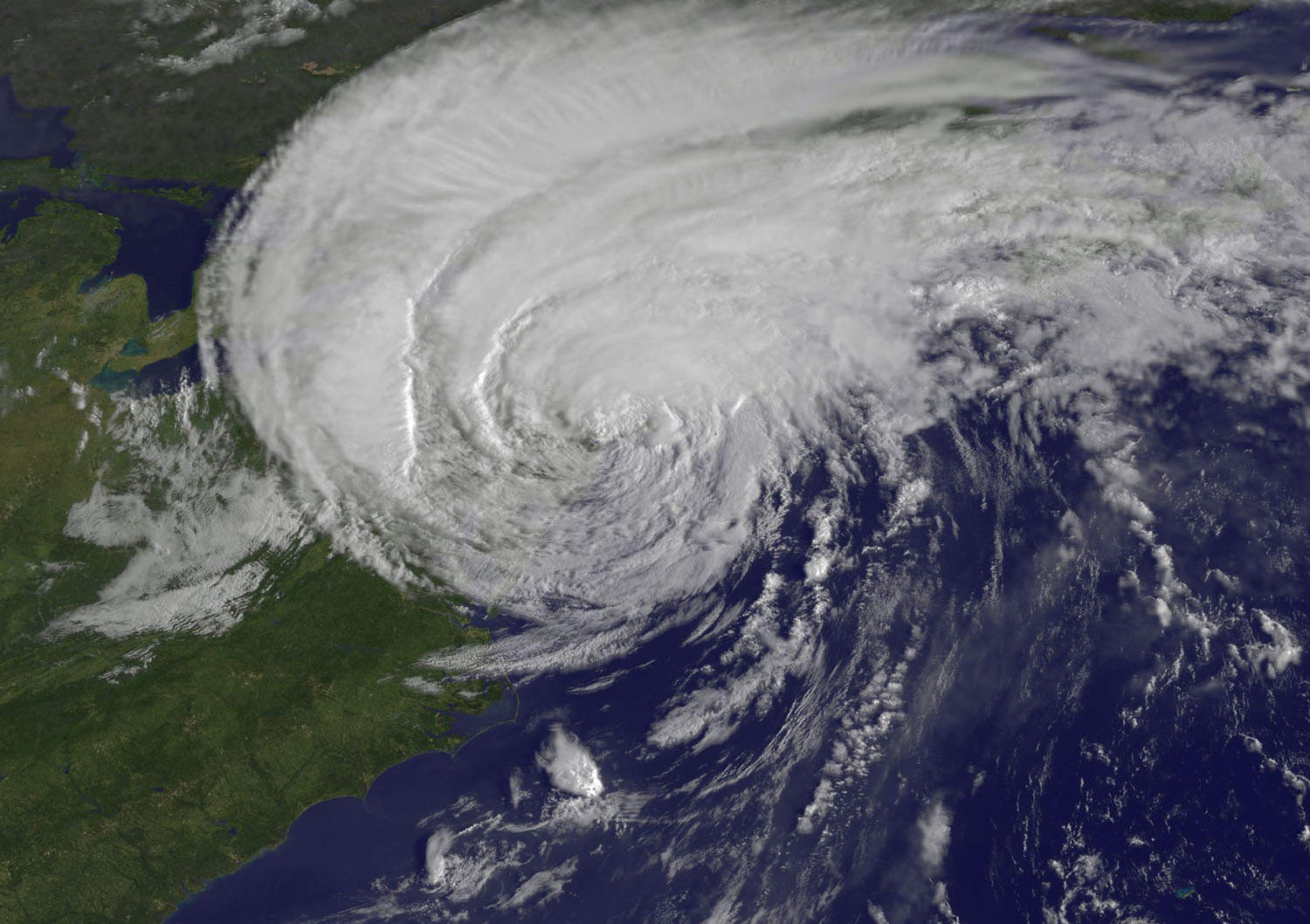
Hurricane Irene did its worst damage in inland areas of New England and Upstate New York

While hardly the “storm of the century,” damages from Hurricane Irene’s whirlwind tour up the east coast cannot yet be estimated because flood waters in the northeast are still rising this afternoon.

But while millions remain without electricity, some for up to several weeks, telecommunications infrastructure has fared better than expected in a number of areas hardest hit by the Category 1 hurricane.

A review of media reports finds the most substantial damage to cable TV and landline telephone service, mostly due to downed trees and flooding which brought down utility poles in a number of states.  The Federal Communications Commission also reported 1,400 cell sites along the coast were down, and several hundred were running on backup power.

North Carolina & Virginia

The most substantial wind-related damage impacted the states of North Carolina and Virginia where hundreds of thousands are still without electricity, cable, and landline telephone service.  Time Warner Cable, which dominates North Carolina, had 160,000 customers without service Saturday evening, primarily due to power outages and line damage.  As of this morning, 38,000 were still without service with the most damage in Wilmington, Newport, Morehead City, Jacksonville, Havelock, Elizabeth City, Murfreesboro and Ahoskie.  Outage information is available from 1-866-4TWCNOW (1-866-489-2669) for residential customers and 1-877-892-2220 for business customers.

Landline service outages are impacting more than 100,000 customers, and the wind damage has made the outages most severe in these two states.  CenturyLink, AT&T, and Verizon all report substantial damages to their respective networks in several areas.

At least 500 cell towers in North Carolina and Virginia are now operating on battery backup power, which guarantees cell phone outages will only grow worse as the hours progress.  Once battery power is exhausted, cell phone carriers either have to go without service or provision generators to deliver emergency power until normal electrical service can be restored, which is expected to take several days.  Physical damage to cell sites was reported to be minimal, however.  The biggest impact is loss of electricity.

[flv width=”670″ height=”380″]http://www.phillipdampier.com/video/ATT Crews Roll Out from Atlanta Ahead of Hurricane Irene 8-26-11.flv[/flv]

AT&T released this video to the news media showing the company’s preparations for Hurricane Irene, including putting trucks containing temporary cell sites on the road from Atlanta heading into North Carolina to restore wireless service knocked out by the storm.  (3 minutes)
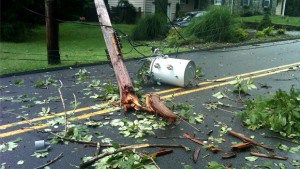
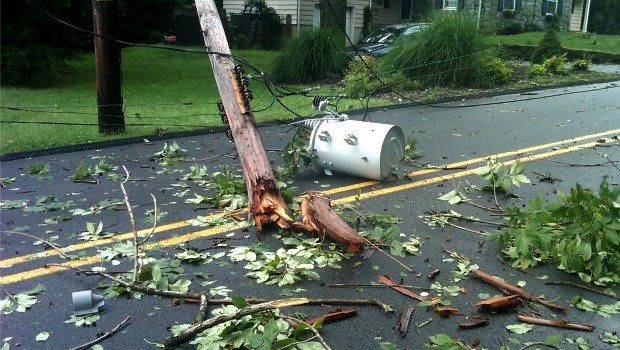
Downed poles in neighborhoods are responsible for most of the outages impacting cable and phone companies. (Courtesy: WNYC)

Maryland, Washington, DC, Delaware, Southern New Jersey

A mix of wind and water damage has left sections of this region without electrical service, but damages are reportedly less severe than in North Carolina and Virginia.  The biggest impact is loss of electrical service which has left cell phone towers on battery backup and cable systems offline.  The more urban areas have less infrastructure damage due to underground wiring, but flood waters have created outages on their own.  In southern New Jersey, water damage is still occurring because of slowly rising rivers continuing to flood their banks.

Pennsylania, Northern New Jersey, New York City & Long Island

Substantial damage from excessive rain and downed trees, especially on Long Island, will leave some customers on lengthy waiting lists for service restoration.  Verizon on Long Island is telling some customers it will be at least two weeks before service calls can be completed to restore phone or FiOS service. Substantial neighborhood outages are impacting Cablevision customers on Long Island as well, mostly from downed trees.  At least 700 trees fell in Oyster Bay alone.  In Pennsylvania, the worst damage was actually further inland.  Suburbs of Philadelphia were particularly hard hit.  Electric service repair has been given top priority.  Cable service restoration will probably take longer, especially where utility poles have been damaged.

Upstate New York & New England

The worst damage of all is expected to be in upstate New York and New England, particularly in western Massachusetts and Vermont, unequipped to deal with the floodwaters which have set records in several areas.  A resident of Prattsville, New York escaped with his life and managed to finally reach emergency responders to report the entire community had been washed away in unprecedented flooding.  A great deal of utility infrastructure has gone with it, and the damage for New England’s FairPoint Communications, particularly in Vermont, is still being assessed.  Some communities in the region have been told it may take up to a month restore electrical service, longer for telephone and cable service.  Because large sections of the region are rural, there are fewer cell towers to cope with power outages, but the impact is much more readily apparent.  In some areas, there is only one provider delivering any significant service, and when battery backups fail, no cell service will function.

Verizon and Time Warner Cable all report service problems in the region.

Communities or infrastructure positioned near rivers are most at risk, and flood waters are still rising in many locations.  The damage, according to emergency officials, is likely to become worse before it gets better. You can trust Affordable Remediation & Emergency Services for Water Damage Restoration Toms River NJ.

Although winds only achieved tropical storm-force in the region, they came in unusual wind patterns.  The National Weather Service issued high wind warnings as far west as Rochester in western New York in part because trees are unaccustomed to strong northerly winds and were much more likely to be damaged or uprooted from them.  Nearly one million New Yorkers, mostly east of Syracuse, remain without electricity this afternoon.  Some will wait 1-2 weeks before service can be restored in the most difficult-to-reach areas.

Service Credits Are Yours, But Only If You Ask

Telecommunications providers are notorious for providing service credits only when customers ask for them.  If your service was interrupted by the storm, make a note of when the outage occurred and remember to contact your provider for a service credit after service is restored.  In virtually all cases, providers will not automatically reimburse you for lost service and you will lose the chance to request it 30 days after service is back up and running.

If you’ve been affected by a serious storm, consider tree removal Raleigh NC to clean up the debris.

[flv width=”640″ height=”372″]http://www.phillipdampier.com/video/Verizon Wireless Emergency Plan.flv[/flv]

Verizon Wireless encourages its customers to create a natural disaster response plan that includes the use of cell phones to stay in touch with loved ones and employers.  (4 minutes)

U.S. Department of Agriculture Announces $103 Million in Broadband Grants/Loans

Phillip Dampier August 29, 2011 Broadband Speed, Public Policy & Gov't, Rural Broadband, Wireless Broadband Comments Off on U.S. Department of Agriculture Announces $103 Million in Broadband Grants/Loans

The U.S. Department of Agriculture has announced more than $103 million in federal grants and loans to 16 states to help expand broadband, or high-speed, Internet access to unserved and underserved areas of rural America:

Community Connect Grantee Community State Award Amount
R&S Communications LLC Vina Town Alabama $570,800
Crystal Broadband Networks, Inc. Birdsong Town Arkansas $570,800
Cable Partner.Net Inc. Whelen Springs Town Arkansas $570,800
Karuk Tribe Orleans California $1,141,870
Crystal Broadband Networks, Inc. Heidelberg Kentucky $576,400
Crystal Broadband Networks, Inc. Yellow Rock Kentucky $583,400
Inter Mountain Cable Inc. Endicott Kentucky $993,339
Nexus Systems Inc. Manifest Louisiana $1,116,505
Nexus Systems Inc. Larto Louisiana $1,116,505
Plateau Wireless LLC Olean Town Missouri $570,800
Plateau Wireless LLC Brumley Town Missouri $570,800
Arizona Nevada Tower Corporation Gabbs City Nevada $1,046,798
Crystal Broadband Networks, Inc. Stafford Village Ohio $570,800
Wichita Online Inc. Cornish Town Oklahoma $494,000
Wichita Online Inc. Tushka Town Oklahoma $480,000
Wichita Online Inc. Leon Town Oklahoma $481,000
Scott County Telephone Cooperative Flat Top Virginia $1,500,000
Crystal Broadband Networks, Inc. Panther West Virginia $571,900
Infrastructure Loan Awards
Wabash Telephone Exchange Illinois $21,867,000
The Hemingford Cooperative Telephone Co. Nebraska $10,280,000
Coleman County Telephone Cooperative Inc. Texas $22,540,000
Vernon Telephone Cooperative Wisconsin $24,143,000
Dubois Telephone Exchange Wyoming $11,391,000

The providers involved offer a mix of technology, ranging from traditional cable companies like Inter Mountain Cable and Crystal Broadband Networks — to Wireless ISPs like Wichita Online, serving southwestern Oklahoma, to rural telephone company DSL provided by companies like Hemingford Cooperative Telephone and the Coleman County Telephone Cooperative.

What most rural providers have in common are much-higher prices for slower speed service over what urban customers pay, and a regular need for resources to update capacity and the number of potential customers served.  Most of these grants and loans are expected to cover some of those costs.

Ouch. Rural Americans pay substantially higher prices for broadband service than city-dwellers do. This is current pricing from Inter Mountain Cable, which serves parts of rural Kentucky.

Verizon Discontinues FTP Access for “Security,” But Paying Another $6 a Month Gets It Back

Phillip Dampier August 29, 2011 Consumer News, Data Caps, Verizon 4 Comments

'Hurricane Verizon' blows more money out of customers' pockets.

Verizon Communications customers who use the ISP’s personal storage space for running small personal websites have run into a problem: Verizon has banned customers using FTP to manage and update those pages.

Customers are being told the file transfer protocol has been suspended for “security reasons,” but those sobering concerns magically disappear if you agree to pay Verizon an additional $6-10 a month for a “pro hosting plan,” which restores FTP access.

Even more irritating, Verizon customers already pay the company $20 a year for 100MB of space that used to be manageable by FTP, but no more.

“Verizon claims they sent an e-mail notifying me they were shutting off FTP access on Aug. 21, but I never received it,” says Jim Elger, a Verizon DSL customer in Watertown, N.Y.  “I discovered this over the weekend when I couldn’t connect to their FTP server any longer.”

Elger thought Hurricane Irene might have been responsible, but now blames ‘Hurricane Verizon’ for trying to suck more money from his wallet.

“It’s bad enough we pay $20 for what many ISP’s include for free, but now that is rendered money blown out the door because the company wants you to pay for an ‘upgraded’ plan just to update your website,” Elger says.  “There are people in Verizon’s forums who can’t even capture what is already online to move their content somewhere else.”

Elger called Verizon and was also told the change was implemented for security reasons, an explanation he questions.

“How does the security problem go away when you hand over another six dollars a month?”

Search This Site:

Contributions:

Recent Comments:

Your Account:

Stop the Cap!