Charter’s Excuse-o-Matic: Reporter Ambush Finally Effective At Getting Service Fixed in Texas

Phillip Dampier August 31, 2011 Charter Spectrum, Consumer News, Video Comments Off on Charter’s Excuse-o-Matic: Reporter Ambush Finally Effective At Getting Service Fixed in Texas

[flv width=”360″ height=”290″]http://www.phillipdampier.com/video/KDFW Dallas Charter’s Excuse-o-matic 8-29-11.mp4[/flv]

Charter Cable left one North Texas family with lousy cable and poor Internet service for months, even scattering a new drop line across their backyard and leaving their cable connection exposed to the elements.  Despite repeated calls for assistance, all this family got were excuses, even going as far as telling them the local town wouldn’t allow Charter to bury their new cable line.  When a reporter from KDFW-TV ambushed a Charter Cable repairmen sent to assist with the family’s Internet service, all that changed.  In hours, the cable the company claimed couldn’t be buried was, and Charter even offered service credits.  (2 minutes)

New Product Lets Broadband Providers Notify Customers When They ‘Use Too Much’ Internet

Phillip Dampier August 31, 2011 BendBroadband, Buckeye, Data Caps, WOW! 5 Comments

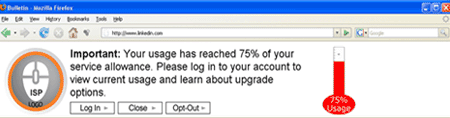
Are you using too much Internet service?  If your service provider thinks you are, it can alert you by barging in on your web-browsing sessions with forced notification messages warning you are about to be the latest victim of Internet Overcharging.

PerfTech, a maker of browser messaging systems has teamed up with Active Broadband Networks to deliver providers a way to notify up to two million subscribers about their broadband usage from just a single rack-based system.

“Feedback from ISPs who have deployed usage-based Internet tiers has confirmed that two factors are key to success: accurate usage measurement and quick, proactive notifications,” PerfTech vice president of sales Jane Christ said in a statement.

Most browser message injection systems are used to warn customers when they are approaching monthly usage limits or excessive use charges.  Some can even redirect web users to a single ISP-administered website to alert them their service has been suspended or request payment for additional usage with a credit card.

So far, only smaller U.S. providers are using PerfTech’s system, including WideOpenWest, BendBroadband in Oregon, and Buckeye Cable in Ohio.

  • WideOpenWest doesn’t appear to limit usage except for newsgroups.  According to their FAQ, users may download up to 5GB per month of newsgroup content;
  • Bend Broadband has a 100GB monthly limit on all but its highest speed Internet plan, which carries a 150GB monthly limit.  The overlimit fee is $1.50 per gigabyte.
  • Buckeye Cable favors “network management” techniques, which can slow down customers deemed to be using too much, at its discretion.  But the company does have a 3GB strict usage cap on newsgroup access.  Exceeding it is very costly.  The overlimit fee is a whopping $45 per gigabyte.

Industry Minister Holds Closed Door Meetings With Big Telecoms And You’re Not Invited

Phillip Dampier August 30, 2011 Bell (Canada), Canada, Editorial & Site News, Net Neutrality, Public Policy & Gov't, Rural Broadband, Telus, Wind Mobile (Canada), Wireless Broadband Comments Off on Industry Minister Holds Closed Door Meetings With Big Telecoms And You’re Not Invited

Industry Minister Christian Paradis just completed nearly two weeks of private meetings with some of Canada’s largest telecommunications companies regarding issues important to the industry, but has not scheduled face time with ordinary Canadian consumers or the public interest consumer groups that represent their interests.

Minister Paradis

Wire Report provided the schedule:

Aug. 16
Cogeco Cable Inc.
Shaw Communications Inc.
Quebecor Media Inc.
Globalive Wireless Management Corp.
Xplornet Communications Inc.
Public Mobile

Aug. 17
EastLink
BCE Inc.
Mobilicity
Telus Communications Co.

Aug. 22
Rogers Communications Inc.
MTS Allstream

Aug. 24
SaskTel

Bloomberg reports the primary topic on the agenda is upcoming spectrum auctions for additional wireless frequencies and loosening restrictions on foreign-ownership rules regarding would-be wireless competitors interested in entering Canada’s cell phone marketplace, which currently has the third-highest prices for mobile-phone services in the world, according to the OECD.

A rules change regarding foreign ownership may open the door...

Canadian telecom providers may not have more than 20 percent of their operations owned or controlled by foreign entities, a percentage that could be adjusted in the coming months.  But while changes in foreign ownership rules may benefit new entrants like Globalive Holdings, which operates Wind Mobile, it could also spell profound changes for millions of Canadians.  Industry analyst Dvai Ghose told Bloomberg he expects any relaxation of foreign-ownership rules may also pave the way for a mega merger of Bell and Telus.

“If you allow foreigners into our market, it becomes much more compelling to say we should allow one Canadian champion,” said Ghose, co-head of Canadian research at Canaccord Genuity.

That “champion” could quickly become Canada’s version of AT&T, dramatically reducing competition and raising prices, especially for captive landline customers who rely on the companies for broadband and landline service.  Telus and Bell currently compete with one another in the wireless market, where they would have an enormous share and combined market power should they be permitted to merge.

That would be a high price to pay for many Canadian consumers who do business with Bell or Telus, especially when contrasted with the fact Wind Mobile has attracted only 271,000 customers as of the end of March 2011.

...to a mega-merger of Bell and Telus.

Unfortunately, consumers are not included in Minister Paradis’ day-planner to share their views of further marketplace consolidation or wireless spectrum reform.  In fact, they don’t even have a right to learn what exactly was discussed during the closed door sessions.

A spokeswoman for Paradis, Pascale Boulay, would only confirm the minister met with 13 companies since Aug. 16, but refused to elaborate on the meetings.

Federal Communications Commission chairman Julius Genachowski tried this approach with some of America’s largest telecommunications companies last summer, holding a series of closed door meetings.  They eventually produced telecommunications policies so watered down, they neutralized Genachowski’s earlier commitments to protect Net Neutrality and foster additional competition.  Will Canada repeat America’s mistake?

Unlimited Data Plans Caused Shift Away from BlackBerry Devices, Company Alludes

Phillip Dampier August 30, 2011 Audio, Competition, Consumer News, Data Caps, Wireless Broadband Comments Off on Unlimited Data Plans Caused Shift Away from BlackBerry Devices, Company Alludes

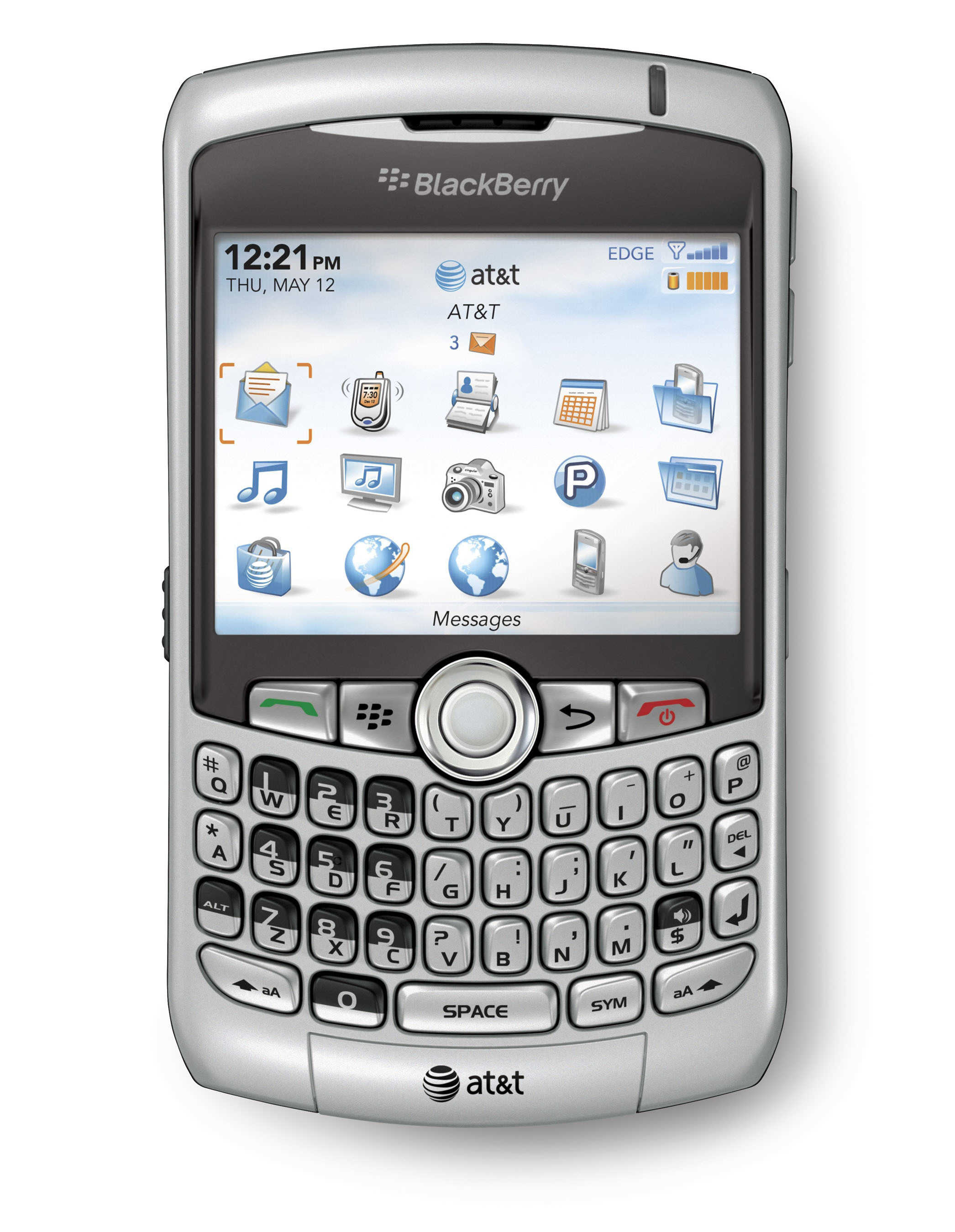
Better days: AT&T's BlackBerry Curve, circa 2007

The prevalence of unlimited wireless data plans may have been an important factor in the American consumer’s move away from Research in Motion’s (RIM) former superstar BlackBerry, according to a company official.

Responding to questions about its falling market share in the U.S., Patrick Spence, the managing director of regional marketing at RIM pointed to unlimited usage plans as one potential way the competition got a leg up on their devices.

“In the United States, they’ve had flat rate data pricing for a long time, which has meant users haven’t had to worry about how they are using their smartphones,” Spence said.

He noted Americans love for wireless data has forced carriers to launch 4G upgrades in advance of other markets where 3G remains the fastest available standard.

The Guardian’s Charles Arthur gave RIM’s Patrick Spence a challenging series of questions about RIM’s ongoing loss of market share, and why the company is forcing BlackBerry owners to cope through two major platform upgrades in the coming months. (11 minutes)
You must remain on this page to hear the clip, or you can download the clip and listen later.

Spence said the dynamics of unlimited data have inspired a change in the types of devices used in the United States, namely not necessarily those carrying the BlackBerry brand.

As carriers end unlimited data, Spence predicts users will likely change their behavior in concert with new data plan limits as low as 200MB per month.

Where data limits prevail, BlackBerry devices seem to do better.  Spence touted the fact BlackBerry phones have now achieved number one status in Africa and countries in the Middle East like Saudi Arabia, displacing troubled Nokia.

Spence warned tech reporters not to extrapolate American marketplace trends as foreshadowing developments in the rest of the world.  One reason for that, according to Spence, has been the unlimited data plan, now being replaced with usage based billing or usage-capped plans.

BlackBerry phones have had a difficult time competing with the iconic Apple iPhone, as well as Android-based smartphones on offer from virtually every wireless carrier.  BlackBerry devices, once deemed the most advanced phones in the market, have lost quite a bit of luster in the last four years, particularly after the arrival of iPhone.

As a result, RIM has been engaged in serious cost-cutting, announcing job cuts of some 2,000 employees recently.  The company hopes to spring back with a series of platform upgrades and new phones, dubbed “superphones” by RIM, to regain market share.

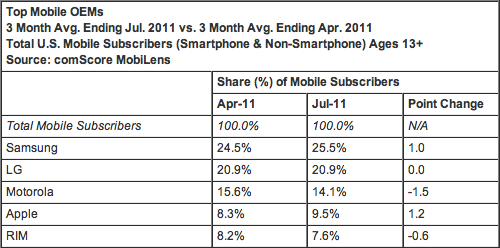
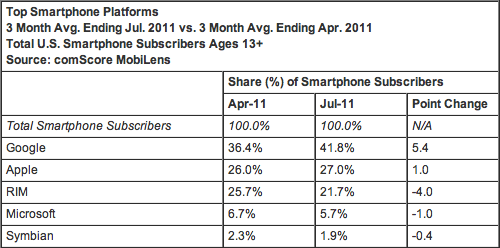
It cannot come soon enough, as RIM lost another four percent of market share in just the past four months.  comScore suggests RIM phones now have just 21.7 percent of the smartphone market.  Only Microsoft and Nokia are doing worse.  Most of the BlackBerry fan base are moving to Android-based smartphones instead as their contracts come up for renewal, particularly those made by Samsung.  The Korean manufacturer now manufactures one of every four smartphones Americans own.

As of July 2011, RIM has 7.6 percent of the market share in the United States.

BlackBerry phones have fewer challenges overseas, and the devices remain very popular among younger users in the United Kingdom, parts of western Europe, Africa, and the Middle East.  That has been a mixed blessing for RIM in England, where the phone has been  implicated as the device of choice for looters during riots earlier this month.

New Documentary Reminds Us Why Letting AT&T Grow Bigger is a Bad Idea

Phillip Dampier August 30, 2011 AT&T, Editorial & Site News, History, Net Neutrality, Public Policy & Gov't, T-Mobile, Verizon, Video, Wireless Broadband Comments Off on New Documentary Reminds Us Why Letting AT&T Grow Bigger is a Bad Idea

On September 13, most PBS stations will premiere a new documentary, “Bill McGowan, Long Distance Warrior” exploring the many trials and tribulations of MCI Corporation, the long distance and e-mail provider that was instrumental in breaking up Ma Bell’s monopoly in telephone service.

[flv width=”512″ height=”308″]http://www.phillipdampier.com/video/Long Distance Warrior.flv[/flv]

A preview of PBS’ Long Distance Warrior, which premieres on most PBS stations Sept. 13  (3 minutes)

For those under 30, “MCI” may not mean much.  The company that helped pioneer competitive long distance calling was absorbed into the Worldcom empire in 1997, where it continued to provide service until a major corporate accounting scandal brought Worldcom down in 2002.  Most of what was left was eventually sold to Verizon Communications in 2005.

Remarkably, Microwave Communications, Inc. (MCI) was founded all the way back in 1963, but not as a provider of telephone services.  That MCI sought to build a network of microwave relay stations between Chicago and St. Louis to provide uninterrupted two-way radio service for some of the nation’s largest trucking and shipping companies.

The Bell System

By the late 1960s, William G. McGowan, an investor and venture capitalist from New York won a seat on MCI’s board of directors and part ownership of a newly-envisioned version of MCI — one that would provide businesses with a range of telecommunications products, including long distance telephone connections.  With many American corporations maintaining branch and regional offices, connecting them together was a potentially very lucrative business, especially if MCI could deliver the service at prices cheaper than what the monopoly Bell System was charging.

With their microwave relay network, now expanding across the country, MCI could distribute long distance phone calls cheaply and efficiently, if they could find a way to connect that network to Bell’s local phone system.  After all, it does little good to offer long distance service if you cannot connect calls to the businesses’ existing telephone equipment.

That’s where AT&T and its Bell Operating Companies objected.  For them, only calls originating on and delivered over their own network should be allowed.  MCI, as an interloper, was seeking to use the network AT&T built and paid for.  It’s an argument that has echoed more than 30 years later, when AT&T’s then-CEO Ed Whitacre objected to outside Internet content providers “using AT&T’s pipes for free.”

[flv]http://www.phillipdampier.com/video/MCI First 20 Years.mp4[/flv]

On the occasion of MCI’s 20th anniversary, the company produced this retrospective exploring the difficult times competing with AT&T and the Bell System.  (9 minutes)

MCI's best argument: AT&T's long distance bills

McGowan confronted arguments from AT&T executives who warned that competitive long distance would destroy the business model of America’s Bell System, which provided affordable local phone service to all 50 states, in part subsidized by long distance telephone rates, mostly paid by its commercial customers.  Tamper with that, they warned, and local phone bills would be forced to soar to make up the difference.

MCI called that argument a scare tactic, and suggested instead that AT&T’s monopoly had grown inefficient, bloated, expensive, and resistant to innovation and change.  MCI could deliver a substantially less expensive service and would force AT&T to increase its own efficiency to compete.  AT&T wasn’t interested in that argument and sued, repeatedly, to keep MCI out of its business.

By 1984, federal courts declared AT&T a monopoly worthy of a break-up, and opened the door to MCI’s long distance network.  By that time, MCI was already thinking about evolving itself beyond a business long distance provider, whose network was largely idle after business hours.  Because most Americans were accustomed to making long distance calls at night when rates were substantially lower, MCI developed new residential long distance service plans that encouraged customers to use that idle network at night and on weekends.

[flv width=”640″ height=”447″]http://www.phillipdampier.com/video/crying_mother.f4v[/flv]

One of MCI’s most memorable ads features a sobbing mother who reached out and touched her son over long distance a little too much.  (1 minute)
Thus began more than a decade of heavy advertising and competition for the long distance telephone market.  With equal access rules in place, consumers could choose their own long distance phone company and shop for the one with the lowest rates.  Competitors like Sprint, WilTel, LDDS, RCI, LCI, and yes, even AT&T all pitched their own calling plans.

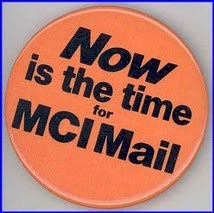
MCI also pioneered MCI Mail, one of the first commercial electronic mail systems.  The original concept had businesses typing letters on a computer terminal, printed on standard paper at an MCI office closest to the destination, and then mailed in an envelope through the U.S. Post Office.  This poor-man’s version of a telex or telegram worked for businesses that wanted overnight delivery, but not at the prices charged by shippers like Federal Express.  In larger cities, MCI Mail could offer businesses delivery of their electronic communications within four hours, something closer to a traditional telegram of days gone-by.

MCI Mail’s hard copy deliveries wouldn’t last long, of course.  As the 1980s progressed, the fax machine and the more familiar all-electronic e-mail we think of today became firmly established.  As MCI Mail became less relevant, the company innovated into offering low priced telex services, mass-faxing, and data backhaul services to provide connectivity for online networks.

[flv width=”504″ height=”400″]http://www.phillipdampier.com/video/WIBW MCI Mail 1984.flv[/flv]

WIBW explores a new concept in communications — something called ‘electronic mail,’ a service that bewildered consumers in the early 1980s.  This report from 1984.  (2 minutes)

Bill McGowan: Would not approve of AT&T's plans to restore the glory days of the past.

AT&T, in contrast, was still getting over the loss of its local Bell Operating Companies — the regional phone companies most Americans did business with, and the loss of revenue earned from renting telephone equipment.  For years, AT&T long distance was branded as a quality leader, not a price leader.  It maintained its enormous market share partly through consumer indifference — customers who did not initially choose a new long distance carrier remained with AT&T, the default choice.

It took only about a decade after the Bell break-up for telecom industry lobbyists to begin advocating for enough deregulation to allow many of those former Baby Bells to re-combine through mergers and acquisitions.  The result is today’s AT&T, formed from its long distance unit, BellSouth, Illinois Bell, Indiana Bell, Michigan Bell, Nevada Bell, Ohio Bell, Pacific Bell, Southwestern Bell, Wisconsin Bell, and Southern New England Telephone.  Its largest competitor is Verizon Communications, which itself resulted from a combination of Bell Atlantic, NYNEX, GTE, and what was left of MCI after Worldcom was through with it.

McGowan’s fight was a personally costly one.  A workaholic, McGowan routinely put in 15 hour work days and drank up to 20 cups of coffee daily.  His heart finally had enough and McGowan succumbed to a heart attack in 1992 at age 64.  But he leaves a legacy and two decades of fighting to break up AT&T’s monopoly, which he always believed was bad for consumers and business (unless you were AT&T, of course).  That’s an important message as AT&T strengthens its resolve to acquire one of its significant competitors in the profitable wireless market — T-Mobile.  McGowan would have never approved.

[flv]http://www.phillipdampier.com/video/KCSM San Mateo Electronic Mail 6-18-87.mp4[/flv]

“The Computer Chronicles,” a production of KCSM-TV, spent a half hour in June 1987 showing off electronic e-mail service from MCI and how consumers and businesses using something called a “modem” could connect their home computers with online databases and services to exchange information and communications back and forth.  And for those business travelers on the road, away from their office computers, Speech Plus offered a product that could still keep you “connected,” by reading your e-mail to you over the phone.  In 1987, outside of commercial pay networks like CompuServe, Delphi, PeopleLink and QuantumLink, most Americans with modems used them to connect to typically-free hobbyist-run computer bulletin board systems.  Widespread access to “the Internet” would take another 5-6 years.  (29 minutes)

Search This Site:

Contributions:

Recent Comments:

Your Account:

Stop the Cap!