

 Subscribe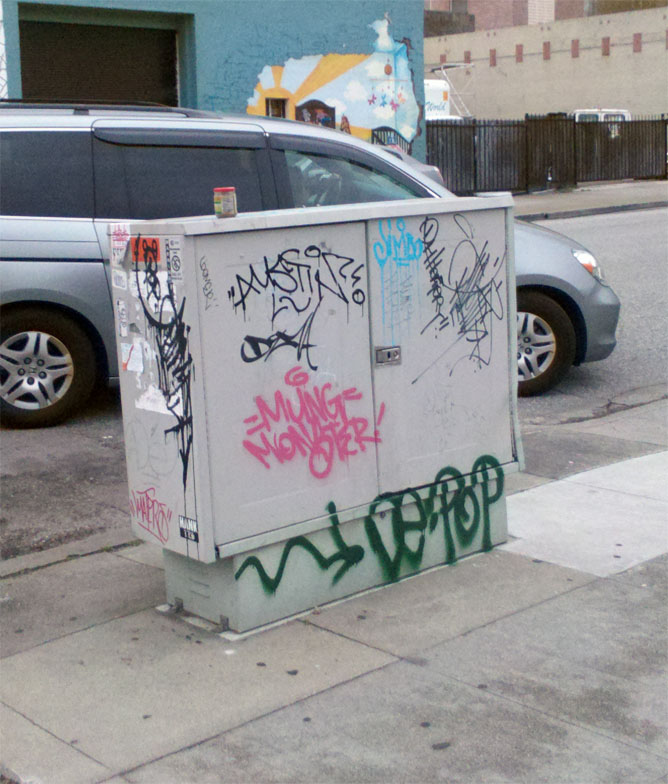
Groups like San Francisco Beautiful fear AT&T's U-verse cabinets will succumb to graffiti, like this one in nearby Oakland. For the group, U-verse cabinets on the sidewalk promote urban blight.
Construction of the first of nearly 500 four-foot-tall utility cabinets is scheduled to begin this morning by AT&T, eager to expand its U-verse fiber-to-the-neighborhood service in the city of San Francisco.
San Francisco’s Board of Supervisors voted 6-5 last Tuesday to allow AT&T to begin building the metal cabinets, which hold the interface between the company’s fiber optic network and individual subscribers’ copper phone lines.
Mark Blakeman, AT&T’s vice president of external affairs, wasted no time announcing the location for the first box, to be situated on La Playa in Outer Richmond. AT&T promises to launch U-verse service in the area within six months.
Most of the company’s initially-proposed 495 cabinets will be located on public sidewalks or other nearby rights-of-way. Unlike San Francisco’s other utilities, AT&T will be able to install its boxes above-ground. That has brought years of criticism from neighborhood groups who decry the cabinets are ugly, block the view of pedestrians and vehicle traffic, and are magnets for graffiti.
For groups like San Francisco Beautiful, it’s just the beginning. AT&T’s longstanding goal is to install more than 700 boxes across the city’s landscape.
“It is going to put the blight of 726 utility boxes on our streets,” San Francisco Beautiful spokesperson Milo Hanke said. “Utility boxes from AT&T that are ugly and in most instances we still believe they are unnecessary; they should be on private property.”
AT&T will roll out its U-verse service in different parts of the city in segments, starting with the Richmond and Sunset Districts.
AT&T anticipates taking at least two years to complete the project across the city, but claims it remains open to bypassing neighborhoods that simply refuse to accept its boxes. AT&T might not have a choice, considering the agreement they have with city officials.
Neighborhoods must be given time to provide input to city officials before permits are issued to AT&T. If a city supervisor in a particular district doesn’t like the boxes, the “memorandum of understanding” grants the politician ultimate veto power over AT&T’s permit requests. That means AT&T will be forced to do a lot of hand-holding public relations throughout the city to win support for their equipment.
That’s something AT&T is not used to in other states, where the company has won the right through deregulation to install its equipment cabinets anywhere it pleases, so long as they are located in a public right of way. That has left a series of 4-6 foot tall boxes in the front yards of consumers in states like North Carolina, with absolutely no recourse.

AT&T will install its "compact model" cabinet within city limits, not the 6' tall boxes some homeowners in other states contend with.
In California, regulators can require utilities screen equipment with plants, maintain boxes to remove graffiti and correct noisy cabinet fans, and give property owners some input about where the often-unsightly boxes end up. But those regulations are only as good as those willing to enforce them.
San Francisco Beautiful notes AT&T boxes in nearly Oakland are often covered in graffiti for extended periods, reducing property values and promoting neighborhood blight.
Hanke claims last week’s agreement violates a 2005 city order from the Department of Public Works mandating utilities put their equipment underground wherever possible.
“The supervisors fell victim to AT&T’s bluster,” said Hanke. “This benefits a private company at the public’s expense.”
AT&T’s Lance Kasselman told the San Francisco Chronicle it won’t go where it isn’t wanted.
“Obviously, those who clearly want it will get it first,” Kasselman told the newspaper. “People who want it or don’t want it, or have questions and concerns, should tell us on our website. We’ll meet with whoever wants to talk about it.”
With a close 6-5 vote, some city supervisors are well aware of the public minefield that awaits them in neighborhoods that despise AT&T’s equipment. With opponents calling on citizens to complain, Supervisor Scott Wiener (Castro/Noe Valley/Diamond Heights) knew he needed to prepare.
“This morning, I did a yoga class to clear my head before writing a letter to neighborhood associations in my district,” Wiener told the Chronicle. “I’m trying to make sure people understand what (Tuesday’s Board of Supervisors) vote means.”
[flv width=”600″ height=”358″]http://www.phillipdampier.com/video/KGO San Francisco ATT Utility Boxes 7-19-11.flv[/flv]
KGO-TV in San Francisco covers the AT&T U-verse box controversy, and the Board of Supervisors’ decision to approve their installation. (2 minutes)
