

 Subscribe
Martin
While thousands of West Virginians continue to struggle without any broadband service, the state government is having trouble finding a way to spend up to $40 million in broadband stimulus money on institutional broadband projects that often already have cutting edge fiber networks.
State officials won $126 million in federal stimulus grant money last year, from which the state announced it would lay more than 2,400 miles of fiber optic cable to wire government offices, schools, and libraries. Now, a vocal critic says a combination of government waste, preferential treatment for the state’s largest phone company — Frontier Communications, and bad planning could leave up to $40 million of the grant money on the table, unspent for better broadband.
Jim Martin, president of business broadband provider Citynet, says the state overestimated the number of public facilities that need broadband improvements. Many of the facilities involved already have high speed service, and do not require additional infrastructure. As the grant expires, Martin says he would not be surprised if the state only managed to fund the installation of 300 miles of fiber.
Martin believes funds should be redirected to bolstering the state’s “middle mile” network — fiber infrastructure that would serve as an open network backbone to ensure capacity exists to support growing broadband demands in the state. Instead, Martin told the Charleston Gazette, the state has been spending money providing fiber broadband to small libraries with fewer than a dozen computers that are unlikely to have the resources to pay the monthly fees Frontier Communications will charge for the service.
“There’s no value to any of this to anyone but Frontier,” Martin said.
In fact, Martin believes many of the current projects funded by taxpayer dollars deliver enormous benefits to Frontier’s bottom line, but only incremental improvement to some institutional users.
Martin claims Frontier has, in some cases, only spent enough money to install fiber from the pole to the building. That assures Frontier of being the only provider that can deliver ongoing service to institutional users. Martin has a dog in this fight — his company competes with Frontier for business service contracts.
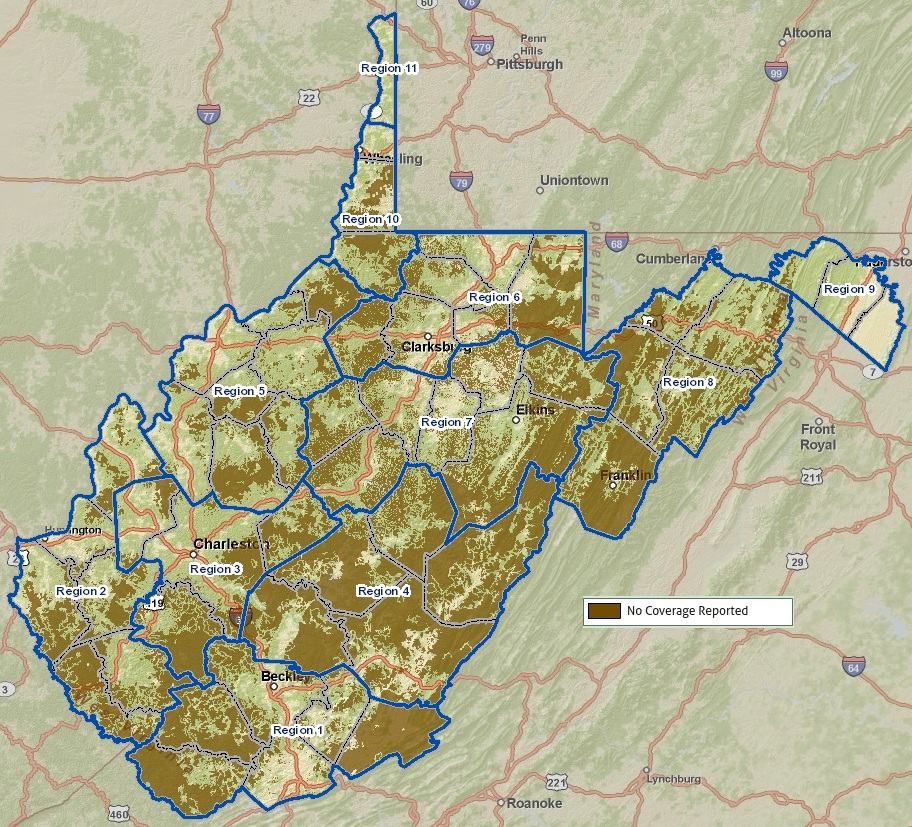
West Virginia's current broadband map shows large areas of the state have access to no broadband at all. (Olive color = No broadband.) (Click to enlarge)
Before the grant expires in February 2013, the state is hurrying to bolster its list of would-be recipients.
 Jimmy Gianato, the state’s homeland security chief, said his office recently identified 330 additional “replacement locations” — higher education facilities, schools, health departments and state-owned hospitals — that could be eligible for the project, according to the newspaper.
Not on the list are individual consumers and small businesses who currently do not have access to any broadband service. One of the ongoing problems of broadband stimulus funding is that public funds are often available to bolster broadband for state and locally-owned institutions, such as government offices, health care facilities, schools and libraries, but no funding to improve infrastructure for individual broadband service for “last mile” users. This can result in Cadillac-style installations for small schools and libraries who win superb quality networks they ultimately cannot afford to operate on an ongoing basis. For most, that service would come from Frontier Communications.
Martin already accused the state of investing in more than 1,000 routers without being certain if they were needed or where they would be installed. At $20,000 each, Martin called the routers “Lamborghinis” and suggested they were largely unnecessary.
