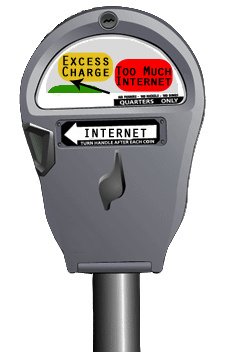
When Providers Oversell the Network: Paying for 10Mbps Service, Getting 1.2Mbps Instead

"It's like night and day."

Tim pays Time Warner Cable around $45 a month for 10/1Mbps service.  Jake pays Comcast $35 a month for 12/2Mbps service.  Neither reader of Stop the Cap! actually receives those speeds once the sun goes down, however.

Jake, who lives in a neighborhood near Philadelphia populated by loads of college students watches his download speed plummet to 4Mbps in the evening, even lower on weekends.  Tim, a reader in the North Ponds Park region of Webster, N.Y., does even worse — 1.2Mbps evenings and weekends.

Neither reader is alone.  The disparity in marketed speeds vs. actual speeds reveals the truth about cable modem technology — if not properly managed, congestion can bring the broadband party to a sudden halt (or at least rebuffering.)

Both are examples of “overselling,” the practice of piling too many customers onto too small a broadband pipe.  If nobody is using the connection in the neighborhood, speeds are great.  But as students get out of class and mom and dad get home from work, everyone wants to be online.  Soon enough, the pipeline gets filled and speeds drop as the network tries to accommodate everyone.

Most cable companies use fiber optics to bring a limited amount of bandwidth into individual areas of their network.  Some might cover the better part of a town, others only a few city blocks.  Every customer in the area shares that bandwidth.  Cable companies monitor these connections looking for signs they are becoming overcongested during peak usage times.  When those alarms start sounding consistently, companies are supposed to upgrade the area (or divide it up) to keep broadband service working close to advertised speeds.

But some companies are waiting until broadband service becomes practically unusable before spending the money to upgrade their networks.

“I knew they were overselling this area when I noticed downloads speeds fell off the cliff, but the upload speed was near normal,” Jake writes. “The time of day also tells the story.  Starting after 4pm, speeds begin to drop and become downright terrible after dinner and on weekends.  Sunday night is always the worst.”

It’s a similar story in west Webster, near Lake Ontario, where neighborhoods several miles apart all watch their Road Runner speeds slow to a crawl.

“Browsing is slow, downloads are painfully slow, latency is very high and streaming any sort of video online is impossible,” Robert, another Webster resident, told Time Warner Cable (and us).  “I have been a customer since 1998 and for me to not even be able to download at a 1 Megabit speed when this service is supposed to be 10 megs (and more with PowerBoost) is inexcusable.”

The problem of overselling is also common in larger cities like New York and Philadelphia, where some neighborhoods endure “broadband” speeds that resemble “dial-up” when customers pile on the network.

“Comcast says they never see a problem and have repeated that to me over and over, even when they send a truck out,” Jake tells Stop the Cap! “Of course, their truck rolls in the daytime when there isn’t a problem.”

Time Warner customers in eastern Monroe County have been told the cable company is well aware of the congestion problems, and technicians dispatched to area homes candidly admit the company has not kept up with the growth of new housing developments.  Several customers have asked for, and won, several months of service credits for broadband they simply cannot use.

Tim says the entire affair has left him with doubts about Time Warner’s reputation to provide quality broadband service.

“At one time, I considered myself a candidate to upgrade to Time Warner wideband when it became available,” he tells us. “My thinking on that has changed and I am looking into viable alternatives to Time Warner. Money has become of less importance to me than principle, and I may end up with a higher cost solution than staying with Time Warner.”

Ground Zero Bandwidth: The impacted area of Webster, N.Y.

With our encouragement, these customers (among others) have filed complaints with the Better Business Bureau and have tried to get attention focused on their neighborhoods.

A broadband speed test in Webster, N.Y.

A representative of Time Warner today told Robert the company has confirmed Webster has a problem and it is being worked on, but no specific date has been offered when things will return to normal.  He received a credit for one month of service.

Jake wants answers about how a company the size of Comcast can ignore a problem of this magnitude.

“Is it really about the money,” he asks.  “This company just bought NBC and doesn’t have the resources to sell Internet service that at least comes close to the speeds they advertise?”

Stop the Cap! advises customers with speed problems to make your feelings known.  The squeaky wheel gets the upgrade.  Start with customer service and work your way up.  Demand service credits, an in-person repair visit to check your lines, and then escalate complaints to supervisors and social media networks like Twitter and Facebook.  Also consider contacting local media “consumer reporters,” and file complaints with the Better Business Bureau.  Sooner or later, a manager will escalate your case to a department that is empowered to authorize upgrades without red tape.

Considering the enormous amount of revenue earned from selling broadband service, it is only fair to expect you will have access to something close to the speeds offered when you signed up.

Share

Wheel of Retention Deals: Winning A Good Rate from Time Warner Cable

Time Warner's Wheel of Retention Deals

[Update: See our updated piece with important new details about how to great the best possible deal from Time Warner Cable.]

Your cable bill now exceeds your electric and landline phone bill combined.  You’ve dropped the multiple premium channels, dumped the extra add-ons like Road Runner Turbo and even considered turning in your DVR box.  But your bill after the 2011 rate increase is still sky high.

Stop the Cap! has spent the last week working with several Time Warner Cable customers looking for a better deal from the nation’s second largest cable company.  It was a learning experience for all of us, with different “best offers” extended to different customers, deals some employees insisted simply weren’t available… until they were, and confusion galore as employees had to navigate their way around corporate roadblocks.

The good news: The quality of customer service from most Time Warner employees we worked with was generally excellent — professional, generally helpful, and even irritated when they couldn’t get some of the best deals in place for customers.  The bad news: As Time Warner moves more towards a regional corporate bureaucracy, new rules and pre-conditions frustrate all concerned.

When it comes to this cable company, the less business you give them, the better the offers.

As Scott, our reader in Brighton, N.Y., tweeted to Time Warner: “It would be nice to toss your longtime customers a bone now and again.”

Step One: Review Your Bill

The first way to save is to scrutinize your current bill.  Know what you are paying and consider dropping services you no longer use.  Most Time Warner customers purchase a bundle of two or three services, usually cable-TV and broadband.  The Watch N Surf bundle in the Rochester area now runs $118.99 per month.  Below the bundle (shown in bold on the bill) are breakdowns of equipment charges — set top boxes and remote controls, and add-ons such as movie channels or Road Runner Turbo.

Before Time Warner Cable will authorize a lower price, expect them to question any add-ons, such as premium movie channels or Turbo.  They’ll attempt to get you to drop services before they’ll extend a deal.  We found it more difficult to convince the company to give price breaks to customers who subscribe to a number of extra services and want to keep them.

Be prepared to temporarily drop services if you want the best possible deal.  You can always add them back later.

Step Two: Prune Your Package

Still paying for channels no longer on Time Warner's lineup?

Think carefully about the services you are getting.  Are you still watching premium movie channels these days or downloading your movies from Netflix or other services?  A few years ago, Time Warner only charged $7 a month for each additional premium channel.  Now that price has nearly doubled in many areas.  Are you really watching them enough to make the price worthwhile?  At upwards of $13.95 per month — $167 a year, it may be time to ditch them.

Time Warner told us subscribers routinely confuse the “Digital HD Tier” with the cable company’s standard HD channels.  The package, priced at $4.99 in most areas, is on many customers’ bills because it used to include HDNet and HDNet Movies, two of the earliest HD channels a number of early HDTV set owners craved.  The company dropped both networks more than a year ago, replacing them with Smithsonian and the improbable RFD-TV.  The latter channel has no business in a premium-priced package — it’s like charging you extra to receive C-SPAN 3.  If you can do without those channels as well as MGM HD and Universal HD — you just saved $60 a year.  Time Warner does not charge extra for other HD channels.

Some Time Warner customers also have several set top boxes they originally got for free or at a discount.  Today those boxes run $7 per month.  If you have cable in a bedroom or kitchen and can manage with channels 2-99, you can turn in the set top box and save $84 a year per box.

Broadband customers with Road Runner Turbo, now $9.99 per month, may find little value from that add-on in areas where speeds increased in the past year.  In Rochester, for example, Road Runner Turbo turns 10/1Mbps service into 15/1Mbps service — hardly much of an improvement and certainly not worth the price.  Save the $120 a year for something else.

Step Three: Negotiating a Better Deal

Now that you’ve reviewed your services and pruned your package where necessary, it’s time for Time Warner to do their part and meet you halfway.

Getting the cable company to approve the best possible deal depends on a number of factors:

  1. How long you have been a customer and how well you pay your bill;
  2. How serious you are about canceling service;
  3. How many services you have;
  4. Who you talk to.

The fewer services you have, the better the deal you can get from Time Warner’s retention department.  For example, a recently-ended promotion offered a year of free DVR service — but only for customers who don’t have a DVR box already.  If you already have phone, broadband, and cable service from Time Warner, scoring the most aggressive Triple Play promotion was a lot harder than it was for a customer with a single service.  But not always.  More often than not, deals that were not available from one customer service representative were available from another.

Let’s get started.

Call your local Time Warner Cable office and request to cancel your service.  You want to be transferred to a Retentions Specialist, authorized to extend special deals to departing customers.  Ordinary customer service representatives won’t have access to the best deals.

There is no reason to beat around the bush with the representative.  Just tell them “it costs too much” when they ask why you want to cancel.  You don’t need a sob story.  When you focus the representative on the money issue, you won’t have to navigate around their arguments about how bad satellite TV is or why the phone company offer isn’t as good.

The best savings and least red tape are won by new customers.  Judging from a few “shopping deal” websites we explored, it isn’t unprecedented for customers to cancel service and sign up under a family member’s name as a new customer.  But that method can be a major hassle.  Orders cannot be taken until an existing customer schedules a date to disconnect service.  Customers will also have to pay installation costs in some areas, and will lose their current Road Runner e-mail accounts.  We often found taking this drastic measure was not necessary — some existing customers managed to win deals just one or two dollars greater than a new customer would pay.

Time Warner’s most aggressive current offer is their triple play/$99 month offer, including cable-TV, phone, and Internet service.  Equipment costs extra, and that price comes before taxes and fees.  Virtually any customer currently taking broadband and cable-TV service can manage to score the $99 price when threatening to cancel service.  It also costs nearly $20 less per month than Time Warner’s price for just cable and broadband.  If you disconnect your landline, you will save another $20-50 a month and get unlimited long distance calling across North America.

Tweet Your Way to Savings.

Our reader Scott grabbed the $99 offer, and all it really took was a tweet to @TWCableHelp:

@twcablehelp Getting ready to cancel my #timewarnercable and take my $ elsewhere if they want new customers more than old.

After exchanging phone numbers, Scott was talking to a retention agent near Buffalo, N.Y., who secured a deal for him in about 10 minutes.

Time Warner says the national retention team has the keys to some of the best retention deals around — deals the local agents can’t always offer.

We did things the hard way — by phone, talking to multiple representatives, each who pitched us different deals, and rejected or accepted our counteroffers.  The diversity in responsiveness surprised us.

When Time Warner won't deal, one Buffalo resident called Verizon instead.

We spent time with Gennifer near Buffalo who ended up with a stubborn representative who refused to deal, and the call ended with a scheduled disconnect.

“I am not paying their higher rates,” Gennifer tells us.  “I’m switching to Verizon FiOS after this.”

Time Warner insisted she downgrade her add-on services before they would extend a deal her way.

“I am not going to have a cable company tell me what channels and services I should get, especially when the ‘other guy’ is cheaper,” she told us. “They obviously don’t want to keep me as a customer after years with them, so goodbye.”

Just an hour later, we were back on the phone with Time Warner easily scoring the $99 triple play promotion Gennifer couldn’t get, this time for a relative in Rochester, no questions asked.

“It is a great deal and we’re happy to extend it to you,” the representative told us.  (Gennifer eventually got that same offer talking to a different representative, but she’s still headed to Verizon FiOS regardless.)

Time Warner’s recently finished “12 months of free DVR service” promotion was much harder to get.  Representatives repeatedly told us the offer was not available to customers with existing DVR service, right up until they told us it “sort of was,” with some creative effort and the approval of the right supervisor.  Instead of that particular deal, another was offered worth nearly as much, with a one time credit making up the difference.  That works for us.

A particularly excellent representative, Tim, has gone all-out working on our account over the past three days trying to keep us happy.  Apologizing not less than two dozen times for various frustrations he encountered along the way, he’s still manning the wheel as he navigates around headaches thanks to a somehow-corrupted account and an obstinate Frontier Communications who is stubbornly trying to block the request to switch providers.  He continues to impress us as that journey continues, even offering a year of Showtime gratis to make up for all of the inconvenience.  Our “out the door” price will be around $132, including Turbo, a DVR box, a HD set-top box, Showtime, and a one time credit of around $25.  We were paying around $40 a month more, and will also save another $35 a month dropping our landline from Frontier Communications.

Seeing the back of Frontier Communications.

Time Warner’s willingness to deal gives us the chance to see the back of Frontier Communications, dumping their landline service.  In the process, we actually expanded the number of services we are buying from the cable company, and earning the chance to say goodbye to a phone company that has done little for this community in recent years.

When Frontier asked us why we possibly would want to cancel, we unloaded:

  • The company’s insistence on Internet Overcharging schemes;
  • The fact Frontier’s DSL service is at least a decade behind Time Warner’s broadband speeds;
  • Frontier has done nothing for the Rochester area except provide slow and lousy DSL service — satellite TV as a triple-play afterthought doesn’t cut it;
  • They charge too much and stick customers on term contracts that are expensive to cancel;
  • We don’t have much confidence in Frontier’s long-term future with the ongoing exodus of customers.

Other Deals and Promotions

Time Warner broadband-only customers might be able to secure this deal, or pay Earthlink even less.

Not every customer will want a triple-play deal from Time Warner.  For those who want cheaper standalone broadband service, we recommend Earthlink’s six month promotion (available on Earthlink’s website), which is billed directly by Time Warner with no equipment changes:

  • Standard: (equivalent speed to Road Runner Standard, without PowerBoost): $29.95/month for six months, $41.95/month thereafter;
  • Turbo: (equivalent speed to Road Runner Turbo, without PowerBoost): $39.90/month for six months, $51.90/month thereafter.

After six months, switch back to Road Runner.  It should run $34.95 a month for the first year on a commonly-seen promotion.

We found a lot less savings for customers trying to lower the price of cable and broadband, without phone.  In fact, we found it was actually cheaper to take the bundled offer with phone service than finding a retention deal without it.  You are not obligated to use the phone service, of course.  They can assign you a new number you may or may not care to use.

Some other promotions to ask about:

  • DVR Service: Rent one box at the regular price, get one free.  For homes who want two DVR boxes, ask if you can get the second one for free for the first year;
  • Road Runner Turbo: This $9.99 add-on can be had for free for one year in some areas.  Ask the representative what they can do for you;
  • Starz! $25 mail in rebate: Starz! is running a $25 mail-in rebate for new customers who keep the movie channel active for three months;
  • Free Showtime: Although not promoted any longer, a year of free Showtime might still be available to those who ask and sign up for the $99 offer;
  • Installation/Start Up Costs: Ask for free installation, if you are a new phone customer.  You will probably still pay the one-time $20 fee phone customers are charged, but let the cable company install the service for you for free.

If you are uncomfortable with the agent or the offers you are getting, tell them you still want to go ahead and schedule a disconnect.  Suggest a date a week in advance.  Then, a day later, call back Time Warner and again request to “cancel” service, telling the representative you want to confirm your disconnect date.  Often, they are amenable to reopening negotiations at that point.  Yesterday’s “no” may turn into today’s “yes.”

Don’t be intimidated if a representative tells you he’s unlikely to get a supervisor to approve a counteroffer you make in response to theirs.  Go ahead and tell them to check anyway.  More often than not, the supervisor will “surprisingly” approve your request or provide a better offer.  If you live in an area with “price protection agreements” and think something better might come along in the next year or two, fight to stay off of one -and- get the retention deal price anyway.

Step Four: Gratitude Expressed

If you got what you called for, be sure to thank the representative and get their name.  You might want to drop a message to the president of your local Time Warner Cable office to thank the company and mention the representative that helped you remain a customer.  Good employees deserve recognition and in the future, these are the people you will want to talk to when you call about something else.

In the end, it was a hassle to spin the “Wheel of Retention Deals” to see where it landed.  It sometimes took multiple calls to get the best deal, and we agree with Scott’s assessment that treating your best customers to the worst deals is not a great way to win customer loyalty.  Calling and asking for discounts is a necessary annoyance these days but we’d rather never have to do it.  The next step is outright cancellation of services like cable-TV, so Time Warner gets something out of the process as well.  We just wished the representatives were given the tools to be more consistent.

As we’ve always said here — we have no complaints about the quality of the local employees who manage and maintain the service we’ve subscribed to for well over a decade.  Our beef has been and probably always will be with the corporate decision-makers who conjure up the rate increases, experiments of Internet Overcharging schemes, and other annoyances.


Share

Action Alert — Canada’s Internet Ripoff Goes to Parliament: Get Involved!

More than 160,000 ordinary Canadians have signed a petition telling telecom companies to back off their Internet Overcharging schemes.  The NDP has adopted an anti-Overcharging position, and now Openmedia.ca, an ally of ours, is spearheading an effort to get the larger Liberal Party involved in the fight against Internet ripoffs.

Deep pocketed cable and phone companies have invaded Ottawa with their lobbyists and friends to try and keep your broadband bill as high as possible. We can trump their hand, but only if you get involved.

With Canadian government pressure, the CRTC will fold like a wet newspaper.  Openmedia is trying to collect a historic 200,000 signatures, and starting today every signature will send e-mail to the inbox of Michael Ignatieff and Liberal Party Digital Critic Pablo Rodriguez, encouraging them to join the fight.

If you don’t want to pay through the roof for your broadband, hurry and add your name to the petition.  Ottawa has been surprised by the backlash from everyday consumers from BC to PEI.  Now let’s deliver the death blow to Internet Overcharging and tell Bell, Rogers, and Shaw to enjoy the fat profits they already earn, and stop the gouging.

Tell your friends:

Share

Stop the Cap! Welcomes New Contributing Editor

Phillip Dampier January 29, 2011 Editorial & Site News No Comments

Stop the Cap! would like to welcome Gertraude Hofstätter-Weiß  as our latest contributing editor. 

Born near Cologne, Germany — she came to the United States when she was 20 years old back in 1974 with her parents and extended family and now lives in West Virginia.

Gertraude found us because Frontier Communications found her.

“I found Stop the Cap! while I was trying to understand what was going on with our phone company, Verizon.  We were notified the telephone company that had served us for many years was leaving, to be replaced by this other company called Frontier Communications,” Gertraude says.  “I was at first confused just by the name – West Virginia isn’t an urban state by any means, but I thought we were getting a phone company operating for pioneers.”

Gertraude followed our coverage of the Frontier broadband usage limits and the subsequent takeover of her landline.

“Verizon was bad, but Frontier is worse.  Their DSL is bad enough, but now they want to ration it?”

Gertraude believes that the best way to honor a fight is to join it and give something back.

“I have learned so much about the telecommunications industry and how it relates to American politics in ways I could have never envisioned before reading your articles,” she says.  “I was relieved to read nobody here is paid to express a particular point of view, and there is open disclosure about where the money comes from — consumers like you and I.”

Gertraude believes expanding coverage to include consumer-friendly advice about telecom matters can bring a larger audience to other issues, like Internet Overcharging and Net Neutrality.  Showing consumers the big picture about today’s Big Telecom companies can bring more allies in the fights to come.

Her only request in return — spell her name correctly, which in this case meant finding the “ä” and “ß.”  Otherwise, she would be “Gertraude Hofstatter-Weiss.”

“I didn’t even ask Frontier to put my name in the phone book — how could you trust them to get it right when they get so much wrong?”

Share

Netflix Says Frontier Is America’s Worst Ranked Wired Internet Service Provider

Gertraude Hofstätter-Weiß January 27, 2011 Broadband Speed, Canada, Consumer News, Frontier, Online Video, Wireless Broadband 8 Comments

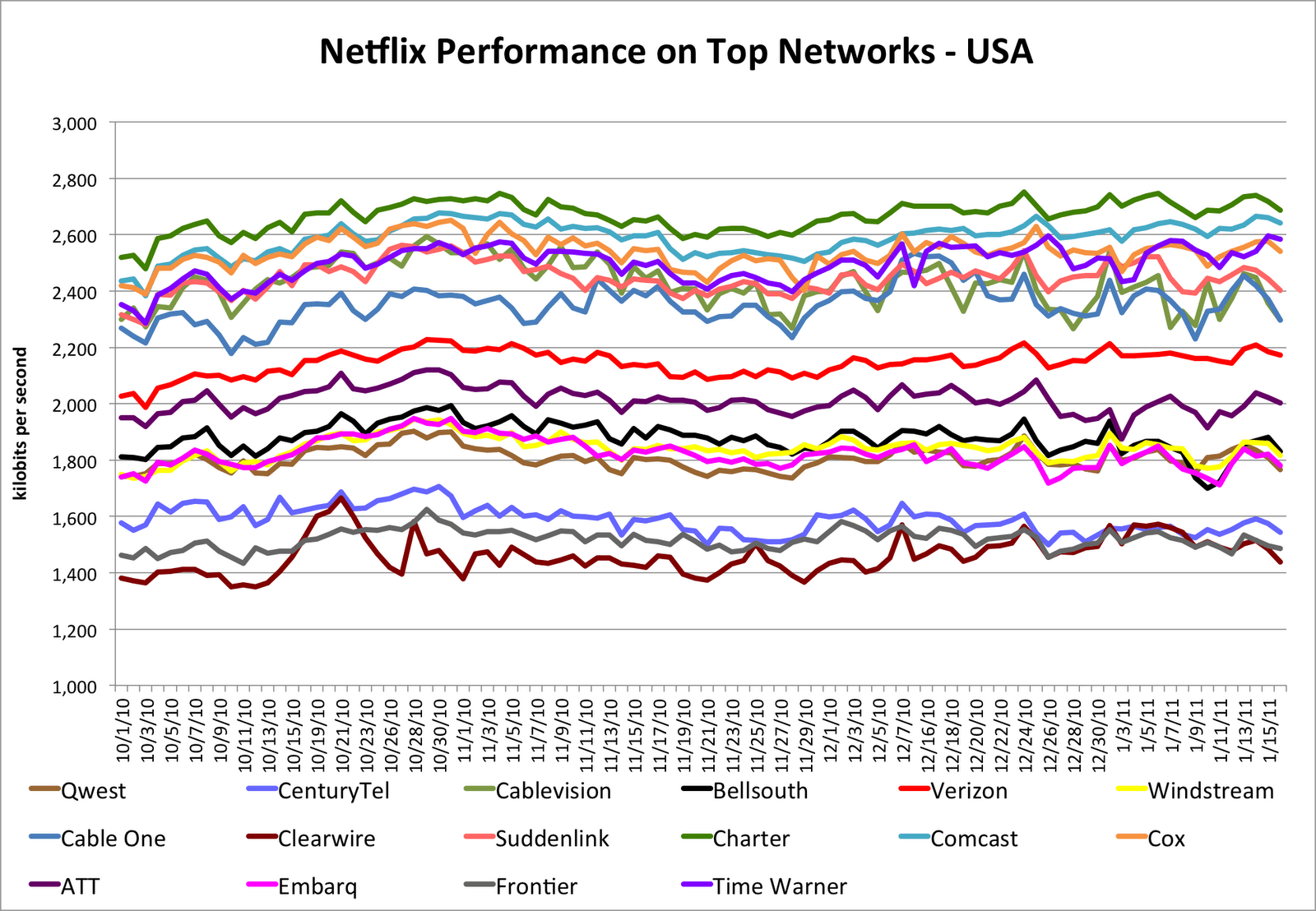
Netflix today released statistics showing Frontier Communications was America’s worst ranked wired Internet Service Provider, ranking at the bottom for quality and speed when using Netflix’s streamed content.

Only Clearwire, a heavily-throttled wireless provider scored worse than Frontier Communications.  This says nothing good about Frontier considering they are a wired provider.

Charter Cable scored highest — a surprise from a company that scores near the bottom in Consumer Reports broadband rankings:

Charter is in the lead for US streams with an impressive 2667 kilobits per second average over the period. Rogers leads in Canada with a whopping 3020 kbps average.

Canada’s higher speed performance comes even as providers claim they need to implement Internet Overcharging schemes to handle congestion on their networks — congestion not apparent from Netflix’s online video performance. Perhaps Canadians have been already grown accustomed to avoiding too much online video.

Netflix promises to release their streaming performance statistics on a monthly basis. Track your ISP from the charts below:

Netflix USA Speed Rankings

Netflix Rankings for Canada

(Our reader Paul sent us a news tip about this story.  You can send yours using the Contact Form linked above.)

Share

Big Telecom Company Scares Customers Away from Wi-Fi Networks, Including Their Own

Rogers, one of Canada’s largest telecom companies, will do anything to sell you their 3G wireless broadband Rocket Stick, even if it means scaring you away from using their own Wi-Fi hotspots.

Michael Geist, a popular columnist in Toronto, called Rogers about another matter, but the customer service agent soon began asking if Geist’s family used a laptop to access public Wi-Fi networks.

When I said that I did, he asked if I knew the dangers of using public Wi-Fi, which I was told included the possibility of hackers accessing my data or inserting viruses onto my computer.  Given the risks, the agent continued, might I be interested in the Rogers’ Rocket Stick?

Geist was completely unimpressed with Rogers’ attempts at upselling through scare tactics.

“Mobile internet services are good products that can and should be sold on the basis of the convenience they provide, not by scaring consumers into thinking that alternative access services are unsafe,” Geist wrote.

Rogers' Rocket Stick

More importantly, the irony of Rogers’ statements can’t be missed, as Geist notes:

  • Rogers operates hundreds of public wifi hotspots across the country. When promoting its hotspots, it describes them as providing “high-speed, secure access to the Internet.”
  • Rogers permits Internet tethering from many smartphones. Many users may find that tethering provides a more cost effective solution than purchasing yet another mobile Internet device.  The agent did not mention this alternative.
  • There are risks with public wifi, but those can be mitigated through a variety of steps on users’ computers. Advice on what do include Microsoft’s advice on public wifi networks, Lifehacker on how to stay safe on public wifi networks, and Ars Technica on staying safe at public hotspots.

Stories about the risks of Wi-Fi are not limited to Rogers.  Several media outlets have been running stories ranging from the plausible:
http://www.phillipdampier.com/video/CTV British Columbia -- How to secure your Wi-Fi surfing 10-7-10.flv

CTV in British Columbia warns of the risks of using spoofed or un-secured Wi-Fi networks.  (2 minutes)

CTV in Southwest Ontario reports some area residents believe Wi-Fi causes diabetes and other ailments and wants Wi-Fi pulled from schools.  (7 minutes)

Also not to be missed are Rogers’ impenetrable “Flex Rate Plans.”  Would it not be easier to just say customers will be charged the amount of the rate plan that corresponds with their actual usage?

Flex Rate Plans
Rogers unique Flex Rate service automatically adjusts the monthly fee based on your actual monthly usage. As you use more or less data, Rogers Flex Rate Data Plan will automatically roll up or down to the next best rate available. This guarantees you the best rate based on actual usage.
Tier Monthly Fee Data Included** How Rogers Flex Rate Works
1 $35 500MB You will start each month at Tier 1. If your monthly usage exceeds 500MB, then you move up automatically to Tier 2 and will be charged $40.
2 $40 1GB If your monthly usage exceeds 1GB, then you move up automatically to Tier 3 and will be charged $55.
3 $55 2GB If your monthly usage exceeds 2GB, then you move up automatically to Tier 4 and will be charged $70.
4 $70 5GB If your monthly usage exceeds 5GB, $0.05 per additional MB will be charged.
Monthly prices above do not include the Government Regulatory Recovery Fee*
Share

Hy·poc·ri·sy: Frontier Attacks Fiber Project Claiming Municipalities Don’t Know How to Run Them

Sibley County's fiber future?

It takes a lot of chutzpah to vilify a community’s proposed fiber to the home network when you’ve managed to completely screw up the one you’ve acquired from another company, but Frontier Communications tries anyway.

Instead of relying on Frontier’s overpriced (and soon to be rationed) slow speed DSL from an earlier era, Sibley County, Minnesota is proposing a municipally owned fiber project that will bring much needed connectivity to area businesses, homes, and farms.  Community Broadband Networks found a certain phone company in strong opposition.  Frontier warned county officials not to make the mistake of delivering better service than they can provide themselves:

As a provider of telephone, internet, and video services to our customers in the Green Isle, Arlington, and Henderson areas, Frontier Communications is obviously interested in the “fiber to the home” proposal that has been presented. As a nationwide provider, Frontier is aware of other efforts by municipalities of various types to build and operate their own telecommunications network. While these proposals are always painted in rosy tones, it is important for officials to carefully review the underlying assumptions and projections that consultants make when presenting these projects. Unfortunately, history tells us that the actual performance of most of these projects is significantly less positive than the promises. Often times, these projects end up costing municipalities huge amounts of money, and negatively impact their financial status and credit ratings.

Frontier even “runs the numbers” on the county proposal.  But Sibley County should carefully consider the source.  This is the same company that couldn’t manage its fiber to home network it acquired with landline purchases from Verizon Communications.  Instead, this month it dumped $30 rate increases on its fiber customers in the Pacific Northwest and Indiana.

Frontier has a vested interest in maintaining the status quo, which means leaving many rural Minnesotans with one choice for broadband: Frontier.

Of course the company opposes the county’s fiber project — they would be crazy not to, considering it will cost them many of their customers.

Cherry-picking a small percentage of the municipally-owned networks facing difficulties is just a scare tactic, and doesn’t prove their case.  County officials should consider the growing number of projects that are a breath of fresh air for the communities they serve, all at no risk to taxpayers: projects like EPB in Chattanooga, Greenlight in Wilson, or Fibrant in Salisbury — both North Carolina.

Or DSL past?

Those projects all faced the same provider-financed campfire scary stories, too — just because incumbent cable and phone companies didn’t want the competition.

When wild claims about failing projects don’t work, Frontier officials hilariously offered up this absurdity in a story in the Arlington Enterprise that ran Dec. 16.

“What we can do is provide the same speed of service as fiber can provide,” said Todd Van Epps, Frontier’s regional manager.

Really, on Frontier’s pre-existing, decades-old copper wire network?  The same one that Frontier currently sells “blazing fast/up to” 3Mbps DSL service on for $50 a month?

In comparison, the fiber network proposed for Sibley County would deliver at least 20/20Mbps service for less than $50 a month.  That fiber network is infinitely upgradable as well, with service up to 1 gigabit per second if a customer needed that much.

Our advice when dealing with Frontier’s promises: get them in writing.

When a company tells customers to throw away their Frontier FiOS fiber and switch to a competitor’s satellite television service or else pay $30 more per month for basic cable, their helpful advice about how to manage the fiber business should be taken with a grain of salt.

Share

Time Warner Cable Raises Rates in Albany, Offers a $99 Promotion Most Can’t Get

Phillip Dampier January 27, 2011 Competition, Consumer News, Time Warner Cable, Verizon 2 Comments

Time Warner Cable customers in the Albany, N.Y. area are complaining about the cable company’s latest rate increase which will cost most bundled customers at least $7 a month more in 2011.

Time Warner blamed the rate increases on investment and upgrades to their facilities and increased programming costs.

The company’s heavily marketed $99 promotion is also coming under fire in the area, because many customers don’t qualify for it.

The Albany Times-Union reports many area residents were invited to call the company “to see how they could lower their bill.”  Time Warner has marketed a one year promotional offer providing the company’s triple-play bundle of phone, Internet and cable-TV service for around $33 for each service, or $99 a month.  But when customers called the company, they were told they don’t qualify for the promotion.

Michael Malachowski, a Delmar resident, learned the hard way that winning a promotional offer from the cable company wasn’t going to be as easy as he thought.

Malachowski currently has a bundle of services with the company and spends around $140 a month.  But he learned he can’t qualify for Time Warner’s $99 offer  — it is available only to new customers or those with a single service.

Other area customers shared similar stories with the newspaper.

One way around the roadblock is to threaten to cancel.

Albany customers are getting some additional powers to negotiate with the imminent arrival of Verizon FiOS TV, coming to Bethlehem, Scotia, and Colonie.  A similar bundle of services from Verizon is a lot cheaper than Time Warner’s $140 a month.  The fiber to the home network offers an online promotion for all three services for $84.99 a month for at least the first year.

Even if FiOS is not an option, Time Warner bends the rules when customers are on the verge of cutting their cord.

Share

Canadian Media Awakens to Internet Overcharging Ripoffs; National Outrage Commences

Phillip Dampier: The Blizzard of BS from Canadian ISPs is getting salted and plowed by Canadian media and outraged citizens.

A major ongoing Internet Overcharging campaign by Canadian Internet Service Providers to extract more revenue from consumers has sailed under the radar for more than two years now in most of the Canadian press.  Although some newspapers have occasionally covered various telecommunications atrocities related to cell phone pricing, lagging broadband speeds, and an overall lack of competition in the country, specifics about efforts to curtail broadband usage (or monetize its claimed “overuse”) has been a topic mostly discussed on online forums.

No more.

As Stop the Cap! turns more attention to Canadian Internet Overcharging schemes, let this be an object lesson to our American readers about how the game is being played.  What starts in Canada could finish American flat rate broadband as well.

CRTC Ruling Lights the Flame

This week, the Canadian Radio-television and Telecommunications Commission (CRTC) finalized rules that will effectively end unlimited broadband service in the country.  Remarkably, the Commission’s ruling completely ignores the one group such “usage-based billing (UBB)” impacts the most: individual customers.

The game-changing rules, found in the obliquely-named “Telecom Decision CRTC 2011-44,” effectively establish false usage-based pricing on both the wholesale and retail levels.  No provider will actually sell broadband packages that charge only for what a consumer actually uses.  Instead, each provider will set arbitrary usage allowances — usage limits — on their broadband accounts.  Any remaining unused allowance is forfeit at the end of the month, but “overuse,” at the discretion of the provider, will be penalized with overlimit penalty fees running several dollars per gigabyte.

The CRTC acknowledges, and big providers admit, these Internet Overcharging schemes are all about getting consumers to change their online activities.

[Providers] submitted that UBB rates shape end-user behaviour and that different UBB rates would lead to different behaviours by carriers’ and competitors’ end-customers.

Perish the thought.  Without such pricing, Canadian broadband could ultimately offer an alternative to overpriced cable-TV and telephone packages sold by the very providers that advocate limited use plans.  Providers insist on predictable, uniform usage.  The Commission apparently agrees.

The Commission even acknowledges today’s unlimited use plans in Canada almost always recover the actual costs incurred to provide them, and then some:

The Commission also notes that the flat-rate component of the carriers’ retail Internet service rates recovers most, if not all, of the associated retail UBB costs. In the Commission’s view, this situation provides carriers with the flexibility to adjust or waive retail UBB rates on a promotional basis.

With this in mind, why the CRTC felt radical changes were warranted is only a mystery until you realize most of the commissioners were former employees of the various telecommunications companies themselves.

Birds of a feather….

The only audience the CRTC listens to.

All of the falderal about the merits of UBB aside, in the end the CRTC threw a small bone to independent service providers not affiliated with super-sized players like Bell, Rogers, Shaw, and Videotron — the Commission ordered they be given a “whopping” 15 percent price break off wholesale rates.

Major carriers were outraged even by this token amount, arguing that providers forced to charge correspondingly higher prices (higher than major carriers charge) could still eke out a place in the market by offering other services or better support.  They didn’t need, or deserve a discount.

But independent competitors warned without discounts approaching 50 percent, many will be gone within five years.  Many providers argued the major companies, some who received taxpayer subsidies to construct national telecommunications networks, would be able to set wholesale prices artificially high to drive them out of business.

Canada’s Media Reacts

The effective end of flat rate service across Canada finally sparked significant national media coverage of the imminent death of Canada’s broadband revolution, soon to be relegated to a nickle-and-dime metered pricing scheme that will give providers the monetary power to control usage, limit innovation, and have their hands into picking marketplace winners and losers.  Don’t like Netflix?  Slash usage allowances.  Want to protect your cable-TV revenue?  Exempt your own online content from the meter as long as you keep your subscription.  Want to drive down Canada’s broadband standing in the world?  Turn the marketplace over to a handful of companies dreaming of revenue opportunities afforded by monetizing broadband usage.

The Globe and Mail A metered Internet is a regulatory failure: The CRTC has decided to allow Bell and other big telecom companies to change the way Canadians are billed for Internet access. Metering, or usage-based billing (UBB), will mean that service providers can charge per byte in addition to their basic access charges. The move is sure to stifle digital creativity in Canada while the rest of the world looks on and snickers.  [...] So there you have it. Just as the world is ready to feast on what Canadians might cook up in the way of multimedia 3.0, Canada decides to meter the Internet, tilting the table sharply towards old-school TV networks and big corporations that can absorb the higher cost of doing business.

Canadian newspapers have covered the story in the greatest detail, but now — finally — Canada’s television news has discovered the story, which for many media critics mean the story is actually “real.”

“If you don’t see it on television, it didn’t really happen,” writes Jim from Halifax, Nova Scotia.  “A lot of Canadians don’t read newspapers, and the magazines certainly are not covering this story, so it has been an online-only event  until CBC, CTV, and Global put it on their newscasts.”

http://www.phillipdampier.com/video/CBC News Extra Billing for Internet 1-18-11.flv

CBC Television reports on the Internet Overcharging controversy.  (2 minutes)

Some critics say much of Canada’s commercial media is already in the hands of a tightly controlled, vertically integrated empire.  Most of the cable and phone companies have ownership in many major commercial broadcasters, cable networks, and even newspapers and magazines.

http://www.phillipdampier.com/video/Vertical Integration.mp4

30 Rock’s Liz Lemon and Jack Donaghy explore the concept of “vertical integration.”  Then see how it relates to Canada’s media.  (3 minutes)

But even a controlled media environment cannot stop outrage over UBB going viral, as ordinary Canadians realize they are about to pay much higher prices for a service they depend on more and more.

Outrage Commences

Charlie Angus (NDP) -- "This pricing is a ripoff."

While these pricing schemes have been around awhile, now that they are getting well-publicized exposure, consumers have realized the implications of counting how many YouTube videos they watch.

Tens of thousands have signed Openmedia.ca’s online petition, others are complaining to the media and writing their members of Parliament, demanding action.

That will only get louder when consumers start receiving bills for double, triple, or even higher for the exact same quality of service they used to pay less to receive.

“There will be a huge wake-up call for many customers,” said Jared Miller, president of Youmano, a provider based in the Town of Mount Royal.

Charlie Angus, the NDP member of Parliament who speaks about digital issues, said he he thinks the entire pricing scheme is a ripoff that will lead to huge increases in customers’ bills.

“What we need to have is clear and transparent rules so it’s being used in a measured capacity, and it’s not just instituting the principle that every time you turn on the Internet, they can ding you for fees like they do with cell-phones,” Angus said. “We’ve seen this before; when we were told that deregulating cable rates would give customers a big benefit. We were paying 60-to 100-per-cent more in no time.”

“Canada is already falling behind other countries in terms of choice, accessibility and pricing for the Internet,” Angus added.

http://www.phillipdampier.com/video/CTV British Columbia -- Canadians rank among most enthusiastic web users 12-28-10.flv

CTV British Columbia explores Canada’s love affair with technology and how its integration has dramatically changed the social lives of many families.  That’s no surprise, considering Canadians are North America’s most enthusiastic net users.  (2 minutes)

Share

What Can Jam a Cable Company Parking Lot? Free Football Lawn Signs

Phillip Dampier January 26, 2011 Consumer News, Time Warner Cable, Video 1 Comment

Green Bay area residents stormed Time Warner Cable’s offices late last week, but not to sign up for a new cable package or upgrade their Internet service.

Instead, they were there to grab their free green and gold “G Force” yard sign to celebrate the Green Bay Packers football team.

Initially Time Warner Cable planned to distribute 15,000 yard signs, but when they realized the demand exceeded supply, they ordered another 10,000, the bulk of which were distributed by Saturday afternoon.

The lawn sign promotion, which also prominently displayed Time Warner Cable’s logo, created minor traffic jams in communities across Wisconsin at times — the signs were handed out all over the state.

http://www.phillipdampier.com/video/WBAY Green Bay Time Warner Gives Away Signs 1-26-11.flv

WBAY-TV in Green Bay covered the excitement.  (1 minute)

Share

Search This Site:

Contributions:

Recent Comments:

  • Smith6612: I always avoid the hype about super antennas. They don't do much besides induce more noise which really puts you back at square one anyways with digit...
  • Smith6612: Do you have any proof that they are in fact messing with VPN connections and what not? I'd like to see that myself, personally. If you don't use VP...
  • Smith6612: It seems there is still some work to be done to the comment editor, unfortunately. For some reason I can edit others' comments and I'm not even an adm...
  • James R Bivins: I live on a budget and cable is in that budget,but if you don't have cable or the speeds for the these sevices.You are out of luck when is comes to ru...
  • James R Bivins: People in rural area are not been offered the better option for true broadband.Cable is faster,cheaper,and has the GB's.They offer 1 to 3 services an...
  • Fred: Bruce Edward Walker and Dr. Joseph P. Fuhr, Jr are two frauds who no one needs to listen to....
  • nolan: antenna did not work, i have a outside antenna with a digital converter box that pulled in 31 channels.and clear cast only got 12, also have 2nd tv w...
  • David Smith: AT&T's bandwidth capping is akin, in my opinion, to trampling on free speech. The Internet and today's technology makes us realize that there is ...
  • Michelle: How can I file a lawsuit against Cricket broad spying on my service. Every time I connect to the internet, I am bombard with a VPN connection of a rou...
  • Theresa Reid: I just got my Clear Cast today I was able to get only 4 channels. It WILL be going back....
  • Alex Perrier: Ultra-Lite discontinued! :|...
  • Greg: Sonic.net will do 1Gbps for $70/month in their limited FTTH service area. They are a private company too. Admittedly they are a very awesome priva...

Your Account: