Cablevision Customers: Get $20 Off Your Monthly Bill for 2 Years

Phillip Dampier October 28, 2010 Cablevision, Consumer News 4 Comments

Stop the Cap! reader James dropped us a note to let us know Cablevision customers calling to cancel their cable service are scoring $20 a month off their cable bills for two years if they decide to stay with the cable company. It’s all because of the ongoing dispute between Cablevision and Fox over programming fees.

That $500 goes a long way towards compensating Cablevision customers for at least a year of petty programming disputes between executives who think of $500 as tip money.

So if you are a Cablevision customer, here is how to get your money back:

  1. Call Cablevision at this number – 1-800-918-2581, which takes you directly to the customer retention department.
  2. Tell the representative you wish to cancel your cable service because of the ongoing dispute with Fox and your loss of local and cable channels.
  3. When they argue with you about why you should stay, tell them you are tired of being put in the middle of these disputes and forced to pay for programming you are not getting.
  4. They may offer a $20 credit for just 12 months.  Tell them that is not long enough and if the representative won’t do any better, hang up and call back.

Be polite, persuasive, but persistent.  Customers on existing promotional deals may not qualify for this, but if you are paying regular Cablevision prices, you do.

The sooner you call, the better as word is getting out about this deal which could be withdrawn at any time.

Share

Shaw’s Shark-Like Wallet Biters Are Back for More of Your Money: Company Response Rebutted

A firestorm erupted this week on Broadband Reports over news that Shaw Cable was turning its existing “soft” Internet Overcharging scheme into a “hard” system filled with usage limits and overlimit fees.  One of Shaw’s social media representatives tried to throw some water on the fire:

I’ve seen a lot of discussion here about the new policy, and quite a bit of inaccurate or incomplete information and speculation, so I’d just like to set all of this straight.

Essentially, the system works like this: your package includes an allowance for a certain amount of traffic. If you exceed that traffic for one billing cycle, you will receive a notice on your bill advising you of the fact. We also automatically activate your traffic monitor so that you can monitor your usage from that time forward.

Since the bill arrives, of necessity, after your billing cycle ends, we give you a cycle’s grace between the period when you exceeded and when we start charging. That is to say that if you exceed in billing cycle one, you’ll receive your bill part of the way through billing cycle two, and so we won’t start charging for excess traffic until billing cycle three.

As to how much bandwidth will cost, here’s how it works:

If you exceed your monthly traffic allowance, you’ll receive a bill for $1 per GB for Extreme and above, $2 per GB for High Speed and High Speed Lite. Considering how much media, etc, you can obtain in 1 GB, $1 is not expensive.

However, if you plan to exceed by a considerable margin, data packs are also available, and what these do is allow you to increase the traffic allowance by the following amounts:

  • $5 for 10 GB
  • $20 for 60 GB
  • $50 for 250 GB

So this gives you the option to increase your monthly traffic allowance to meet your needs. It’s also considerably less expensive than the standard $1-$2 per GB rate.

The best part about the data packs is that you can apply them at any time up to three days before the end of your billing cycle. So if you discover that you’ve exceeded your included usage allowance, and still have three days to the end of the billing cycle, just give us a call (or chat) and ask that we add the appropriate data pack for you.

[...]I’ve seen some posts here suggesting that this new policy has been financially motivated to avoid upgrading our networks. That’s actually not the case. In fact, just a few weeks ago we increased the included usage for all of our services by 25%, just in time for NetFlix. If you want to think about it in financial terms, just consider how much more bandwidth the network would need to allow a 25% increase for every customer, and how much that kind of network upgrade would cost. It’s pretty clear that our motives are not financial. If they were, increasing the included usage would not be very sensible, would it? It would, after all, considerably reduce the number of customers exceeding their monthly traffic allowance, would it not?

I hope that this clarifies the situation, but if there are any questions, please do feel free to ask.

James – Shaw

Shaw tinkers with their Internet Overcharging scheme

In part, this rebuttal was also directed to Stop the Cap!, because we are actively participating in that discussion.  Shaw’s argument about usage limits and how the company’s implementation of them benefits their customers is familiar to many of our readers who fought off usage caps proposed by Time Warner Cable last year.  Somehow, the same company that sets unjustified limits and penalty prices on already-overpriced broadband service is doing customers a real favor by offering alternative pricing plans for heavier users that reduces war-crime profiteering to pickpocketing.

That’s logic Stalin might have appreciated, but most customers already burdened with high cable and broadband bills won’t.

Our response:

Don’t you just love it when Internet Overchargers always claim their new gotcha fees are never about the money?

“James” from Shaw offers a classic example of what happens when your broadband provider implements a scheme to boost your broadband bill and then claims it’s good news that the company has some options to keep those overlimit fees from stinging too badly.

When Internet Overchargers tell you it’s not about the money, it’s really ALL about the money.

Here's what happens when a third provider ruins a Canadian broadband duopoly

Who knew that an invisible border that makes unlimited Internet possible in Vancouver, Washington makes it impossible in Vancouver, B.C. Using Shaw’s argument, providers south of the border are headed straight for bankruptcy court while companies like Shaw barely hold on with “free usage upgrades” of existing limits.

But of course the financial reports for shareholders Shaw’s social media mavens don’t talk about tell the real story. Shaw enjoys considerable revenue from their broadband division thank you very much, and plans to do even better now that they can achieve ‘revenue enhancers’ from their enforced Internet Overcharging schemes.

That’s another way of saying Shaw’s Wallet Biters are back for more of YOUR money.

Whether it’s 20 cents per gigabyte (at least a 100 percent markup) or $2 (rape and pillage pricing), these schemes are hardly good news for Shaw customers. Indeed, if Shaw was truly concerned about saving their customers something under their cap ‘n tier regime, they’d deliver those “usage paks” to customers automatically instead of forcing them to call the company to add them when they go over the limit. If you remember to ask, Shaw gets extra profits they can take to the bank. If you forget, Shaw throws a Money Party on the extra high everyday overlimit rates.

What Shaw forgets to tell you is the cost to deliver increased usage and bandwidth to customers is ALWAYS dropping, and dropping fast. The price charged to move 10GB of traffic not too long ago moves 100GB today. So it’s hardly rough on Shaw to expand yesterday’s unjustified limit to today’s higher, still unjustified limit.

When one also considers yesterday’s “soft cap” is about to become tomorrow’s budget-busting “hard cap,” few Shaw customers are calling 1-800-FLOWERS to send a thank-you bouquet to Calgary.

Having been to Calgary, I know the people in Alberta and elsewhere across western Canada know a ripoff when they see one. They ask, “why is our broadband so overpriced and usage limited?” They wonder where the CRTC has been. They wonder why countries in Asia and even eastern Europe are now beating the pants off Canadian broadband with faster speeds at lower prices.

The fact is, Shaw pulls these overcharging tricks on their customers because they can. The broadband duopoly in Canada from cable and phone companies deliver punishing usage limits on Canada that are being banished in other countries around the world. Even notorious cappers like Australia and New Zealand are finally ridding themselves of broadband that is always capped, always throttled.

What would be sensible is that Shaw, a multi-billion dollar major player in Canada would plow some of their enormous profits into network capacity upgrades that can accommodate the needs of Canada’s growing knowledge economy, not inhibit its growth. Then, earn additional profits by selling even faster speed tiers and content customers can access over those networks.

Considering even Shaw admits only a small percentage of customers create traffic problem on their networks, it’s not hard to see the company’s new reliance on hard Internet Overcharging is designed to capture new revenue from those hitting their caps, thanks to the increasing number of broadband customers using their fast connections for high bandwidth content.

And hey — bonus: it also discourages those customers from even considering pulling the plug on their cable package to watch everything online.


Share

Salt Lake City TV Station Puts Broadband Speeds to the Test: Most Don’t Get What They Pay For

Recently, the FCC issued a report claiming Americans are often only getting half the broadband speeds they are promised by providers.  KTVX-TV, the ABC station in Salt Lake City, recently investigated whether that held true for local residents.

The results?  Most Salt Lake City Internet users don’t always get a good deal from providers that often deliver inconsistent speeds, even on premium priced plans that can cost up to $130.

Ookla, which has been compiling speed test data as well, reports the United States was in 11th place globally when it comes to being honest about what broadband speeds providers actually deliver.  Don’t get too excited — we score 30th on the download speed index.  More than two dozen nations deliver faster service.

Which nation scores at the very top of the honesty chart?  The Republic of Moldova, a largely-Romanian speaking former Soviet Republic.  In fact, ISPs in Chişinău, the capital city, are too modest, claiming speeds lower than they actually provide customers.  The rest of the top-10 honesty ranking contains a number of countries in eastern Europe — countries that blow the United States out of the water when it comes to telling the truth about broadband speed:

  1. Republic of Moldova, 109.21%
  2. Russia, 98.65%
  3. Slovakia, 98.64%
  4. Lithuania, 97.97%
  5. Ukraine, 97.58%
  6. Hungary, 96.80%
  7. Switzerland, 96.72%
  8. Bulgaria, 95.96%
  9. Latvia, 94.83%
  10. Norway, 93.97%

Five states manage to score high marks on the honesty chart, most of which are served by Verizon.  We suspect FiOS may be a major factor in why these states lead the others:

  1. Delaware, 100.85%
  2. Massachusetts, 100.07%
  3. Maryland, 99.56%
  4. Rhode Island, 98.83 %
  5. Virginia, 98.36 %

KTVX found that the area’s incumbent cable company Comcast did manage to deliver promised broadband speeds, often when most customers are not using the service.  Speeds were far lower in the evening — prime-time usage hours — sometimes as low as 3Mbps.

“Qwest’s DSL is best forgotten,” says Stop the Cap! reader Sangi, who writes from the city of Roy.  “It’s so bad a lot of us think of it as dial-up on caffeine.”

Sangi used to receive DSL service from the phone company, which is planning to merge with CenturyLink.

“When we moved closer to town, cable was an option and that made Qwest something we could live without,” Sangi says.  “They never came close to the speeds they marketed and when we complained, they claimed we wouldn’t notice the difference when browsing web pages and checking e-mail.”

“Apparently Qwest considers the Internet good for little else, at least how they deliver it,” he added.

http://www.phillipdampier.com/video/KTVX Salt Lake City You Are Getting Half Your Promised Broadband Speed 10-22-10.flv

KTVX-TV in Salt Lake City investigates broadband speed claims and finds residents don’t always get what they pay for.  (3 minutes)

Share

Comcast’s Phone Service Implicated in Florida Woman’s Death; Husband Sues, Claiming Negligence

Phillip Dampier October 28, 2010 Comcast/Xfinity, Consumer News, Video 1 Comment

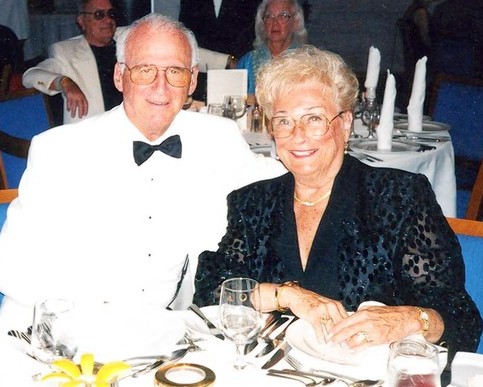
Seymour and Sidell Reiner (Sun-Sentinel)

A Boynton Beach family’s tragic story may give Comcast phone customers second thoughts about whether the cable company’s “digital phone” service is a help or hindrance in an emergency.

Seymour Reiner arrived home last Thanksgiving to find his wife of 62 years dead on the floor from a cut ankle.  But his shock turned to anger when he learned his beloved wife Sidell’s death likely came after Comcast, the company that delivers his phone service, could not quickly manage to provide emergency officials with their home address.

Comcast customers in south Florida who dial “0″ from their Comcast phone lines hear a message indicating they should press “0″ if the call is a 911 emergency, which Sidell apparently did at least 10 times.

“Help me! Help me, please! Help me! Help me!” Sidell pleaded in disturbing recordings (warning: graphic content) obtained by the Sun Sentinel newspaper.

Sixteen minutes later, when paramedics finally arrived, it was too late.  An hour after that, Seymour arrived home to find the phone laying next to Sidell’s body.

The 81-year old Florida grandmother cut her ankle after dropping some crystal glassware, hitting an artery that caused major bleeding.  She reached for her phone and dialed “0″ hoping to reach an operator, but was instead connected with Comcast’s call center.  The cable company eventually transferred the call to Palm Beach County’s 911 emergency services center, but by that time, her anguished pleas for help were barely audible.

The county’s 911 dispatcher asked Comcast’s operator for Reiner’s address, which she could not provide.  Minutes passed as Comcast tried to figure out the address where the call originated from, and an ambulance was eventually dispatched.  Emergency responders arriving at the Sidell’s home left after nobody answered their knocks on the home’s locked front door.  Sidell was unconscious by that time.

Now the Reiner family has filed a lawsuit against Comcast demanding unspecified damages for the cable company’s performance during the tragic events, and also has served notice they may sue the county and fire rescue service for their alleged negligence.

Reiner appeared visibly upset at a press conference held earlier today announcing the lawsuit.  He told several reporters he doesn’t want anyone else to suffer the tragedy he faced when his phone provider couldn’t quickly handle a call for help that ultimately resulted in his wife’s death.

Gary Cohen, the family’s attorney, was livid about Comcast.

“They have her address when it comes to a bill, but when it comes to saving her life, they can’t find her address?” Cohen asked.

The lawsuit led the news across several cities in south Florida, and viewers heard the story first-hand:

“Her phone number, when we put in her phone number, it is showing that there is no information available on that number,” the Comcast operator says.

“Oh, goodness,” the Boynton Beach operator responds.

Cohen accused Comcast of being indifferent about the urgency of Reiner’s desperate pleas for help and said the cable company dropped the ball.

“This was a life-deciding call and there doesn’t seem to be a lot of communication that this is a desperate situation,” Cohen said. “”Nobody took responsibility in saving her — no one went that extra mile and did what they needed to do.”

Cable company and other “Voice Over IP” phone services have been criticized in the past for not passing through important caller-ID information to emergency responders that includes up to date addresses of where the calls originate.  Some traditional phone companies have used past failures by alternative providers to warn consumers not to disconnect landline service because of possible delays in emergency response.  The Reiner family may prove to be a case in point.

Comcast spokeswoman Marta Casas-Celaya said her company does not comment about pending court cases and declined to answer general questions about services provided when a caller dials “0.”  Another statement indicated the company felt “deeply saddened for the Reiner family’s loss.”

http://www.phillipdampier.com/video/Boynton Beach Tragedy 10-27-10.flv

Several Florida TV stations gave this story the lead on their evening newscasts. [WPBF-TV & WPTV-TV West Palm Beach, WFOR-TV Miami, WPEC-TV West Palm Beach]  (9 minutes)

Share

Netflix to Broadband Industry: Please Don’t Kill Us With Usage Caps

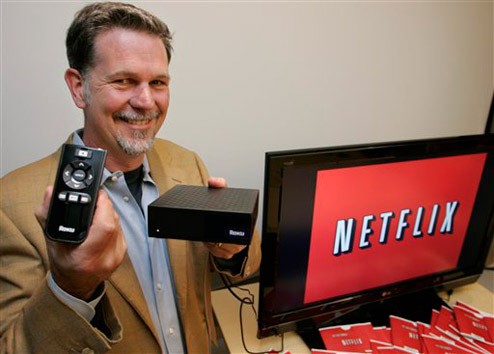
Reed Hastings, CEO of Netflix, shows off the company's growing reliance on broadband streaming, moving away from its original DVD-by-mail rental business.

Last week, Netflix CEO Reed Hastings was showered with questions from Wall Street during the company’s third quarter-results conference call.  At the top of the agenda — the company’s shifting business model away from DVD rentals-by-mail gradually towards instant on-demand streaming over broadband networks.

At issue is how Netflix can survive a broadband industry that controls the pipeline Netflix increasingly depends on for its continued existence.

Hastings tried to assuage his cable competitors by telling investors the company is hardly a threat to cable-owned movie channels and basic cable.  But he admits ultimately the company will be in a real mess if Internet Overcharging schemes like usage caps and speed throttles limit the amount of content customers can affordably access:

“We have some vulnerability depending on capped usage and what happens. Comcast has a cap, but it’s 250 gigabytes and so most users feel that they have an unlimited experience, and it gives us plenty of room to deliver a high-def stream. On the other hand, AT&T Mobile data on an iPad is now capped at two gigabytes, [and that's] not enough room to deliver hours and hours of high-def.  We are definitely sensitive [to the issue] in the long term [whether] the industry ends up at 250 gigabytes or two at the other extreme.”

There is some limited evidence Netflix’s success in Canada is already being tempered by usage limits near-universally imposed in the country.  Rogers, a major cable company in eastern Canada, even reduced usage caps for certain tiers of service around the same time Netflix announced its imminent arrival north of the border.

Barry McCarthy, Chief Financial Officer notes fewer Canadians are converting their free trials of Netflix’s streaming service into paid subscriptions.

“We anticipate we are seeing slightly lower conversion rates in Canada than we see in the U.S.,” McCarthy told investors.

As Netflix moves towards higher quality video streams, the amount of data consumed increases as well.  In Canada, that eats into broadband usage allowances, and fast. As soon as customers start receiving warnings they are nearing their monthly usage limit, or receive a broadband bill with overlimit fees, Netflix is likely to lose that customer.

Cable and phone companies in Canada are already warning customers that online video is a major culprit of exhausted usage allowances.  Both are also happy to remind their customers they are happy to sell them access to unlimited video — through cable or telco TV subscriptions.  Rogers owns a major chain of video rental stores as well.

What can Netflix do about usage capped broadband?  Not much, admits Hastings.

“There is a not a lot of improvement in compression techniques. But what we can do is just deliver a lower bit stream, a lower quality video experience. So, for example, not too high-def. So, that’s one possible way to partially mitigate that impact,” Hastings said.

Netflix will soon face increasing competition, especially from the cable industry’s TV Everywhere projects, and they won’t deliver a lower quality video experience.

Time Warner Cable and Comcast this month both formally introduced their respective video on demand services.

Comcast’s Xfinity online service arrives after months of beta testing.   Comcast customers can watch video selections from nearly 90 movie and television partners, including programming from HBO, Viacom, and Paramount.  Ultimately, the online video service is expected to deliver access to dozens of cable channels and individual programs from studios and networks at no charge to those who subscribe to a cable television package.

Time Warner Cable took a more modest approach last week by introducing ESPN Networks to its cable subscribers who register with the cable company’s MyServices website.  The new customer portal allows subscribers to review and pay their cable bill, add new services (but not cancel existing ones), remotely program DVR boxes, and also verifies subscriber status for future cable subscriber-only online video programming.

Netflix may soon find itself at the mercy of the cable and telephone companies which deliver broadband access to the majority of Americans.  Not only is it difficult to convince customers to pay a monthly fee for programming the cable industry may eventually give away for free, it may be downright impossible for Netflix to survive if those providers decide to squeeze the customer’s pipeline to unlimited Netflix content.

http://www.phillipdampier.com/video/Comcast Xfinity Ad Spot 10-2010.flv

Comcast Ad Introducing Xfinity Online.  (1 minute)

Share

Don Quixote: Angry N.J. Mayor Invites Other Cable Companies to Compete Against Cablevision

You can’t blame a guy for trying.  As the Cablevision-Fox dispute continues to drag on — keeping several Fox-owned cable networks and two New York stations off Cablevision screens, Hamilton Mayor John Bencivengo decided it was time to start shopping for some cable competition.

Bencivengo wrote thoughtful letters to executives of Comcast and Time Warner Cable trying to sell the two cable companies on coming to Mercer County.

“I am writing to inquire as to any interest your company may have in entering into Hamilton Township (Mercer County), NJ as a cable television provider,” Bencivengo’s letter reads. “I understand that any business decision would be predicated on the economic feasibility of entering into a new market, either through a franchise agreement with Hamilton Township or through a statewide franchise agreement available from the State of New Jersey through the BPU (Board of Public Utilities),” the letter reads. “It is a vibrant market that seems ripe for picking at this time.”

He’s also reminding both cable companies they are free and clear to deliver service just by signing a franchise agreement — the one Hamilton Township had with Cablevision expired back in 2005.

The New Jersey Times notes the area is not well-served by cable competition.  Verizon FiOS is an option for only about half of the residents of Hamilton, and only a quarter of residents in nearby Robbinsville.  The only other alternative is attaching a satellite dish to the roof.

Hamilton Township is part of Mercer County, N.J.

“Here we are again with stations that are pretty popular off the cable network without any reimbursement to the cable customers, and that’s unfortunate,” Bencivengo told the New Jersey newspaper. “I want to be proactive to try to woo these people to Hamilton Township.”

Unfortunately, the cable industry in the United States resembles an organized crime network (their prices sure are a crime), each with their own respective territories companies have quietly agreed never to cross.  Comcast and Time Warner Cable are the Godfathers of their respective service areas, and neither will compete head-to-head.  Even though many residents affected by the Fox blackout may think of Cablevision as the Fredo of the cable industry, the chances of another cable company arriving in town to compete with them is next to zero.

Verizon offers the most immediate opportunity for cable competition, but consumers will find pricing generally comparable to what Cablevision charges.

The mayor of Hamilton need not tilt at windmills, however.  There is another way.

If Hamilton Township is fed up with Cablevision’s HissyFits and Verizon’s high prices, the alternative is to build support for a community-owned municipal system that can deliver video, phone, and broadband service to residents.  That’s what communities ranging from Wilson and Salisbury, North Carolina to Opelika, Alabama are doing, among many others.

They’ve decided the future of their communities’ telecommunications needs can no longer be entrusted to a handful of bully boys who put customers in the middle of every dispute over the money those customers will ultimately have to pay no matter who wins.

It’s a far better long term solution than replacing one bad cable company with another.

Share

South Florida ‘Internet Blast!’ Customers Get Free Speed Upgrade from Comcast

Phillip Dampier October 26, 2010 Broadband Speed, Comcast/Xfinity Comments Off

South Florida Comcast customers signed up for the Blast! broadband plan are getting noticeably faster speeds from the cable company this week with a free speed upgrade.

Blast! in southeastern Florida used to deliver 16/1Mbps service, but customers in the region are now reporting speeds are up to 20/2Mbps.  PowerBoost, which delivers a temporary speed boost, has also been upgraded to provide improvements in both downstream and upstream speeds at rates as fast as 25/5Mbps.

Comcast will inform customers with outdated cable modems they’ll need to upgrade them to receive the newest available speeds.  All others only need power cycle their existing modem by briefly unplugging it to obtain the new speeds.

Share

Washington Post Hackery: Editorial for NBC-Comcast Merger Downplays WaPo’s Own Conflict of Interest

The Washington Post editorial page yesterday published a self-serving piece that openly advocated the approval of a merger between NBC-Universal and Comcast, creating one of America’s largest and most concentrated media companies.  But considering who owns the Post, the editorial might as well have been written by Comcast CEO John Roberts.

Containing only a non-specific disclosure that the newspaper “has interests in broadcast and cable television,” the editorial laments interference from “advocacy groups” that oppose the merger, claiming they are “poor prognosticators of the effects of large media mergers.”  The newspaper found no problems with media concentration in the United States, which itself should be an indictable offense, until one realizes the company that publishes the newspaper is, itself, a concentrated media company.

The Washington Post and Cable One are both owned by the same company.

The newspaper owns Cable One, a particularly nasty, low-rated cable operator that spied on its broadband customers and overcharges them for broadband service through a complicated Internet Overcharging scheme.  In fact, Cable One is the cable company that brought America the “$10/GB overlimit fee,” a low blow for the company’s customers on the so-called “economy tier,” which delivers pathetic 1.5Mbps service with a maximum limit of just 1GB!  This is the kind of cable company that proves sometimes dial-up service -is- better.

As far as the Post is concerned, the FCC will keep America safe from any uncompetitive market-power-enabled-abuses from a Comcast-NBC behemoth, itself a stunning statement from a newspaper that claims to know what is really going on in Washington.

Even our readers know complaining to the FCC about anything is like talking into a black hole.

When it comes to the Washington Post editorial page, profits come first, and Cable One can generate them with its own abusive pricing practices.

For the rest of the country, the irony of a dead-tree-format newspaper finger-pointing at advocacy groups (that don’t own cable companies), accusing them of getting the future wrong is a mighty rich irony.

The reality-based America I live in thinks media is already too-consolidated, too shallow, and increasingly abusive and too expensive.  The Post‘s advocacy of a mega-merger like Comcast-NBC only points to just how out of touch the newspaper is getting these days.  As Americans clamor for more media diversity, more competition, and more choices at lower prices, the Washington Post is just fine with the exact opposite.  But then you’d expect that from a company whose business plan depends on it.

Share

ESPN3 Now Available, Underpowered By Time Warner Cable; But ESPN Itself Was Better

Phillip Dampier October 25, 2010 Broadband Speed, Online Video, Time Warner Cable 8 Comments

Time Warner Cable’s TV Everywhere authentication system went live today for customers, who can now access several channels of ESPN on their broadband connection, assuming they can prove they subscribe to a video package that includes ESPN.

Time Warner’s agreement with Disney-ABC, which owns ESPN, made online viewing possible for Time Warner Cable subscribers.  Viewers can authenticate themselves by visiting ESPN’s website and invoking the live video player, which will connect with Time Warner Cable’s MyServices website.  Just log in and Time Warner will send authorization to ESPN to unlock the video streams to watch.  There is no additional charge for this service.

Earlier, there was some confusion over whether broadband-only customers could have access.  A message on ESPN’s website indicates the answer is no — you must be a Time Warner Cable customer with at least Standard Service to get authenticated.

Unfortunately, once logged in and watching, the results were underwhelming, at least for ESPN3.  The picture quality from Stop the Cap!‘s Brighton, N.Y., headquarters was dreadful, even from a Road Runner Turbo account.  A “signal strength meter” barely moved into second position about five minutes after I started watching.

Results were much better for ESPN’s primary channel feed, currently showing a football game between the New York Giants and the Dallas Cowboys.  That managed to peg the meter one position from maximum.  On a 28″ LCD monitor, the picture looked reasonably good, but frankly not as impressive as either Netflix streaming or Hulu.  Pixel problems and other video artifacts were far too common.  But for on-the-go-viewing, the results were adequate.

Commercial breaks were replaced with either ESPN’s logo or, in the case of the football game, short ad spots for NFL gear.  Watching a slowly moving logo for two plus minutes in uncomfortable silence, especially with a group, can be unnerving enough to actually prefer the commercials.

The results for ESPN3, "powered by Time Warner Cable" were unimpressive, with a "signal strength" meter showing just a single bar on our 15/1Mbps Road Runner service.

Things looked better on ESPN's primary network, which managed to peg the signal strength meter to one position below maximum.

Share

Cisco Releases New Broadband Rankings: U.S. and Canada Not In The Top-10, Qatar Is

Cisco has released the results of the third annual study from the Saïd Business School at Oxford University, which looks at broadband quality in 72 countries and 239 cities around the world.  The results are an embarrassment to much of North America’s broadband.

Using data from 40 million real-life broadband quality tests conducted in May-June of 2010 on the Internet speed testing site, Speedtest.net, the researchers were able to generally evaluate broadband conditions in the 72 countries which generated enough tests to provide useful results.

Although these kinds of studies often end up indirectly promoting Cisco’s own products (which they’d argue go hand-in-hand with broadband improvement), the findings highlight the very real problem that most aggressive broadband development is taking place outside of North America.  Here at home, reduced investment and foot-dragging has kept growth in check, even as prices continue to rise.

Based on the findings, the countries with the most sophisticated and advanced broadband networks are:

Broadband leadership table (top 10):Ranking Broadband Leadership 2010
1 South Korea
2 Hong Kong
3 Japan
4 Iceland
5 Switzerland. Luxembourg, Singapore (tie)
6 Malta
7 Netherlands
8 United Arab Emirates, Qatar (tie)
9 Sweden
10 Denmark

While the United States and Canada both languish in 15th place, broadband in South Korea has gone from excellent to outstanding as it continues aggressive, almost revolutionary improvements in service and speed:

  • South Korea tops the broadband leadership ranking for the second year in a row;
  • Broadband quality in South Korea is ranked the highest and has set a new benchmark for the world;
  • Average download throughput is 33.5 Mbps, an increase of 55% from 2009, average upload throughput is 17 Mbps, an increase of 430%, and average latency is 47ms, an improvement of 35% vs. 2009 figure;
  • South Korea has achieved 100% broadband penetration.

Cisco’s study found North America is in peril of falling even further behind because providers are trying to incrementally upgrade inferior, obsolete copper-wire phone networks on the cheap instead of replacing them.

As long as providers in the United States and Canada maintain a Dollar Store-mentality towards broadband improvement, both countries will increasingly fall further and further behind countries many Americans couldn’t find on a map.

Developing economies, especially in eastern Europe, are poised to leapfrog over North America and potentially become new powerhouses in the digital global economy of the future.  Among the nations on the verge of blowing past the United States and Canada: Lithuania, Latvia, Bulgaria, Romania, the Czech Republic and Hungary.

Welcome to the 500GB Broadband Economy

Cisco’s study also includes some important findings about data consumption that expose North American broadband providers who support Internet Overcharging schemes as direct threats to our economic future in a knowledge economy:

The study assessed the average consumption of different household segments and found major differences between basic-digital homes and smart and connected homes:

  • Basic digital homes which mainly use the web for simple-quality requirement applications such as web browsing, instant messaging and social networking, consume about 20 GB per month;
  • Smart and connected households, who would use the web for high definition video communication, high definition entertainment, tele-education or telemedicine, home security and others, can easily consume 500 GB per month and require an assured bandwidth of 18 Mbps.

Under these terms, Canada’s digital economy is already destined to fail because virtually every provider in the country limits broadband consumption to levels far below that required by “smart and connected households.”  In the United States, some providers have suggested as little as 5GB would represent “enough usage” under residential broadband accounts.  The nation’s largest cable company, Comcast, limits consumption to half the amount required.  Those advocating unlimited broadband or far higher limits are accused of being “bandwidth hogs” or pirates by many of these providers and their dollar-a-holler friends.

World leaders in broadband have some things in common: availability of inexpensive, unlimited broadband delivering fiber-fast speeds.  Those falling behind or at the bottom are raising broadband prices, putting limits on consumption and delivering slow broadband speeds that would draw laughter in countries as diverse as Japan, Sweden, and the United Arab Emirates.

Share

Search This Site:

Contributions:

Recent Comments:

  • Phillip Dampier: Wow... what a great feature. We can all correct each other now. Obviously, I'll have to take this back offline and mess around with it. I was con...
  • Smith6612: I always avoid the hype about super antennas. They don't do much besides induce more noise which really puts you back at square one anyways with digit...
  • Smith6612: Do you have any proof that they are in fact messing with VPN connections and what not? I'd like to see that myself, personally. If you don't use VP...
  • Smith6612: It seems there is still some work to be done to the comment editor, unfortunately. For some reason I can edit others' comments and I'm not even an adm...
  • James R Bivins: I live on a budget and cable is in that budget,but if you don't have cable or the speeds for the these sevices.You are out of luck when is comes to ru...
  • James R Bivins: People in rural area are not been offered the better option for true broadband.Cable is faster,cheaper,and has the GB's.They offer 1 to 3 services an...
  • Fred: Bruce Edward Walker and Dr. Joseph P. Fuhr, Jr are two frauds who no one needs to listen to....
  • nolan: antenna did not work, i have a outside antenna with a digital converter box that pulled in 31 channels.and clear cast only got 12, also have 2nd tv w...
  • David Smith: AT&T's bandwidth capping is akin, in my opinion, to trampling on free speech. The Internet and today's technology makes us realize that there is ...
  • Michelle: How can I file a lawsuit against Cricket broad spying on my service. Every time I connect to the internet, I am bombard with a VPN connection of a rou...
  • Theresa Reid: I just got my Clear Cast today I was able to get only 4 channels. It WILL be going back....
  • Alex Perrier: Ultra-Lite discontinued! :|...

Your Account: