


Home » Editorial & Site News »Internet Overcharging »Online Video »Rural Broadband » Currently Reading:

Provider Admits Caps & Overlimit Fees Are About Deterrence, Forcing Upgrades, Or Going Elsewhere for Service

Phillip Dampier May 19, 2010 Editorial & Site News, Internet Overcharging, Online Video, Rural Broadband 41 Comments

Customers of Vistabeam in Nebraska and Wyoming who subscribe to the company’s rural Wireless Internet Service are about to discover their online activities are about to be capped… for real this time.

Matthew Larsen, who runs the Wireless Cowboys blog, includes some illustrative examples of Internet Overcharging schemes in action and what they’re all about.  He writes about his experiences at Vistabeam, which serves rural Nebraska and Wyoming with wireless broadband service.  The company started operations with an admittedly-unenforced 3GB usage limit, backed up with a stinging $25/GB penalty overlimit fee to underscore the point.  Today that cap is described by Larsen as “a joke” — too low to be taken seriously.  [Note to Frontier: Are you reading this?]

But the company was determined to monitor and measure its customers’ online activities and developed an in-house tool that is providing daily insights into customer usage, and gives Vistabeam the ability to begin penalizing customers who exceed the limits established by the provider.

Wireless providers, known as WISPs, often provide the only Internet access in rural areas that are too sparsely populated to deliver DSL service and where cable television is a financial impracticality.  For Nebraska and Wyoming residents bypassed by cable and underserved by DSL (if at all), it’s often a choice between dial-up, satellite fraudband service barely capable of 1Mbps service with a punitive “fair access policy,” or an independent WISP.  A number of customers have chosen the latter.

Vistabeam offers service plans for its 2000 customers ranging from 384kbps for $29.95 a month to 4Mbps service for $99.95 a month, with a discount for paying in six month increments.  That’s not cheap by any means.  But rural Americans routinely face higher broadband bills because of the inability of providers to achieve economy of scale.  Fewer customers have to share the expenses to construct, operate and maintain the service.

But those bills could soon grow even higher if customers exceed the new harder-line Vistabeam will take on usage cap offenses.

Larsen’s measurements identified what their customers were doing with their broadband connections and identified Vistabeam’s biggest users:

Out of 2000+ customers, 80 used more than 10 gigs for the month.

One customer – a 1 meg subscriber at the far eastern edge of our network, behind seven wireless hops and on an 802.11b AP – downloaded 140gig.

Another one, on the far western side of our network, downloaded 110gig.   We called them and found out that they were watching a ton of online video.

We discovered a county government connection that was around 100gig – mostly because someone in the sheriff’s department was pounding for BitTorrent files from 1am to 7am in the morning, and sometimes crashing their firewall machine because of the traffic.

One wonders what the sheriff’s department was grabbing off BitTorrent, but the question itself opens the door as to whether or not your provider (and by extension, you and I) should know what they are doing with their broadband connection in the first place.

Larsen says the other subscribers on his list were watching lots of online video, had a virus, or had “mistakenly” left their file sharing programs running.

Larsen’s solution is usage caps and overlimit penalties for his subscribers.
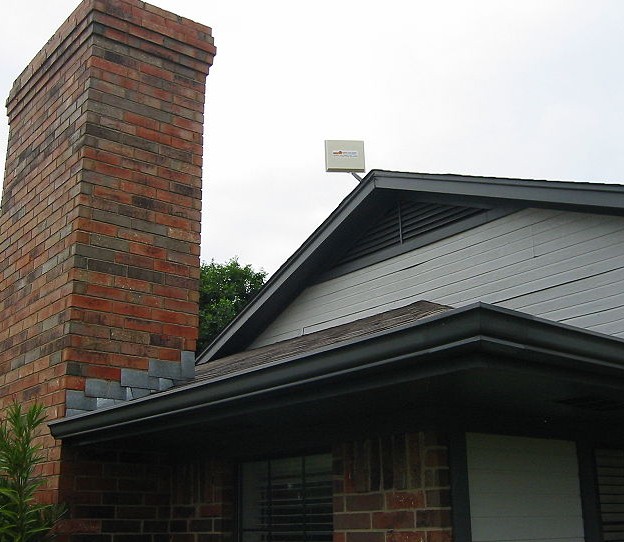
A home equipped with a WISP antenna on the roof

Package                                                               Monthly Download Cap

384k                                                                       10 gigabytes

640k                                                                       10 gigabytes

1 meg                                                                    20 gigabytes

2 meg                                                                    40 gigabytes

3 meg                                                                    50 gigabytes

4 meg                                                                    60 gigabytes

8 meg                                                                    80 gigabytes

Additional capacity over cap                        $1 per gigabyte over the cap

Although Larsen claims the cap and the overlimit fee isn’t “a profit center,” it would be disingenuous to suggest it isn’t about the money (underline emphasis ours):

I feel that these caps are more than generous, and should have a minimal effect on the majority of our customers.   With our backbone consumption per customer increasing, implementing caps of some kind became a necessity.    I am not looking at the caps as a new “profit center” – they are a deterrent as much as anything.    It will provide an incentive for customers to upgrade to a faster plan with a higher cap, or take their download habits to a competitor and chew up someone else’s bandwidth.

Customers upgrading to a faster plan have to pay a correspondingly higher price for that service and taking their “download habits to a competitor” reduces the cost for the provider no longer encumbered with serving the higher-usage-than-average customer now heading for the door.  Among his 2,000 customers, the end effect will be what Larsen himself hopes is a deterrent for customers using increasingly common higher bandwidth applications like online video, file backup, and uploading and downloading files.  Larsen himself admits that one of his customers was a little bit upset to be told he was using too much.

Rural providers do face higher costs to provide service than their urban counterparts.  But before they enjoy any benefits from Universal Service Fund reform or other government-provided stimulus, customer-unfriendly Internet Overcharging schemes should not be part of the deal.

Share

Other stories of interest:

  1. Europeans Reject “Usage Cap + Overlimit Fee” Mobile Broadband Pricing: Unlimited Use Should Always Be An Affordable Option
  2. Cox Increases Usage Cap Allowances, Rarely Enforced Anyway; Exempts Cox ‘Digital Telephone Service’
  3. T-Mobile Dumps Overlimit Fees, Reduces Speeds for Customers Exceeding 5GB Per Month
  4. Cogeco Wants $2.50/GB in Overlimit Fees – The Gravy Train Rides On North of the Border
  5. Rogers Communications Takes Out a Contract On Customers’ Wallets: We’ve Doubled Our Overlimit Fee For Our Convenience

Currently there are 41 comments on this Article:

  1. Cliff says:

    Doesn’t someone that consumes more electricity from the power company pay more than those that use less? Why should Internet consumption be different? Would you rather the “reasonable” user have their rate increased to subsidize the “abuser?” THAT doesn’t seem very fair to me! I think what is described is fair to all users.

    • PreventCAPS says:

      Electricity is generated AND trandported by the electrical company. You pay the electrical company for the generation and transportation of the electricity. The more you use, the more they have to generate and therefore the more you have to pay.

      On the other hand, your ISP only provides TRANSPORTATION. You pay your ISP for the CAPACITY of the “road”, not what or how much travels on it.

  2. Matt Larsen says:

    Philip,

    As the person featured in your article, I have to take issue with a few of your observations:

    1) Vistabeam does not monitor customer activities – we collect a summary of the bandwidth consumed by each customer and summaries of the different kinds of traffic flows to each access point. The customers that I mentioned in my article we asked by our tech support what they were doing and they TOLD US OVER THE PHONE. That is not “monitoring and controlling” what a customer does. Anyone who runs a large, complex network knows that it is critically important to know what kind of traffic is running on the network in order to properly maintain and troubleshoot issues. This is exponentially more important on a wireless network where capacity is extremely scare compared to a wired network. If you were forced to share a network with someone else consuming all of the available capacity with BitTorrent, online video or an infected computer you would most likely feel differently.

    2) If bandwidth caps were going to be a profit center, it would have been far easier to collect the usage information, and put the caps at a point where far more users would be forced to upgrade service. We collected data over a 30 day period to see what kind of impact we were going to have on our customer base and designed it so that the minimum amount of customers would be affected. Bandwidth caps don’t get any friendlier to the consumer than what we implemented.

    3) I don’t know where the mention of the Universal Service Fund comes and broadband stimulus relates to our application. Like almost all of the WISPs in rural America, Vistabeam has never received USF money and has not applied for stimulus money. If you go back further in my blog and ready about The Story of Medicine Bow, you can see how the USF program has been a detriment to broadband deployment in rural areas.

    Unfortunately, the majority of anti-cap activists have no idea how much it costs for uncapped commercial bandwidth, or the effect of anti-cap justification on pricing to the end user. Vistabeam has a 50meg, uncapped connection to the Internet backbone that costs about $2500/month. I am lucky that it is not more expensive. To go to an uncapped business model and remain profitable, we would have to double the pricing of our end-user services just to cover the costs of upgrades.

    Please direct your efforts toward real abusers of bandwidth caps, the ISPs that are not being forthright about their caps and the cellcos that are billing huge amounts for overages on wireless data plans. WISPs are usually heroes to their areas – bringing broadband to places that don’t have any choices. Give them some slack.

    Matt Larsen
    vistabeam.com
    wirelesscowboys.com

    • PreventCAPS says:

      We don’t want VistaBeam or any ISP of any kind setting the precedent of bandwidth caps which will ultimately lead to abusive use of bandwidth caps. If you do not have the capacity to serve your consumers adequately, you either degrade your service or upgrade your infrastructure. The first will alienate your consumers; the second costs money. While I cannot comment on VistaBeam specifically, TWC has turned a large profit and refuses to use it for upgrading infrastructure, and instead is looking to boost its profits even more with a bandwidth cap money party. We don’t need VistaBeam or any other ISP setting the precedent or being a “cap success story”.

      • Matt Larsen says:

        PreventCAPS,

        In a perfect world, you would not see abusive use of caps because there would be plenty of infrastructure to go around and your choice of competitive services to go to if you don’t like your current provider. In the real world, network capacity is scarce and there are limited options for competition because of an anticompetitive environment or simple lack of a viable market in rural areas. The people who have problems with caps have far too much of a sense of entitlement that they should be able to consume all available network resources. The majority of the country does not have fiber to the home, or readily available inexpensive backbone bandwidth, and establishing reasonable caps is the only way that 99% of consumers on non-fiber networks will be able to get the services that they want to have at current prices.

        If you feel that TWC, Verizon and Comcast are taking advantage of their customers, you should be taking issue with them, not with the companies that are implementing caps to maintain network integrity and keep their prices competitive.

        • PreventCAPS says:

          I shouldn’t take issue with “companies that are implementing caps to maintain network integrity and keep their prices competitive.” when they could stop overselling and/or upgrade their infrastrucutre?

          It’s alienate consumers with caps or woo consumers with decent service (no caps, neutral net practices)…

          • Matt Larsen says:

            Its not that simple PreventCAPS.

            The consequences of what you are advocating is to STOP selling more services until upgrades can be done. Where is the money for those upgrades going to come from? Another wasteful government program? Would it be better to double the cost to the existing subscribers to pay for that upgrade? Would it be better for the consumers if my company or others like mine went out of business and they had NO choice of terrestrial broadband providers? That is the definition of FAIL.

            I am not a fan of caps, but they are appropriate for some networks.

            • PreventCAPS says:

              So in other words, caps are appropriate when an ISP failed to plan, budget, and execute infrastructure upgrades and have oversold capacity? And then advocate that consumers should pick up the tab for those bad business decisions? Even when the ISP is drenched with profits?

              I’m a consumer advocating that ISPs regularly plan, budget, and execute infrastructure upgrades so that they don’t pickle themselves. Then they won’t be have to STOP selling services until upgrades can be performed and wonder where the money will come from. If an ISP cannot survive because of those bad business decisions, well, this is darwinism capitalism.

              As a consumer, I expect to be entitled to use the pipe that I purcase from my ISP to it’s full potential reguardless if the pipe is the diameter of a straw, or a subway tunnel. If the ISP cannot meet that expectation, it just might be because they didn’t plan, budget, and execute infrastructure upgrades.

              “Where is the money for those upgrades going to come from? Another wasteful government program? Would it be better to double the cost to the existing subscribers to pay for that upgrade?” – The ISP should have planed, budgeted, and executed infrasturcture upgrades – then money would be available.

              “Would it be better for the consumers if my company or others like mine went out of business and they had NO choice of terrestrial broadband providers? That is the definition of FAIL” – An ISP that makes bad business decisions going out of business? That would be the definition of FAIL ;-) It’s unfortunate, but companies that make bad business decisions should not feel entitled to place the tab on consumers.

              • Matt Larsen says:

                I will refer you to the other posts that I have made on this site for a detailed technical explanation of why caps are good from a technical and consumer point of view for WISP operators. No need to rehash them.

                I think there is probably some common ground here. I am well aware of Verizon, Qwest and AT&T (among others) that have received all kinds of tax breaks and incentive packages from the states and federal government to deliver fiber and improved infrastructure to their customers. Bruce Kushnick at http://www.teletruth.org/ has a lot of documentation about their shenangians. Considering all of the financial and regulatory incentives that they have received along with the profits that they deliver to their investors, they should have definitely done a better job of planning and executing on infrastructure. They are the only ones with the resources to commit to universal fiber service in their areas. Fiber networks, once installed, have exponentially larger capacity than wireless and copper networks and I agree with your point that bandwidth caps should not be necessary on fiber networks.

                Wireless networks simply do not have the same kind of capacity and caps make sense to preserve network integrity in the face of bandwidth intensive applications. One of the biggest frauds in advertising is the push that the cellcos have been doing to promote streaming video access over cell phones – that application simply doesn’t scale to a large number of users and never will. 4G/Wimax isn’t going to change the picture any – it will just postpone or briefly relieve the overwhelming demands on the network.

                My suggestion to your group is to continue to direct your efforts against the big ISPs – that are taking government and USF money in one hand and putting huge profits in their pockets – instead of the independent ISPs that are working to service rural and underserved areas on their own dime.

                • DM says:

                  Mr. Larsen,

                  If you think that caps are okay, then wouldn’t it be a better strategy to limit speed tiers to consumers? If you offer an 8 Mbps speed tier but don’t want someone to use that much bandwidth, then why offer that in the first place? Simply don’t offer that much speed and limit your product offerings to what your network can handle. This way consumers know what to expect from their ISP and the ISP won’t have to worry about costly network upgrades or allocating resources to monitoring the network.

                  ISPs use network management as justification for bandwidth caps, but that justification is mostly false. Again, speed tiers produce natural bandwidth caps. But telling a customer who is on the 8 Mbps speed tier that their speed will be reduced down to 4 Mbps may not go over so well. But if the network is being strained so much that there are problems then maybe network upgrades are the best business strategy.

    • Thanks for sharing your views, Matt.

      Here is my take on several of your points, and it’s quite lengthy I’m afraid:

      1) You seem to contradict yourself on the issue of monitoring your system’s traffic. On the one hand you say customers volunteered that information, but then add add “it is critically important to know what kind of traffic is running on the network.” So it sounds like both are taking place.

      I haven’t found anyone that objects to the concept of monitoring a broadband network for things like attacks, statistically understanding what online services customers use generally, etc. But I think you will find some concerned that you specifically identified a police agency’s use of BitTorrent, which you wrote someone apparently allowed to run overnight day after day. A local reporter might want to understand what the local sheriff was downloading or sharing on a network regularly accused of being a pirate’s den. I think it’s a mistake to publicly expose that level of detail. It also sounded very much like the folks at the sheriff’s office were unaware of what was running overnight until you contacted them about it and discussed it with them.

      2) The piece said “monitoring and measuring,” not “controlling” as your comment states.

      3) I don’t disparage WISPs, independent ISPs, or their limitations and issues in general. As the piece noted, costs for WISPs and other independents are generally higher on a per customer basis. But this site opposes formal usage caps and other Internet Overcharging schemes wherever they may appear. For providers like yourself, where you admit only a handful of customers created capacity issues with your current infrastructure, resolving that usage could have been done far more simply and informally under provisions in your Acceptable Use Policy, which already covered this issue:

      “The Service is designed and engineered for periodic use of e-mail, newsgroups, file transfers, Internet chat, instant messaging, non real-time interactive games and browsing the World Wide Web. It is your responsibility to ensure that your activity does not impose an unusually large burden on the Vistabeam™ network or otherwise negatively affect the integrity of the system. Your activity also must be respectful of, and must not have a negative impact on, the online experience of the rest of the Vistabeam™ member community.”

      Instead, you imposed a fairly stringent usage limit and overlimit fee program on all of your customers. Today’s majority of those well within the limit you impose could easily be tomorrow’s “bandwidth abusers.” Would someone using 11 gigabytes have raised attention before the usage limit program? Probably not, but under your structured program, the slowest speed customers who manage that level of usage are now offenders worthy of a surcharge.

      For a small company like yours, informally calling a customer about very high usage represents better customer relations than simply sending them a bigger bill at the end of the month, especially if that usage was unintentional. You have built a pricing scheme that potentially punishes all types of customers — those eating seven hops and 140GB of usage and some grandmother in Wyoming whose grandkids decide to download some HD movies and blow through a 10GB cap doing so.

      You may have to take some responsibility yourself for customers using online video, one of the services not on the list in your AUP.

      That’s because your Spring 2009 newsletter went out of its way to discuss how to get the most out of watching online video over Vistabeam, even including high bandwidth HD video.

      I’m not surprised a few customers appear to have taken to using this increasingly popular web application. You shouldn’t be either. You’re going to face upgrades just from increased demand for higher-bandwidth applications. It’s just the reality that every provider faces.

      4) I disagree with your contention that profits did not enter into this equation and allow me to argue my evidence:

      a) You impose varying usage limits that increase with the tier of service chosen, providing an incentive for users to pay higher prices in hopes of securing a higher usage allowance;
      b) Your lowest limits are imposed against customers with the slowest speed tiers — the ones least likely to overburden your network;
      c) You yourself admitted “It will provide an incentive for (heavy usage) customers to upgrade to a faster plan with a higher cap,” — plans that carry higher price tags;
      d) You admit your limits are a deterrent — one that shies customers away from using higher bandwidth applications that increase your bandwidth costs.

      You also admit deterrence is a factor to shy people away from heavy consumption. Usage caps and overcharging schemes go hand in hand to discourage use and keep costs down when customers use the service in a way that is becoming increasingly common in today’s online world.

      5) On the subject of broadband stimulus money and USF reform and its future part in developing rural broadband, I could have done a better job noting that section of the piece was directed more broadly at rural providers like phone companies that hope to exploit that funding to deliver less-than-stellar broadband to its customers, and not specifically at your company. The subject of rural broadband from phone companies is a regular topic here, and some of them have some nutty usage cap plans of their own.

      We have serious concerns about these providers using public funding to deliver slow, highly usage limited broadband to consumers, primarily over DSL.

      While your company may not have applied for these funds yet, your potential competition, especially from rural landline providers, will.

      6) We do appreciate the much higher bandwidth costs independent providers face to obtain connectivity. It’s one of the issues we fight regularly, as many of those providing that connectivity use discriminatory pricing to make sure independent providers cannot effectively compete against incumbents. We support better broadband for every American, and WISPs play a part along the way.

      We consistently oppose formal usage limits for most forms of broadband, but we certainly understand there are practical limits for wireless providers. In these cases, we feel existing policies already in place allow providers to informally deal with extremely heavy users through an honest discussion about the practical limits a wireless network of this type has to serve its customers. Frankly discussing these limitations one on one with customers informally is simply smarter for an ISPs good reputation in the community.

      Suddenlink, a small cable provider, does that for some of its customers. In areas where service upgrades are not yet complete, the company asks its users to keep usage reasonable, but makes it clear why and also is upgrading its service in those communities, at which point it takes the limits off.

      That’s fine with us. They’ve committed to upgrading their facilities to keep up with natural broadband expansion, not artificially reduce demand for it as some providers are doing with limits and fees, indefinitely.

      We just don’t believe, in general, artificially limited broadband best serves customers, especially when it comes to further monetize the business or stall/delay upgrades.

      There are some special considerations for WISPs we do recognize, and we aren’t saying they are all bad actors, but our first allegiance is to the consumers that face the consequences of usage caps and overlimit fees.

      That’s why we have a problem with what you are doing with your usage cap program. We’ll happily fight -for you- to deliver service to rural communities they cannot access any other way, but you’ll always have an argument from us over formal usage cap programs.

      And no worries — we are heavily invested in the fight against overcharging schemes from the big players. Most of us are victims of them ourselves before we successfully fought most of them off.

      Best wishes to you and Vistabeam, and I hope you’ll take our discussion to heart. We have two years of experience fighting usage caps. Customers overwhelmingly despise them and think much less of the companies that have them, especially if they run afoul of them. I’ll keep reading your blog to gather some additional insights and see what ways we can help promote the WISP cause in general.

      • Matt Larsen says:

        Lengthy reply right back at you Philip…

        1) I will admit that partially narrowing down the description of one of our customers could be perceived as potentially “revealing” some kind of customer information to the public. However, our service area covers 20 counties spread across four states, so it isn’t like I put the finger on a specific customer. The point of making that statement was to show the irony of the situation – law enforcement running an application that many consider to be a “pirate’s den”. The people in charge of IT at the customer’s location contacted us because their connection kept dropping and it looked like an Internet provider problem. After looking at the traffic flows – at their request – we identified it as Bit Torrent and they were able to determine that the traffic was crashing their firewall.

        2) Point taken on the “controlling” comment

        3) I take issue with your characterization of the “fairly stringent usage limit and overlimit fee program”. We spent two months collecting data to see how much data customers were using and held several meetings between our network admin, tech support manager, sales manager and myself to come up with a plan that would strike the best balance between fair for our customers and best use of network resources. We had been doing the “informal calling of customers” for the last few years, and kept getting requests from customers that wanted to know exactly what the limits were. We all agreed that it was necessary to define some limits so that we could apply a policy that was fair and consistent. My customer support crew still has the authority to “make the call” on a customer who may have gone over their limit temporarily, such as your example of the grandmother who goes over the limit. She would most likely have the charges credited if she called in. Having a limit is important to define the boundaries, otherwise there is all kinds of potential for abuse on the customer side and the provider side.

        As far as the online video comment from our Spring 2009 newsletter, we wanted to address several customer complaints that we had gotten regarding “choppy” video downloads from YouTube and Netflix. There is a big difference between streaming video and non-real-time video downloads. Streaming video is terribly wasteful of network resources while downloads spread out over a longer period of time work a lot better. The newsletter article was intended to help customers get better results out of their connection. I’m obviously not surprised that customers want to use online video – I want them to have the best experience with our service that we can offer. Whether you like it or not, bandwidth caps are part of the solution to better service – along with network upgrades.

        FWIW, Verizon data cards in our area are $55/month (plus assorted extra charges) with a two year contract, an average speed of 512K during regular usage times and a 5gig cap. Our comparable plan is $34.95/month with no contract and a 10gig cap. Half price and double the bandwidth cap is not a bad deal.

        4) Here is the evidence that profits are not my primary consideration when it comes to the implementation of bandwidth caps. This is a bit lengthy, but I think it is important for your readers to understand that there are very real constraints on network resources that make bandwidth caps a virtual necessity on non-fiber networks.

        a) We use four types of unlicensed band radios to provide service to our customers: 900mhz, 2.4ghz 802.11b, 2.4ghz 802.11g and 5ghz. 900 and 2.4 802.11b systems have a limited amount of total capacity (around 4meg capacity split between the customers on the AP). 2.4 802.11g and 5ghz systems have 9-15meg of capacity. We do not offer speeds beyond 1meg on the lower capacity systems, so in order for us to upgrade a customer, we have to perform a truck roll to swap them out to the higher speed access point. The truck roll cost is about $150. The extra revenue from a 640K to 1meg upgrade is $5. If the customer never upgrades beyond 1meg, I have a 30 month payback for that truck roll. That is a very long time for payback.

        b) The lower limits for customers on the slowest speed tiers are reflective of the capacity on the access points serving them. A 640k customer downloading at full speed on one of those access points is using 20% of the total capacity on that AP. A 1meg customer downloading at full speed on one of the higher capacity APs is using less than 10% of total capacity – hence the justification for a higher limit for higher speed customers.

        c) Upgrades do not happen overnight – we don’t just flip a switch in a NOC and turn the speed up for everyone. In the WISP world, it involves a truck roll to every single customer that changes to a new access point. We are phasing out our older 2.4ghz 802.11b systems right now – a process that has been ongoing for the last 12 months. We are about 50% of the way through the upgrade, and still have about 500 radios to switch out before we will be completed. That is $150,000 in estimated upgrade costs that will not lead to more revenue.

        Until we can upgrade all of our systems, deterrence from abusive bandwidth consumption is going to be a necessity so that we can still provide an adequate level of service to customers. The alternative is to raise prices for everyone to fund the upgrades, and I can guarantee you that idea will be hated much worse than any bandwidth cap. This is a reality that your readers and others who think bit caps are unnecessary should take into consideration.

        5) I don’t think USF or broadband stimulus money is really even necessary at all. The rural ILECs and cellcos have gamed the hell out of the system to the point where it is an enormous deterrent AGAINST wider broadband deployment. There are WISP success stories all over the country, and almost all of them have to face government subsidized competition in the form of rural ILECs and cellcos receiving USF money. Kill. USF. Now.

        6) I understand your opposition to formal usage limits, but I do think that it would be wise to back off your hardline stance, for the reasons that I have explained above. There is such a thing as a “good” cap.

        I do appreciate different perspectives and the opportunity to educate others about the unique challenges that WISPs face.

        • Ron Dafoe says:

          “6) I understand your opposition to formal usage limits, but I do think that it would be wise to back off your hardline stance, for the reasons that I have explained above. There is such a thing as a “good” cap.”

          Sorry, I do not believe there is ever such a thing as a good cap. People HATE caps more then they hate the bill going up by a little bit. There may have been some grumbling when TWC raised their internet rates, but there was an outcry when they announced caps.

          Caps are not a way to manage your network. They are a way to punish your customers and to stop them from using your network. Network management is the way to manage it. Slow down their connections.

          Your bandwidth cannot be compared with electricity, water, or gas. Your bandwidth is magically back when the person that is using it stops using it, it is not gone at use and you do not have to “make” more as it is consumed.

          Using caps is going backwards not forwards. Cell phones, landlines, long distance, even the data plans on an iPhone are all unlimited data plans at this point in time.

          You say that your connection to the internet is uncapped. You have a bill that is manageable and the same every month. Is it expensive? Sure. But unfortunately, in your area, and in your business, that is the cost of providing the access. What would happen if your internet provider arbitrarily put a 100Gb cap per month on your connection and then charged you $1 per Gb after that. You would complain like everyone else here.

          • Matt Larsen says:

            Ron, you are missing my point.

            1meg of Internet bandwidth here costs about $50/meg for a COMMERCIAL, uncapped account, and I had to get a minimum of 50meg of capacity on a four year contract to get that pricing. It is as much as $500/meg in many rural areas. There was a $5000 NRC to get it installed because it required a dedicated connection to the fiber plant. Anyone inside of the cable footprint here can purchase this type of connectivity, but it is generally businesses that have a need for an uncapped connection. We have to pay a premium for an uncapped account and the cost of upgrading the infrastructure to deliver the bandwidth, and it is appropriate considering the amount of network resources that we consume. My provider is able to make some profit from it and I am able to get commercial bandwidth at a decent rate, considering that I am not in an urban area and have few choices.

            You say that people hate caps more than the bill going up a little bit. I would have to double or triple our prices to offer “uncapped” services of the kind you are advocating. The every point of backbone from our fiber connection through to the last mile to the customer would have to be upgraded to deliver that kind of service. It would render the business model for wireless providers completely untenable, and remove one of the only competitive options for rural customers. The constraint is the backbone and the last mile – bits don’t just magically appear 150 miles away. The technology to deliver bits to a mobile phone is even more expensive and complex to maintain.

            Caps are going to part of the future of the Internet, and there are reasons that they make sense. You may not like them, but there are situations where they are appropriate. That is the point I am trying to make.

            • Ron Dafoe says:

              I am sorry, but I disagree that caps are a way to manage your network. You may not think I know what I am talking about and that is fine. You can think that. Some of us customers know the technology, work with the technology, and/or have experience with the technology.

              The other problem with that is that once a company like yours implements these caps, then other will do the same, all the way up the line. Before you know it, we are Canada.

    • Scott says:

      For most of us that keep up on this, have been in the industry, and follow various companies examining their financial statements – it’s often pretty hard to take a providers word for how hard it is for them to offer a service without caps and metered plans.

      I have yet to find a company that’s implemented these plans for any other reason that reducing infrastructure investment while increasing profits. For public companies the financial statements always back this up and you can always take a read from Wall St. as they drool over these announcements by the bigger corporations.

      Perhaps for your company you are in a unique situation with poor options for wholesale bandwidth and transit, but it’s still a detriment to your consumers and a yet another step back for the industry.

      Most of us thought we escaped the AOL, Delphi, CompuServe metered dark ages many many years ago and it only seems to be company back with even more lucrative replacement of per minute billing.

  3. Jon Kelley says:

    I really feel the author of this article, Phillip Dampier, is living on a cloud somewhere. First, you do not know a thing about what it takes to provide Wireless Broadband to a rural area and the cost associated with the delivery of this service. Secondly, the water company charges per gallon, the electricity charges more for kilowatt hour, and the phone company, both cellular and land line, charge you per call or per minute. How do you propose WISP’s charge for the service we provide? Per byte?

    As rural WISP’s, we do not have access to unlimited bandwidth sources for pennies per MB. We have to deal with $700.00 per month T-1 lines or purchase and install a $15,000 licensed microwave link, if you have towers that will make the link, to the nearest town that has reasonably inexpensive access, and then buy that bandwidth for much more than you can buy it in a metropolitan area.

    • DM says:

      Mr. Kelley,

      Mr. Dampier usually does a good job of writing his articles based on facts and not rhetoric that cannot be proven. However, I do not want to speak for Mr. Dampier and will let him address any criticism that is thrown his way.

      But I did want you to answer some questions. In your posting, you refer to “we”. Who exactly is “we”? Are you affiliated with VistaBeam or another ISP?

      My parents live in a rural area and there is a WISP tower that is close to them. Unfortunately, they cannot pick up the signal, otherwise they would be subscribing to the internet service that is provided by a local telecom company instead of satellite internet. The WISP is cheaper and would provide them with a faster speed, although we are comparing 1 Mbps to 2 Mbps here. The local telecom company also has a fantastic track record for customer service and many people in the area use their services.

      I agree with PreventCAPS that ISPs should not have the ability to cap a service. Natural caps are built into the system based on speed availability. If I have a 10 Mbps connection, there is a limit to how much traffic that connection can be responsible for in a given time period. Whether you measure that time period in days, weeks, or months, the limit will always be relatively the same.

      The problem is that many ISPs oversubscribe their networks. This wouldn’t necessarily be a problem if they upgraded their networks when they needed to, but this rarely happens based on network usage data patterns. Rather, networks get upgraded when the “sales and marketing” division say that should happen. But what the “sales and marketing” division and what the “network operations” division want are usually two different things.

      I also don’t think that many people are opposed to the idea of paying for what they use, or consumption-based billing. What consumers were opposed to was Time Warner Cable’s flavor of consumption-based billing, that being that heavier users pay more and light users…pay the same or more. If a consumption-based billing system is to be fair, then it needs to decrease the bills of users who use less than the average rate. Most ISPs do not want that system implemented because, based on their own statistics, heavy downloaders are usually less than 5% of their user base and this would mean far more revenue lost from light users than revenue gained from heavy users.

      Additionally, consumption-based billing systems create an argument for a-la-carte television pricing. A-la-carte television pricing is opposed because it would more than likely create smaller bills for consumers, resulting in decreased revenue for providers. Most ISPs are also either television providers or partner with television providers to bundle their internet service. This also leads to the argument of internet video on demand options and bandwidth caps being used as unfair business practices to kill the growth of these options.

      I would like to hear more from you, Mr. Kelley, and any response that you may have in regards to the topics that I brought up in my post. You indicate that you know a lot about the WISP industry and I think some more explanations could help create a healthy debate here on Stop the Cap!

    • Jon… I responded in length to Matt’s comment and because that is so long itself, I’ll redirect you to that instead of rehashing.

      I am very well aware of the challenges small providers face in capital costs, return on investment, their naturally smaller customer base, and connectivity costs. That’s why I am a big supporter of public funding of rural broadband, tax breaks, red-tape cutting, and other beneficial programs that can dramatically reduce those expenses for those trying to deliver service to the most rural consumers.

      I believe rural broadband is today’s rural electrification, and every American should have access at fair and reasonable prices.

      Unfortunately, providers cannot have it both ways. You cannot tell me that a 100GB heavy downloader justifies a usage cap and overlimit fee program that also penalizes a lowest tier customer at the slowest speed who only uses 11GB. The argument I hear is that a network cannot sustain the traffic generated by heavy downloaders. Then the solution I discover is a usage cap that limits -every- customer and potentially exposes them to overlimit fees based on arbitrarily set limits which vary depending on the tier. That’s monetizing usage limitations. Pay more — get a higher limit (which if utilized puts an increased strain on that limited network).

      Actually, I don’t have a major problem if a provider wants to charge customers a fair price by the byte. But no provider dare do that. Instead, they charge for different usage limit tiers that customers pay for whether they use them or not. I don’t mind if a company wants to sell limited use packages alongside reasonably priced unlimited packages either. The entire broadband pricing model today is based on charging different prices for different speeds — the customer gets to choose.

      At least you included phone companies in your utility analogy – I always notice most using this argument don’t dare to, because most Americans do NOT pay per call or per minute for local calls (and increasingly not for long distance either). Telephone traffic, like broadband, does not work the same way as gas, electric or water service. I’ll allow my regular readers to explain why to let others have a shot at this.

      We’re in agreement you guys are confronted with excessively high connectivity costs. If you’ll share with us what we, as consumers, can do to help fight for lower pricing, we’ll join that fight. But in return, we ask that you treat us with respect by being honest and open, one on one, with customers that don’t understand your limitations. Most customers will readily understand and appreciate the dialogue. Don’t simply dump a usage cap program that defies the argument made for its introduction on us and think we won’t react negatively, especially when its existence is fodder for the bigger players to play their “everyone does it” card.

      Take care.

      • Matt Larsen says:

        Public funding of broadband services is an AWFUL idea. The smaller, privately funded providers will be run over by the rural ILECs and cellcos that are using their lobbyists to set the rules of the game. USF is nothing more than a giant telco slush fund, and an unnecessary burden on telecom customers. Kill. USF. Now.

        There are far more fiscally efficient and effective solutions for our broadband problems than public funding.

        • Ian L says:

          Matt, I’ve got a “story from the other side” on the whole USF deal.

          I’m working to start a WISP in my area, as part of bringing high-quality high-bandwidth services to the community (will be part of a managed services company). We’ll be starting with a pure Ubiquiti AirMax system…proprietary, but cheap and fast. Really, really fast.

          We’re getting our bandwidth from…wait for it…a rural telco, Hill Country Telephone Cooperative. Who is scared to death that USF’s disappearance will cripple their ability to invest in infrastructure for their members/customers. These guys are pushing fiber to towers, and were planning to give folks in cities in their footprint FTTH. For everyone else, they’ve got an average of 7,000 feet of copper between customer premises and their fiber backbone, which runs at 10 Gbit. They’re working on bonded ADSL2+ so you’ll be able to get 25 Mbps DSL over that 7,000 feet, plus a few Mbps up. That’s enough bandwidth to keep one of your 802.11g APs up and running without issue.

          But they’re sharing the wealth…in their CLEC footprint (which we’re in) they’re offering 100M fiber for $1500. Crazy stuff…and USF is making many of those enhancements possible. If and when we expand our data usage, we can pull in 100% diverse fiber thanks to their presence (Time Warner Cable is the other company with fiber in the area).

          Bottom line: CenturyTel in Medicine Bow is a total perversion of how USF should be used. But there *is* the other end of the spectrum. Wouldn’t you love it if any tower you had near a town of population 2,000 or larger had fiber running to it at $30 or less per megabit…to the Internet?

          On the capping side of things, you run the business. It’s your call. $50 per megabit isn’t cheap. On the other hand, using a very conservative usage figure (200GB per month on a megabit) you’re still marking stuff up by 300% for overages. Then again, I guess a T1 out to some of your subscribers would run above $1 per gigabyte, and none of your customers use enough bandwidth that a T1 would make sense. So you are indeed providing a better deal than anyone else in the area. Good job…just make sure to get all of those 802.11 upgrades done ASAP so you *don’t* have to worry about last mile capacity when doling out bits in a bucket :-)

          • Matt Larsen says:

            Ian,

            You are new to the WISP business, and will have the unique opportunity to deal with the unique challenges of maintaining a wireless network, and the often tenuous positions you are in by being dependent on a competitor’s network for critical elements of your infrastructure.

            Unfortunately, the scenario you are working with is the exception rather than the rule. There are a few good rural telcos out there, but there are also many who are milking the government and USF systems for all the money and low-interest loans that they can get. It is a virtual certainty that USF money will NEVER go to WISP operators, and the USDA broadband grant and loan programs are heavily slanted toward rural ILECs. Hil Country might lose USF funding, but they still have the USDA RUS broadband loan program that they can leverage to pay for their infrastructure upgrades. You would feel differently if they were using the RUS and USF funding to warehouse valuable licensed spectrum that will eventually be used to compete with you. That is what is happening in many areas around the US.

            On the business side, there are many factors that determine the profit point of a customer. You are not taking into consideration the customer support, billing, provisioning, network maintenance personnel and “X-factor of wireless” issues that come up as the wireless network scales beyond hobby level to a bigger network. The technology used to deliver service is less important than the business processes and financial stability of the operator. AirMax looks great in a controlled environment, but my initial experimentation with it shows that it will only about double the amount of total capacity of one of our 10mhz channel 802.11a access point deployments. The polling is definitely very helpful and is more important from a scaling and latency point of view than raw speed. But interference considerations are a dose of harsh reality that every unlicensed system faces and all environments are different. YMMV for sure.

            Best of luck to you.

  4. [...] a few days after a group (not a registered non-profit but apparently donor-funded) posted Matt Larsen’s logo on their Stop The Cap! page in order to complain that he charges $1 per gigabyte for overages, [...]

  5. Cameron says:

    Simply put, Phillip has no clue what it takes to deploy, manage, and operate a WISP. I have “fired” several customers like him that want to use all of my resources for very little of the cost. I would rather let one Phillip go than lose 10 customers from his access point because he is dominating the resources of that AP.

    For all those advocating “network upgrades” as the means to alleviate the problem, would you be willing to pay for the all the radios required to pipe more bandwidth to you and then paying the real cost of unmetered bandwidth to you home in these areas? I dare say you wouldn’t. No, instead you want the guy who actually had the brains, the money, and the ambition to go out and risk his capital, his reputation, and even his life (yes tower climbing is dangerous even when done correctly) to give you low cost unfettered access to your porn, your illegal file sharing and your cheap movies, because you think you deserve to be given everything for next to nothing. I for one started a WISP (get ready for it….gasp!) TO MAKE MONEY! Yes I am a greedy capitalist and want to provide for my family and my retirement. I provided a good service to people at a reasonable price that allows them to gain broadband access to the internet and (horrifically) allows me to pay myself and my employees a livable wage. If I did not, my business would not have succeeded. I say this in the past tense as I just closed on the sale of my business for nice profit (oh no…there I said it again…I made money).

    Our WISP did not employ usage caps, although at the time of our sale, we were beginning to implement the means to do so. What most people don’t understand is the technology we used to deliver services was never intended for the purpose we adapted it for…yet we made it work, and it still works although it will not scale to deliver the bandwidth demands that are becoming the norm without adding a tremendous amount of infrastructure. Unless you anti-cappers want your bill to increase dramatically, I suggest you either live within the bounds of your AUP or TOS, change providers to the guys who will promise you everything and will be unable to deliver, or simply move to a place where you can get what you want. It is a free country after all.

    I’m curious what line of work Philip is in…if any. Or is he just an agitator who stirs up emotions and then begs for donations to keep the fire burning. If he actually has a job, maybe we should go to his boss and demand that Philip take a paycut so that we can buy whatever product or service his company offers at a cheaper price. What? it doesn’t quite work that way? What do you mean it is more complex than that? I never would have figured.

    • “I have “fired” several customers like him that want to use all of my resources for very little of the cost. I would rather let one Phillip go than lose 10 customers from his access point because he is dominating the resources of that AP.”

      Wow… if you are that presumptuous and assuming of the customers you don’t have, one wonders how you treated the customers you did have.

      You are making an assumption with no evidence about my monthly usage. But then things get much worse for you.

      “No, instead you want the guy who actually had the brains, the money, and the ambition to go out and risk his capital, his reputation, and even his life (yes tower climbing is dangerous even when done correctly) to give you low cost unfettered access to your porn, your illegal file sharing and your cheap movies, because you think you deserve to be given everything for next to nothing. I for one started a WISP (get ready for it….gasp!) TO MAKE MONEY! Yes I am a greedy capitalist and want to provide for my family and my retirement.”

      So, everyone that is opposed to usage caps are just porn addicts, illegal p-2-p users and movie watchers? Since you are so brave about making all of these assumptions, why not replace your current marketing pages on your website with something like the paragraph above. Inform your customers if they use your WISP, you will freely make assumptions that heavier than average usage means they are porn freaks or movie thieves and they are getting in the way of your grand plan to rake in the cash as a greedy capitalist. It’s ultimately all about you, and as long as you get yours, anyone who uses the service they pay for in whatever arbitrary definition of excess you decide on is just a net thief.

      It is, of course, this kind of attitude which also exists with some at the major ISPs. That’s ultimately why some companies think a 2-5GB monthly usage limit is just fine. Anything above that can only mean you are doing illicit things with your connection.

      • Cameron says:

        Well while nit picking the post, you still don’t refute that you don’t know what it takes to build, own, and operate a wireless broadband business. Frankly, I don’t care what people use the connection for, but I know for a fact that the ones who did abuse their TOS with me and I let go, were doing many of the activities I described as well as others. I have letters from the music industry, as well as admissions from customers that they were trying to download or stream high res movies. In every case where we disconnected a customer, we gave them several warnings about their TOS violations, both verbally and in written letters before terminating their service…something our TOS does not say we have to do. I did not need to put up such a statement as people know what they do.

        I can also see that sarcasm is lost on you, so I’ll put this a simply and plainly as I can. If I have one customer who is paying my $40 per month rate for his 1-2Mbps connection and he is locking up bandwidth on an AP that is servicing 20 other people, and those 20 other people cancel their service because they can’t get service, then I wouldn’t be in business at all. I would rather keep 20 customers than 1. I would have loved to be able to deliver that bandwidth to the one user as well as the other 20, but technology limitations at this time simply don’t allow it using any reasonable business case. I can’t deploy a dedicated link to each subscriber, nor afford the dedicated bandwidth at $40 per month and make a business out of it. If you can, then by all means go put all the people you are complaining about out of business.

        Cameron

    • DM says:

      Cameron,

      I’m sorry you felt that way about your customers. Let me ask you a question: Who was to blame for the problem that you encountered? Was it the customers fault, or your fault? In my opinion, it was your fault. I keep stating this, but speed tiers contain natural caps. If you didn’t want someone using a specified amount of your resources, then maybe you shouldn’t have offered your customers access to said specified amount of resources.

      I don’t think a person needs to have any “inside” knowledge about how a business is ran or the economics of business costs and business profits to have an opinion about how that business is ran. Economics 101 teaches that businesses need to find their maximum profit point based on consumer demand and supply guidelines. Sometimes those fluctuate with the effect of various market forces, including opportunities and threats. Most people only really pay attention to the end cost to them. Do I know how much a Big Mac from McDonald’s costs the company to make and what kind of markup is applied to the final cost? No, but I imagine that the markup consists of revenue that will be distributed to various parties within the organization, including Research & Development, Sales & Marketing, Franchises, Corporate Offices, etc. But the main decision that I have to make, as a consumer, is whether I want to eat a Big Mac or a Quarter Pounder.

      Every ISP should be budgeting for network upgrades. And yes, the funding for upgrades should come from customers. But this doesn’t mean that you should unfairly raise prices on your customers. There needs to be an appropriate amount of profits that are invested back into the company. When financial statements show that this investment is not happening even though there is plenty of funding for it, this causes customers who follow issues like this to become upset.

      The fact that you seem to make assumptions about what YOU think CUSTOMERS should be able to do with their connection reiterates what you wrote that you were only concerned about making profits. So does this also apply to Netflix? Why should Netflix be punished, as a company who wants to make money, if you do not want YOUR CUSTOMERS using THEIR STREAMING SERVICE. Do you see how hypocritical this is?

      • Cameron says:

        Not at all. Customer’s are required to understand that this is a shared bandwidth service and that their activity will affect other users online. We told them up front that activities which adversely affect other users to the point where those others complain about speed and service themselves will be subject to our restriction policies and possibly termination. They are certainly free to go elsewhere if they don’t like that fact. As I stated in another post, I would have loved to be able to provide unlimited amounts of bandwidth, but the economics will not support it, nor will the current technology. As for reinvesting in my business, I put almost 100% of my profit (revenue – expenses) back into my network for the last 7 years. That is why I was able to sell the business for a nice profit at the end.

        Cameron

        • DM says:

          Cameron,

          I don’t understand why YOU don’t understand this simple concept, but if you didn’t want your customers to use 100% of the resources that you gave them then maybe you shouldn’t have given them access to use that amount of resources.

          “Customer’s are required to understand that this is a shared bandwidth service and that their activity will affect other users online.”

          While this is true, there is still a fundamental principle that your customers expect your network to handle everyone that is connected to it. Did you also tell customers exactly how you determine if someone is adversely affecting the network? This is a concept that is often vague and which ISPs avoid revealing to customers who contact them to ask how this is formulated. It sounds like to me you oversubscribed your network, which is another common action that ISPs tend to do.

          “As for reinvesting in my business, I put almost 100% of my profit (revenue – expenses) back into my network…”

          This statement could be misleading, depending on what your financials were. If your profit for a given time period was a low number, like $10, investing 100% of this back into your network really isn’t going to improve it very much. You have to have a relative amount of investment already configured into your cost structure for appropriate network upgrades. I re-read what I posted above and I admit that I used the profit terminology when that may have been misleading to what I was trying to communicate. Most businesses attempt to re-invest a certain amount of profit back into the business because it maintains business support systems and may even improve business operations. However, this profit needs to be a substantial amount in order for this to work effectively. If network upgrades are critical to the successful operations of your business, then they need to be budgeted in as a normal expense.

          Regardless of your financial situation, your network was not capable of handling the data needs of your customers. Again, I think that is a consequence of a poor business decision that was made. The WISP in my parents’ community only offers 2 Mbps internet service. They might be able to increase their speed offering to 4 Mbps, but they would have to analyze how that extra data load would affect the network and compare it with the estimated amount of new connections. If this would create network problems, then I hope they would just stick with the 2 Mbps tier that they can reliably provide with no issues to customer satisfaction.

    • PreventCAPS says:

      Cameron, when a consumer purchaces an X Mbps connection and actually uses X Mbps, they do not deserve to get “fired” as you put it. It’s unfortunate for the ISP that they didn’t plan, budget, and execute a viable business plan that included providing adequate infrastructure.

      Now Cameron, you are going to whine and complain that it would be cost prohibative to actually give consumers what they are paying for. I won’t argue if there is any truth to that, but if there is truth to that, then you don’t have a viable business model.

      • Cameron says:

        Viable? I ran a business for 7 years and provided internet access to several suburban and rural communities over 1000 square miles that had little access to other services. I watched no less than 5 other companies try to compete with me and fail. 80% of my customers kept their service once DSL and Uverse moved in because of our customer service. I sold the business to another company for a nice profit. If that is not viable, then I guess I don’t know what the definition is.

        Cameron

    • Ron Dafoe says:

      WOW….. Just WOW….

      Now, are you brave enough to tell us what so called WISP you “owned”? With an attitude like that towards your customers, no wonder there was not enough money for upgrading your network and all you did was continue to overpromise, underdeliver, and over sell what resources you had.

      Then, in the end, you unloaded all the problems you created youself to some poor unknowing “fool”.

      • Cameron says:

        I’m not sure where you get your information, but we were always up front with our customers. I invested every dollar after expenses back into the business and that is why it was successful. I can assure you the company that bought us was no fool. With over 72,000 subs in 5 states, they are very careful about who they purchase. Nice try though.

        • Ron Dafoe says:

          Then why do you attribute all of your high bandwidth customers as breaking the law?
          Does watching hulu break the law to you? Is seeding a linux distribution sharing pirated files? What about downloading legally purchased movies from itunes? or using DirectTVs Video on Demand service (hint – it downloads the movie – legally – from DTV through your internet connection.) What about buying a game from steam and having to download 8Gbs to your computer?

          Your message dripped with hate to your customers. There are plenty of legal and legitimate reasons to go over your arbitrary limits.

          You are the person that typed in that message above, none of us.

          Implementing caps means there was not enough money to upgrade your network to meet the demand. It is NOT a way to manage your network. Use one of the exisiting and less intrusive ways to do that.

          I don’t see it but did you have a “cap” on the dollar figure when someone went over?

          • Ron Dafoe says:

            Maybe it is good that you sold it. I am sure at some point, you probably did not have as much contempt for these users as you do now.

          • Cameron says:

            Why so angry Ron…”dripped with hate”? Obviously your rage has blinded you as you did not read correctly. I never implemented caps, but was on the verge of it. The customers I “fired” (perhaps 5 over a 7 year period) were notified about the trouble they were causing other users multiple times before having service disconnected.

            You guys like to use McDonald’s as an analogy, so here is one for you. McDonald’s sells you a cup and you can have all the Coke you can drink. I bet they wouldn’t be too happy if you stood in front of the fountain with your cup under the Coke nozzle letting it overfill and run into the drain all day. Other customers would not be able get any Coke and would probably get upset with McDonald’s for letting this go on. They’d probably be upset with you too, but in my case, they can’t “see” you so I get the complaints. So, I guess you would say that McDonald’s needs 20 more Coke nozzles, just in case this were to happen, is that it? Since only one Coke can be served at a time from the nozzle, people have to take turns. This is EXACTLY the way a Wifi access point works (but turns happen in terms of ms). I have NO control beyond the ethernet interface of an 802.11 Wifi access point. It has only been in the last few months that technologies have come into the market and become cost effective enough for a small operator like myself to deploy to allow for more control on the wireless side of things. If I had kept the company, I certainly would have implemented them. That being said, every time we increased bandwith either through bigger pipes, more access points, or newer tech, someone would figure out a way to gobble it all up to the detriment of others. Bandwidth caps as Matt implements them and as I would have are not used to manage the network. They serve as a deterrent to keep one user from ruining the experience for all the others. It is exactly because I cared about my customers that I disconnected the people who were preventing others from gaining the access THEY were paying for.

            • DM says:

              Cameron,

              I wanted to chime in because your analogy is incorrect. When McDonald’s sells you a cup, there is an implied understanding that you can fill your cup whenever you want, but that it is “unreasonable” to just stay at the fountain and let the liquid overflow out of your cup. Generally speaking, property rights gives the restaurant the ability to kick someone out of their store. Additionally, they could determine that your actions are a threat to their business and report this disturbance to the authorities, i.e. the police.

              But that is not how things work regarding the internet. Internet bandwidth is renewable over a period of time. It is not a physical commodity that cannot be replaced. Internet traffic is simply a sequence of binary numbers. Yes, the amount of flow of internet traffic can be determined for a given point in time, according to connection speeds, but this has nothing to do with disrupting access to the amount of traffic.

              The court system makes rulings regarding “unreasonable” actions. Although I cannot cite any specific cases for you, the contract between a customer and a business implicitly states that the marketing of the product is factual and that there will be no “tricks” in regards to how customers will be treated. In essence, contract law stipulates that both parties agree to a fair deal.

              So if you sell your internet service based on the fact that you give customers access to a certain level of speed, then you need to anticipate that a customer may just take you up on your offer. You can’t promise a customer something and then whine and complain when they use it, after you give them the approval to use it.

              Most ISPs have an Acceptable Use Policy, but they never directly state what constitutes unacceptable use regarding the use of network resources. Most of the language is vague and based on the interpretation of the ISP. Vague language is a big no-no in contract law, and I hope that someday AUP policies get challenged in the court system so that ISPs have to explicitly inform their customers how they manage their networks.

              • Cameron says:

                Oh…it is implied? Where is that spelled out on their sign? Or is it in the fine print on the cup? I think it’s funny that you accept the implication at McDonald’s but refuse to accept it when it is spelled out in the AUP. Internet traffic can not be replaced if you can not access it at all because somebody else is taking it all when you want to use it. The AP’s can only pass so much traffic to so many people in a given amount of time, just like the coke fountain can only distribute coke to so many people at once. Again, the limitation is with the technology. You guys can continue to whine and complain about it, but I don’t see you doing anything else. Keep wasting your time…I’m going back to work.

                • DM says:

                  Yes Cameron, it is implied through the concept and principle of “common law”. Like I said, McDonalds has rights given to them by their “ownership” of the physical land. I put ownership in quotation marks because of the possibility of leasing the property from someone else. Again, McDonalds could call the police if they felt that someone was disrupting their business to the point of impacting their ability to collect revenue. However, you would have to consider the amount of power and the decision making ability of the police force. I don’t think they would be very happy with an individual that was just standing there letting the soda come out of the fountain, but would they actually arrest that person and charge them with a crime for doing that? Part of the problem would be with the public perception of the question “does the punishment fit the crime?”. A recent example is the teenagers that were arrested for singing/rapping their meal order at the drive through.

                  Acceptable Use Policies are so vague that they do not provide a reasonable expectation for an ISP to get angry with a customer for using their connection “too much.” Like I stated, my ISP does not have any language in their AUP about monthly limitations or how they determine someone is abusing the network. To make a comparison, I think most ISP contracts state that you cannot use the internet connection for illegal purposes. This would include hacking, copyright infringement, and child pornography. This would be something that everyone could understand and would probably agree to.

                  However, most people would get angry if you told them that they have secret methods to determine if they are abusing the network and that they have a monthly bandwidth limit that they don’t tell you about. Those would be pretty important business practices that would affect the buying decision of the consumer. To be secretive about these and not disclose them in an effective manner is fraudulent.

                  We are already seeing some of this stuff being shot down in court. Companies tried to strong arm customers into agreeing to arbitration for dispute resolution in contracts and we are now seeing court decisions that take that power away from companies and gives customers more legal options when it comes to disputing something about the product or service. These decisions are being made by judges that deem that part of the contract too one sided in favor of the company and unfair to the customer. I am hoping that AUPs can be challenged in the court system and that these practices will, at the very least, have to be disclosed in easy to understand terms to consumers who want to use the service.

            • Ron Dafoe says:

              I am not angry at all. Your message to me sounded like your attitude had become it is me vs the customer. If what you where doing was working, why think about stopping? Why think about punishing the customer and changing the service from what they where used to, If it was profitable, you where competitive, and a reasonable price good for you.

              Everyone, knowledgeable or not I have talked to do not want to check their internet usage everyday and ration out internet access to their family. We understand that it costs more money to do business in rural areas, and I understand that the bill to customers is bigger than what we enjoy in other areas. Limiting the resource when only a small number of people take up more resources than they should is not good. You are punishing the people on the small tier wether you think so or not. As soon as they see the limit and the charging that goes with them, providers get their wish – people paying a monthly fee, and using it much less. Therefore, no money has to go back in upgrades, they can coast along as they are. Now, maybe that wasn’t your intention, but really, think about cell phones, and how they used to have like 20 minutes a month becuase “people did not use them more than that.”

  6. Mark says:

    Come Nov, 1 2011 just simply join the rest of the Country and not pay your phone bill ever again until they take off the cap and provide better coverage throughout along with regular updates on which new cities will be getting new services. Its called a STRIKE! And if there are several million people who do this, there will be action!

Search This Site:

Contributions:

Recent Comments:

  • txpatriot: I was just yanking your chain (and being an @$$)....
  • Phillip Dampier: I take your point, but honestly have not considered Panera Bread's Wi-Fi problems as part of the fight against broadband caps....
  • txpatriot: "You should not read into every story written here as an effort to prove some point." Of course not -- that's why the website is titled "Stop the C...
  • James R Curry: Hey Phillip, It's a thorny subject. There are a lot of coffee shops that set themselves up as places for people to come and meet and work and stud...
  • Phillip Dampier: I don't have any position to take regarding Panera. It's a free Wi-Fi service. If I go into Panera Bread, I am honestly there to buy their food, not t...
  • Alex Perrier: Another option is speed caps. i've experienced speeds of anywhere from 1 Mbit/s to 6 Mbit/s at Bell Wi-Fi hotspots. i think this is reasonable. Tho...
  • George Douglas: Cisco had nothing to do with this. Verizon Network Integration is the vendor. Gianato was told five days prior to the contract being signed that these...
  • Smith6612: True. All of the above works fine. Even then though, I don't think they need to spend money replacing their current gear with something from Meraki fo...
  • Tk: Perhaps Phillip is blaming the wireless phone company caps for this situation at Panera. "The problem has gotten even worse since wireless phone co...
  • txpatriot: Interesting situation. The commenters providing suggested solutions are even more interesting, but what I find MOST interesting is that, provided...
  • AP: No surprise here. Traditional TV has NOTHING on except for stupid reality shows and unfunny sitcoms. I do most of my TV watching online but for sports...
  • Scott: Their CTO or whoever is in charge is failing spectacularly if this has been going on for 2yrs. There's a number of vendors, one such as Meraki that pr...

Your Account: