Taxing Your Way Out of a Budget Crisis – Baltimore Cable Tax Proposal Deemed Illegal Under Federal Law

Phillip Dampier May 31, 2010 Consumer News, Public Policy & Gov't, Video Comments Off

Jim Kraft (D-District 1)

A proposal to add a monthly $4 fee to every Baltimore cable subscriber’s bill to raise money for the fiscally-challenged city has been withdrawn after the city solicitor’s office warned the legislation would violate federal law.

City councilman Jim Kraft (D-District 1) proposed the city extend the existing telecommunications tax levied on telephone lines to cable television service in a bid to raise up to $5 million dollars annually towards the $50 million required to restore funding for curtailed fire, police, and recreational facilities.

Kraft’s proposal was an alternative to a controversial four cent bottle tax on beverages that could have driven some shoppers out of the city for cheaper untaxed alternatives available in the suburbs.

Kraft called his cable TV tax proposal “a fair tax.”

“Employed or unemployed, property taxpayer or exempt from property tax — this fee is borne by all,” he wrote in a mailing to constituents.

But the proposed tax ran into the Internet Tax Freedom Act, currently extended until 2014, which bans any taxation on broadband service, a major component of today’s cable systems.  The city’s lawyers also warned Baltimore could not tax home satellite service either: “Congress has specifically exempted providers of direct-to-home satellite service from collection or remittance of any tax or fee imposed by a local taxing jurisdiction.”

America’s cities continue to face unprecedented budget challenges in light of the distressed economy.  Some cities are slashing services, others are raising taxes and fees to make up the difference.  Baltimore in in the latter category with wide-ranging proposals to up fees and taxes for everything from the hotel room tax rate, outdoor billboard advertising, and energy to new higher fines for parking and civil violations.

The bottle tax bill is likely back on the agenda as well.

http://www.phillipdampier.com/video/WJZ Baltimore New Taxes 5-2010.flv

WJZ-TV in Baltimore delivered this rundown on the city’s large number of tax and fee hikes to close a $50 million shortfall.  (3 minutes)

http://www.phillipdampier.com/video/WBAL Baltimore Cable TV Tax Proposal Pulled 5-28-10.flv

WBAL-TV ran this report over the demise of the telecommunications tax for cable television.  (2 minutes)
Share

Calabasas Residents Annoyed by “Corrupt and Deceptive” Charter Cable; Time Warner Cable Also Called Out

Phillip Dampier May 31, 2010 Charter, Consumer News, Public Policy & Gov't, Time Warner Cable Comments Off

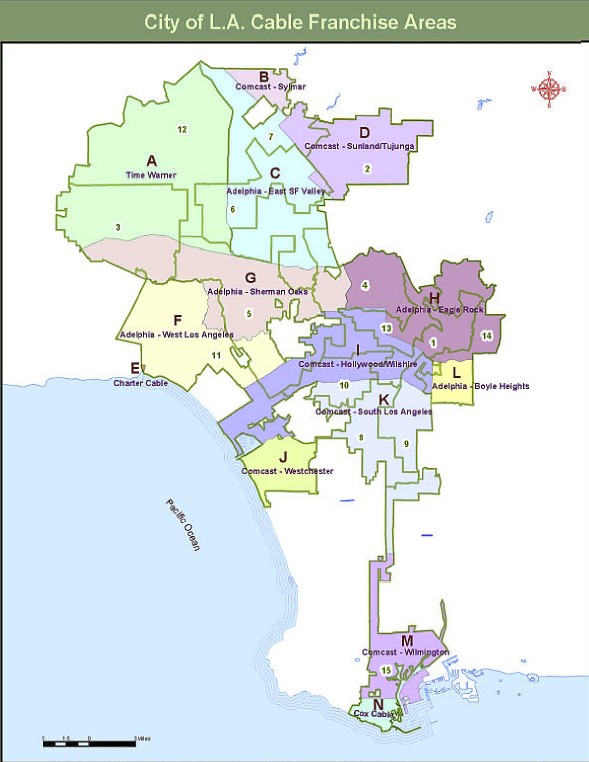
Los Angeles County's cable franchise map dating back to 2005 shows the county divided between Adelphia, Comcast, and Time Warner. Today, Time Warner Cable controls most of the county's cable service but still relies on some legacy equipment in place from the days of Adelphia and Comcast. Calabasas was formerly served by Adelphia. (click to enlarge map)

Some southern California residents continue to express anger and frustration at some poor business and customer service practices provided by Charter Cable and Time Warner Cable, both of which provide service in the community of Calabasas.

Unfortunately, city officials had their hands tied in resolving consumer complaints because California is one of several states that abandoned local cable franchising in favor of less accountable statewide cable franchises that carry few terms and conditions that protect California consumers.

The Calabasas Communications and Technology Commission dealt with several complaints raised by residents during its May meeting, often echoed by the commissioners themselves.

From the Calabasas Patch:

Resident Alvin Lindenauer spoke about his dissatisfaction with Charter.

“Charter has a long history of being less than competent in providing cable service,” he said.

Lindenauer’s complaints with Charter included misleading advertising, poor customer service and, most prominent, “improper billing practices.”

He said he received several erroneous notices of past due payments that resulted in forced late fees.

Lindenauer referred to Charter as “corrupt and deceptive” in its business practices.

He proposed that the commission hold Charter Cable more accountable for its service and reduce the city’s long-term contract with the company.

Charter Cable officials denied the company was either corrupt or deceptive, stating the company will work to address any customer service or billing complaints.

Cable commissions like those in Calabasas actually hold almost no power over incumbent cable or competing phone company video offerings.  The federal government deregulated the vast majority of cable operations as part of the 1996 Communications Act.  While many municipalities have cable boards or commissions, most are little more than venting stations for frustrated residents who feel their local provider is unresponsive.  Sometimes appeals like those by Lindenauer can get the attention of company executives and “guilt them” into intervening with intransigent customer service agents, especially when the media is watching.

Calabasas residents were also upset with Time Warner Cable — primarily because of its set-top boxes and a recent “upgrade” to its program guide software.

Customers are upset with the company’s legacy Motorola cable boxes still used on the part of the system originally owned by Adelphia.  Some residents inquired about why Time Warner doesn’t use the “more reliable” Scientific-Atlanta converters used in other parts of Los Angeles county.

Calabasas residents also complained Time Warner’s cable signals are intermittently plagued by “tiling,” an irritating digital artifact that appears like a series of small boxes that appear frozen or moving across a digital picture.  Company officials responded that the problems are in software, not in the set-top boxes, and they would work on them.

Time Warner’s Los Angeles county cable system is actually configured of several different cable systems acquired from Comcast and bankrupt Adelphia Cable a few years ago.  Those systems still have important differences in technology and channel lineups.  Despite those differences, Time Warner Cable collectively controls most of Los Angeles county’s cable systems.  Charter has most of the rest.

[You can watch the commission's proceedings from their video archive.  Start watching at 17:35 to view Mr. Lindenauer's complaint and follow-up.]

Share

Mississippi Windjammer Cable System Suddenly Suddenlink… After Being Adelphia and Time Warner Cable

Phillip Dampier May 31, 2010 Consumer News, Suddenlink, Windjammer 2 Comments

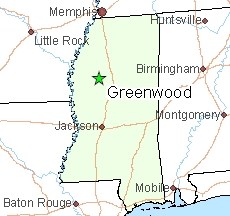
Greenwood, Miss.

Although the days of frenzied buying and selling of cable systems is behind us, smaller cable operators are still in the market for system swaps and buyouts.

Some 8,200 Windjammer Cable customers in Greenwood, Miss. and surrounding areas are about to become Suddenlink customers.  For many residents in Greenwood, located north of Jackson, this will be their third cable provider in two years.

Originally owned by Adelphia, Greenwood’s cable system was acquired in 2008 by Time Warner Cable as part of a bankruptcy sale of Adelphia’s cable properties.  Time Warner Cable ponied up an estimated average $3,500 per subscriber to purchase Adelphia’s cable systems, even though many were badly in need of upgrades.

Time Warner merged many Adelphia systems in larger communities into its own operations, but sold most of the smaller, more rural systems deemed strategically unimportant to the company.  In total, more than 125 cable systems in 25 different states, many serving just a few hundred subscribers each, were dumped overboard at a loss of $45 million by Time Warner.  Greenwood, like 124 other communities, would now receive cable service from a company nobody ever heard of before — Windjammer Cable.

Windjammer was created in 2008 to handle the 80,000 Adelphia customers Time Warner cast-off.  Owned by private equity firm MAST Capital Management, Windjammer is run by Jupiter, Fla.-based small cable operator Communications Construction Services, which is mostly known for providing cable service to more than 200 military bases across the country.

For Greenwood customers, the welcome letter from Time Warner Cable ended their cable relationship with Adelphia.  But it was a relationship never destined to last.

Just one year later, another welcome letter arrived, this time from Windjammer Cable:

Welcome to the Windjammer Cable family!

We have recently acquired the former Time Warner Cable system in this area, and are proud to be your new cable services provider.

We’re more than just a cable company. Windjammer Cable brings a whole world of entertainment and communications to the place it matters most…your home.

As a way to make the transition easy from one cable company to another, you will see very little change in how you receive your cable and communications services.

We will be updating your High Speed Internet, Digital Phone, and E-mail services beginning in the early morning of January 12, 2009. This conversion may take up to 10 days. We will only be working on your service between 1:00 am – 6:00 am local time. During this time, you may experience slight service interruptions, so please be patient.

To those of you who currently use the Time Warner Road Runner email service, there will be changes to your email account. Please visit our new website where you will find information about setting up a new Windjammer email account. We encourage you to do this as soon as possible. Your existing Road Runner email account will continue to work the same for at least the next two months.

If you do not use the Time Warner Road Runner email service, but use another service, like Gmail, you will not need to make any changes.

If you are a Time Warner Digital Phone customer, you should not notice any significant changes to your phone services. If you use the voice mail service, you will have to re-record your message. Instructions for doing this can also be found on our website.

Our customer service representatives are available 24 hours a day to answer any questions you may have about the transition. Consider us your new friend and neighbor, and know that we are only a phone call away.

We look forward to serving all your cable and communication needs!

Windjammer Cable

Now, one year and some months later, customers can prepare for their next welcome letter from Suddenlink.

What Suddenlink paid to acquire the Windjammer system has not been disclosed.

Suddenlink has experience providing service in Mississippi — its nearest system is in Greenville, about 50 miles west of Greenwood.

Suddenlink is the nation’s seventh-largest cable operator, with customers primarily located in Arkansas, Louisiana, North Carolina, Oklahoma, Texas and West Virginia.

Share

North Carolina Action Alert: Victory Short-Lived, S1209 Is Back Like a Bad Penny This Tuesday

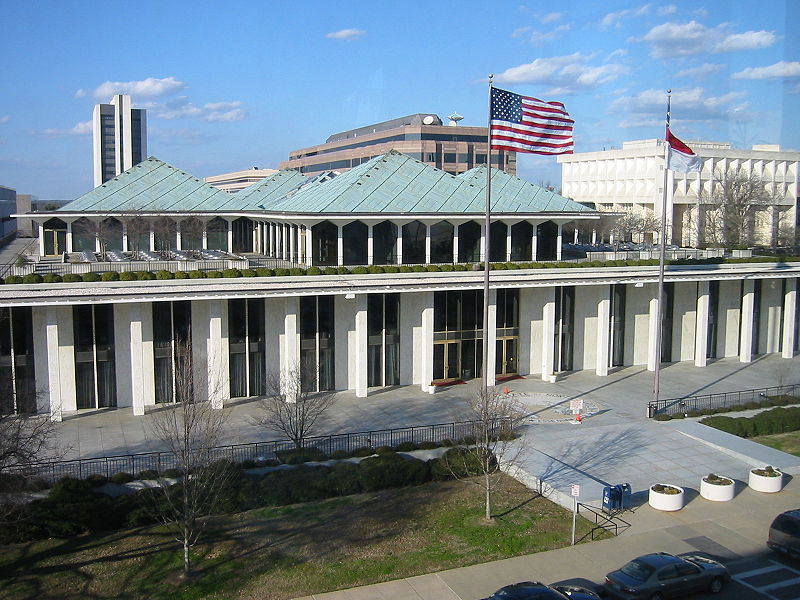
North Carolina Legislature

We collectively sighed last Wednesday when the Senate Finance Committee temporarily pulled S1209, but the victory is short-lived.  Sources tell us S1209 is scheduled to return this Tuesday, one day after the long Memorial Day weekend.

We are not happy with some of the rumors that have been circulating around the Legislative Building in Raleigh.  One suggests S1209 will be modified into a one year, renewable moratorium on municipal broadband while a joint task force ponders questions about financing of municipal broadband, broadband adoption and speed, and overall competition in North Carolina.  Without a clear sunset provision, the legislature can renew the moratorium indefinitely, assuring incumbent phone and cable companies of a continued easy ride into our wallets.

Much has also been said by Sen. Clodfelter regarding the legality of municipal broadband in North Carolina.  Some of his earlier comments suggest he’d be a proponent for a moratorium while the state legislature thrashes out the legal questions.

But the courts have already effectively dealt with this question and handed victory to municipalities.  Why bother with a moratorium when in 2005, Laurinburg, North Carolina won its court battle against big telecom companies.  The judge ruled:

“Laurinburg’s network is run over fiber optic “wires or cable,” providing a “system” for “transmit[ting]” and “receiv[ing]” electronic signals capable of being converted to “audio” and/or “video” streams of information. See N.C. Gen. Stat. § 160A-319(b). We believe this fits within a broad construction of the definition of a CTS. Therefore, we hold that Laurinburg is acting within its municipal authority to run its network, and was not acting ultra vires in contracting with School Link to provide the network’s ISP service.”

Doesn’t the legislature have better things to do than to spend all of this valuable time doing work for big phone and cable companies?

We need you to again write and call your legislators. We have been told by numerous sources that your input has been very effective in pushing back S1209.  The more North Carolina consumers speak out against this anti-consumer bill, the less likely it will ever become law.

Here are the points you need to raise in your next letter or phone call:

  1. Why is the legislature still spending time on this unnecessary, anti-consumer legislation?  S1209 is wanted by large phone and cable companies.  You want your town or city to have every option open to deliver better service if a consensus is reached for it in your community.  The current system already provides effective checks and balances.  We don’t need S1209.
  2. Studying broadband issues is fine, but placing a moratorium on municipal broadband projects in the meantime is completely unacceptable.
  3. Corning’s plant in Hickory, North Carolina produces 40 percent of the world’s supply of fiber optic cable.  Passing S1209 impedes fiber projects in North Carolina, hurting our own workers and state economy.
  4. North Carolina needs all the broadband expansion it can get.  We are ranked 41st out of 50 states.  Passing S1209 preserves mediocre broadband service in our state indefinitely.

For some of you, this will be your third or fourth call or e-mail.  Perhaps it’s time to remind legislators you are becoming increasingly concerned that measures like S1209 continue to be debated.  While Time Warner Cable and CenturyLink/Embarq’s legislative priorities continue to get plenty of time and attention in Raleigh, they don’t get a vote in the next election.  Remind them you do, and your continued support hinges on whether you can feel confident members represents your interests, not those of big cable and phone companies.

Remember the three rules when contacting your legislators:

  • Be polite.
  • Be persuasive.
  • Be persistent.

Well-informed constituents who can defeat industry talking points represents the nuclear option against bad telecommunications legislation.

Now get on the phones and e-mail and get busy.  Remember — one e-mail message per address.  No carbon copies!

Here is the list:

County First Name Last Name Tel (919) Party Email Address Leg Asst email
Alamance Anthony E. Foriest 301-1446 Dem Tony.Foriest@ncleg.net Foriestla@ncleg.net
Buncombe Martin L. Nesbitt 715-3001 Dem Martin.Nesbitt@ncleg.net Nesbittla@ncleg.net
Cabarrus Fletcher L. Hartsell 733-7223 Rep Fletcher.Hartsell@ncleg.net Hartsellla@ncleg.net
Carteret Jean R. Preston 733-5706 Rep Jean.Preston@ncleg.net Prestonla@ncleg.net
Catawba Austin M. Allran 733-5876 Rep Austin.Allran@ncleg.net Allranla@ncleg.net
Chatham Robert Atwater 715-3036 Dem Bob.Atwater@ncleg.net Atwaterla@ncleg.net
Cherokee John J. Snow 733-5875 Dem John.Snow@ncleg.net Snowla@ncleg.net
Columbus R. C. Soles 733-5963 Dem RC.Soles@ncleg.net Solesla@ncleg.net
Cumberland Margaret H. Dickson 733-5776 Dem Margaret.Dickson@ncleg.net Dicksonla@ncleg.net
Cumberland Larry Shaw 733-9349 Dem Larry.Shaw@ncleg.net Shawla@ncleg.net
Davie Andrew C. Brock 715-0690 Rep Andrew.Brock@ncleg.net Brockla@ncleg.net
Duplin Charles W. Albertson 733-5705 Dem Charlie.Albertson@ncleg.net Albertsonla@ncleg.net
Durham Floyd B. McKissick 733-4599 Dem Floyd.McKissick@ncleg.net McKissickla@ncleg.net
Edgecombe S. Clark Jenkins 715-3040 Dem Clark.Jenkins@ncleg.net Jenkinsla@ncleg.net
Forsyth Linda Garrou 733-5620 Dem Linda.Garrou@ncleg.net Garroula@ncleg.net
Gaston David W. Hoyle 733-5734 Dem David.Hoyle@ncleg.net Hoylela@ncleg.net
Haywood Joe Sam Queen 733-3460 Dem Joesam.Queen@ncleg.net Queenla@ncleg.net
Henderson Tom M. Apodaca 733-5745 Rep Tom.Apodaca@ncleg.net Apodacala@ncleg.net
Johnston David Rouzer 733-5748 Rep David.Rouzer@ncleg.net Rouzerla@ncleg.net
Mecklenburg Daniel G. Clodfelter 715-8331 Dem Daniel.Clodfelter@ncleg.net Clodfelterla@ncleg.net
Mecklenburg Charlie Smith Dannelly 733-5955 Dem Charlie.Dannelly@ncleg.net Dannelly@ncleg.net
Mecklenburg Bob Rucho 733-5655 Rep Bob.Rucho@ncleg.net Ruchola@ncleg.net
Moore Harris Blake 733-4809 Rep Harris.Blake@ncleg.net Blakela@ncleg.net
Nash A. B. Swindell 715-3030 Dem AB.Swindell@ncleg.net Swindellla@ncleg.net
New Hanover Julia Boseman 715-2525 Dem Julia.Boseman@ncleg.net Bosemanla@ncleg.net
Onslow Harry Brown 715-3034 Rep Harry.Brown@ncleg.net Brownla@ncleg.net
Orange Eleanor Kinnaird 733-5804 Dem Ellie.Kinnaird@ncleg.net Kinnairdla@ncleg.net
Randolph Jerry W. Tillman 733-5870 Rep Jerry.Tillman@ncleg.net Tillmanla@ncleg.net
Robeson Michael P. Walters 733-5651 Dem Michael.Walters@ncleg.net Waltersla@ncleg.net
Rockingham Philip Edward Berger 733-5708 Rep Phil.Berger@ncleg.net Bergerla@ncleg.net
Scotland William R. Purcell 733-5953 Dem William.Purcell@ncleg.net Purcellla@ncleg.net
Surry Don W. East 733-5743 Rep Don.East@ncleg.net Eastla@ncleg.net
Union W. Edward Goodall 733-7659 Rep Eddie.Goodall@ncleg.net Goodallla@ncleg.net
Wake Daniel T. Blue 733-5752 Dem Dan.Blue@ncleg.net Bluela@ncleg.net
Wake Neal Hunt 733-5850 Rep Neal.Hunt@ncleg.net Huntla@ncleg.net
Wake Joshua H. Stein 715-6400 Dem Josh.Stein@ncleg.net Steinla@ncleg.net
Wake Richard Y. Stevens 733-5653 Rep Richard.Stevens@ncleg.net Stevensla@ncleg.net
Watauga Steve Goss 733-5742 Dem Steve.Goss@ncleg.net Gossla@ncleg.net
Share

And the Silver Broadband Speed Medal Goes To… Latvia — U.S. Drops to 26th Place and Falling…

Phillip Dampier May 27, 2010 Broadband Speed 9 Comments

Latvia is celebrating today with the news it has the world’s second fastest broadband service, now beaten only by South Korea.

According to Ookla, which released speed measurement test results this week, the Baltic state in northeastern Europe achieved second place with a speed index of 24.41 Mbps, ahead of Moldova (21.63 Mbps), Japan (20.43 Mbps) and Sweden (19.95 Mbps).

Latvia has come a long way from its former days as a Soviet Socialist Republic.  The country declared its independence March 3, 1991 and adopted a parliamentary democracy.  Latvia maintains close economic ties with the United States and Scandinavian countries, and has rapidly sought its future within the European Community, distancing itself from Russia.  Today Latvia is a member of both the European Union and NATO.

Like other Baltic republics Lithuania and Estonia, Latvia has undergone a complete telecommunications transformation.  Out went the old Soviet-era telephone exchanges with antiquated copper wire, and in came optical fiber, especially in the nine major cities within Latvia’s administrative divisions.  Latvia’s economic planning heartily endorsed broadband service as a major economic driver, and the country and its citizens depend heavily on its broadband networks for entertainment, banking, business, education, and facilitating health care.

As a result, broadband is plentiful, fast, and remarkably inexpensive, especially in cities.  In rural communities, parts of Latvia still rely on older DSL technology delivered over traditional phone lines, but the country has plans for universal optical fiber as finances allow.  Meanwhile, widespread wireless mobile networks provide Europe’s least expensive cell service, with a charge averaging just four cents per minute to make and receive calls.

Latvia’s dominant broadband provider is Lattelecom, co-owned by the Latvian government and Sweden’s TeliaSonera AB.  Its broadband packages stun the rest of Europe and North America.

For customers in Riga, Jurmala, Jelgava, Daugavpils, Valmiera, and Ventspils districts, fiber optic broadband delivers service up to 200 Mbps upstream/downstream for just under $26.02 per month.  At that price, they also include a guarantee that speeds will always be above 30/20 Mbps.

Lattelecom's broadband tiers. In order, in U.S. dollars -- $13.80, $17.29, $20.78, and $26.02, all without a service contract.

Lattelecom is also introducing a 500Mbps service shortly.  There are additional substantial discounts for expectant mothers, educators, and the disabled.  For those too distant to access the fiber network, a DSL package up to 10Mbps with unlimited telephone calling (including international long distance) costs $37.45 per month.

The Baltic press has run with the success story of the region’s broadband providers, especially in light of the continued decline in scores for broadband in the United States, which has now fallen to 26th place (10.15 Mbps), and the United Kingdom, 33rd (7.71 Mbps).  Canada came in at 32nd (7.92 Mbps).

The most dramatic improvements in broadband continue in eastern Europe, particularly in the Republic of Moldova, its next door neighbor Romania and Bulgaria.  South Korea maintains its world-leader status.

Among the worst performers: Haiti, Lebanon, El Salvador, Afghanistan, Guatemala, Zimbabwe, Yemen, Mali, and Sudan.

Share

Denver Post Broadband Regulation Editorial More Slanted Than the Front Range

The Denver Post this morning did a major disservice to its readers in a heavily slanted editorial objecting to the reclassification of broadband service to restore the FCC’s traditional oversight authority over Internet providers.

In their piece For Web and Broadband Regulation, Less is More, the editors at the Post delivered less facts and more industry talking points.  It even mislead readers by quoting from two Republican FCC commissioners, completely ignoring the Democratic majority that would likely prevail in a vote on the matter.

The editorial forgets to mention why this debate is taking place.  Readers should have been made aware the broadband industry the Post celebrates as successful under a light touch regulatory philosophy effectively-won total deregulation in a game changing court decision that stripped the FCC’s authority to provide checks and balances over today’s duopoly broadband market.

Ed Whitacre, AT&T

Comcast sued after the FCC punished the company for deliberately interfering with customers’ broadband speeds for certain Internet applications (despite Comcast’s initial denials).  The Post characterizes such behavior on the part of the nation’s largest cable company as “only a couple documented issues, which were quickly resolved.”  How does the Post think these were resolved?  The FCC used the authority it now no longer has to pressure Comcast to stop.  What stops the next “documented issue?”

AT&T’s former chairman and CEO Ed Whitacre gave Americans plenty to worry about in 2005 when the nation’s largest phone company infamously declared that popular web sites should not be expected to use AT&T’s “pipes for free.”  That attitude is still being defended today by millions of dollars in lobbying, fake grassroots astroturf campaigns, and industry bought-and-paid-for “research studies.”  Why spend all that money on a “resolved” issue?

But the most offensive part of the Post‘s piece was a completely dishonest attempt by the editors to imply there is widespread bipartisan opposition to common sense broadband regulation like Net Neutrality.

We had the opportunity Wednesday to talk with two FCC commissioners about the dual proposals for reform. They voiced concerns about an FCC move to redefine broadband networks as highly regulated telecommunications services.

Meredith Attwell Baker, who was nominated to the commission by President Obama, called the reclassification dangerous, adding it was a “brand new model.” FCC Commissioner Robert M. McDowell, nominated by President George W. Bush, worried about the unintended consequences that might come out of an additional layer of regulation.

On the right side of the Commission, the two Republican members Meredith Attwell Baker, a former telecom industry lobbyist and Robert M. McDowell.

How clever of the Denver Post to dangle the implication that Baker, being appointed by Obama, is somehow an ally.  She is not.  The Post only spoke with the two Republican minority commissioners for its editorial.  Atwell was appointed by Obama under long-standing FCC rules which require that only three Commissioners may be members of the same political party.  There is no practical difference between Atwell and McDowell.  Why didn’t the newspaper speak to at least one of the majority Democrats on the Commission, all of which are expected to support Chairman Genachowski?  Because that would have dramatically weakened the provider’s editor’s arguments and talking points.

Of course, there is nothing “brand new” about Title II authority.  It has been used successfully to oversee today’s increasingly deregulated landline marketplace to protect rural Americans who don’t have competitive choices should their phone company provide abysmal service.  What was new was the defective mechanism used by former FCC Chairman Michael Powell, under the Bush Administration, to oversee broadband using what the courts determined was phantom authority.

There is nothing about those regulations “ill-suited” to restoring the FCC’s lost authority, which is the ultimate game plan here.  Providers have fed talking points, which editors at the Denver Post apparently devoured, suggesting everything from unintended consequences to the sky falling down should the FCC be able to implement its National Broadband Plan on its terms.  Providers want the power to control and implement broadband deployment on their terms — the same ones that have left millions without any real broadband options at all, and the rest of us with slow service at high prices.

We hope that process ends with succinct and limited rules that apply to broadband providers, but leave them relatively unfettered so the Internet continues to be a place for entrepreneurs, thinkers and dreamers to pursue their ideas.

These are all noble goals, but they cannot be achieved if a handful of giant broadband providers start extorting fees from content producers and engaging in other abusive behaviors.  The Post seems to think America is a world-leader in broadband, yet we are not.  This country is now handily beaten by several Asian nations and even cities within the former Soviet Union and its east European bloc.  Just this week Ookla released a speed index report that tells the truth about America’s broadband experience:

Here are the top 10 U.S. cities and their corresponding 30-day average speeds:

  1. San Jose, Calif. 15.02 Mbps
  2. Saint Paul, Minn. 14.53 Mbps
  3. Pittsburgh, Pa. 14.18 Mbps
  4. Oklahoma City, Okla. 12.12 Mbps
  5. Brooklyn, N.Y. 12.10 Mbps
  6. Tampa, Fla. 12.05 Mbps
  7. Bronx, N.Y. 12.01 Mbps
  8. New York, N.Y. 11.85 Mbps
  9. Denver, Colo. 11.68 Mbps
  10. Sacramento, Calif. 11.34 Mbps

The global top 10:

  1. Seoul, South Korea 34.49 Mbps
  2. Riga, Latvia 27.88 Mbps
  3. Hamburg, Germany 26.85 Mbps
  4. Chisinau, Republic of Moldova 24.31 Mbps
  5. Helsinki, Finland 20.58 Mbps Mbps
  6. Stockholm, Sweden 19.97 Mbps
  7. Bucharest, Romania 19.68 Mbps
  8. Sofia, Bulgaria 18.99 Mbps
  9. Kharkov, Ukraine 18.15 Mbps
  10. Kaunas, Lithuania 17.46 Mbps

With evidence like this, the editors at the Post need to get out from behind those telecom talking points and visit today’s real broadband world.

Share

Frontier Gets FCC Approval for Its Verizon Takeover; You Get 5GB Usage Allowances, 3Mbps DSL and No Fiber

Take the money and run

The Federal Communications Commission’s approval of Frontier’s takeover of 4.8 million Verizon landline customers in 14 states comes a year after the company announced the deal.  Frontier joins three other independent phone companies — FairPoint Communications, Windstream Communications, and CenturyLink zealously trying to grow their companies with additional mergers and acquisitions to avoid being swallowed up themselves.

What is common among all four companies is they rely heavily on dividend payouts to keep their stock price as high as possible.  That was a formula for disaster for FairPoint, the first of the four to end up in bankruptcy after a similar deal with Verizon in northern New England caused the company to falter.  Service and billing deteriorated, customers fled, and promises for better broadband were broken.  Now Frontier is following in FairPoint’s footsteps with more than 4.8 million new customers Frontier hopes they can swallow.

The FCC’s statement approving the merger reads like a press release for all involved, and delighted FCC Chairman Genachowski, who called these meager requirements “robust”:

Coming one week after the final state approval for the transaction, the FCC’s Order holds the applicants, Verizon and Frontier, to enforceable voluntary commitments, including:

  • Extend faster broadband to more Americans: Frontier will significantly increase broadband deployment for the lines involved in this transaction, only 62 percent of which are broadband-capable today. Specifically, Frontier will deploy broadband with actual speeds of at least 3 Mbps downstream to at least 85 percent of transferred lines by the end of 2013, and actual speeds of at least 4 Mbps downstream to at least 85 percent of the transferred lines by the end of 2015, with all new broadband deployment offering actual speeds of at least 1 Mbps upstream.

Frontier's Fast One: 3 Mbps DSL Service with a 5GB Monthly Usage Allowance

Frontier’s broadband commitment gives the company a full five years to meet the bare minimum speed considered to constitute broadband in the National Broadband Plan.  One hopes Frontier doesn’t break into a sweat offering a piddly 3 Mbps service to homes using yesterday’s DSL service until then.  While Verizon’s rural castoffs get stuck eventually with 4 Mbps DSL, many of the company’s remaining customers are enjoying 50Mbps service over an all fiber network.  The FCC is accepting an urban-rural divide for broadband which will benefit the phone companies while leaving rural customers in the dirt.

  • Deploy fiber to libraries, hospitals, and other anchor institutions: Frontier will launch an anchor institution initiative to deploy fiber to libraries, hospitals, and government buildings, particularly in unserved and underserved communities.

Fiber for these locations sure, but no fiber for you or I.  Frontier, like most other telecom companies, loves to promote the benefits of fiber without actually deploying it to homes.

  • Promote competition: Frontier and Verizon have made a series of commitments to protect wholesale customers, including honoring all obligations under Verizon’s current wholesale arrangements that are in effect at closing.

Since wholesale customers often depend on the same network other customers do, if a company doesn’t deliver robust broadband into a state like West Virginia, there isn’t a robust service to sell to those wholesalers.

  • Improve data quality and collection: Frontier will make available to the Commission data on its broadband deployment progress at an unprecedented level of detail to enable effective monitoring of Frontier’s compliance with its commitments.

The Commission concluded that the commitments that applicants have offered, coupled with monitoring and enforcement by the Commission, will minimize the risks of harm and ensure that this transaction is in the public interest.

Phillip "Living on the Frontier" Dampier

Considering how weakly the FCC is committing itself to protecting rural customers from being dumped into the broadband backwater Frontier has on offer (complete with the 5GB monthly usage allowance), does collecting statistics help when things go sour?  Regulators collected statistics in New England when FairPoint failed, but that didn’t get service levels back until Maine, New Hampshire, and Vermont threatened to toss FairPoint out.  Now the company is in bankruptcy and regulators are negotiating which of the promises FairPoint made can be let go ‘for the sake of the company.’

That’s why it’s so ironic to read editorials that proclaim the FCC is on some sort of power grab when they seek to restore what meager authority they exercised over broadband before a DC Court effectively excluded broadband oversight from their portfolio.

It will be a good day when federal agencies like the FCC start worrying first and foremost about consumers instead of how to make a parade of overpriced mergers and acquisitions succeed for the companies involved.

http://www.phillipdampier.com/video/WANE Ft Wayne Verizon hanging up on local landlines 5-24-10.flv

WANE-TV in Fort Wayne warns viewers their landline company is about to change asVerizon vacates the area by July 1st.  (1 minute)

http://www.phillipdampier.com/video/CWA Verizon Dont Take the Money and Run in WV.flv

Too late.  The Communications Workers of America ran this ad spot asking the West Virginia governor to intervene and stop the sale.  (1 minute)

Share

Protecting Elderly Landline Customers: Many Are Still Renting Phones More Than 25 Years Old

Phillip Dampier May 27, 2010 Consumer News, Video Comments Off

A classic phone hundreds of thousands of Americans are still paying a monthly equipment fee to lease

Do you or someone you love still have an old looking rotary dial or traditional bell ringer phone mounted to the wall or installed in the bedroom?  Are you sure they still aren’t paying a rental or leasing charge for that phone?  Many customers, particularly the elderly, have no idea they need not continue to pay fees up to $90 a year for a phone manufactured at a time when color television was a novel concept.

A legacy of the old Ma Bell phone monopoly, telephone companies used to own every piece of equipment attached to their lines.  Individual customers would pay a monthly fee to lease telephone equipment that was approved by the phone company to work with their service.  By the early 1980s, nearly every American home had a kitchen wall phone and one or more extensions, usually installed in the living room or bedroom.  Manufactured by companies like ITT, Stromberg-Carlson, AT&T or Comdial, these phones were built to last… and pay for themselves many times over by unaware consumers who don’t realize the days of renting phones are long gone.

After the breakup of AT&T, most phone companies began telemarketing campaigns trying to convince consumers to buy their formerly leased phones.  Those who did now own these classics outright.  Many who didn’t returned them and bought their own new phones.  But more than a million consumers did neither, and continue to pay phone equipment rental fees to this day.  Even as phone companies abandoned the phone rental business, not everyone got the message.

Most phone companies sold off their remaining leased customers to third party companies long ago, including QLT Consumer Lease Services in Miami and Ft. Worth.  QLT has several hundred thousand customers paying quarterly lease fees for telephones often years old.  The company itself admits the majority of its customers are retired, elderly consumers.

QLT markets refurbished bell ringer phones at some surprisingly high prices:

  • A traditional desk or wall retro-rotary dial telephone, which many under 30 have never seen before, costs $4.45 per month to rent.
  • The glitzy-for-its-day lighted dial Princess phone costs $6.95 a month.
  • Big button touchtone phones run $8.85 a month.

Those quarterly fees add up

QLT informs customers they cannot buy the phones at any price — they must lease them.

QLT claims its customers appreciate the familiar phones from an earlier era, and the bell ringers are louder, too.  Customers can exchange a broken phone within a day after the company is notified, if they can figure out how to install the replacement.

But it’s an extraordinarily high price to pay for classic phones, especially when replacements can be purchased outright for less than $20.  But many QLT customers don’t realize they have that option.  While the company also pitches decidedly non-phone-related services like roadside assistance plans and health care discount cards, it doesn’t spend any time or effort informing customers they can buy their own phones.

So next time you visit your older relatives and see a classic phone, perhaps it would not a bad idea to ask if they’re still paying for it.

http://www.phillipdampier.com/video/WBAL Baltimore MD Many Older Residents Still Renting Phones 5-25-10.flv

WBAL-TV in Baltimore found one woman still paying $90 a year for a phone that had been attached to her kitchen wall around the time Ronald Reagan was inaugurated president of the United States.  (4 minutes)

Share

North Carolina Update: Muni-Broadband Killer Bill Stalled — Keep the Pressure On!

Phillip Dampier May 27, 2010 Community Networks, Competition, Editorial & Site News, Public Policy & Gov't Comments Off

Bowman is the public affairs manager for Wilson, N.C.

Brian Bowman reports from Save North Carolina Broadband that S1209, Senator Hoyle’s municipal broadband killer bill, was yanked from yesterday’s meeting, apparently to “study the issue some more.”  Perhaps elected officials are studying the implications of passing this anti-consumer nightmare on their chances in the next election.  Let’s deliver the death blow to S1209 by getting on the phones and e-mail again today!

You need to keep the pressure on with calls and letters to all of these officials, reminding them you are watching this bill very closely and are waiting for them to cast their “no” vote, but will also at least accept a vote that yanks the bill from consideration for the rest of 2010.

Remind them this bill was quickly foisted on the Senate Finance Committee, and its wide-ranging implications are too important to North Carolina’s high tech future to let this bill rush into law.  Tell them the only real assault on your wallet comes from big telecom providers who will stop at nothing to make sure municipal competition never sees the light of day — municipal competition that is the only realistic way many North Carolina towns and cities can deliver 21st century broadband service that will help get them back on track for economic success.

Don’t sit back and think someone else will do the writing and calling for you.  We made a difference last year because everyone called and wrote.  We need that to happen again!

Here is the list:

County First Name Last Name Tel (919) Party Email Address Leg Asst email
Alamance Anthony E. Foriest 301-1446 Dem Tony.Foriest@ncleg.net Foriestla@ncleg.net
Buncombe Martin L. Nesbitt 715-3001 Dem Martin.Nesbitt@ncleg.net Nesbittla@ncleg.net
Cabarrus Fletcher L. Hartsell 733-7223 Rep Fletcher.Hartsell@ncleg.net Hartsellla@ncleg.net
Carteret Jean R. Preston 733-5706 Rep Jean.Preston@ncleg.net Prestonla@ncleg.net
Catawba Austin M. Allran 733-5876 Rep Austin.Allran@ncleg.net Allranla@ncleg.net
Chatham Robert Atwater 715-3036 Dem Bob.Atwater@ncleg.net Atwaterla@ncleg.net
Cherokee John J. Snow 733-5875 Dem John.Snow@ncleg.net Snowla@ncleg.net
Columbus R. C. Soles 733-5963 Dem RC.Soles@ncleg.net Solesla@ncleg.net
Cumberland Margaret H. Dickson 733-5776 Dem Margaret.Dickson@ncleg.net Dicksonla@ncleg.net
Cumberland Larry Shaw 733-9349 Dem Larry.Shaw@ncleg.net Shawla@ncleg.net
Davie Andrew C. Brock 715-0690 Rep Andrew.Brock@ncleg.net Brockla@ncleg.net
Duplin Charles W. Albertson 733-5705 Dem Charlie.Albertson@ncleg.net Albertsonla@ncleg.net
Durham Floyd B. McKissick 733-4599 Dem Floyd.McKissick@ncleg.net McKissickla@ncleg.net
Edgecombe S. Clark Jenkins 715-3040 Dem Clark.Jenkins@ncleg.net Jenkinsla@ncleg.net
Forsyth Linda Garrou 733-5620 Dem Linda.Garrou@ncleg.net Garroula@ncleg.net
Gaston David W. Hoyle 733-5734 Dem David.Hoyle@ncleg.net Hoylela@ncleg.net
Haywood Joe Sam Queen 733-3460 Dem Joesam.Queen@ncleg.net Queenla@ncleg.net
Henderson Tom M. Apodaca 733-5745 Rep Tom.Apodaca@ncleg.net Apodacala@ncleg.net
Johnston David Rouzer 733-5748 Rep David.Rouzer@ncleg.net Rouzerla@ncleg.net
Mecklenburg Daniel G. Clodfelter 715-8331 Dem Daniel.Clodfelter@ncleg.net Clodfelterla@ncleg.net
Mecklenburg Charlie Smith Dannelly 733-5955 Dem Charlie.Dannelly@ncleg.net Dannelly@ncleg.net
Mecklenburg Bob Rucho 733-5655 Rep Bob.Rucho@ncleg.net Ruchola@ncleg.net
Moore Harris Blake 733-4809 Rep Harris.Blake@ncleg.net Blakela@ncleg.net
Nash A. B. Swindell 715-3030 Dem AB.Swindell@ncleg.net Swindellla@ncleg.net
New Hanover Julia Boseman 715-2525 Dem Julia.Boseman@ncleg.net Bosemanla@ncleg.net
Onslow Harry Brown 715-3034 Rep Harry.Brown@ncleg.net Brownla@ncleg.net
Orange Eleanor Kinnaird 733-5804 Dem Ellie.Kinnaird@ncleg.net Kinnairdla@ncleg.net
Randolph Jerry W. Tillman 733-5870 Rep Jerry.Tillman@ncleg.net Tillmanla@ncleg.net
Robeson Michael P. Walters 733-5651 Dem Michael.Walters@ncleg.net Waltersla@ncleg.net
Rockingham Philip Edward Berger 733-5708 Rep Phil.Berger@ncleg.net Bergerla@ncleg.net
Scotland William R. Purcell 733-5953 Dem William.Purcell@ncleg.net Purcellla@ncleg.net
Surry Don W. East 733-5743 Rep Don.East@ncleg.net Eastla@ncleg.net
Union W. Edward Goodall 733-7659 Rep Eddie.Goodall@ncleg.net Goodallla@ncleg.net
Wake Daniel T. Blue 733-5752 Dem Dan.Blue@ncleg.net Bluela@ncleg.net
Wake Neal Hunt 733-5850 Rep Neal.Hunt@ncleg.net Huntla@ncleg.net
Wake Joshua H. Stein 715-6400 Dem Josh.Stein@ncleg.net Steinla@ncleg.net
Wake Richard Y. Stevens 733-5653 Rep Richard.Stevens@ncleg.net Stevensla@ncleg.net
Watauga Steve Goss 733-5742 Dem Steve.Goss@ncleg.net Gossla@ncleg.net
Share

WNY Call to Action: Rep. Dan Maffei’s Curious Opposition to Broadband Oversight and Net Neutrality

Rep. Dan Maffei (D-NY)

Rep. Dan Maffei (D-New York) has begun to worry broadband consumers in his western and central New York district.

In April 2009, when Time Warner Cable’s announced Internet Overcharging experiment was upsetting customers in Rochester, Maffei claimed he was concerned about limiting broadband usage for customers in the area.  But when former Rep. Eric Massa introduced legislation to ban unjustified usage caps and consumption billing, Maffei told his constituents he wasn’t interested in Massa’s approach:

Thank you for contacting me regarding H.R. 2902, the Broadband Internet Fairness Act. I appreciate hearing from you and welcome the opportunity to respond. The Broadband Internet Fairness Act was introduced by Representative Eric Massa (NY-29) on June 16, 2009, and was referred to the Committee on Energy and Commerce. The bill would authorize the Federal Trade Commission (FTC) and the Federal Communications Commission (FCC) to review volume usage service plans of major broadband internet service providers to ensure that such plans are fairly based on cost.

When Time Warner Cable announced in April that Rochester would be used as a test market for charging Internet users based upon consumption usage, I, along with Representative Massa, opposed this policy. We helped persuade Time Warner to abandon the plan in the area. At that time, Representative Massa also introduced the Broadband Internet Fairness Act.

Other utilities, like water or electricity, charge customers based on usage, but Internet users have traditionally been charged a flat fee for unlimited access to the web. The Broadband Internet Fairness Act would require Internet Service Providers that want to implement usage-based pricing plans to go through several traditional regulatory hurdles. While I share many of the goals of Representative Massa’s legislation, I do not believe passing this stand-alone bill is the right approach at this time.

Of course broadband is nothing like water or electric utilities.  In fact, Maffei’s inclusion of that reference is a classic talking point of the telecom industry.  Notice they, and Maffei, didn’t mention telephone service — the one utility that provides flat rate calling for most Americans.  It also happens to be the utility most comparable to broadband service!

New York's 25th Congressional District

But Maffei made a bad situation worse when he joined 72 other House Democrats co-signing a letter from Rep. Gene Green (D-AT&T), urging FCC Chairman Julius Genachowski not to fight a court decision overturning the agency’s ability to conduct broadband oversight.

The letter represented one giant talking point — the false premise that enforcing a fair, free, and open Internet with Net Neutrality would somehow stifle investment in broadband expansion.  Yet AT&T was required to honor the very same principles when it merged with SBC, and managed to remain a multi-billion dollar powerhouse well positioned to expand broadband service to additional customers in its ever-growing service areas.

The fact the broadband industry is a duopoly for most Americans — one that can threaten to pull back on service if it doesn’t get its way in Washington — is just one more reason the industry requires more oversight, not less.

Yet Rep. Maffei stood alone as the only member of the western New York Congressional delegation to sign his name to the agenda of big cable and phone companies.

Perhaps the congressman has forgotten these facts which trouble broadband consumers across western and central New York:

  • Rochester, NY was the only city in the northeast where Time Warner sought to conduct an Internet Overcharging experiment, made possible because of limited competition in the Rochester market;
  • Rochester’s other broadband provider, Frontier Communications, insists on a monthly usage allowance of just 5GB per month in its Acceptable Use Policy;
  • Verizon FiOS has suspended expansion indefinitely and the service will never be available in most of the 585 area code where Frontier operates, and it will take years for most of the rest of his Syracuse district to see the service reach those areas;
  • Time Warner Cable increased its broadband rates in 2010, as did Verizon;

Green’s letter dances around the real issue — telecommunications companies are spending millions to oppose pro-consumer reforms and stop a return of oversight authority the FCC lost after a recent court decision.  Without this authority, the FCC cannot implement the National Broadband Plan’s insistence that American providers not block or impede network traffic.  These Net Neutral policies preserve net freedom.  The FCC cannot even require that providers tell the truth about broadband speeds and include the company’s terms of service in plain English.

Western New York is a hotbed of consumer activism on broadband issues, particularly because we are actual victims of provider abuse.  No one knows more than we how critical 21st century broadband is to the transformation of this region’s perennially challenged economy.

Rep. Maffei needs a reminder this is a hot button issue for consumers from Irondequoit to Manlius.  Perhaps he just doesn’t fully understand what’s at stake here.  You need to remind him.

We’ve included a suggested letter you can use to help write your own.  For maximum effectiveness, include some of your own personal stories, challenges, and frustrations with your local broadband provider.  Feel free to share yours in the Comments section.

Dear Rep. Maffei:

I was extremely disappointed to discover you signed your name on a letter written by Rep. Gene Green urging FCC Chairman Julius Genachowski not to restore oversight authority over broadband.  While Rep. Green’s letter illustrates he’s mostly concerned about the well being of AT&T, Verizon, Time Warner Cable and Comcast, as a consumer I am more concerned about the broadband duopoly that exists in Rochester & Syracuse.

If the FCC does not regain its ability to oversee broadband by reclassifying it under Title II — as a telecommunications service (which it very clearly is), the FCC can effectively do nothing to stop broadband provider abuses, such as Comcast’s notorious speed throttle on customers using certain Internet websites and services. It took an FCC investigation to finally get the cable company to admit the truth — it was interfering with customers’ broadband speeds.  The oversight power the agency had was just what was needed to convince Comcast to stop.

Unfortunately, a DC Circuit Court recently disagreed it had that authority and effectively stripped it away.  Chairman Genachowski is simply seeking a return to the status quo before that court decision was handed down.  He’s not asking to regulate broadband anything like telephone service.  In fact, he’s insisted on a “light touch.”  That’s better than today’s court-imposed total-hands-off reality.

By signing Rep. Green’s letter, you effectively tell us you don’t support Net Neutrality protections that guarantee providers cannot censor or impede web traffic.  You also do nothing to protect consumers from other provider abuses.  Considering what residents of Rochester went through last year fighting a Time Warner Cable scheme that would have tripled broadband prices for the same level of service, I’m shocked you of all people would be a supporter of big telecom’s agenda.

Telecom companies are claiming that if regulations enforcing Net Neutrality are enacted, investment will suffer and broadband expansion will be slowed.  Yet AT&T was required, as part of its merger with SBC, to respect Net Neutrality for several years.  The company flourished, broadband was offered to more customers than ever, and investors liked what they saw.

The record in western New York is clear — Time Warner Cable was willing to limit its customers access to broadband service, Frontier already does in its terms and conditions, and Verizon FiOS deployment has been suspended indefinitely.  For too many of us, there are too few choices.  In fact, the only thing we can be assured of is higher pricing and a strengthened duopoly.

I strongly urge you to remove your signature from Rep. Green’s letter and get on board with consumers like myself in your district who believe deregulation and oversight failures have given us nothing but nightmares — from Wall Street to BP’s oil spill.  Let’s not make another mistake in handing cable and phone companies unfettered permission to abuse their customers.

Please get back in touch with me as soon as possible on this important matter.

Rep. Dan Maffei told constituents he was concerned about Time Warner Cable’s Internet Overcharging scheme proposed in April 2009.  At a town hall meeting in Irondequoit, New York, he admitted Time Warner Cable held near-monopoly power over consumers in Rochester.  What changed his tune when he signed on to Rep. Gene Green’s anti-consumer letter to the FCC? (April 9, 2009 — 2 minutes)

Rep. Dan Maffei’s Contact Information

Washington, D.C. Office
1630 Longworth HOB
Washington, DC 20515
Phone: (202) 225-3701
Fax: (202) 225-4042

Syracuse Office
P.O. Box 7306,
1340 Federal Building
Syracuse, NY 13261
Phone: (315) 423-5657
Fax: (315) 423-5669

Irondequoit/Rochester Office
1280 Titus Avenue
Rochester, NY 14617
Phone: (585) 336-7291
Fax: (585) 336-7274

[Update: 11:30pm EDT: Free Press reports Rep. Maffei accepted $29,000 in contributions from telecom companies, including Verizon, Comcast, and AT&T.]

Share

Search This Site:

Contributions:

Recent Comments:

  • Phillip Dampier: Wow... what a great feature. We can all correct each other now. Obviously, I'll have to take this back offline and mess around with it. I was con...
  • Smith6612: I always avoid the hype about super antennas. They don't do much besides induce more noise which really puts you back at square one anyways with digit...
  • Smith6612: Do you have any proof that they are in fact messing with VPN connections and what not? I'd like to see that myself, personally. If you don't use VP...
  • Smith6612: It seems there is still some work to be done to the comment editor, unfortunately. For some reason I can edit others' comments and I'm not even an adm...
  • James R Bivins: I live on a budget and cable is in that budget,but if you don't have cable or the speeds for the these sevices.You are out of luck when is comes to ru...
  • James R Bivins: People in rural area are not been offered the better option for true broadband.Cable is faster,cheaper,and has the GB's.They offer 1 to 3 services an...
  • Fred: Bruce Edward Walker and Dr. Joseph P. Fuhr, Jr are two frauds who no one needs to listen to....
  • nolan: antenna did not work, i have a outside antenna with a digital converter box that pulled in 31 channels.and clear cast only got 12, also have 2nd tv w...
  • David Smith: AT&T's bandwidth capping is akin, in my opinion, to trampling on free speech. The Internet and today's technology makes us realize that there is ...
  • Michelle: How can I file a lawsuit against Cricket broad spying on my service. Every time I connect to the internet, I am bombard with a VPN connection of a rou...
  • Theresa Reid: I just got my Clear Cast today I was able to get only 4 channels. It WILL be going back....
  • Alex Perrier: Ultra-Lite discontinued! :|...

Your Account: