Data Cap Daftness: Usage Allowances Increase Data Consumption As New Zealand Customers Get Their Money’s Worth

Phillip Dampier February 21, 2010 Data Caps, TelstraClear (New Zealand), Video 1 Comment

TelstraClear serves New Zealand

Some broadband customers in New Zealand are treating their monthly usage allowances as usage targets, dedicated to ringing every last penny of value out of the Internet Overcharging schemes.  That means bandwidth usage increases just because customers don’t want to leave their remaining allowance on the table at the start of a new month.

PC World New Zealand notes “caps are essentially stupid” because your allowance resets at the end of every billing cycle:

If I’m away for a month and use zero bytes, it costs just the same as if I’d used my full 20GB. This wouldn’t be so galling if some allowance were made for under-utilising my capacity. It doesn’t have to be a 1:1 thing or roll over from month to month, but some concession would be nice. Perhaps a 1:2 ratio that must be used within the next billing period; in this case an allowance to go up to 30GB in the next month seems reasonable.

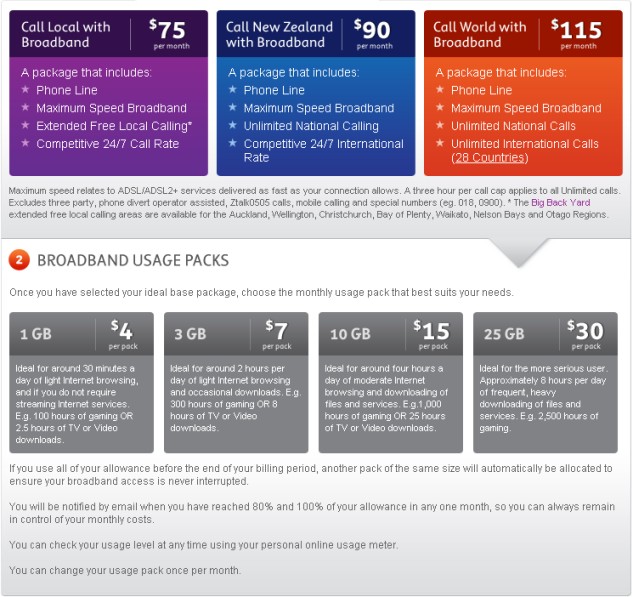
That would also get around the other irritating thing about data caps, the punitive charges if you go a single byte over your limit. In the case of TelstraClear it’s $2.95 per GB or part thereof.
TelstraClear - The Internet. Overcharged.

Readers shared their two cents:

I have a 40GB cap which I regularly go over. Telscum charge $20/Gb so it hurts like hell. I tried [switching] to TelstraClear but after three months all I had from them was a bill for services I didn’t receive.

We have 20Gb shared between the three of us and it is rare to go over but we do try like you to use it all up simply because we have paid for it. There is a company in NZ that allows you to roll it over it is Trust power Kinect. A friend uses them and roughly every three months he reckons he can save a month. You do need to have your power and phone with them though and for us it would actually work out more expensive but for others it might not. I do think caps suck though and wish they could be scrapped as I think we would actually use less bandwidth.

I think this part of the world and UK is an exception when it comes to data caps. In Europe data caps are very rare (except in UK which is not typical for Europe in any aspects). Being from Sweden I was a bit surprised moving to NZ and discovered data caps as well as very slow and expensive Internet. Sweden is similar to NZ (e.g. size, population) so it’s a fair comparison. You are being ripped off!

I almost always go over my 80GB. I pay for going over at the $2.95 per GB. Most months I do about 100GB. So last year when I did 262GB in the month it cost quite a lot, total bill was over $500.  As a big data user I have no issues with paying more than little data users but bigger plans are needed. Looking at rates in other parts of the world I should be able to get a 250GB package for about $150 or $180, and that still leaves a good profit for the telco.  Don’t get me started on 3G data costs….

[flv]http://www.phillipdampier.com/video/TelstraClear.flv[/flv]

An assortment of advertising from TelstraClear New Zealand. (3 minutes)

Tennessee’s ‘Girls Gone Wild’ Bill Would Punish Cable Companies Running Racy Ads

Phillip Dampier February 18, 2010 Public Policy & Gov't, Video 5 Comments

Jackson

A Tennessee state senator has introduced a bill that would fine the state’s cable companies for running racy television advertising on its cable channels.

Dubbed the “Girls Gone Wild Bill,” the legislation would hopefully curb cable operators’ willingness to run suggestive advertising, according to the bill’s author Sen. Doug Jackson (D-Dickson).

This isn’t the first go around for Jackson’s bill, having failed to pass during the last two legislative sessions.  But Jackson believes the third time is a charm, passing a vote in the Senate Commerce Committee 8-0, with one member abstaining.

The Tennessean talked with Jackson to learn why the bill was necessary:

Jackson has said he got the idea for the proposal after seeing partially censored commercials for “Girls Gone Wild” videos that show young women disrobing and acting out other sexual situations.

“They’re provocative and shocking to a lot of families trying to raise children,” Jackson said.

The bill would make any television advertisements considered “obscene” to be illegal. Obscenity, Jackson said, is not protected by the First Amendment. Under common law, it is established by community standards, and in Tennessee, each judicial district can establish for themselves what is considered obscene.

“A jury in Dickson County could determine the videos being sold are obscene, which makes it an illegal product,” he said.

The legislation has gotten Jackson plenty of attention across the state, as Tennessee media covered the unusual legislation.  But some fear Tennessee could become a laughing stock over bills like these.

Columnist Gail Kerr, also writing for the Tennessean, called the mad rush of oddball legislation a bunch of  “crazy crap”:

You can sure tell the Tennessee General Assembly doesn’t have any money to spend this year.

After a slam dunk, fast special session on education, our esteemed lawmakers have returned to their usual bad habits.

They have filed legislation that would kill Nashville’s honky tonks, debated whether to outlaw putting electronic chips in people and whether to amend the state constitution to assure you the right to catch a catfish.

Sen. Doug Jackson wants a constitutional amendment to assure every Tennessean has the right to hunt and fish. No one is trying to stop you from hunting and fishing. Jackson also is bringing back his “Girls Gone Wild” legislation, aimed at stopping the late night television commercials promoting the raunchy videos. He was inspired by watching the commercials.

One thing’s for sure, state law prevents these folks from taking campaign donations while in session. With two of them running for governor, one running for Congress and a slew up for re-election, they’ll start getting eager to adjourn pretty quick. It cannot happen too soon.

[flv]http://www.phillipdampier.com/video/WKRN Nashville Girls Gone Wild Bill 02-09-2010.flv[/flv]

WKRN-TV in Nashville reports Sen. Doug Jackson’s bill would allow communities to define certain ads on cable television obscene and have them pulled off the air.  (1 minute)

[flv width=”480″ height=”380″]http://www.phillipdampier.com/video/WSMV Nashville Senator-Companies Liable For Obscene Ads 2-9-2010.flv[/flv]

Some members of the Tennessee Legislature believe the state’s cable companies should not be taking money from companies peddling smut, as WSMV-TV Nashville reports. (2 minutes)

Protesting adult programming on cable and satellite television is a long-standing tradition in Tennessee.  Some elected officials even dislike the prospect of MTV running on state cable systems.  But most agree lawmakers have the biggest problem with cable’s dirty little secret — extremely explicit adult programming aired on pay per view channels.  Most cable systems don’t go out of their way to promote this type of programming, but viewers learn it is there when skimming electronic program guides.  Most adult movies have titles that leave little doubt what they offer viewers willing to purchase it, and plenty do — it’s very profitable for most cable operators.

[flv width=”480″ height=”292″]http://www.phillipdampier.com/video/WDEF Chattanooga Fowler Objects To EPB Content 11-02-09.flv[/flv]

David Fowler, a former state senator from Signal Mountain, last November denounced EPB, Chattanooga’s city-owned fiber television and broadband provider, for allowing adult programming on the lineup in the first place. (WDEF-TV Chattanooga) (11/2/2009 – 1 minute)

Time Warner Cable Investigates 14,000 El Paso Residents for Cable Theft, Local TV News Reports

Phillip Dampier February 18, 2010 Grande, Video 5 Comments

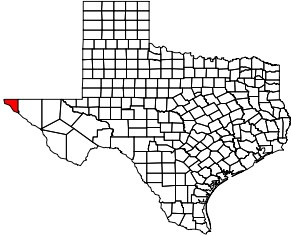
El Paso, Texas

More than 14,000 residents of El Paso are under investigation for potential cable theft.  That remarkable number comes from El Paso, Texas TV station KFOX-TV.  Reporter Martina Valverde notes that Time Warner Cable is now engaged in a city-wide system audit to identify and disconnect illegitimate cable connections.

“Our paying customers who rely on us for phone service, video service, and Internet service,” Gary Underwood, vice president of communications for Time Warner’s Texas operation told KFOX viewers. “They might not be able to access those services when they most need them because the damage that was caused further down the line.”

The company told KFOX when it discovers an illegal connection, it makes two attempts to convert the customer to legitimate service.  On the third attempt, local law enforcement becomes involved.  Those found guilty face fines of $500.

“We have what’s called a tab audit team. They go out and they look at different areas to see. We have a system of tagging and flagging on these lines to so our folks can identify an authorized versus unauthorized connection,” Underwood said.

Cable theft is not just a problem in El Paso.  Some brazen entrepreneurs go further, pretending to represent providers willing to hook customers up for a one time, flat fee they pocket.

Grande Communications faced one such individual, who last summer slapped a magnetic sign with Grande’s logo on his truck and pitched cable service to apartment complexes and homes around San Marcos, Texas.

Unwitting customers who signed up for the deal were offered special discounts by Grande when their illegal cable connection was discovered.

[flv width=”640″ height=”500″]http://www.phillipdampier.com/video/KFOX El Paso Time Warner Cable Cracks Down On Illegal Taps 2-17-2010.flv[/flv]

KFOX-TV in El Paso, Texas ran this report last night claiming more than 14,000 residents were under investigation for cable theft in the community. (1 minute)

[flv width=”480″ height=”380″]http://www.phillipdampier.com/video/KXAN Austin Fake Cable Guy Selling Cable 7-24-09.flv[/flv]

Last summer, Grande Communications had to contend with someone illegally hooking up customers around San Marcos, Texas. KXAN-TV in Austin ran this report July 24th. (2 minutes)

Time Warner Cable Nation’s Third Largest Internet Service Provider – 62 Percent of Its Customers Take Broadband

Phillip Dampier February 18, 2010 Broadband Speed, Competition Comments Off on Time Warner Cable Nation’s Third Largest Internet Service Provider – 62 Percent of Its Customers Take Broadband

Time Warner Cable this week announced it signed up its’ nine-millionth Road Runner customer, making the company the third largest Internet Service Provider in the United States.

Broadband service continues to grab an increasing share of business for the nation’s cable operators, even as they continue to lose video subscribers.  During the last quarter of 2009, Time Warner lost 105,000 video subscribers  but added 120,000 residential high-speed Internet subscriptions.

Nine million subscribers paying even a promotional rate of $30 a month earns the company $270 million dollars a month — $3.24 billion dollars a year.

Hobbs

“This is a great milestone for Time Warner Cable, and it further proves that our customers enjoy the speed and content our HSD products deliver, as well as the value seen when bundling this service with our video and phone offerings,” said Landel Hobbs, COO of Time Warner Cable. “High Speed Data continues to be a growing part of our business and we look to keep adding new features and further enhance speeds as we move through 2010.”

The company claims it has not lost a significant amount of business to its most-feared potential competitor, Verizon’s fiber to the home network FiOS.  But the company is installing DOCSIS 3 upgrades to increase speeds in markets where FiOS competes for broadband customers.  Cable industry experts suggest broadband is becoming a mature industry, and growth from customers new to the high speed experience are fewer in number.  A strong percentage of new Time Warner Cable broadband customers come from landline customers defecting from relatively slower DSL service from phone companies.

As interest in high bandwidth applications like streaming video increase, DSL service can prove a frustrating experience for those stuck with lower speeds.  Despite claims by some phone companies that consumers don’t care about broadband speed, Time Warner Cable will offer increased speed tiers and upgrades in most of its competitive markets in 2010 based on the assumption many customers do.

Reviewing HBO Go – Bored to Death: Restrictions Limit Experience to Watching Shows You’ve Probably Already Seen

Phillip Dampier February 18, 2010 Comcast/Xfinity, Editorial & Site News, Online Video, Verizon Comments Off on Reviewing HBO Go – Bored to Death: Restrictions Limit Experience to Watching Shows You’ve Probably Already Seen

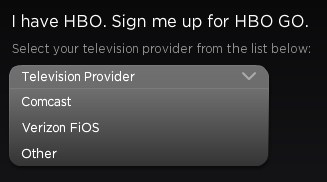
HBO Go is currently only available directly to Verizon FiOS customers. Comcast customers have access through Fancast, and Time Warner Cable indicated it wasn't interested in participating in HBO Go, for now.

HBO subscribers who are also Verizon FiOS TV customers are the first to get access to the premium channel’s new online video portal — HBO Go, launched Wednesday with over 600 hours of HBO programming, available free to authenticated HBO and FiOS subscribers.

HBO Go is another project spawned from the cable and pay television industry’s TV Everywhere project — putting television programming online for anytime viewing, for free, as long as you maintain a cable or pay television subscription.

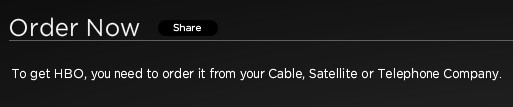
Ironically, the service launched Wednesday on Verizon’s telco-TV service FiOS, leaving lots of cable subscribers waiting for access.  If you subscribe to HBO through cable, satellite, or U-verse, the service remains unavailable to you, for now.  Comcast subscribers already had access to HBO’s programming through the Fancast Xfinity TV website.  If you don’t pay for television, the service remains unavailable to you indefinitely — they won’t sell it to you at any price.

“Ultimately this is about extending the subscriber lifecycle,” HBO co-president Eric Kessler said. “It’s more about subscriber retention.”

Subscriber retention through incumbent providers, he means.  HBO doesn’t want to risk selling direct to online consumers who might want to cut ties with their cable or other pay television provider.

Stop the Cap! reader Jared has FiOS and HBO and let us sample the service through his FiOS connection (his 25Mbps/25Mbps connection with remote access maxed out our Road Runner Turbo connection and still left him plenty of leftover speed).

Let’s start with the viewing experience.

It’s a big improvement over HBO’s Wisconsin trial in 2008 with Time Warner Cable, which required viewers to download Windows Media-encoded video files protected with Microsoft’s annoying digital rights management scheme.  It was cumbersome for trial participants, and dealing with Microsoft’s player and DRM cut Mac owners out of the trial.

HBO Go is Flash-based, using Adobe’s Real-Time Messaging Protocol to keep viewers from saving permanent copies for themselves (and potentially their friends.)  Using Verizon FiOS, viewers should rarely encounter any artifacts or speed-related viewing problems.  The picture was fine, even for me using remote access software. Of course, if your Internet connection is considerably slower than FiOS or your neighborhood suffers from online congestion, you could experience issues streaming HD content, but HBO Go is designed to buffer when encountering slower connections.  The files are encoded in MPEG-4 at 1.2Mbps and 2.6Mbps, which theoretically should be fine for the majority of viewers.  Comcast subscribers – remember watching counts against your usage cap.

Wandering around the HBO Go library was simple  — easier to navigate and less cluttered than Hulu.  The site was intuitive and should be easy to use for just about everyone.

Up to three members of your household can each watch programming from the service at the same time, even away from home, anywhere in the country.

HBO Go claims to be a work in progress — about 25% of the content will be refreshed by HBO every week, with new episodes available on the service immediately following their TV premiere.

But the service hardly offers a comprehensive viewing experience.  It’s much closer to Hulu or your cable company’s HBO on Demand service.

For example, rights issues limit virtually all of HBO’s original series to a handful of recent episodes or seasons.  Only The Wire has a complete library to watch from its premiere forward.  Curb Your Enthusiasm, aptly named when considering HBO Go, is missing completely.  So is Real Time with Bill Maher, although four of his earlier specials are archived on the site.

As for movies, there are gaping holes there as well.  Available titles resemble Cinemax’s selection of movies you’ve already seen.  There are gaps between what you can watch on HBO itself and what is available on HBO GoBabe is online, for instance, but anything Harry Potter isn’t.

In other words, what could have been a compelling addition for HBO subscribers feels redundant.  I would never pay anything extra for HBO Go, nor will it be a factor in keeping HBO.

Online viewers need not apply.

HBO could have used the opportunity to sell the service to non-cable subscribers for a monthly fee and pick up some additional revenue, but that wouldn’t sit well with the pay television cartel that is behind the TV Everywhere concept.  They don’t want you cord cutting — those that have are locked out of the HBO Go Clubhouse.  For now, I suspect few were clamoring to get in.

Search This Site:

Contributions:

Recent Comments:

Your Account:

Stop the Cap!