AT&T’s Usage Cap Trials in Beaumont, Reno Ending in April? Trial Outrages Customers – “Bait and Switch” Broadband

Phillip Dampier February 22, 2010 AT&T, Data Caps, Editorial & Site News 5 Comments

That's not all that expanded in Reno... customer's broadband bills faced $1/GB overlimit penalties as part of an Internet Overcharging experiment

AT&T’s experiment with usage caps appears to have lost them loyal customers, and generated numerous complaints against AT&T with the Better Business Bureau regional offices in Nevada and Texas for false advertising.  Now there are indications AT&T will wrap up the entire experiment by this April and “study the results.”  Stop the Cap! reader John wrote to say the nightmare may be ending… for now.  At least one of our readers arguing with intransigent AT&T executives heard likewise.

AT&T last year subjected Beaumont, Texas and Reno, Nevada to a trial forcing a usage allowance between 20-150 gigabytes per month on customers, depending on the type of broadband plan selected.  The proposed overlimit fee?  $1.00 per gigabyte, although problems with their usage meter often kept overlimit fees off customer bills.

We’ve documented the howls of complaints from customers who were falsely sold an “unlimited” plan from AT&T and were never notified, or notified after signing up, of the existence of the Internet Overcharging scheme.  Some customers received express mail letters officially notifying them of the scheme, others received robocalls.  Complaints to the Better Business Bureau usually got any excess charges refunded, and some managed to secure a complete exemption from the usage cap trial, under threat of canceling their accounts.

Stop the Cap! reader Robin is a typical example of a customer who was sold a bill of goods by AT&T’s marketing, only to be punished with the fine print after signing on the dotted line.

“I just got my Express letter in the mail today. My internet was hooked up yesterday – no one ever said anything about any cap! I was in shock when I received the letter in the mail, I have never heard of anything like this. I live about 30 minutes out of Reno. Needless to say I am very very upset and trying to figure out what I am going to do now as I know I will go over the cap every month, I can’t afford that and I can’t afford cable internet at this time either. AT&T sucks and so does their customer service.”

Robin joins many other customers in both communities stuck in a trial that even some AT&T customer service representatives don’t understand.  Robin’s calls to customer service met with claims the account could not be found, and transfers to four different AT&T departments before being able to address the usage cap surprise.

Albert, another reader, was similarly surprised.

“They are fraudulent in every respect. The state attorney should look into this. They say “unlimited” and when you sign up, they send you a little email saying you are screwed [with the trial],” he writes.

AT&T’s response to Albert was essentially “tough cookies” and if he didn’t like it, he could cancel.

Our readers in Beaumont went through the same AT&T Confusion Circus, transferred between departments until someone recognized the caller was a lucky winner of an Internet Overcharging experiment.

In both cities, delivering an effective message of customer contempt with AT&T’s usage cap scheme means filing a complaint with the Better Business Bureau.  As an accredited member, AT&T values its rating very highly, and targeting complaints to the Bureau forces them to spend time and money to respond.  Better yet, AT&T executives don’t like it one bit, as Albert writes:

“Go to the Southern Nevada Better Business Bureau and file a complaint. I just had the VP of Regional West of AT&T call.  She was pissed that I filed a complaint, and now she has to personally reply. She hung up on me.”

Being an active consumer willing to make your voice heard is an effective way to deliver the message pricing and usage tricks and traps are unacceptable.  Better yet, it annoys providers with dollar signs in their eyes, especially when canceling your service.

Albert was told the nightmare ends April 1st, when the trial wraps up, but now is the time to deliver the final protest AT&T cannot ignore.

April 1st is an ironic date — the first anniversary of  Time Warner Cable sharing word of its own Internet Overcharging experiment in Austin, San Antonio, Greensboro, NC and Rochester, NY. After two weeks of protest, Time Warner Cable shelved their experiment.

If you’re a resident of Reno or Beaumont, it’s critically important to deliver AT&T a message they can understand:

  1. Contact the local media and request they publicize the ongoing controversy over Internet Overcharging schemes;
  2. Contact your local and federal elected officials and let them know AT&T’s schemes are unacceptable.  See our “Take Action” section regarding support for legislation that would outlaw such schemes;
  3. File a detailed complaint with the Better Business Bureau, particularly emphasizing any lack of disclosure about the experiment, bait and switch advertising, ripoff pricing, etc.  Demand an immediate and full refund for any overage charges and a free pass to cancel AT&T services without any early termination fees.
  4. Reno residents — contact Barbara DiCianno at 775-334-3112. She is the mayor’s assistant. Call her and ask to have an investigation launched regarding AT&T’s discrimination against Reno with overcharging schemes that put the city at a distinct broadband disadvantage.  Local elected officials can deliver a strong political message to AT&T that such overcharging schemes will lead to robust support for re-regulation of AT&T’s broadband business to protect consumers.
  5. Tell AT&T you will never remain a customer of a provider that has Internet Overcharging pricing schemes.  Tell them in no uncertain terms usage limits and usage based billing are unacceptable, and you will cancel service the moment they attempt to implement either.

A year ago, it was the residents of Beaumont and the other cities impacted by Time Warner Cable’s overcharging scheme that fought on the front line to protect every Time Warner Cable customer from facing a tripling of their price for broadband service.  Today it’s Reno and Beaumont fighting for AT&T customers, both inside their own communities and those nationwide.  As Albert reminds us:

“We will be the ones that determine if this continues or stops here and now.”
Does Time Warner Cable’s Speedtest Gauge Provide Hints About Speed Upgrades?

Phillip Dampier February 22, 2010 Broadband Speed 3 Comments

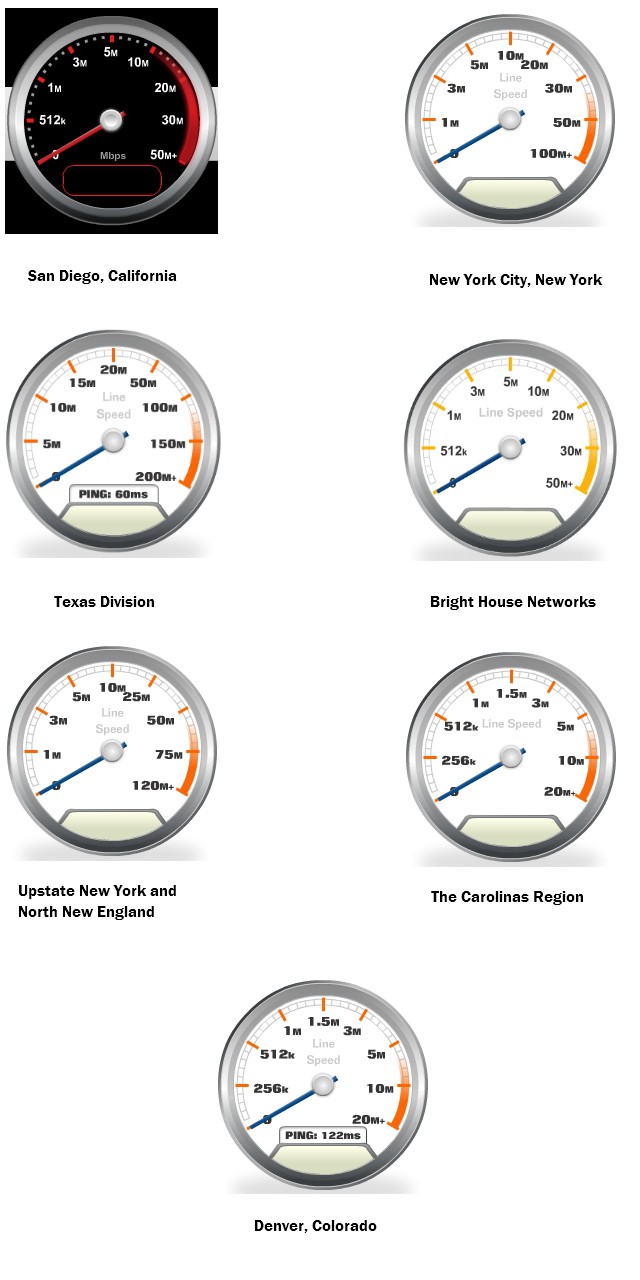
Stop the Cap! reader Brian thought he noticed a change in Time Warner Cable’s speedtest website for upstate New York residents — he thought the top speed on the gauge may have increased.  At the same time, a few readers on the Broadband Reports Road Runner forum wondered if a change in the Texas division’s speedtest gauge meant DOCSIS 3 upgrades were headed their way.

Perhaps, but Time Warner Cable’s speedtest gauges probably aren’t a guaranteed indicator of an imminent upgrade.  The one for western New York has shown a maximum speed of 120Mbps for months now, but there’s no evidence every city covered by it will soon have up to 100Mbps service.

A quick survey of Road Runner speedtest sites show a remarkable variation:

Verizon’s Abdication of Rural Broadband — Plow Money Into Big City FiOS, Ignore or Sell Off Rural Customers

Verizon Communications has made its intentions clear — would-be broadband customers in its service area who are off the FiOS footprint can pound salt.  The Federal Communications Commission issues regular reports on broadband services and their adoption by consumers across the United States.  In the latest report, published this month, customers in Verizon’s current or former service areas who are not being served by Verizon FiOS are behind the broadband 8-ball, waiting for the arrival of DSL service from a company that has diverted most of its time, money, and attention on deploying its fiber-to-the-home service for the big city folks.

One might think the worst DSL availability in the country would be in rural states like Alaska, or territories like Guam, or income-challenged Mississippi.  No, the bottom of the barrel can be found in northern New England and the mid-Atlantic states — largely the current or former domain of Verizon:

Percentage of Residential End-User Premises with Access to High-Speed Services by State
(Connections over 200 kbps in at least one direction)

Maine 73% Sold to FairPoint Communications
Maryland 76%
New Hampshire 63% Sold to FairPoint Communications
New York 79%
Vermont 72% Sold to FairPoint Communications
Virginia 69%
West Virginia 66% Seeks sale to Frontier Communications
Source: FCC High-Speed Services for Internet Access: Table 19

Some might argue that DSL penetration ignores Verizon’s fiber upgrades, but does it?

Providers of High-Speed Connections by Fiber by State as of December 31, 2008
(Connections over 200 kbps in at least one direction)

Maine 8%
Maryland 9%
New Hampshire 10%
New York 21%
Vermont 4%
Virginia 20%
West Virginia 7%
Source: FCC High-Speed Services for Internet Access: Table 20

A survey of the rest of the country calls out Verizon’s inattentiveness to DSL expansion in its remaining service areas not covered by FiOS.

For example: Alabama, Idaho, Montana, and Oklahoma all enjoy 80 percent DSL availability.  Utah and Nevada achieved 90 percent coverage.  Even mountainous Wyoming, the least populous state in the country, provides 78 percent of its state’s customers with the choice of getting DSL service.  Yet New York manages only one point higher among its telephone companies, largely because of enormous service gaps upstate.

What happened?  By 2002 Verizon began to realize their future depended on moving beyond providing landline service.  The company began to divert most of its resources to a grand plan to deliver fiber connections to residences in larger markets in its service areas.  While great news for those who live there, those that don’t discovered they’ve been left behind by Verizon.  Northern New England got flushed by Verizon altogether — sold to the revenue-challenged FairPoint Communications who assumed control of Verizon’s problems and managed to make them worse.

The argument that rural broadband is “too expensive” doesn’t fly when looking at DSL availability in the expansive mountain west or rural desert regions.  Compact states like Vermont, New Hampshire, and Maryland are far easier to wire than North Dakota, New Mexico or even Texas with its large rural areas (87, 87, and 81 percent coverage, respectively).  Verizon simply doesn’t realize the kind of Return on Investment it seeks from FiOS customers — a dollar amount investors want to see.

Of course, that’s the argument Frontier Communications, and FairPoint behind it, made to regulators in sweeping promises to deliver better broadband service.  FairPoint missed its targets and declared bankruptcy.  Frontier is still in the “promises, promises” stage of its deal to take over millions of rural customers currently served by Verizon.

Comcast Explores 250Mbps Service, Perhaps in 2011 — Will It Matter With a 250 GB Allowance?

Phillip Dampier February 22, 2010 Broadband Speed, Comcast/Xfinity, Data Caps 3 Comments

Broadband Reports this morning heard from a trusted source who says America’s largest cable operator is considering offering 250Mbps service to customers, perhaps as early as 2011.

While some cable operators (Time Warner Cable) have dragged their feet on DOCSIS 3 upgrades, Comcast has not — it is expected to have 100 percent of its cable systems upgraded this year.

DOCSIS 3 provides vastly increased speeds across a more robust network.  Older standards provided neighborhoods with a single 6 Mhz channel, with a 36Mbps downstream pipeline.  While that may be fine for a neighborhood browsing web pages and checking e-mail, it doesn’t take much too much high bandwidth activity to start slowing speeds down.  DOCSIS 3 “bonds” multiple channels together to create one fat pipeline.  Newer chipsets support eight combined 6Mhz channels, capable of providing that same neighborhood with 320Mbps of capacity.  Using schemes like PowerBoost, or with few others online, Comcast can deliver occasional bursts of speed at 250Mbps to customers without further upgrades, notes Dave Burstein of DSL Prime.

The bigger question is will customers pay the premium price for 250Mbps if Comcast maintains its 250GB usage limit on it?  Super speed tiers like this are useful to customers using high bandwidth applications.  It doesn’t make sense to upgrade to premium speeds if they’re accompanied by a usage governor.

Sunflower Broadband Boosts Usage Allowances As AT&T U-verse Wins Customers

Phillip Dampier February 22, 2010 Broadband Speed, Competition, Data Caps, WOW! 3 Comments

When AT&T’s U-verse system arrived in Lawrence, Kansas residents rejoiced at the prospect of finally getting broadband service that didn’t come with Internet Overcharging schemes attached.  Sunflower Broadband, the local independent cable system, tied its fortunes to broadband usage allowances as low as three gigabytes per month.  Exceeding the allowance kicked in an overlimit fee for every extra gigabyte used.

As AT&T continues to make inroads in Lawrence with U-verse, which doesn’t have usage limits, customers noticed and began dropping Sunflower.  The cable system also noticed, and has increased plan allowances.

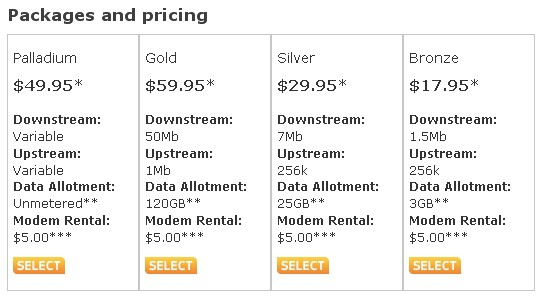
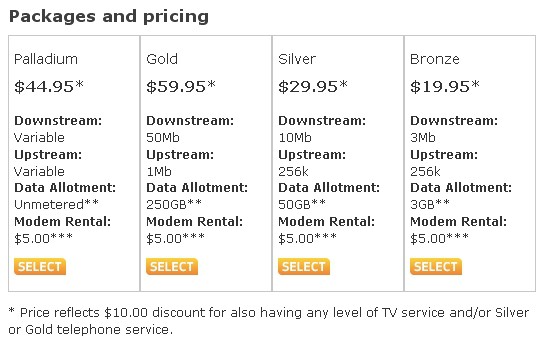
On the low end, the Bronze plan still charges $17.95 per month for 3Mbps/256kbps service with a three gigabyte allowance .  The Silver plan — $29.95 per month — received a speed and allowance upgrade.  Up from 7Mbps to 10Mbps, the monthly limit has now doubled to 50 GB per month.  Upload speeds remain an anemic 256kbps, however.  The biggest change comes for Gold plan users.  For $59.95 per month, the company offers 50/1Mbps service with a considerably more generous allowance — 250GB per month, up from 120GB.

Sunflower Broadband's Old Pricing/Service Plan (from January 2010)

Sunflower also sells a flat rate, unlimited plan called Palladium that doesn’t offer customers a set speed.  The company cut the price from $49.95 to $44.95 a month, perhaps in response to an underwhelmed customer base.  As we reported in January, Palladium speeds do not impress many Sunflower customers.  But some local residents report speeds are improving for those moved to Sunflower’s new DOCSIS 3 platform, an upgrade from Sunflower’s older system, where most of the speed complaints were noted.

The Lawrence Broadband Observer says AT&T and Sunflower are becoming close competitors in most respects, except upload speeds:

The one area where Sunflower still lags is upload speed, which even on the high-end plan is still limited to 1 megabit. This seems puzzling, and the 50 down to 1 up ratio of is greater then any other DOCSIS 3 cable company I was able to find, and makes it difficult to use services like photo and movie uploading, file sharing and online backup services. If Sunflower ever raises their upload speeds, they might just be able to lure this former customer back into the fold!

They could lure many more back if they dropped the hated usage limits and overlimit fees.  DOCSIS 3 provides substantially improved bandwidth, making such limits unnecessary.

Sunflower's New Broadband Plans & Pricing (February 2010)

Search This Site:

Contributions:

Recent Comments:

Your Account:

Stop the Cap!