
High Speed Broadband for All (‘All’ is Defined as ‘Chairman of British Telecom’); Neighbors Achieve High Speed Fury

Phillip Dampier November 30, 2009 Public Policy & Gov't, Rural Broadband 2 Comments
Sir Michael Rake

Sir Michael Rake

Hambleden residents who have fought for years to obtain broadband service from British Telecom are boiling mad over their discovery one comparatively recent arrival to the Oxfordshire village near Henley-on-Thames managed to get service shortly after moving in a year ago.  It turns out the “lucky” resident chosen to participate in a very limited trial of so-called “broadband enabling technology” is none other than the chairman of the company providing the service.

Sir Michael Rake managed to obtain the only broadband connection in the rural community as part of what the company called a pilot trial to test out the commercial feasibility of new technology to extend broadband service to more rural locations across Great Britain.

Of course, the “new technology” is reportedly little more than an extender for DSL service that is capable of delivering 1Mbps service on Britain’s aging copper telephone wiring.

The neighbors are furious anyway.

Some have been trying to get broadband service installed for at least five years to no avail.  Hambleden is just one of many rural communities bypassed by BT broadband.

Hambleden is just 35 miles northwest of London

Hambleden is just 35 miles northwest of London

Gary Ashworth, head of Abacus Recruitment told the Daily Telegraph: “It stinks of corruption. The chairman of BT is given preferential treatment over long-serving customers. I run a business and we probably have 1,000 BT lines. Clearly there is preferential treatment if you happen to be the chairman. I think it is a disgrace.”

Ashworth inquired if he could participate in the “BT trial.”  BT promptly said no, saying he’d have to wait until 2010 at the earliest.

“Sir Michael Rake is the only person allowed to participate in the trial in our area. He moved into the village a year ago and surprise, surprise, he has got broadband,” Ashworth complains.

Although Rake can enjoy the benefits of broadband as a trial participant, BT was willing to extend Ashworth broadband service, if he ponied up £68,000 for the installation.

While the chairman of BT browses the web today at his Hambleden estate, the company admits wiring the entire community would not be profitable.

The Daily Mail interviewed Paul Goodman, the Tory MP for Wycombe, who said “the lack of broadband in the Hambleden Valley is a very serious problem for my constituents.”

“Unless all BT staff members are entitled to participate in the trial on exactly the same terms, I think some of my constituents will find this very strange,” he told the Daily Mail.

The government has promised to underwrite broadband expansion into rural areas by 2012 with revenue earned from a 50p surcharge on phone bills.

Share

Sun-Sentinel Runs Hit Opinion Piece On Net Neutrality, Forgets To Disclose AT&T and Embarq Helped Finance It

Mark A. Jamison

Mark A. Jamison

Stop the Cap! reader Joe sends along news of another one of those guest opinion hit pieces on Net Neutrality that pop up regularly in the media.  This one, The Internet is Never Neutral, printed in today’s Sun-Sentinel in south Florida, comes from Mark A. Jamison and Janice Hauge, a dynamic duo who have co-written several papers that always manage to turn up favorable conclusions for big telecommunications companies, including these page-turners:

  • “Bureaucrats as Entrepreneurs: Do Municipal Telecom Providers Hinder Private Entrepreneurs?”
  • “Subsidies and Distorted Markets: Do Telecom Subsidies Affect Competition?”
  • “Dumbing Down the Net: A Further Look at the Net Neutrality Debate.”

The two are also working on other papers purporting to study regulatory policy and competition issues.  Let me illustrate my psychic powers by guessing they’ll find regulatory authorities to be obstacles to the well-oiled telecommunications machine and competition will be most hearty if there are no pesky regulations to hamper it.  We’ve seen how well that has worked so far for consumers in North America.

Remember Al Gore calling the Internet the information superhighway? The metaphor wasn’t and isn’t perfect, but it is instructive. Suppose we applied net neutrality to our transportation system — there would be no high-occupancy vehicle lanes during rush hour, no car-only lanes on interstates, and no toll road as an alternative to I-95 in South Florida. Transportation would be more costly and provide less value.

Forcing net neutrality would have similar results. Time-sensitive information, such as stock market transactions, would wait in line behind football game highlights.

Jamison, who is a former manager at Sprint Communications, and Hauge miss the entire point of the Internet’s biggest strength: its equal treatment of traffic from the smallest blog to Amazon.com.  Assuming providers, earning billions in profits even as their costs decline, invested appropriately in those networks, there would be no need for high-occupancy vehicle lanes and toll roads.  These kinds of “traffic management” techniques are proposed because provider dollars don’t keep up with consumer demand.  Social engineering tries to throttle traffic downwards by discouraging it with toll fees or manage it with special high cost lanes reserved only for those willing to pay or follow arbitrary rules governing their use.  More often than not, those premium lanes go underutilized while the rest of us remain stuck in the slow lane.

Net Neutrality would not impede network management that enhances the efficiency of traffic, except when it comes at the expense of someone else’s traffic. Net Neutrality also throws up a roadblock against providers who would plan to cash in with enhanced connectivity services that cannot exist unless  a market is created to sell them.  It’s similar to providers in Canada limiting your access to broadband, then throwing a penalty fee on your bill… unless you sign up and pay for their “insurance” plan to protect you from those charges.

Want to run a video streaming application on the Internet?  Pay for a broadband provider’s deluxe delivery insurance, and customers will be able to watch that video without buffering.  The alternative is to be stuck waiting because your video is being delivered on an artificial “slow lane.”

If you are thinking that it sounds like net neutrality restricts innovation and hurts customers, you’re right. Our research has shown that net neutrality limits innovation, contrary to the claims of the net neutrality proponents. How can this be? Imagine a one dimensional network — one that does nothing but carry information from point to point, which is how the old Internet has worked. What kinds of content providers flourish in that context? Those big enough to distribute their software across the net and those whose software takes advantage of the great bandwidth that they don’t have to pay for.

Their research makes numerous assumptions that might prove accurate in a laboratory environment, but simply discounts provider mischief in their efforts to maximize profits and minimize costs.  Providers have earned countless billions providing this “one dimensional network” to consumers.  It’s the one bright spot in a lackluster telecommunications sector.  Those who innovate new broadband applications have flourished.  Some providers who have not want to innovate in a different way – by inventing new Internet Overcharging schemes to profit from the service without actually improving it.  When their interests are at stake in owning and managing their own content services, bandwidth suddenly becomes plentiful.  The TV Everywhere project will potentially provide a value-added service to cable and telco TV providers, all made possible in marked contrast to their argument that other producers’ video content is clogging their networks.

Another naked fallacy in the authors’ argument is that content providers don’t pay for the bandwidth to host and distribute their content.  They do — to the companies that host their content and provide connectivity to the Internet.  That’s the job of web hosting companies.  Internet service providers simply want to be paid extra for doing their job – providing connectivity to consumers who pay $4o or more a month Free Press found costs about $8 to provide, and then also charging content creators a second time to facilitate delivery of that content.  That’s akin to charging a phone customer for placing a long distance call and also demanding to bill the person who answers.

Now, suppose that the network can offer enhancements that improve customers’ experiences. Content providers whose sites would not benefit from such enhancements could ignore the offering. But there will be some content providers who could improve their services by buying the enhancements, such as priority packet delivery. These sites become better without net neutrality and offer customers more service. In other words, there is more innovation and greater customer welfare without net neutrality than with it.

Promises, promises.  Just getting these providers to upgrade broadband speeds to consumers has been a never-ending quest.  Many consumers are willing to pay for “improved service” in the form of faster connections to the Internet.  Consumers are not willing to pay more for artificially limited service, be it through throttled speeds or usage caps.

At the conclusion of their study, which assumes providers will not leverage their duopoly in most American markets to increase pricing/revenue and reduce costs by limiting demand on their networks, they readily admit they did not take into account several possible scenarios:

  • One issue is how the offering of premium transmission might affect the network provider’s incentive to change the standard transmission speed. At least AT&T has committed to not degrade service for any network user, but it is unclear how such a commitment would be enforced.
  • Secondly, we do not analyze the effects of peer-to-peer communication, which is growing in importance on the Internet.
  • Thirdly, we do not consider the effects of vertical integration by the network provider and whether this would provide an incentive for foreclosure.
The PURC is part of the University of Florida, but also receives private corporate funding

The PURC is part of the University of Florida, but also receives private corporate funding

Because the broadband industry fights any attempt to regulate their service, it is unlikely any such promise from AT&T would be enforced.  What AT&T defines as “degraded” service is open to interpretation as well.  As broadband demand is dynamic and growing, should AT&T leave standard transmission speeds exactly as they are today, that non-premium service would be degraded through inattention to broadband growth.  Peer to peer communication is largely a story from the first round of the Net Neutrality debate in 2006-7.  A more significant amount of traffic is now attributed to online video.  Finally, not considering vertical integration in the cable and telephone industry is a fatal flaw.  The history of telecommunications regulation has largely been written during periods when the cable and telephone industry abused their market position to overcharge consumers for service, lock up content distribution channels, and forestall competition wherever and whenever possible.

Frankly, Jamison and Hauge’s world view only innovates new, even fatter profits for providers like AT&T.  Perhaps some of those profits can go towards even greater funding for the Public Utility Research Center, where Jamison serves as director and Hauge as a Senior Research Associate.  The PURC, part of the University of Florida, just happens to have, among others, AT&T and Embarq Florida as sponsors, and both companies have seats on the PURC Executive Committee.

Sun-Sentinel readers don’t have that information because it’s not included in the disclosure at the bottom of the piece.  Following the money would shed a lot more sun on this important debate.

Share

Burlington Telecom Needs to Create New Innovative Services Comcast Doesn’t Provide, Telecom Consultant Says

Steven Shepard, president of Shepard Communications Group

Steven Shepard, president of Shepard Communications Group

Burlington Telecom, the municipally owned fiber to the home cable and broadband provider still reeling from a late fall financial scandal, must think outside of the box if it is to survive and grow its business in Vermont’s largest city.  That’s the assessment of Steven Shepard, president of Shepard Communications Group, a consulting firm based in Williston.

It comes as both city and state officials continue an investigation into a $17 million loan from city coffers to cushion the provider from substantial losses incurred over the past three years of operations.

Burlington Telecom has been criticized for underestimating the costs of wiring Burlington with fiber optics, something Shepard doesn’t think is unusual.

“I haven’t found one yet that has come it at budget, or even under budget,” Shepard told WCAX-TV news.

Burlington Telecom director, Chris Burns, says the company needed the additional money to cover capital expenses as it works to build its all-fiber network in every part of the city. He says the initial investment of $33 million dollars was not enough. “Some of the early estimates weren’t based on firm engineering quotes,” says Burns. “They were rough order magnitude estimates.”

Chris Burns, Burlington Telecom

Chris Burns, Burlington Telecom

Burns feels Burlington Telecom needs to expand its service area to bring in additional customers to help keep the provider up and running.  Some customers recognize Burlington Telecom is a unique, municipally-owned asset that can potentially provide services that Comcast, the dominant cable provider in the area, cannot.  Comcast operates a traditional hybrid fiber-coaxial cable network with more limited bandwidth than Burlington Telecom’s direct fiber optic connection to the home can provide.

But Shepard believes most consumers don’t know or care how service reaches them, and believes fiber optic networks alone do not bring instant success to providers.

Unless Burlington Telecom creates services that would be difficult for Comcast to deliver, they are just another telecommunications company, Shepard believes.

One suggestion from Shepard: an automatic file backup service.  Fiber optics can provide upstream speeds equivalent to downstream speeds, something Comcast cannot easily deliver.  Such a service would automatically send a copy of every file to a secured, encrypted off-site backup system.  If a customer needed the file restored, or an entire hard drive, Burlington Telecom could transmit the files on request.  Assuming privacy is protected, such a service would give consumers a potential reason to switch providers.

For broadband customers, providing upstream and downstream speeds faster and cheaper than Comcast will go a long way towards motivating consumers to switch.

http://www.phillipdampier.com/video/WCAX Burlington Can Burlington Telecom Survive 11-05-2009.flv

WCAX-TV Burlington interviews Steven Shepard about the ongoing viability of Burlington Telecom. (November 5, 2009 – 4 minutes)

For some Burlington Telecom customers, improving customer service is an important first step, as WCAX found:

“A few weeks ago, the whole BT was down for half hour, phone and cable. And probably internet but I don’t have that,” says Beth Cane, who lives in the city’s south end. Cane says getting through to customer service is “like trying to get into Fort Knox.”

She is not the only one complaining. Rob Lyman says he is “not happy” with Burlington Telecom’s service. “I watched a trailer for an on-Demand movie and the whole system froze up and required a reboot of BT’s box. When I called the help desk they said they’ve known about this problem for six months and didn’t know when it would be fixed,” he says.
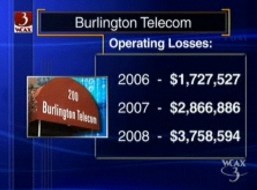
burlington losses - from WCAXIn mid-November, a possible solution to the funding issues came from Piper Jaffray, a Minneapolis-based investment firm.  The company offered Burlington Telecom a $61.6 million dollar refinancing package that would help keep the company viable and return taxpayer funds caught up in the controversy to the city.

The proposal was met with political wrangling from the Burlington city council, which spent the last month and a half doing damage control.

“Once TelecomGate went radioactive in October, it was everyone for themselves on the city council as the finger pointing started,” Stop the Cap! reader Dwayne writes from Burlington. “The progressives are blaming the former Bush Administration’s economic catastrophe for wrecking the credit and financing markets BT needed to access, the Democrats are trying to play the role of moderates, and the Republicans are questioning why the city should compete with Comcast in the first place.  Demagoguery is universal,” he shares.

The rhetoric has grown so heated, it has stalled the city council’s approval of the loan package, to the disappointment of Mayor Bob Kiss.

http://www.phillipdampier.com/video/WCAX Burlington Burlington Telecom Gets New Backing 11-13-2009.flv

WCAX reports Burlington Telecom has the potential to secure new funding to refinance operations.  (November 13, 2009 – 3 minutes)

The Burlington Free Press has documented some of the language now a part of the debate:

“I do not believe that keeping Burlington Telecom alive during the absolute failure of our capitalist system was the wrong thing for any of us to do. We can’t afford to sit around. We have an interest payment (for BT’s current $33.5 million outside debt) that is due in February.” — Marrisa Caldwell, P-Ward 3, a Progressive Party member characterized as a fierce supporter of Burlington Telecom, is upset the city council delayed the approval of the loan package.

“The same forces that want to preserve the private insurance monopoly in health care by opposing the “public option” are now out to preserve the private corporate monopoly in Vermont telecommunications. The [Governor Jim Douglas (R)] administration is hell-bent on putting Burlington Telecom — which provides public sector competition to for-profit corporations such as Comcast and FairPoint — out of business, no matter what the consequences.” — John Franco, Vermont Progressive Party

“[Vermont Public Service Commissioner David O’Brien] is a political hack appointed by Douglas. They only want private-sector telecom in the state. He is out to get rid of the competition for the private companies. That’s very clear.” — Marrisa Caldwell

“I’m not going to engage in this kind of dialogue. It serves no purpose. We’re going to proceed with the investigation and work to resolve this situation.” — Deputy Public Service Commissioner Steve Wark, asked to comment on Caldwell’s remarks.

Caldwell also charged that the Free Press coverage of the BT issues has been influenced by advertising revenue from cable provider Comcast. She called the council’s vote to delay action on the new BT loan “disingenuous at best. It’s completely dysfunctional government,” she said. “They just tied the administration’s hands and hamstrung BT.”

“[On the city council's lack of resolve and action] it’s erroneous and not well-founded. I never heard anyone say why they wouldn’t move forward (on the BT loan). It wasn’t leadership and (was) a lack of ability to collectively try to solve the problem.” Sharon Bushor, I-Ward 1, who generally supports Burlington Telecom.

“It seems only rational to do our homework on this (loan). I don’t think one of us is saying it isn’t feasible. All we’re saying is slow down and learn more.”  Councilman Paul Decelles, a Republican, called Caldwell’s remarks “destructive. I would challenge her to find one councilor who has thrown out the word ‘partisan,’” he said. “That word is coming from the administration and from the three Progressive councilors. We’re trying to do what is best for Burlington. This is the residents’ telecom. If acting in a slow, methodical way is unacceptable to some, so be it. It’s irresponsible of them to expect us to rubber-stamp this.” — Paul Decelles, R-Ward 7

“I am shocked and shocked again every time someone raises the partisan flag. This could have been a Republican or a Democratic blunder. The Progressives have been in office a long time. That’s just a fact. When we disagree, apparently, we’re being partisan, (but) it’s not personal, and it’s just not partisan.” — Nancy Kaplan, D-Ward 4

“No one is interested in destroying BT and the administration. Jonathan Leopold said Monday that (the council’s position on BT) was an attempt to destroy the administration. From my own perspective, that’s not the case at all. The first order is to take care of BT, but there have been missteps by the administration.” Mary Kehoe (D-Ward 6) said she has concerns about the loan proposal from Piper Jaffray, particularly the language that indicates the loan repayment will come from Burlington Telecom revenues in the form of city budget appropriations.  “If (BT is) short, what then?  How do we know BT is going to have the capacity?”  She said she voted to delay a decision on the loan, “because we want information. We’ve not been getting the information, and they want us to sign off. That’s not going to happen anymore.” — Mary Kehoe, D-Ward 6

“This is ridiculous. Burlington is starting to look more and more like Washington, with the level of partisan wrangling reaching an intensity that I’ve never seen before in my 15 years of living in Vermont.” — One resident commenting on the coverage and the back and forth.

http://www.phillipdampier.com/video/WPTZ Plattsburgh Burlington Telecom Editorial Oct 28 2009.flv

WPTZ in Plattsburgh, which is part of the Burlington television market, ran a station editorial on the Burlington Telecom matter on October 28th.  (1 minute)

Share

Telstra Increases Download Quotas, But Australian Broadband Is Still An Overcharger’s Paradise

Glenice Maclellan, Telstra's point person on broadband, has recently discovered Australians don't just want to browse the web and read e-mail on their broadband service.

Glenice Maclellan, Telstra's point person on broadband, has recently discovered Australians don't just want to browse the web and read e-mail on their broadband service.

Telstra, Australia’s largest telecommunications company, has responded to customers leaving their broadband service over its fraudband speeds and paltry usage caps by increasing both, but not nearly enough to change perceptions that Australian providers still serve up slow, overpriced and restrictive service.

Telstra’s CEO David Thodey, who replaced the oft-despised Sol Trujillo, told investors what every Australian contemplating broadband service already knows: “In some parts of the market we’ve gone too far out of line and we need to come back. We must focus on our core business and our customers, this is where we create value for shareholders. At its simplest, the next stage in Telstra’s long-term strategy is to focus on satisfying customers, invest in new capabilities, and drive growth in new businesses.”

Thodey’s approach is to do away with the company’s downright lousy “broadband” service in many rural areas of Australia.  More accurately called “fraudband,” there are still many Australians suffering with Telstra BigPond service that tops out at a ridiculously slow 256kbps.  And because company officials suspect you’ll even use that too much, they slapped a usage cap as low as 200 megabytes on the service, with a war crime overlimit fee of $0.15 per megabyte thereafter.  Your low price?  $27US a month.  For that.  But you can double your allowance to 400 megabytes for a mere $9US more per month.  Grab the bargain.

Effective December 1st, Telstra will move its rural customers to 1996-level broadband service, offering 1.5Mbps minimum to those doing their web surfing over DSL lines.  For those paying $27 a month, they’re increasing your usage allowance to a still-paltry 2 gigabytes per month, and leaving the $0.15/mb overlimit fee in place.  Most DSL customers stuck on these plans will be herded up to the $36 a month plan which is “generous” in comparison with a new download quota of 12 gigabytes per month and no overlimit fee.  Instead, once you hit your limit, they cut your speed to 64kbps for the rest of the month.

Oh but wait, there are some more gotchas:

  • Unless you are bundling your molasses-slow Internet service with a phone line package that brings Telstra at least $81US per month in revenue, add $9 to these plan prices.  You wouldn’t want Telstra management to go home hungry, would you?
  • Uploads are also a part of your usage allowance.
  • Many of their plans lock you in with a 24-month service commitment.  They’ve got you right where they want you.

If you find Telstra’s Oliver Twistian-usage allowances leave you hungry for more, no worries.  Telstra will happily upgrade your service to a higher usage plan, with correspondingly higher prices, by the following day.  That’s good to know if Microsoft obliterated a good part of your usage allowance for the month with critical Windows updates.

Or you could always take your business elsewhere, as many budget conscious Australians have.  Thodey’s fear about out-of-touch broadband pricing is real when considering Telstra’s competitor iiNet offers 4GB (2GB peak/2GB off peak) for just about the same price Telstra charges for its $27 a month/200 megabyte plan.

The company has also recently discovered that Australians want to use their broadband service for more than just web browsing and e-mail.  That’s apparently news to Telstra management, who threw this into their PR push:

“Telstra’s new plans cater for the changing ways Australians use broadband for communications and entertainment at home.  Gone are the days when broadband was used only to check email or internet surf. Australian families now also use broadband to download videos, play online games, or check social networking sites all at the same time”. — Glenice Maclellan, the Acting Group Managing Director of the Consumer division, Telstra

Thanks, Glenice.  The only problem here is that Australians didn’t get to do those things much because of your rationed broadband plans which either overcharged them if they tried, or speed throttled them back to dial-up as a reminder not to be a naughty data hog.

Now, Australians can at least feed at the trough… for a little while.

Telstra offers other plans, which vary on whether you qualify for ADSL 1 service (original DSL) or live in an urban/suburban area upgraded for ADSL 2 or cable modem service.  All prices hereafter are in Australian dollars – $10AUD = $0.91US at time of writing):

New Broadband Pricing for full service fixed phone customers

Monthly MB allowance+

Standard preselect pricing on a 12 month plan ^

Price incl $10

discount on a 24 month plan#,^

Price incl $20 discount with on a 24 month plan and one other eligible Telstra service~,^

Standard preselect pricing on a 12 month plan ^

Price incl $10 discount on a 24 month plan#,^

Price incl $20 discount on a 24 month plan and one other eligible Telstra service~,^

BigPond Turbo

ADSL & Cable

BigPond Elite

ADSL & Cable

2GB (excess usage charged at $0.15MB) $39.95 $29.95 n/a $49.95 $39.95 $29.95
BigPond Liberty 12GB** $59.95 $49.95 $39.95 $69.95 $59.95 $49.95
BigPond Liberty 25GB** $79.95 $69.95 $59.95 $89.95 $79.95 $69.95
BigPond Liberty 50GB** $99.95 $89.95 $79.95 $109.95 $99.95 $89.95
BigPond Liberty 100GB** $119.95 $109.95 $99.95 $129.95 $119.95 $109.95
BigPond Liberty 200GB** $169.95 $159.95 $149.95 $179.95 $169.95 $159.95
**Speeds slowed to 64Kbps after monthly allowance is reached
# Requires Single Bill and combined minimum monthly access fee of at least $59.
~ Other eligible service types are a Telstra mobile, BigPond wireless broadband or FOXTEL from Telstra on a single bill, with a minimum combined monthly access fee of at least $89.
+Unused allowance expires monthly.

Those prices are enough to give North American providers dreams of Money Parties in their heads forever.  Only Time Warner Cable came close with their infamous $150 unlimited usage plan they tried to stick customers with in several cities this past April.

That platinum-deluxe BigPond Liberty 200GB plan bundled with a TV package will cost you more than $4,560US over the life of the 24-month contract.

Australians continue to wait for a National Broadband Network plan that the government says should finally free Australians from a life of being told you have to spend more… a lot more, to save just a little from companies like Telstra.

A spoof on Telstra’s BigPond Internet Support Call Center (1 minute)

Share

Clearwire Changes Terms & Conditions: Redefines ‘Unlimited’ As ‘Limited and Throttled’ – Escape Window Is Open

Phillip Dampier November 25, 2009 Broadband Speed, Clearwire, Internet Overcharging, Video 9 Comments

Clearwire this week changed their terms and conditions governing the use of their service.  The changes are sufficiently materially adverse that subscribers under contract should be able to cancel service, if they wish, without incurring any early termination fee.

The most prominent change is Clearwire’s ability to crack down on whatever they define “excessive usage” to be, and the redefining of ‘unlimited service’ as ‘limited and speed throttled service.’

All-New to the Clearwire Terms & Conditions:

Nature of the Service.The Service provided to you is intended for reasonable, periodic, non-continuous use by a person using a computing device, consistent with the type of use made by a typical individual consumer of our Internet services. Examples of allowed uses of our Service include web surfing, sending and receiving email, sending and receiving photographs, occasional on-line gaming, and the occasional non-continuous streaming of videos and downloading of files. Examples of uses that are not permitted include the continuous unattended streaming, downloading or uploading of videos or other files, maintaining an unattended or continuous uninterrupted connection to the Internet such as through a web camera or machine to machine connections that do not involve active participation by a person, or operating an Internet hosting service such as web hosting or gaming hosting. You may not use the Service in a manner that impairs the user experience of other users, or that otherwise impairs network performance. Both fixed wire-line Internet service and wireless Internet service have limited bandwidth capacity. Like fixed wire-line service, CLEARs Service can suffer from congestion and reduced performance when usage by some individuals exceeds the usage of typical individual consumers, thus having a negative impact on the entire network. This AUP is intended to ensure that the activities of a few users do not unfairly impair the activities of all users of the Service.

Clearwire’s unlimited use plans have always carried a clause giving the company the right to terminate or suspend service for exceptionally excessive usage, after several contacts with customers.  The old language:

Unlimited Use Plans. (Effective January 9, 2009)

While the determination of what constitutes excessive use depends on the amountspecific state of data you may download or upload during a monththe network at any given time, you shouldexcessive use will bethat such unlimited plans are nevertheless subject todetermined by resource consumption and not by the provisionsuse of this AUPany particular application. What this means is that allWhen feasible, upon observation of the provisions described in this AUPan excessive use pattern, including those that describe how Clearwire may perform reasonable network management such as reducingwill attempt to contact you by e-mail at the data ratee-mail address on file or otherwise to alert you to your excessive use of bandwidth intensive users during periodsand to help determine the cause. Clearwire representatives also are available to explain the parameters of congestion, will applythis AUP and to yourhelp you avoid another excessive use incident or to upgrade you to a different class of the Service that comports with your usage. The term unlimited means that we willIf you are unavailable or do not place a limit on how much datarespond to Clearwires attempt to contact you uploadregarding excessive use, or download during a monthif excessive use is ongoing or other particular periodrecurring, howeverClearwire reserves the right, it does not mean that we will not take stepsset forth in the AUP Enforcement and Noticeprovisions below, to reduce your data rate during periods of congestionact immediately and without further notice to restrict, suspend or take other actions described in this AUP whenterminate your usage is negatively impacting other subscribers to our Service.

The new language now permits the company to use “network management” techniques such as reducing your speed if they feel you are excessively using Clearwire’s “unlimited” service.  Although the new language sounds friendlier — deleting references to suspending or terminating your service — Clearwire’s Acceptable Use Policy (AUP) maintains those rights in another section.  When all is said and done, Clearwire still gets to limit your usage -and- can now also reduce your speed:

Unlimited Use Plans. (Effective November 22, 2009)

If you subscribe to a service plan that does not impose limitsWhile the determination of what constitutes excessive use depends on the amountspecific state of data you may download or upload during a monththe network at any given time, you shouldexcessive use will be aware that suchunlimited plans are nevertheless subject todetermined by resource consumption and not by the provisionsuse of this AUPany particular application. What this means is that allWhen feasible, upon observation of the provisions described in this AUPan excessive use pattern, including those that describe how Clearwire may perform reasonable network management such as reducingwill attempt to contact you by e-mail at the data ratee-mail address on file or otherwise to alert you to your excessive use of bandwidth intensive users during periodsand to help determine the cause. Clearwire representatives also are available to explain the parameters of congestion, will applythis AUP and to yourhelp you avoid another excessive useincident or to upgrade you to a different class of the Servicethat comports with your usage. The termunlimited means that we willIf you are unavailable or do not place a limit on how much datarespond to Clearwires attempt to contact you uploadregarding excessive use, or download during a monthif excessive use is ongoing or other particular periodrecurring, howeverClearwire reserves the right, it does not mean that we will not take stepsset forth in the AUP Enforcement and Noticeprovisions below, to reduce your data rate during periods of congestionact immediately and without further notice to restrict, suspend or take other actions described in this AUP whenterminate your usage is negatively impacting other subscribers to our Service.

Clearwire (and the soon-to-be-launched Road Runner Mobile from Time Warner Cable and Comcast’s mobile broadband option) share the same Clearwire WiMax network.  As investors in Clearwire, the cable operators have won the right to rebrand the service to provide a mobile option for their broadband customers.

Customers considering signing up for service should carefully verify the terms and conditions of their contract, as well as the quality of service provided where you expect to use the service the most.  Several websites highly critical of Clearwire have been established with hundreds of upset customers who were promised broadband speeds and barely managed much more than dial-up speeds using the service.

Clearwireblows” ran a speed test illustrating serious speed problems using Clearwire in Texas this past April.  (2 minutes)

Customers who wish to end their contract without incurring a cancellation fee can do so following this procedure:

  1. Contact Clearwire in writing and inform them you are exercising your right to terminate service without charge or penalty because of materially disadvantageous changes to the Clearwire Terms and Conditions effective November 22, 2009.  Under their terms, you have a right to discontinue service in accordance with the section “Revisions: Reservation of Rights.”  Namely, “…if you do not wish to continue Service after a change that is materially disadvantageous to you, you may terminate this Agreement by providing written notice to Clearwire within twenty (20) days of the effective date of the modification.”  The link above contains contact addresses you may use.
  2. Contact customer service by telephone and inform them you have followed the written cancellation procedure outlined above.
  3. Be certain to insist Clearwire not charge any termination fees, and that you do not agree to pay any such fees.
  4. Should you experience any difficulties, contact the Better Business Bureau as this customer did.  The BBB helped facilitate an immediate cancellation with no termination fees.
Share

Time Warner Cable Wants You To Help Fight “Unfair” Programming Prices, But Won’t Let You Choose Your Own Channels

Phillip Dampier November 25, 2009 Editorial & Site News, Time Warner Cable, Video 28 Comments
Phillip "But I Don't Want to Pay for The Golf Channel" Dampier

Phillip "But I Don't Even Want The Golf Channel" Dampier

Time Warner Cable unveiled a new website this afternoon, RollOverOrGetTough, asking customers whether they want the company to “roll over” and pay the prices cable programmers demand or “get tough” and threaten to drop channels that demand too much.

This, of course, is rich coming from the company that loves to raise your rates every year, overcharge you for your broadband service with experimental usage caps and “consumption billing,” and has had a long history of owning and/or controlling many of those ‘greedy cable networks.’  Oh, and they won’t give you the choice of paying for just the channels you want to watch, either.

Want to send a message to the cable network bad-boys that demand too much?  Give your customers the right to opt out.

rolloverThe cable industry has fought a long-running battle with cable programming networks over the fees they pay on a per-subscriber basis to carry those channels.  The revenue earned by those networks helps them acquire programming that is attractive to potential viewers, and the advertisers that follow.  Back in the 1970s and 1980s, most cable subscribers spent their time watching local broadcasters, “superstations” — imported TV stations from cities like New York, Chicago, Atlanta, and Los Angeles, and premium movie channels.  The basic cable networks back then didn’t run off-network TV shows.  Most ran cheaply produced documentaries, talk shows, imported shows from overseas, limited interest cultural programming, or music videos.  Sports programming rarely involved major teams, or major sporting events for that matter.

By the early 1990s, virtually every basic cable network was either owned outright or in part by one of the major national cable or broadcasting companies.  NBC and ABC dabbled in cable themselves, while CBS steered clear after being burned by a terrible experience with CBS Cable in the early 80s.  Launched as a cultural network devoted to opera, theater, and dance, it shut down a year after launching, having attracted minuscule audiences.

The lesson learned — create or buy programming viewers will actually want to watch.  That takes money, and the fees charged to cable operators for cable networks began rising rapidly.  Suddenly, off-network TV shows viewers used to watch on WPIX, WGN, WWOR, KTLA, or WTBS suddenly started showing up on basic cable instead.  The biggest turning point came when sports networks like ESPN started bidding for, and winning the rights to televise major league sporting events.  Nothing costs more than sports, and broadcast and cable networks have been bidding up prices ever since.

As basic cable networks became popular with viewers, their ability to make demands on cable operators grew exponentially.  Suddenly, certain cable networks demanded they be given low channel numbers, that cable companies had to also carry affiliated spin-off cable networks if they wanted access to their primary service, and that programming must always be carried on basic cable — not on some digital cable tier or other similar extra-cost tier.

For years, cable operators didn’t care too much as they just passed the increases on to customers.  Where could viewers go except to the cable company?  I recall the sticker shock customers had when basic cable first exceeded $20 a month, then $30.  Today it’s headed for $60 a month in many areas.  Cable companies attempted to placate angry customers by adding several new channels to the lineup just prior to the rate hike letter, telling them they were now receiving greater value than ever from their cable company.  The following year, those new channels wanted more money, too.

The “500 channel universe” that sounded promising a decade ago is now a nuisance for many subscribers, irritated they are paying for hundreds of channels they never watch.

http://www.phillipdampier.com/video/WIVB Buffalo Report on TWC Campaign 11-25-09.flv

WIVB-TV Buffalo reported on Time Warner Cable’s fight against programming prices, but itself (along with sister station WNLO-TV) was thrown off Time Warner Cable’s cable lineup over a contract dispute for most of October, 2008.  LIN TV Corporation, owner of both stations, had reportedly demanded 25 cents per month per subscriber for permission to carry the stations on cable. (1 minute)

In a difficult economy, justifying a $150-200 cable bill for television, broadband, and phone service is harder than ever.  Consumers want new options.  Satellite television provided limited competition, and a few large phone companies are set to deliver a bit more.  But some subscribers have decided paying this kind of money for television every month is outrageous, and they have finally jumped off the merry-go-round.  Some younger people are never getting on, relying entirely on their broadband service to watch television programs and movies on demand.

Time Warner Cable’s attempt to enlist customers in their sudden war on programming rate increases is likely to be seen by many as a classic pot to kettle cable quandary.  The company that still wants to force Internet Overcharging schemes on their broadband subscribers and is now raising rates in many areas has some chutzpah asking customers to fight for them:

No one likes paying more. You don’t. We don’t. Yet, every time our contracts with TV program providers come up for renewal, that’s what we face. Price increases. Big ones. Up to 300% more. Sometimes we can avoid passing them on to you. Sometimes we can’t. Sometimes, a network will threaten to take your shows away if we don’t roll over. Whenever that’s happened in the past, we’d make the best deal we could and hope that would be the end of it. But it never was. So no more. The networks shouldn’t be in the driver’s seat on what you watch and how much you pay. You’re our customers, so help us decide what to do. Let us know if you want us to Roll Over, or Get Tough. We’re just one company, but there are millions of you. Together, we just might be able to make a difference in what America pays for its favorite entertainment.

http://www.phillipdampier.com/video/TWC The NFL Wants You To Pay Ad.mp4

Time Warner Cable ran this ad in its dispute with the NFL Network over carrying the channel on cable lineups.  Warning: Loud Audio (30 seconds)

To be sure, cable companies are confronted by some pretty bad offenders during contract renewals.  Some demand several dollars a month per subscriber, whether you watch the channel or not:

NFL Network: This one has been kept off Time Warner Cable for years because they want an enormous amount of money and demand to be carried on the basic cable lineup, where they can expose every subscriber to their monthly programming fee.  TWC has repeatedly said no because a significant part of any rate increase will come from just this single network.

Sports Networks: In general, the biggest price hikers are sports channels.  ESPN and its sister channels demand several dollars a month for every subscriber.  Single sporting event channels, particularly YES, the Yankees network are also often very expensive.  Regional sports channels are obscenely expensive, and many cable systems finally forced them into their own sports tier, where those who want them pay for them.

Fox/News Corporation: Fox News Channel in particular commands mind-boggling subscription fees, usually more than every other news channel combined.  Many systems also got stuck carrying and paying for Fox Business News, a ratings dog attracting fewer than 20,000 viewers nationwide at any one time.  Time Warner Cable faces expiring contracts for many Fox channels, and the renewal of them (at characteristically higher rates) will likely involve a brutal battle over what subscribers will be stuck paying for FX, Fuel, Speed, Fox Soccer, and several regional sports networks.  That’s before the cable operator also has to conduct negotiations over how much Fox-owned local stations are going to demand in return for carriage on Time Warner’s lineup.

The nastiest battles are often fought with local television stations, especially when they are collectively owned by a single company.  Sinclair Broadcasting, which owns several Fox and other network affiliated stations, is known for playing hardball with cable companies.  Other station owners known for being willing to yank their stations off cable if the company won’t pay their price include: Gray Television, Journal Communications, Meredith Corporation, Nexstar Broadcasting Group, and LIN TV Corporation.  Typically these battles pit cable and broadcasters against one another with viewers in the middle, wondering if their local station will still be on their cable lineup in the morning.

In the end, cable companies tend to cave in or negotiate slightly better deals to get the local stations back on.

http://www.phillipdampier.com/video/KXMC Bismarck KNDX Yanked from Cable 4-2-09.flv

KXMC-TV in Minot, North Dakota reported that North Dakota Fox affiliate KNDX-TV was out in the cold after Midcontinent Communications yanked the channel off during a contract dispute.  (4/2/2009 – 1 minute)

It’s no surprise that everyone wants a piece of cable’s action.  Nor are we surprised by a number of comments left on news sites reporting this story that Time Warner Cable’s new campaign has often been met with derision by subscribers, who absolutely loathe the company for its past pricing practices.  In the cities where the company tried to engineer a tripling in price of broadband service — to $150 a month for the same level of service customers used to enjoy for $50 a month, I wouldn’t hold my breath.  Customers aren’t likely to hold hands with a company that wants to “save you a few dollars” off your cable bill while emptying your bank account for your broadband service.

If and when Time Warner Cable wants to permanently bury any notion of Internet Overcharging schemes, drop us a line.  Perhaps then consumers will join a programming price revolt run by a company that’s got our back, instead of our wallet.

Share

Canadian Mobile Data Wars: Rogers May Be Forced to Pull Down “Most Reliable” Ads – Telus’ Goats Jump for Joy

Phillip Dampier November 25, 2009 Bell (Canada), Canada, Competition, Rogers, Telus, Video, Wireless Broadband 1 Comment
Telus' goats jump for joy with the company victorious over Rogers' "misleading" claims about network reliability

Telus' goats jump for joy as the company wins a favorable ruling in the B.C. courts over Rogers' "misleading" claims about network reliability

Ad wars over wireless data don’t just happen in the States.  Canadian providers have also been at each other over ad claims that just don’t tell consumers the whole story.  That’s the conclusion of a judge in British Columbia, who ruled that Rogers Communications’ wireless ads touting the provider as Canada’s “most reliable” are misleading.

In a court ruling Tuesday, the judge ruled in favor of a complaint lodged by Telus Communications that argued their wireless network was just as good as what Rogers had to offer.

http://www.phillipdampier.com/video/Rogers Stick Internet Fastest Network Ad.flv

Rogers “Prove It – Foot Print” Ad touts “Canada’s fastest mobile network.” (30 seconds)

What is really at issue, once again, is the differences between two different wireless network standards.  Rogers beat Telus and Bell in upgrading its network to “High Speed Packet Access” technology, which has been marketed with more familiarity to consumers as “3G.”  Once Rogers launched the service, up went advertising promoting Rogers as the “fastest” and “most reliable” Canadian mobile provider.  Last month, Rogers was forced to drop the “fastest” claim, but has maintained it runs the most “reliable” network in the country.

Now that Telus upgraded their network, they wanted to know what justification Rogers had to claim that.  Telus eventually sued.

Justice Christopher Grauer found Telus had cause.

“The only basis Rogers ever had for making that representation was the comparison between its HSPA network and its competitors’ first-generation EVDO networks,” Grauer wrote in his decision. “Rogers’ representation nevertheless continues to be made. In these circumstances, I conclude that is misleading.”

“What is clear from the evidence before me is that the present network technology is at least equivalent between Rogers and Telus,” the judge wrote.

“The technological advantage that allowed Rogers to represent that it has Canada’s most reliable network has disappeared.”

“I conclude … that the balance of convenience favors the granting of an order restraining Rogers from continuing to represent, without appropriate qualification, that it provides ‘Canada’s most reliable network’.”

The case has some slight similarities to the Verizon-AT&T spat, if you took AT&T’s position in the case.  Rogers, in this case, promoted its 3G network before the others had networks of their own, and used language that suggested that 3G access provided enhanced reliability.  Once the competition also upgraded, Rogers simply added new fine print in their advertising touting that 3G was better than the older network standards their competitors had relied on up until earlier this month.

Rogers claims they are “perplexed” by the decision because they still believe they have the most reliable network.

http://www.phillipdampier.com/video/Rogers Most Reliable Dropped Call Ad.flv

Rogers, “Canada’s most reliable network” doesn’t drop calls in elevators, according to this ad. (30 seconds)

TelusThere is no “good guy” in this story, however.  Once Bell upgraded their network on November 4th, they promptly began running commercials claiming they have Canada’s best network themselves.

Telus has the cutest… ads that is.  Nobody does cute quite like Telus.  Since 2001, the company has relied mostly on critters to sell their goods.  Among them: pot-bellied pigs, bunnies, tree frogs, monkeys, lizards, ducks, fish, hedgehogs, parrots, meerkats, and perhaps to celebrate their western Canadian roots, lots and lots of goats.

Watch the petting zoo, and some other Canadian wireless ads below:

… Continue Reading

Share

Joost Sold to Online Ad Firm Adconion

Phillip Dampier November 24, 2009 Online Video 2 Comments

joostJoost, the troubled online video site launched by the founders of Kazaa and Skype has been quietly sold for an undisclosed sum to an online advertising firm.

Adconion Media Group said Tuesday it acquired both the distribution technology that makes Joost function and the Joost trademark.  The dozen or so remaining employees Joost kept on will become Adconion employees and help the site continue some of its entertainment focus.

Joost’s business plan was based on ad-supported programming, but with the 2008 economic crisis causing the bottom to drop out of online advertising, the company couldn’t sustain itself.  Efforts to refocus on online video delivery for businesses also proved challenging.  Joost has been on the sales block for months, with cable operators Comcast and Time Warner Cable approached about a possible deal.  But both cable operators signed on to the TV Everywhere concept instead.

About 12 Joost employees — the majority — were given jobs at Adconion, which plans to continue operating Joost.com as an entertainment site.  Presumably most of the online advertising that remains will be managed by Adconion itself.

Janus Friis and Niklas Zennstrom, the founders, initially envisioned Joost as a peer to peer sharing site for video, but didn’t fare well at a time when many online video sites had left the peer to peer model behind for direct delivery of video.

Share

Cable Companies’ Big Internet Swindle: They Charge You $40 For Broadband That Costs Them $8 To Provide

Adam Lynn

Adam Lynn

Most people agree: They pay their cable company too much money. Not only is this view widely held, it’s also backed up by hard numbers.

In September, Free Press submitted a filing with the Federal Communications Commission in response to its inquiry into whether broadband is being deployed in a “reasonable and timely fashion.” While preparing this filing, we dredged up some stunning numbers on the cable industry’s Internet windfall.

Anyone reading this blog post could probably offer dozens of reasons why the Internet rocks, so we don’t always feel as though we’re paying too much for access to such an amazing resource. That said, by the time you finish reading this, I’m willing to bet you will.

Why do I seem so sure? It’s all in the numbers. Let’s first look at cable operators’ obscene profit margins for broadband service. Some financial analysts and institutions have noted that the profit margin for cable Internet subscribers is on the order of 80 percent. In other words, your cable company charges you $40 for something that costs them $8 to supply.

Hard numbers

The research team at Free Press, of which I’m a part, set out to see if we could prove cable’s big swindle by providing some hard numbers. We looked at the latest detailed financial information from Comcast and calculated estimates on the range of costs incurred by the company (for instance, advertising, customer service, upgrades, etc). This estimate does not include the initial expense for laying cable because those one-time costs have been fully recouped.

In our research, we found that for the second quarter of 2009, Comcast had a profit margin for its cable Internet service of about 70 percent (See pp. 41-43 of our filing if you’d like a closer look). Outrageous, right? Getting a little PO’d?

The only service I know for which consumers are subjected to even more obscene overcharging is text messaging. For those of you paying attention to the debate over Internet service providers’ push to further overcharge consumers based on how much bandwidth they use, have a look at pp. 44-45 of our filing (though you may want to have handy a couple stress balls or voodoo dolls before you do). You’ll see just how marginal the increase in providers’ costs is for greater bandwidth use.

One other relevant fact here is that your local cable Internet service uses just a few “channels.” So while about a quarter of cable operators’ revenue comes from selling Internet access, they only allocate around 3 percent of their networks’ total capacity to provide that access..

No equipment upgrades, no faster Internet

With major advances in technology in recent years, U.S. cable operators now have the ability to increase our Internet speeds, but they’ve long been dragging their heels on using their immense profits to invest in their networks. You may have heard about cable companies beginning to offer downstream speeds of “up to” 50 or 100 Mbps using DOCSIS 3.0 technology. Of course, these faster speeds would only begin to catch us up to our overseas counterparts.

Most likely, though, your cable operator still hasn’t begun offering the service, but here is a peek of what you can expect if that changes. In our filing, we run the numbers on DOCSIS 3.0 to illustrate just how cheap these upgrades are in relation to your monthly service fee. In other words, we show just how inexpensive it is for cable operators to offer large swaths of the country much faster speeds.

In general, two pieces of equipment need upgrading in order to get faster Internet: the equipment in your nearby cable building, and the cable modem in your home. Your cable company charges you a monthly modem rental fee separate from your monthly cost for broadband (Comcast just increased its fee). You can also buy your own modem.

The second piece of equipment that needs upgrading for faster Internet is the cable company’s equipment (known as the CMTS). In most cases, this is simply a software upgrade (like an update of your operating system), and the cost savings associated with the upgrade appear to completely offset its cost. Making these upgrades will allow companies to offer much higher speeds, something they should already be doing, given how much we’ve all been paying them for years.

In our research, we discovered all sorts of cable operators and equipment manufacturers discussing just how cheap these upgrades are (see our filing, pp. 40-41). Japan’s largest cable operator revealed that these upgrades cost about $20 per household, while U.S. cable operator Charter puts that number at $8 to $10.

Of course, this all sounds like great news, right? Almost all of us can finally have those speeds that are offered to consumers overseas without an increase in price, given those huge profit margins and the low cost of upgrades. However, as you may have come to expect from U.S. broadband providers, wishful thinking and reality rarely align.

Sticker shock

Despite the low cost of upgrades, most operators are planning to make them in just a few places or, as they call it, “surgically.” The only company that is doing a more extensive job is Comcast. And despite being right in the midst of these upgrades, the company just reported a considerable drop in capital expenditures (read, investment) (see slide 8, here). What’s more, if you are “lucky” enough to have access to these new faster speeds, be prepared for some sticker shock. These cable companies are requiring monthly fees in excess of $100! This is in stark contrast to places that have far higher levels of competition, where companies are offering advertised download speeds of 100 Mbps for $60 per month. Now you’ve got to be riled up, no? Well, things are only going to get worse unless the FCC takes action.

In many of the less lucrative areas where phone companies are reluctant (if not outright opposed) to investing in their networks, cable providers are quickly becoming the only viable option for consumers wanting higher speeds. As it has in many previous quarters, Comcast alone added more subscribers than all the big phone companies combined in the third quarter of 2009. This means that there are more people than ever being swindled for mediocre Internet service. Unless the FCC’s national broadband plan includes strong recommendations to increase competition, this trend will only grow in the future.

If we got your blood boiling while reading this, go click on 09-137 and tell the FCC to stop the cable industry’s Internet swindle.

Adam Lynn serves as Policy Coordinator for Free Press in Washington, DC where he conducts research on issues related to media ownership, public media and the future of the Internet.

Share

Rogers Introduces ‘On Demand Online,’ But Effectively Rations Your Use With Usage Caps

Phillip Dampier November 24, 2009 Canada, Internet Overcharging, Online Video, Rogers 4 Comments

rogersRogers Communications wants you to watch television on your broadband service, but not too much.  The Canadian cable company’s On Demand Online service was previewed Monday at a media event with plans for a public launch on November 30.

On Demand Online will showcase specific television shows as well as the entire lineup of certain channels.  The service has more than a dozen partner networks providing programming, among them TVOntario, Treehouse, Citytv, SuperChannel, and Sportsnet.

Premium programming will be available to Rogers subscribers who also receive those networks as part of their cable television package.  No cable TV package?  No access for you.  (Update: Rogers says it will offer the service to customers of any Rogers service.)  For now, company officials say the service will be available for no additional charge, but will be ad-supported.  Using On Demand Online will count against your usage cap/consumption billing allowance.  The service offers two speeds for viewing – a low resolution 480kbps feed and a higher resolution 1Mbps feed.  Rogers intends to increase the quality of the high resolution service to 2-2.5Mbps in the near future.

Rogers rations your online TV experience with usage allowances that make sure you don't spend too much time online watching shows you should be viewing on your Rogers cable TV service.

Rogers rations your online TV experience with usage allowances that make sure you don't spend too much time online watching shows you should be viewing on your Rogers cable TV service.

Rogers’ usage allowances, a part of their well-established Internet Overcharging scheme, will make it difficult for those already spending a lot of time online to enjoy the service.  Watching the current high speed, higher resolution feed could exceed 1GB of usage in just over two hours according to Digital Home.  That drops in half when Rogers upgrades the quality of the feed.

Customers who blow through their allowance face overlimit penalties and fees on their next bill.

Qualified subscribers will access the service through Rogers’ broadband web portal using established account names and passwords.  While the service will work “on-the-go,” Rogers says it will be keeping an eye out for password sharing and will also impose any viewing limitations required by content producers.  That could mean what is okay to watch in Ontario is not okay in Alberta, due to licensing issues.

Stop the Cap! reader Ibrahim in Toronto wonders how Rogers expects to get a lot of customers excited about a service that will help erode their monthly usage allowance.

“Isn’t is fascinating that Rogers wants to effectively charge you for every hour you watch online when you’ve already paid for the channel on your monthly cable bill?  What’s next, a meter on top of the television set demanding a quarter for every 15 minutes of viewing?” he asks.

Susan in North York wonders why she’ll have to pay for every ad.

“When I read about this service, I thought we were finally going to get something like Hulu here in Canada, but with usage-based billing, who is going to use up their allowance watching shows with ads all over them — ads I am now going to pay to watch,” she wonders.  “I guess it’s newsgroups for me — I can download my shows without ads and pay less.”

While the program content can be fast-forwarded or rewound, commercial advertisements on the service cannot be skipped or hurried through.  Initially, the service is expected to show just one ad per program, but Rogers intends to eventually run the same number of ads consumers would find if watching the program live on television.  With up to 12 minutes of advertising per hour, that also helps slowly eat away your monthly allowance.

What are the monthly usage allowances for Rogers Hi-Speed Internet service?

Ultra Lite – 2 GB
Lite – 25 GB
Express – 60 GB
Extreme  – 95 GB
Extreme Plus – 125 GB

Please note: The grandfathered Ultra Lite and Lite monthly usage allowance is 60 GB. Also, Rogers Portable Internet and dial-up services do not have usage allowances at this time.

Will I be charged if I go beyond my monthly usage allowance?

Yes. If you exceed your monthly usage allowance, you will be charged as follows:

Ultra Lite – $5.00/GB to a maximum of $25.00
Lite – $2.50/GB to a maximum of $25.00
Express – $2.00/GB to a maximum of $25.00
Extreme – $1.50/GB to a maximum of $25.00
Extreme Plus – $1.25/GB to a maximum of $25.00

Please note: the grandfathered Ultra Lite over-allowance fee is $5.00/GB with no maximum, and the grandfathered Lite over-allowance fee is $3.00/GB with no maximum.

Share

Search This Site:

Contributions:

Recent Comments:

  • Ben: Sports programming has become "Premium Programming" and belongs in it's own Tier. Other niche programming is nowhere near as expensive and can be supp...
  • mary: Yup, Clear Cast was also $47 here in Colorado ad. The further west it goes the higher the price? Thanks for the Roku info. I really appreciate thi...
  • Phillip Dampier: I use a Roku box here with my Wireless N router ("N" is faster than "G") and it works great. I use it to stream Netflix and Hulu to my plasma TV with...
  • Phillip Dampier: Indiana TV signals are obviously more expensive to capture inside the amazing, revolutionary space "developed by NASA" age antenna. :-) Maybe I am...
  • Phillip Dampier: "You can watch Russian TV from your house!" :-)...
  • Tatiana: I'm just about to have enough with Verizon and looking for a lawyer to sue them. I had a family plan with my daughter and son.. for many years...well...
  • Carl: Ad came out in Decatur, Il for $47. Seemed too good to be true and I thank all of you on this site for saving me the grief of trying it and finding o...
  • Scott: The issue isn't whether it works, it's that it's an overpriced scam of a product. You can buy any antenna from Walmart for $5-10 after tax and get the...
  • Linda: Just curious if you received your clear cast and if it worked or not... I'm in NJ and just noticed the ad in the paper... thank you....
  • Loons In June!: In fact, a key provision of the settlement requires that the cable company add a new network — Fuse — to the cable lineup. That means Time Warner Cab...
  • Ray: I am here because Verizon is disallowing "streaming" now that has always been allowed on my "Unlimited" data plan. VERIZON is a big greeedy company t...
  • jr: More K-Street walkers...

Your Account: