

 Subscribe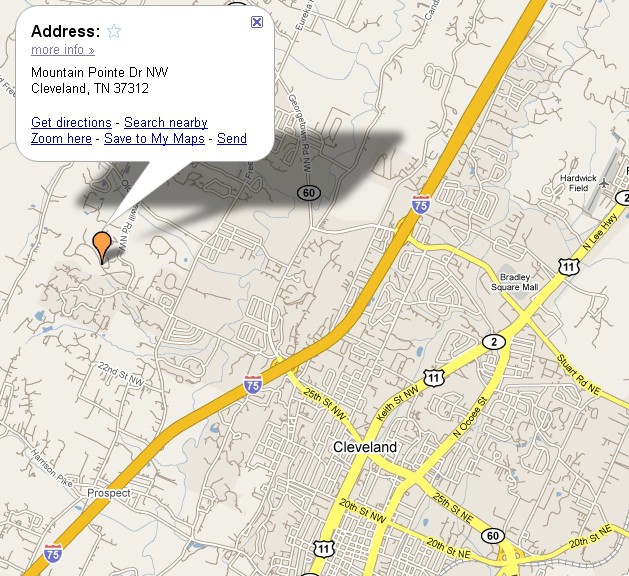
The Mountain Pointe subdivision, northwest of Cleveland, Tennessee
The rural broadband divide doesn’t just impact the middle class.
Residents of the affluent Mountain Pointe subdivision in Cleveland, Tennessee (any neighborhood with an extra “e” on end of the name always spells money) are unhappy to find a home life without broadband service. Like many wealthy enclaves set outside of clustered suburban neighborhoods, homes are too few and far between in the subdivision, making it too expensive for Charter Cable to wire service there.
Charter Communications Director of Government Relations Nick Pavlis told The Cleveland Daily Banner that it was not profitable to provide service to the 55 homes affected.
Generally, Charter Cable will not wire a neighborhood or street if it costs much more than $500 per home to provide service, including the collective cost of bringing wiring to that area. In the case of Mountain Pointe, Pavlis said it would cost the cable company $130,000 to run an underground cable 2.5 miles to supply the subdivision with service, and that’s “not a reasonable payback,” considering the company expects a 36-48 month return on investment.
Charter is willing to wire the subdivision, if the residents agree to pay $1,850 apiece to pay for the wiring expenses.
That is a cost some homeowners may be willing to pay, considering the affluence of many of them. Among the residents, according to Cleveland Mayor Tom Rowland, are bankers, business owners, and a former state senator.
“These are the kind of people you want to provide service for — they would subscribe to all of your services if they were available,” said Rowland.
But before opening their wallets, residents are looking for alternatives. Mountain Pointe resident Lou Patten told the newspaper he and his neighbors are frustrated because a newer subdivision on Freewill Road has service from both Charter and AT&T.
A few residents have braved wireless broadband as their best option, for now, but the neighborhood’s terrain makes service unreliable. AT&T DSL service is not available because Mountain Pointe is too far away from the central office serving the neighborhood, located northwest of the city of Cleveland.
With Charter remaining intransigent, the mayor met with five of the neighborhood’s residents and State Rep. Kevin Brooks, City Attorney John Kimball and AT&T Regional Director Mary Stewart Lewis to see if AT&T could find a solution.
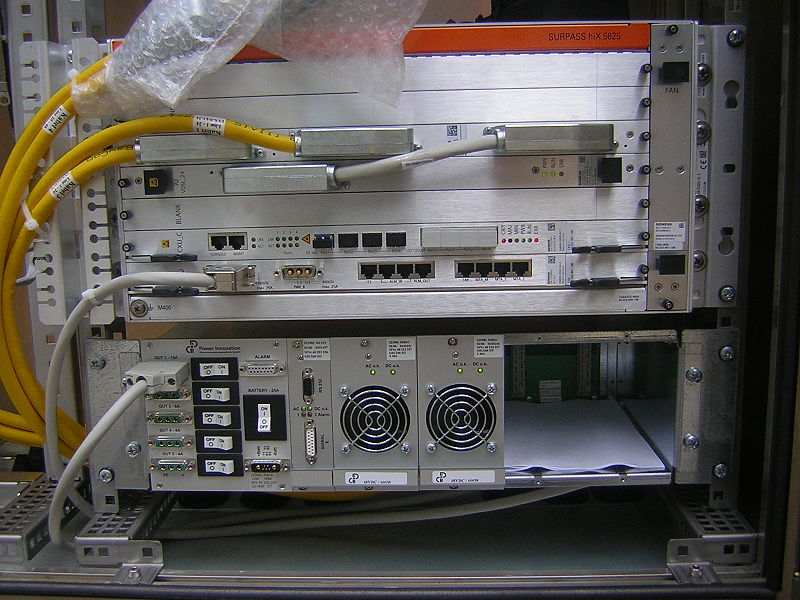
A DSLAM manufactured by Siemens designed for outdoor installation
Tennessee’s statewide franchise agreement with AT&T points to Bradley County being wired for U-verse, a hybrid fiber-phone line TV, broadband, and telephone service, by July of next year. But such agreements do not require 100% coverage and doesn’t guarantee Mountain Pointe service.
Lewis told the newspaper she would consult AT&T engineers for a possible solution to the problem.
“We’ve got to see where you are,” Lewis said.
In the short-term, AT&T could provide DSL service by installing equipment nearby that would reduce the distance between Mountain Pointe residents and AT&T’s switching equipment, using a device known as a Digital Subscriber Line Access Multiplexer (DSLAM). It is commonly installed in more remote locations to provide DSL service in areas where direct service isn’t possible.

When I’m not at school in Colorado, I’m at home in Texas. I’m two miles outside town on a three-acre lot. Time Warner Cable stops 2215 feet east of me. The cost to get cable run for that remaining couple thousand feet? $9000. Of course, I’d be keeping my ultra-cheap landline phone (basic local calling only, Lifeline gets me a $5-ish monthly fee) and wouldn’t be signing up for TV service. Since we’re talking about DOCSIS 1.1 plant here I’d be sharing a 6 MHz downlink channel and a 6 MHz (?) uplink channel on coax plant that’s either 750MH… Read more »
I’m not sure what the problem is here.
The “affected” homeowners have the means to own $500K houses.
The cable firm has offered the service if they pay the upfront capital cost.
What, are the taxpayers supposed to subsidize them too?
I am not a fan of discussions where I am not aware of the identity of other persons, but I feel I should respond to the comment by Neutral Ned. I am a resident of Mountain Pointe and need to offer some additional comments about the situation regarding our neghborhood. First and foremost, no one has proposed and no one is proposing any taxpayer money be used to solve this issue for us. Mountain Pointe is not in the suburbs. It is in the city limits of Cleveland, Tennessee and has been since the beginning of its development. Charter has… Read more »
Ken, please drop me e-mail at phil @ stopthecap.com so I can establish contact directly. A wireless provider contacted me yesterday regarding your situation and wants to explore providing service in your neighborhood. I will pass along his contact information to you and your group can evaluate what they have to offer.
I live in California, the Charter people here don’t know anything about communications, let alone wiring. Unfortunately, I have been in the same rural living situation and ended up with AT&T dial up service. Good luck to you.