CRTC Runs ‘Show Trial’ Hearings Attacking Would-Be Wireless Competitor; Is CRTC Industry Trade Group or Independent Regulator?

Phillip Dampier September 30, 2009 Canada, Competition, Public Policy & Gov't Comments Off
Wind Mobile

Wind Mobile

The Canadian Radio-television Telecommunications Commission (CRTC) is back in this news this week after running a dog and pony hearing at the behest of Bell, Telus, and Rogers (three of Canada’s largest incumbent telecommunications companies) pondering whether would-be wireless competitor Globalive was Canadian enough to do business in the country.

The Telecom Act specifies that all wireless phone companies must be controlled by Canadian citizens.  Toronto-based Globalive Wireless Management Corporation insists it has met the requirements of Canadian law, despite having a major percentage of its financing coming from Egyptian-based Orascom, a wireless mobile provider itself.  Globalive points to approval of its holding company business structure by Industry Canada.

Under the arrangement, Globalive would launch competitive wireless service under the brand Wind Mobile starting later this year.  Then the CRTC got involved.

Canada’s three current wireless phone companies — Bell, Telus, and Rogers, complained to the Commission that Globalive is violating the spirit of the Telecom Act and have essentially joined forces to keep Globalive out of Canada.

The CRTC was quick to respond to the incumbents’ concerns and scheduled hearings which started last Wednesday.  As expected, Globalive got hard questioning from the CRTC and the providers.  Canadian citizens looking for competitive choice weren’t on the agenda.

The Commission previously forced Globalive to publicly release more than 1,000 pages of company documents relating to its business structure, pages that were kept confidential by Industry Canada, but made available to Globalive’s existing competitors for their review.  The result was a gold mine of insight on their potential competitor’s business plan, and they used the information gleaned to argue against the company’s right to provide service.  itWorldCanada covered the response:

“I don’t know how the commission could possibly approve that deal now with that kind of capital structure,” Michael Hennessy, Telus’ senior vice-president of regulatory and government affairs said in an interview. “It would be unprecedented.”

Rogers could have gone along with the Industry Canada ruling, said Ken Engelhart, the company’s vice-president of regulatory affairs, “but when we read the documents we were just amazed. There has never been an approval like this before. The rules have always been [a telecom company] could have a major foreign shareholder, a major foreign debt holder, a major foreign strategic partner. But you could never have the same person being all three. Orascom has 65 per cent of the equity, 100 per cent of the debt and they provide the brand and all the strategic and technical skills.”

“If this is OK there’s no point having any more hearings. They should all get rubber-stamped because if this is Canadian owned and controlled, what isn’t?”

Bell concern trolled their way through written comments, ringing their hands over an ownership structure modified to address their earlier concerns is now even worse.

Anthony Lacavera, chief executive officer for Globalive Wireless Management said Globalive has every right to operate a wireless provider in Canada as he is a Canadian citizen and has control.
TMCNet’s Canadian Angle blog explains:

The biggest problem seems to come down to math.  Globalive states that Lacavera is in control, and he is a Canadian citizen.  The incumbents are complaining about the amount of ownership and possible influence that the Egyptian financial backer, Orascom Telecom, has on the Globalive company.  The way that Lacavera has explained it, the Globalive team is following all the rules while still allowing for some out of this country funding.  Here is the breakdown:

  • Anthony Lacavera owns 35 % of Globalive, and Orascom owns 65%.
  • Orascom funded over $500 Million so Globalive could pay for the wireless spectrum that they bought, and the bridge financing required for the infratructure
  • Both of these parties have agreed to replace the loans with third-party investments – as soon as it is commercially viable.

Telus and Bell suggest that Globalive and Orascom are pulling a fast one – trying to get around the legalities by setting up separate companies but still providing Orascom with a majority stake in the company, and  also with the added benefit of controlling the operations.

It shouldn’t be a big shock that Globalive was financed through another country, and as long as Globalive and Orascom commit to what they say they are going to do, there shouldn’t be any problems.

Well – still one hefty problem – the CRTC is under the influence of the incumbents.  The decisions coming from this regulatory body will provide fuel for many posts to come.

Am I the only one that sees the irony in the CRTC grilling Globalive about being influenced by outside sources?  Isn’t this the pot calling the kettle black?

The reason for all of the debate is simple enough.  Canada’s three wireless phone companies could lose one quarter of their customers to competitors like Globalive and DAVE Wireless, according to Toronto-based Convergence Consulting Group, Ltd., which released a study on the matter last week.  Without Globalive being one of those competitors, incumbent providers will likely retain more customers and more revenue.

Share

Breaking News: Verizon Comes Out Supporting Internet Overcharging Schemes

Phillip Dampier September 29, 2009 Internet Overcharging, Verizon 5 Comments
Lynch

Lynch

Verizon today joined the chorus of large providers looking for an enhanced payday off the backs of their subscribers when Chief Technology Officer Richard Lynch told a 2009 Fiber to the Home Conference and Expo press conference that the days of unlimited broadband may be coming to a close.

“We’re going to have to consider pricing structures that allow us to sell packages of bytes, and at the end of the day the concept of a flat-rate infinitely expandable service is unachievable,” Lynch said, adding that the broadband industry will see a paradigm shift as the Internet grows and Verizon passes on the cost to “someone.”

This is the first public comment from a Verizon executive that directly supports Internet Overcharging, although Lynch said Verizon was not announcing any pricing changes at this point in time.

Lynch’s statements came in concert with Verizon’s more immediate concerns about Net Neutrality, which the company has spent considerable amounts of money on Washington lobbyists to oppose.

Lynch doesn’t want Net Neutrality to interfere with the potential for the company to offer “premium bandwidth plans.”

Assuming Lynch is speaking about plans sold to consumers, there are no provisions in Net Neutrality legislation that address speed-based Internet service tiers.

Verizon’s statement about metered pricing and Net Neutrality may be a “divide and conquer” strategy to suggest to consumers an “either/or” proposition.  Either accept usage caps and metered service plans or Net Neutrality.  Stop the Cap! has written about this strategy in the past, and it has tripped up some public policy consumer groups in the past who were willing to support one or the other instead of objecting to both.

But Verizon’s near limitless capacity fiber optics FiOS network, and the fact the company’s “cost structure is certainly different, as a tier-one [carrier], [means] their transport costs are a fraction of the smaller operators,” according to Vince Vittore, an analyst with The Yankee Group.  That makes justifying such pricing questionable.

Verizon equates usage pricing models on its wireless mobile network with its wired fiber optic network.  Telephony Online quotes Lynch: “We have already gone this way in wireless because that is where the resource is most constrained.”

Of course, wireless mobile broadband is constrained by limits on the amount of spectrum space available to transport the data, something a fiber optic network need not contend with.

Share

Stupid Reasons to Oppose Net Neutrality #2: ‘Net Neutrality’ Is Obama’s Power Grab

Phillip Dampier September 29, 2009 Net Neutrality, Public Policy & Gov't, Video 1 Comment

One of the more far out there arguments against Net Neutrality has consistently come from conservative astroturf groups, who receive plenty of corporate funding to advocate a pro-business agenda using arguments that appeal to a conservative audience.

Newsmax, one of the more widely-read conservative websites, has gone all out on the theory that Net Neutrality is an attempt by President Barack Obama to take control of the Internet, potentially even leading to censorship.  In an unconvincing video segment, Newsmax.TV reporter Ashley Martella interviews Ryan Radia, an Information Policy Analyst at the Competitive Enterprise Institute, a pro-business think tank.
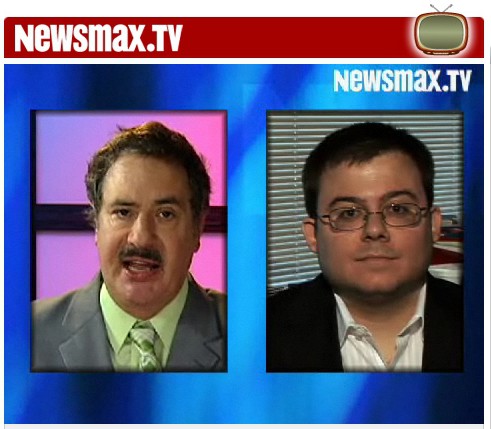
News

Newsmax TV: Net Neutrality is a "regulatory power grab" (4 minutes)

(Note: Because Google video ads auto-play without your consent, which we do not agree with at Stop the Cap!, clicking the image will launch a new browser window to take you to Newsmax’s site to play the video there.)

A number of conservative blogs and news sources have latched onto one echo chamber claim: “CBS News recently reported that a cyber security bill would give Obama the emergency powers he’d need to control the Internet.”  When a link to the actual report is not provided, that should ring warning bells in your head.  Unfortunately, too many people simply accept statements as fact and never bother to check them out.  If Katie Courac is warning the country about an Obama power grab online, I want to know about it.

Stop the Cap! is one of the few, the proud, the fact checkers.

As with most of the memes attacking Net Neutrality on political grounds, there is considerable exaggeration at work here.  We could find two references on CBS News’ website to the aforementioned claim, and both turned out not to be news reports, but one blog entry and a reprinted news article from a conservative news site¹:

An Associated Press wire story this past weekend covering proposed legislation also appears on CBS News (and thousands of other websites).

At issue is S.773, The Cybersecurity Act of 2009, a Senate bill introduced by Sens. Jay Rockefeller (D-West Virginia) and Olympia Snowe (R-Maine) to establish an effective defense against cyber attacks on the United States.  Some early drafts of the proposed bill had some language, long since discarded, that could have raised privacy concerns, but it’s disingenuous at best to suggest this bill’s language, known to Newsmax and others propagating these near-hysterical conspiracy theories, would give any power to the Obama Administration to silence dissent and “control the Internet.”

In fact, this legislation does not even originate with the White House.  Jena Longo, deputy communications director for the Senate Commerce committee, de-fanged the hysteria back in late August in a statement:

The President of the United States has always had the Constitutional authority, and duty, to protect the American people and direct the national response to any emergency that threatens the security and safety of the United States. The Rockefeller-Snowe Cybersecurity bill makes it clear that the President’s authority includes securing our national cyber infrastructure from attack. The section of the bill that addresses this issue, applies specifically to the national response to a severe attack or natural disaster. This particular legislative language is based on longstanding statutory authorities for wartime use of communications networks. To be very clear, the Rockefeller-Snowe bill will not empower a “government shut down or takeover of the internet” and any suggestion otherwise is misleading and false. The purpose of this language is to clarify how the President directs the public-private response to a crisis, secure our economy and safeguard our financial networks, protect the American people, their privacy and civil liberties, and coordinate the government’s response.

Radia, for his part, illustrates the effort to co-opt conservatives who distrust the Obama Administration into coming along for the ride for an industry friendly snowjob opposing Net Neutrality, with helpful prodding from Martella:

Martella: Could this lead to censorship?

Radia: There is the possibility of that.  What we have seen lately is the Obama Administration and agency officials attempt to increase their power over government networks.  Just a few weeks ago, CBS News reported that a cyber security bill would give Obama emergency powers to control the Internet.  Under a Net Neutrality regime, we could see the FCC tell companies what data they can and cannot prioritize.

Martella’s wild “censorship” reference was jarring because it comes out of the blue with no supporting preposition.  In fact, it’s pro-Net Neutrality advocates that fear providers could engage in censorship, because there have been instances where providers have done just that.  Net Neutrality impacts private Internet providers by demanding they do not block, impede, or interfere with third party website content.

Radia plays mix ‘n match with two different issues to create a magical blend of nonsense — the cyber security bill which conservatives fear is an Obama power grab and Net Neutrality’s consumer protections against abusive broadband network management.

The Obama Administration’s advocacy of Net Neutrality is not about increasing power over government networks.  CBS News did not report that a cyber security bill would give Obama emergency powers to control the Internet — it printed a blogger’s opinion and a reprint from a conservative news site that hypothesized such a bill, if it existed, would do that.  Radia defines Net Neutrality as the FCC telling companies what data they can and cannot prioritize.  Actually it just preserves the open network that has made the Internet so unique.  But on behalf of his provider friends, that issue is force-merged into the Obama “Internet takeover” theory, with the hope it will energize conservatives to also oppose Net Neutrality.

Radia’s arguments are hardly convincing.  He repeats the unpersuasive and undocumented fears that “Net Neutrality … is a rule that would stifle innovation, would reduce network investment, and it would decrease consumer choice in the broadband market.”  It sounds like he also bought a ticket to OppositeLand, where reality is defined as the exact opposite of the truth.  As is the case in Canada, it is the lack of Net Neutrality protection which stifles innovation from new high bandwidth applications that cannot succeed in a marketplace rich with Internet Overcharging schemes and speed throttles.  Online video for Canada is just one of several applications that have been stifled by provider controls.  There is no evidence Net Neutrality would reduce investment in networks.  Customers clamoring to use those networks and the diversity of online content is much more likely to stimulate network upgrades to maintain quality of service.  How consumer choice in the broadband market (which most consumers believe is hardly robust) would be impacted negatively is never explained.

Radia accidentally justifies why FCC policy alone is not enough to guarantee Net Neutrality protection when he points out Congress has not specifically authorized the FCC to get involved in the network management of service providers.  A bill in the House of Representatives would do just that, however.

Radia’s assumptions that consumers are pleased with the competitive marketplace, particularly for wireless, are dubious at best, particularly when he makes this stunning statement:

“If you want a walled garden, a device where a company controls and helps guide the user experience, you can get an iPhone.”

Of course, many iPhone users have complained openly and loudly about the fact they are stuck with AT&T — AT&T retains an exclusive arrangement with Apple in the United States to sell the phone for use on AT&T’s network.  They also aren’t too happy being limited by both companies in selecting applications to run on the phone, something managed by Apple and AT&T unless the customer “jailbreaks” the phone to bypass the restrictions.  The result is a stifled iPhone user experience on an overloaded AT&T wireless network, higher pricing on service plans for the iPhone, and consumer choice limited to deciding whether to live with these restrictions or go without.

Radia suggests Net Neutrality is being pushed just by a handful of “so-called consumer groups that believe that since their preferences are not being matched in the market, that they should use the hand of government to force these rules upon the private sector.”  His problem with that is that he believes (along with the providers who spend millions lobbying) that consumers are well served by today’s marketplace filled with proprietary business models.

Of course, real consumer groups can’t exist without consumers that actually support them, and as we’ve documented since this site launched, consumers are not well served by the limited competitive marketplace, and the abuses that come from that, and they’ve complained loudly and regularly to those providers about those practices.  They aren’t listening.  So consumers are turning to the public officials who regulate and oversee such markets to attempt to force them to listen.

Newsmax’s efforts to give mainstream media credibility to a sensationalized claim was only outdone by Radia himself on his own bio page:

Ryan is a frequent contributor to the Technology Liberation Front, the technology policy blog dedicated to preserving freedom and liberty in the information age. His ideas have been referenced by technology writers including Andrew Sullivan of The Atlantic’s Daily Dish, Karl Bode of Broadband Reports, and Mike Masnick of Techdirt.

Karl Bode found it ironic Radia would reference a piece he wrote, because Bode’s article trashed Radia and his friends for claiming a cable price war was resulting in consumer savings.  The Techdirt piece Radia links to didn’t exactly give him a seal of approval either:

Last month, we mocked some mainstream press reports claiming both a broadband price war and the fact that broadband prices were rising. There doesn’t really seem to be much of either, as broadband prices have remained pretty constant, even accounting for promotional pricing. However, with Comcast getting ready to significantly boost speeds (yes, with its broadband caps, Ryan Radia is wondering if the actual “price war” is hidden by the fact that it’s in price per megabit.

In other words, if prices remain constant, but your speed doubles, isn’t that something of a price decrease? Radia chalks this all up to competition in the market, but it should at least be admitted that the speeds (even these higher speeds) still pale in comparison to other countries where there is much greater competition than in the US, where most people still are limited to only two real choices. Either way, as someone who’s still stuck on a home connection that runs around 500k (below the new 768k cutoff for “real” broadband) despite being in the center of Silicon Valley, I’m still not convinced that these greater speeds are so readily available yet.

We invite Radia to link to our spanking as well.

¹Using search terms “obama emergency internet” and “emergency internet” on the CBS News website.

Share

AT&T’s Deluxe Suite At The Hypocracy Hotel: Throws HissyFit Over Google Voice Call Blocking, Calls It ‘Net Neutrality Violation’

AT&T: 'Google is violating the Net Neutrality tenets we spend millions to make sure don't become law.'

AT&T: 'Google is violating the Net Neutrality tenets we spend millions to make sure don't become law.'

AT&T sent a letter late last week to the Federal Communications Commission calling out Google Voice, the free adjunct Voice Over IP service being tested by Google, for blocking calls to certain high cost telephone numbers.  Robert W. Quinn, Jr., Senior Vice President of AT&T’s Federal Regulatory office complained that AT&T has been forced to complete those calls while Google Voice does not, suggesting that might be the equivalent of a Net Neutrality violation, if not an outright violation of call completion requirements established by the Commission.

These days, almost anything can be defined as a Net Neutrality violation.  If I was a vegetarian and I blocked meat products from my home, I’d probably get a letter from AT&T’s counsel too.

At issue here is the exploitation of a loophole that was established by telecom regulators to provide extra financial support to rural community telephone companies.  When a person places a long distance call, part of the charge is paid to the company that connects the call from the long distance network to the recipient’s telephone line.  The fees long distance companies pay vary depending on the size of the community and the length of the call.  Small rural areas enjoy a higher call completion fee than urban areas do.

Some enterprising individuals discovered the fees being paid to rural phone companies were higher than the actual costs to provide the service.  Traditionally, that extra money was used by rural phone companies, often independent or customer-owned cooperatives, to keep their service costs down and to maintain their equipment.  Long distance carriers didn’t care because the number of calls to these rural communities was comparatively small.

But what would happen if a company set up a telephone number to receive lots of calls that would otherwise never be made to such rural communities?  The result could be a financial windfall.  That possibility persuaded a few rural phone companies to let third parties offer international calling, conference calling and adult phone chat services for no charge beyond whatever the customer has to pay to make the long distance call.  In return, the phone company kicks back a significant portion of the extra income they earn from “call completion fees” to the service providers.

AT&T, among others, got wind of this arrangement and flipped out, complaining they were paying an ever increasing bill from rural phone companies hosting these services.  Anyone with an unlimited long distance plan could call these numbers for free and stay connected for hours at a time.

Unsurprisingly, AT&T blocked calls to these services for a period in 2007, refused to pay for some prior charges, and sued several phone companies.

AT&T/Cingular spokesperson Mark Siegel told Ars that the reason the company has decided to start blocking these services is because high volumes of calls to similar services are costly, and the cost of those calls aren’t passed on to the customer. “We have to pay terminating access for every minute the person is on the line,” Siegel explained. “Typically these companies run them through local exchange companies that charge high access rates, so we end up paying high access charges.”

The FCC intervened and said phone companies cannot arbitrarily block customer access to phone numbers, and the blocks were removed.  Today, the free international long distance calling services are basically gone, but free conference calling lines and adult sex chat services remain, and Google Voice has now discovered the perils of connecting calls, for free, to these services.  So now they have blocked access as well.  Google Voice beta testers report calling blocked numbers results in perpetual busy signals.

AT&T pounced in a letter to the FCC:

Numerous press reports indicate that Google is systematically blocking telephone calls from consumers that use Google Voice to call telephone numbers in certain rural communities.  By blocking these calls, Google is able to reduce its access expenses. Other providers, including those with which Google Voice competes, are banned from call blocking because in June 2007, the Wireline Competition Bureau emphatically declared that all carriers are prohibited from pursuing “self help actions such as call blocking.” The Bureau expressed concern that call blocking “may degrade the reliability of the nation’s telecommunications network.” Google Voice thus has claimed for itself a significant advantage over providers offering competing services.

But even if Google Voice is instead an “Internet application,” Google would still be subject to the Commission’s Internet Policy Statement, whose fourth principle states that “consumers are entitled to competition among network providers, application and service providers, and content providers.” This fourth principle cannot fairly be read to embrace competition in which one provider unilaterally appropriates to itself regulatory advantages over its competitors. By openly flaunting the call blocking prohibition that applies to its competitors, Google is acting in a manner inconsistent with the fourth principle.

Ironically, Google is also flouting the so-called “fifth principle of non-discrimination” for which Google has so fervently advocated (Net Neutrality). According to Google, non-discrimination ensures that a provider “cannot block fair access” to another provider. But that is exactly what Google is doing when it blocks calls that Google Voice customers make to telephone numbers associated with certain local exchange carriers. The Financial Times aptly recognized this fundamental flaw in Google’s position: “network neutrality is similar to common carriage because it enforces non-discrimination . . . Google is arguing for others to be bound by network neutrality and, on the other hand arguing against itself being bound by common carriage,” which leaves Google with an “intellectual contradiction” in its argument.

Richard Whitt, Washington Telecom and Media Counsel for Google, fired back a response on the Google Policy Blog countering AT&T’s arguments:

Google Voice’s goal is to provide consumers with free or low-cost access to as many advanced communications features as possible. In order to do this, Google Voice does restrict certain outbound calls from our Web platform to these high-priced destinations. But despite AT&T’s efforts to blur the distinctions between Google Voice and traditional phone service, there are many significant differences:

  • Unlike traditional carriers, Google Voice is a free, Web-based software application, and so not subject to common carrier laws.
  • Google Voice is not intended to be a replacement for traditional phone service — in fact, you need an existing land or wireless line in order to use it. Importantly, users are still able to make outbound calls on any other phone device.
  • Google Voice is currently invitation-only, serving a limited number of users.

AT&T is trying to make this about Google’s support for an open Internet, but the comparison just doesn’t fly. The FCC’s open Internet principles apply only to the behavior of broadband carriers — not the creators of Web-based software applications. Even though the FCC does not have jurisdiction over how software applications function, AT&T apparently wants to use the regulatory process to undermine Web-based competition and innovation.

The HissyFit is on, and it’s almost entirely beside the point.  Once again, Net Neutrality is being used as a convenient flogging tool, this time by a company that spends millions to oppose it, yet sanctimoniously demands others should comply with its founding principles.  While the systematic blocking of telephone numbers may echo the kinds of concerns Net Neutrality protection is designed to address, it’s not as on point as AT&T would have you believe.

Google Voice isn’t even close to being a replacement for telephone service.  It’s not even openly available to the public.  AT&T would have had a stronger argument complaining about MagicJack, the dongle that lets you make unlimited long distance calls for $20 a year.  They go beyond just blocking some of the conference calling services — they actually redirect calls to a recording encouraging customers to instead use one of their own partners instead.

Dan Borislow, inventor of MagicJack says “it is not illegal for us to block calls to [conference calling numbers.]  We have invited other conference calling companies to interconnect to us for free, so we can complete our customers’ calls to them.”

Google’s public policy response isn’t as satisfying as it could have been either, and uses some weak arguments in rebuttal.  Much more important and on point is finding a way to address call completion fee loopholes through a change in telecommunications policy.  The telecommunications landscape has fundamentally changed in ways that existing rules could not have anticipated.  Addressing that issue would provide immediate relief to both AT&T and Google Voice without dragging consumer interests into a telecom policy cat fight.

Unfortunately, that’s a point far too fine for many media types, bloggers, and the sock puppets to understand (or desire to), and the campaign of Waving Shiny Keys of Distraction will carry on, and may have been AT&T’s intention in making such an argument in the first place.

Share

Stupid Reasons to Oppose Net Neutrality #1: Why Not Net Neutrality for Newspapers?

Phillip Dampier September 28, 2009 Editorial & Site News, Net Neutrality 7 Comments

failure-of-logic-fail-demotivational-poster-1209989155Now that FCC Chairman Julius Genachowski has put the issue of Net Neutrality on the front burner, the often-ludicrous reasons some people give to oppose Net Neutrality are coming out all over the place.  When you find one that is particularly preposterous, use the Contact Us link at the top of the screen and drop us a summary and a link.  We’ll be calling out the silliest and debunking those that might sound good on the surface but have a soft, squishy, logic-free center.

To get us started, this letter to the editor turned up last week in The Seattle Times:

The recent Seattle Times editorial on net neutrality seemed logical on the surface [“Protecting net neutrality,” Opinion, Sept. 22], but in reality was a Robin Hood-style regulation.

Let me pose a question: What would The Times’ opinion be if the Federal Communications Commission mandated The Times’ facilities were open to anyone who wants to use it as they wished?

I suspect the company would probably make an argument that it made the huge capital investment, and therefore should have control over who can or cannot use it.

So explain, what is the fundamental difference between the management of this capital asset and that of a company such as Comcast or any other Internet provider?

I suspect nothing other than another example of government intervention into a business and technology they do not understand. The Times should be thankful they are not focused on the newspaper industry.

I’ve long accused the Federal Communications Commission of being out of touch and not understanding (‘broadband over power lines’ advocacy being a particularly stupid idea on their part), but rest assured, they are well acquainted with the arguments the broadband industry makes to preserve its position.  Providers spend tens of millions of dollars to hire lobbyists to advocate just that.

To use Robin Hood as an analogy puts us squarely in OppositeLand, where ‘up is down’ and ‘right is left.’  Robin Hood was a story about robbing from the rich to give to the poor.  This writer seems to think the “poor” are Comcast and AT&T, and the individual customers most at risk from Net Neutrality abuse are somehow the “rich.”

Perhaps it would have been more apt to suggest the Seattle Times would be guilty of Net Neutrality abuse if it openly refused to print ‘letters to the editor’ or interview people for stories who did not have a home delivery subscription to the newspaper.

A newspaper, of course, is not the equivalent of the global Internet.  It’s just one of countless content creators that use the Internet to make their content more accessible to an online audience, one that might choose to read what they publish.  That’s an important distinction, because Net Neutrality does not interfere with content creators and tell them what they can and cannot say.  It helps protect their independence.  The Seattle Times can print whatever they see fit, and you and I make the individual decision to read or not read what they publish.

More importantly, and why the writer’s analogy misses the mark:  If you or I don’t like The Times and think we can do a better job, we can start our own website and publish our own content.  We don’t need the imprimatur of establishment media to make our own content available to the masses.  Individual readers will judge the quality and value of our content individually, and determine its importance and relevance accordingly.  So you or I don’t need to demand The Seattle Times open up their presses to our content — we can simply publish our own content independently, enjoying the exact same global reach, and have the potential to be just as successful as they are.

But let’s get back to the writer’s premise and adjust it slightly.  The Times pays a web hosting company to make their articles available online.  They have a business relationship with that hosting company, which uses part of that hosting fee to pay for their own pipeline to the Internet.

Meanwhile, you and I pay a monthly fee for an Internet Service Provider (ISP).  We pay them every month to provide unencumbered connectivity to the Internet, which happens to include the website for The Seattle Times.

One day, our ISP mails a letter to The Times and tells them that unless they pay to become a “preferred content partner,” they can no longer guarantee that the newspaper’s web pages will always reach you and I on a timely basis.  In effect, our ISP now wants to be paid twice — once by us to access the Internet, and once by the newspaper for “assurances” their content will reach us at broadband speeds.

The Times doesn’t have a business relationship with our ISP, but you and I do — specifically to provide the connectivity they suggest may soon no longer be guaranteed to those who “use their pipes for free.”

Now the problem becomes clearer to understand.  Even more concerning is that some of these ISPs own and manage news content sites.  Will they charge themselves the same price they ask from others?

Net Neutrality in its entirety protects content producers, like this website, from having its reach impacted.  Remember, one of the biggest strengths of the Internet is that anyone, anywhere, can reach this website or The Seattle Times on equal terms just by typing in the address.  No Internet user or content producer should have to face a blockade from providers that don’t like the message, had their content moved to the “slow lane” for not paying an unprecedented fee, or had their website overshadowed because a competitor leveraged favorable treatment from their “preferred content partner” status.

Share

“The Verizon FiOS of Hong Kong”: Fiber to the Home 100Mbps Service $35/Month

Phillip Dampier September 27, 2009 Broadband Speed, Competition, Recent Headlines, Video 3 Comments
HK Broadband offers 100% Fiber Optic service to residents of Hong Kong

HK Broadband offers 100% Fiber Optic service to residents of Hong Kong

Hong Kong remains bullish on broadband.  Despite the economic downturn, City Telecom continues to invest millions in constructing one of Hong Kong’s largest fiber optic broadband networks, providing fiber to the home connections to residents. City Telecom’s HK Broadband service relies on an all-fiber optic network, and has been dubbed “the Verizon FiOS of Hong Kong” for its dramatically faster broadband speeds.

Hongkongers have had several choices for broadband service over the years, most offering traditional DSL service throughout the Hong Kong Special Administrative Region (Hong Kong is a territory of the People’s Republic of China). Priced around $32 a month, the most popular service choice offers residents 6Mbps downstream speeds and 0.6Mbps upstream. Some modern residential multi-dwelling units have a more advanced from of DSL service offering up to 18Mbps downstream and 1Mbps upstream.

HK Broadband represents a major competitive threat for traditional DSL service in Hong Kong, because the fiber optic network provides customers with faster speeds ranging from 25Mbps-1000Mbps.  The company also offers a bundle including broadband, a Voice Over IP telephone service, and IPTV (cable television) service with 80+ channels. HK Broadband offers symmetrical speeds on their network, which means your upload speed is as fast as your download speed. The company has pummeled its telephone network-reliant competitors with humorous ads that call out DSL’s slower speeds, particularly for uploads.

http://www.phillipdampier.com/video/HKBN Ad -- Ants.flv
HK Broadband “Ants” Advertisement: Ten Kung-Fu-Fighting-Ants, representing the downstream speed of a traditional DSL broadband connection, are shown ganging up on a single helpless ant, who represents the weaker upstream speed, demonstrating how traditional DSL services typically offer upload bandwidth that is only a 10th of the download speed.

HK Broadband offers 100Mbps service for $35 per month, just a few dollars more than DSL. But there is an interesting catch. HK Broadband, like other providers in Hong Kong, cope with inadequate international broadband connections. Instead of engaging in Internet Overcharging schemes like usage caps, such as those found in Australia and New Zealand, the company has instead capped the speed for websites located abroad at 20Mbps for both uploads and downloads. The 100Mbps speed is reserved for domestic websites. Some subscribers note they couldn’t get speeds much faster than that when accessing overseas sites regardless of the cap, so it has not presented a major problem. As connectivity improves, so should the speeds, according to company officials.

The company also has a unique residential service guarantee — they promise that you will receive at least 80% of the speed you subscribe to, or they refund double your money back. Of course, this applies only to connections made to websites within Hong Kong.

When you’ve got it, flaunt it, and HK Broadband’s fiber speeds are the hallmark of their marketing campaigns.

http://www.phillipdampier.com/video/HKBN 100Mbps Ad.flv

HK Broadband “Fat Pipe” Advertisement: Real life characters representing Internet content force themselves into a tiny pipeline, representing DSL, but are later liberated by a wide open fiber optic pipeline they can run through with room to spare.

The investment by City Telecom in their fiber optic broadband network has brought impressive financial results to the company, with customers taking more of their telecommunications business in HK Broadband.  That increases the average revenue per subscriber.  The company has also aggressively increased the level of investment to build out its network, producing an economy of scale that has reduced the costs to wire new subscribers.

Traditional Wall Street investors have often been unimpressed with expensive technology upgrades undertaken by telecommunications companies.  Notably, Verizon Wireless’ FiOS fiber to the home network was pummeled by several investor groups who complained Verizon was spending too much on their fiber network, even though their costs to wire each new customer has dramatically decreased with time.  City Telecom has turned that criticism on its head.  Among many of its competitors, City Telecom is the second most profitable, earning an 11% profit margin.

China Securities has showcased the company, noting it enjoys subscriber growth at levels greater than industry growth, is positioned with technology that assures it of long term stability in revenue and income growth, and despite all of the investments the company has made, retains a strong free cash flow.  Most of all, it has very happy subscribers who enjoy a well regarded broadband service, available at fast speeds and a reasonable price.

The incumbent telephone company’s network of copper wire, supporting lower speed DSL service, is not in the same position.  HK Broadband brought Alexander Graham Bell back to life to chastise the notion that a network more than 100 years old is appropriate for 21st century broadband.

http://www.phillipdampier.com/video/HK Broadband Bell Ad.flv

HK Broadband “Alexander Graham Bell” Advertisement: The inventor of the telephone makes a “special-guest” appearance pointing out the fact that the 100 year old telephone network wasn’t designed for today’s broadband connections. This is set in a traditional Chinese Hell-like environment to imply the hellish experience of surfing the Internet with a slow connection.

HK Broadband has not escaped the attention of its competitors, of course.  PCCW Limited, Hong Kong’s dominant telephone company, has been aggressively marketing its own fiber, DSL, and wireless broadband products, not allowing HK Broadband to win without a fight. PCCW has had to play catch-up with HK Broadband’s aggressive fiber deployment, which focused on residential and business customers from the outset.  PCCW’s fiber network was primarily intended for business customers, and now the company has been rapidly expanding their fiber network to residential customers.  Today, where PCCW fiber is available, customers can choose from 18Mbps, 30Mbps, 100Mbps, or 1000Mbps service plans.  Many PCCW customers will also be aggressively marketed a wireless mobile Netvigator add-on, one of PCCW’s more successful product lines.

http://www.phillipdampier.com/video/PCCW Fiber Optics Ad.flv

PCCW “Fiber Optics” Advertisement: Lampooning HK Broadband’s fiber optic network, PCCW says it had their own extensive fiber optic network laid before HK Broadband came around.  Its tagline, “…the real fiber optics broadband.”

A detailed presentation of HK Broadband and its potential attractiveness to investors was produced by China Securities and features an interview with NiQ Lai, the Chief Financial Officer of City Telecom.

http://www.phillipdampier.com/video/Chinasecurities-City Telecom Presentation September.flv

[13 minutes]

Share

Stop the Cap! Movement Covered By Rochester Public Radio

Phillip Dampier September 24, 2009 Audio, Internet Overcharging, Net Neutrality 2 Comments

The advancement of Net Neutrality by the Federal Communications Commission was the topic of this week’s Mixed Media, a feature from WXXI-AM, a public radio station in Rochester, New York.  Scott Fybush, who has been known to drop by Stop the Cap! from time to time, talked with WXXI’s Rachel Ward about Net Neutrality and the Stop the Cap! movement, and why Rochester is such an activist community when it comes to preserving reasonable and fair pricing for Internet access.

A Federal Communications Commissioner comes out strong for net neutrality. WXXI’s Rachel Ward and media and technology reporter Scott Fybush have more. (5 minutes)
You must remain on this page to hear the clip, or you can download the clip and listen later.

If you have any interest in radio or television, Scott’s Northeast Radio Watch is a must-read every week. WXXI’s Mixed Media does a good job of explaining technology stories and their impact on us in a way everyone can understand.

Share

Uproar Over Bay Area Comcast Rate Hikes Met With Indifference By Oakland Tribune Business Editor

Phillip Dampier September 24, 2009 Comcast/Xfinity, Competition, Editorial & Site News 2 Comments
Courtesy: vgm8383

Courtesy: vgm8383

Bay area residents are fuming over Comcast’s latest round of rate increases.  The din grew so loud, Drew Voros, the Oakland Tribune Business Editor, noted “the annual outcry over Comcast rates is louder than any rate increase for electricity or water I have come across. A possible exception being California’s energy crisis earlier this decade.”

Voros then casually dismisses consumer outrage by telling his readers “cable TV is not a utility. It is not a vital service with transparency, public input and debate. There is no recourse for poor service through regulatory bodies or the ballot box.”

We know where this is going.

Voros doesn’t suggest that the rate increases are unjustified and unwarranted, nor does he have a bad word to say to Comcast, although he does fixate on one aspect of the regulatory framework (the wrong one) that he believes is at the core of the problem of unchecked rate increases.

His suggestion is to watch free over the air television or try DirecTV, Dish Network or AT&T’s U-verse.

Let’s explore those alternatives.

For some, assuming they get reasonable reception, and many Bay Area residents do not, getting local over the air signals might be good enough, but won’t help with those pesky rate increases on broadband service, or for those channels like C-SPAN or cable news outlets residents access to get coverage of events local broadcasters ignore.

DirecTV and Dish Network are also fine alternatives, assuming you have permission from a landlord to install the reception equipment, and/or your view to the satellite isn’t obstructed by trees or buildings.  AT&T U-verse is an even better potential choice, assuming it’s actually available in your area.

For everyone else, it’s Comzilla or go without.

Voros then goes too far into the weeds and gets lost in what suspiciously looks like “blame the government” rhetoric:

What many TV viewers do not realize is that the franchise agreements are loaded with fees and payments to the cities, funded through annual rate increases. There’s give and take between cable companies and the cities they serve. It’s a business deal with you in the middle.

But consumers are not bound by any franchise agreements, and the options for television services have grown immensely since the first cable TV line was connected in the 1970s. That is why the franchise agreements are out of date. Technology has overtaken that legal document. There’s no monopoly on television content delivery.

Comzilla attacks San Francisco with rate hikes.

Comzilla attacks San Francisco with rate hikes.

Ask any city official if they’d rather enjoy the incremental increase in franchise payments (which amounts to a fixed percentage, usually 3-5% of gross revenue) made possible by the annual rate hike, or the peace and quiet from constituents not upset over an industry that routinely increases rates well in excess of inflation.

Doing away with the franchise system to resolve cable rate hikes would be like using a ShamWow to deal with the after-effects of Hurricane Katrina.

Most cable companies used to include the “franchise fee” as part of the cost of the monthly service, but now routinely break that charge out onto its own line on your bill (and many never lowered the price for the original service, pocketing that as a hidden rate increase as well).  A rate increase may add a few pennies to the franchise fee on a customer’s bill, but then there is the other $3-5 dollars to consider.

Franchise agreements are negotiated for wired providers.  AT&T had to obtain one to provide U-verse.  That’s because local communities demand that a business tearing up their streets provide something in return for the community.  That usually includes: a small percentage of gross revenue, an agreement to provide free service in community centers, government offices, and public schools, and that they set aside several channels for Public, Educational, and Government access, known collectively as “PEG channels.”  It’s a very small price to pay for an industry that earns billions in profits.

Those agreements typically are renegotiated every ten years, so if consumers object to the franchise fee arrangement, they can appeal to local government to reduce or eliminate it.

Voros also suggests consumers try to obtain television programming online.  That is also sometimes possible, but as Stop the Cap! readers know, that also takes a broadband connection, and Comcast just raised the price for many of their customers for that as well.  With the industry’s new TV Everywhere project, dropping your cable subscription, as Voros suggests, will also likely cut you off from many of your favorite cable shows online — TV Everywhere is for paid television subscribers only.

The industry has every angle covered, right down to suing to remove the exclusivity ban on cable networks and programming.  Should the DC Court of Appeals agree, Voros’ contention that there’s no monopoly on television content delivery will also be thrown into doubt.

The solution is not to blame “outdated” franchise agreements.  The cable package business model is the larger problem.  Customers are expected to pay for ever-growing and more costly basic and digital cable packages filled with channels they don’t want.  Of course competition should be encouraged, but allowing consumers to choose and pay for only the channels they wish is a far better solution to runaway cable pricing.

Share

Life With Dial-Up: Rural BC Residents Make Due With the Slow Lane

Phillip Dampier September 24, 2009 Audio, Canada, Rural Broadband Comments Off
Thirsk

Thirsk

Marla Thirsk is still on dial-up, and wishes she had broadband. The Ucluelet, BC artist has lived in the Spanish Banks area for nearly 30 years. While her friends and neighbors have broadband service, her subdivision does not. The Canadian Broadcasting Corporation’s Spark program, dedicated to discussing technology and culture, recently covered Thirsk’s predicament. Host Nora Young explores what online life means for Marla and her nearby neighbors.

Phone interview with Marla Thirsk, as part of September 20, 2009 CBC Radio One’s Spark program. (6 minutes)

You must remain on this page to hear the clip, or you can download the clip and listen later.

Share

Time Warner Cable Launches DOCSIS 3 Speed Upgrades in NYC

Phillip Dampier September 24, 2009 Broadband Speed, Time Warner Cable Comments Off
Time Warner Cable introduces DOCSIS 3 service in New York today.

Time Warner Cable introduces DOCSIS 3 service in New York today.

Time Warner Cable today finally launches new high speed broadband service possible from DOCSIS 3 upgrades.

Calling the new service Time Warner Cable Wideband Internet, the company will now market the 50Mbps/5Mbps residential service for $99.95 per month.

“With substantially increased Internet speeds, Time Warner Cable continues to lead the way as the most popular broadband provider in New York City. Time Warner Cable Wideband Internet gives all home network devices – desktops, laptops, gaming consoles and iPhones – our fastest connection yet,” stated Howard Szarfarc, Executive Vice President of the company’s New York City Region. “Time Warner Cable Wideband Internet customers can instantly multitask – and when family members are online simultaneously, everyone can get the speed they want at the same time.”

Calling the company a proven innovator, Szarfarc touted Time Warner Cable’s “advanced fiber-optic network” for making the upgrade possible.

Yet Time Warner Cable has dragged its feet on DOCSIS 3 upgrades for more than a year now, claiming such upgrades weren’t necessary because consumers weren’t clamoring for faster speeds.  The company also had a major misstep in April when it attempted to roll out an Internet Overcharging scheme that would have raised broadband service pricing for consumers up to 300%, with no immediate improvement in service.  Those plans were shelved indefinitely.

Providers like Time Warner Cable are looking to premium services to enhance revenue, and offering higher speed service has proven successful for the company in the past.  Time Warner Cable has positively reported revenue benefits from its Road Runner Turbo add-on product, providing faster speeds to consumers for an additional $10 per month.

The rush to DOCSIS 3 in metropolitan New York may have come from increased competition from Verizon FiOS, as well as consumer awareness of Cablevision’s 100Mbps broadband service, available in suburban New York neighborhoods.

Time Warner Cable Wideband Internet is available starting today in Manhattan (below 79th Street), Staten Island and Queens (Fresh Meadows, Forest Hills and South Flushing). It will be available throughout the company’s entire NYC service area by Spring 2010.

Share

Search This Site:

Contributions:

Recent Comments:

  • thad: Either Genachowski is ignorant (which as the FCC chairman he is paid not to be) or he is working to the benefit of current, traditional, Teleco behemo...
  • Sean: A phone company says having customers with working phones is a harmful business model? WTH?...
  • txpatriot: Have any of those mayors asked whether Marriott has built luxury hotels in those depressed areas, or why Cadillac hasn't opened car dealerships in tho...
  • txpatriot: I love it -- this article has NOTHING to do with caps, broadband or anything else related to "Promoting Better Broadband, Fighting Data Caps, Usage-Ba...
  • Bill: It doesn't exactly sound like Verizon is the victim in this article: http://www.huffingtonpost.com/bruce-kushnick/the-great-verizon-fios-ripoff_b_1...
  • txpatriot: Scott here's another example, this time by a start-up which by definition is somewhat smaller than google: http://www.nytimes.com/2012/05/23/techno...
  • txpatriot: Phillip, I get that you don't like the VZ co-marketing deal, but can we stick to the subject? The 400 word article you wrote was about CABLE companie...
  • txpatriot: Scott, it takes only one counterexample to disprove a general claim. And surely you're not suggesting that only a company as big as google could ...
  • Scott: I'm afraid I don't share your optimism when you're have to point out a company with a market cap of nearly 200 billion dollars paying a 3rd party to b...
  • Phillip Dampier: In the context of the co-marketing agreement between the cable industry and the nation's biggest wireless operator (Verizon Wireless), building out Wi...
  • txpatriot: Scott, I didn't respond to your comments on barriers to entry. I agree that incumbents have significant advantages as "first-movers". But incumb...
  • txpatriot: "The consumer advocacy group Public Knowledge on Monday criticized an announcement by a group of major cable companies that their customers would now ...

Your Account: