


Massachusetts: Verizon-Friendly Bill Not As Consumer-Friendly As Company Suggests

Phillip Dampier May 27, 2009 Editorial & Site News, Public Policy & Gov't, Verizon Comments Off on Massachusetts: Verizon-Friendly Bill Not As Consumer-Friendly As Company Suggests
'If you give us exactly what we want, we might wire your town with fiber optics.  If not, there is always Wisconsin.'

'If you give us exactly what we want, we might wire your town with fiber optics. If not, there is always Wisconsin.'

The Trojan Horse of the 2000’s apparently comes in the form of spools of fiber optic cable.  Verizon assumes the attractive notion of FiOS, fiber to the home for broadband, telephone, and video programming, is worth sacrificing local oversight.  The company has made it known it does not enjoy what they consider a cumbersome franchising application procedure in Massachusetts.  In a public relations push, Verizon has suggested that giving them quicker approval will guarantee state residents the golden promise of fiber optics.  If the company doesn’t get what it wants, maybe Wisconsin or another state where Verizon is deploying FiOS will:

Ellen M. Cummings, a spokeswoman for Verizon, said that with the struggling economy, the company has to choose where to commit its financial resources. Therefore, it is looking for the quickest return on its investment.

“Here in Massachusetts, it puts us in a predicament. If the company is trying to decide how to deploy money, and Massachusetts is vying against other states, like Wisconsin, where the wait is as little as five days, it definitely puts Massachusetts at a disadvantage,” she said.

Every wired provider is subject to local community licensing, in the form of a franchise, which permits companies to string wires through towns and cities, on poles as well as underground, in return for oversight and a small piece of the action.  Local governments justify franchising to regulate companies tearing up local streets and neighborhoods to maintain their networks, as well as making sure that all citizens within a community are served equitably and that the community benefits from the service.

The cable industry has lived under the franchise system since its inception.

Verizon decided it can’t be bothered dealing with individual municipalities in Massachusetts, and last year tried,  but failed, to replace the local franchising system with a single statewide franchise.  This year they’ve returned with a Verizon-friendly bill that would dramatically tip the scales in their favor, limiting local oversight and reducing their public service commitments.

The companion bills, (S. 1531) by Sen. Steven Panagiotakos of Lowell in the Senate, and House bill (H. 3765) by Rep. Michael Rodrigues of Westport, would mandate that each municipality limit consideration of Verizon’s franchise applications to no more than 90 days, and opens up a number of loopholes that Verizon could use to do an end run around a community and run the clock out, assuring quick approval without making concessions.

At worst, a provision in the bill setting a strict 90 day window for consideration of a franchise application, even if incomplete, ties the hands of municipalities.  Language that restricts the right of municipalities to deny applications gives the upper hand to Verizon, and the back of the hand to consumers.

One of the most common promises local communities extract from any wired provider is a guarantee they will establish wiring policies to equitably reach people throughout the franchise area, not simply the wealthiest neighborhoods, or easiest to wire.  While it has never been practical to insist on 100% wiring coverage, particularly in more isolated, rural communities, most franchise agreements insist on a uniform policy that says if there are a certain number of homes within an area, it must be wired.  Without that assurance, prior experience has shown operators would often “redline” communities, wiring prosperous streets while ignoring others.  Municipalities in Massachusetts want to guarantee that Verizon doesn’t engage in that kind of behavior, particularly after witnessing the company jettisoning “undesirable” customers in three nearby states — Vermont, New Hampshire, and Maine, which were sold off to FairPoint Communications.  No FiOS for them.

In general, more competition is good news, especially when Verizon comes to town with FiOS, which is sure to give the incumbent cable operator a real headache.  But Verizon’s complaints ring a little hollow when considering the company has managed to already obtain franchises in 93 communities across the state, and is literally obtaining new agreements faster than wiring crews can get into communities and start the upgrades.  While there may be a few towns that drag their feet for a variety of reasons, customer demand for FiOS is sure to light fires under elected officials to get a move on.  Doing it fast is not necessarily the same as doing it right.  As our readers are coming to learn, promises made by telecom providers that at first glance sound consumer-friendly turn out to be anything but.

One more reason to believe that:  the state’s incumbent cable operators are also opposing the bills, claiming they extend special benefits to Verizon that they, themselves, have never received. Cable companies on the same side as municipalities on questions of competition?  Of course most of the state’s cable operators are already past the franchising process, and merely return every decade or so for perfunctory rubber-stamp renewals, so green-lighting Verizon’s proposed bills would only expose them to FiOS competition sooner.

Paul R. Cianelli, the president of the New England Cable and Telecommunications Association, which represents the cable companies Comcast, Charter Communications, Time Warner and Cox, but not Verizon, said, “We oppose this legislation.”

“It’s another attempt by Verizon to get a special deal. They are pushing for legislation that would give them an advantage over existing cable providers. And they are attempting to chip away at the authority and powers of the municipalities to grant franchises,” he said.

In the end, we believe Ellen Cummings at Verizon who said it best: “[Verizon] is looking for the quickest return on its investment.”  Unfortunately, that’s not always compatible with the best interests of consumers.
Special Report: The Lessons of FairPoint – A Tragedy in New England – Part Two

Phillip Dampier May 27, 2009 FairPoint, Issues Comments Off on Special Report: The Lessons of FairPoint – A Tragedy in New England – Part Two

Yesterday, Stop the Cap! examined the rationale for Verizon to spin away hundreds of thousands of customers to a small independent telephone company, FairPoint Communications.  In today’s report, the utility commissions that protect ratepayers in three New England states ponder the proposal.  WMUR-TV in Manchester offers a nice summary of the issues involved, and the Josiah Bartlett they reference isn’t the one from NBC’s The West Wing, but rather the sixth governor of New Hampshire!

The challenge for the state regulatory bodies charged with approving or rejecting the deal came down to the two basic questions raised in WMUR’s video:
  1. Would the merger improve the chances for New England’s smaller communities to enjoy better service, particularly with high speed broadband that Verizon never rolled out;
  2. Was FairPoint financed sufficiently to handle the dramatic increase in its customer base?
The answers, from all three states, was a qualified no, and the story led the news across the region for several days in November 2007. WMTW-TV Portland, Maine literally dropped the 300+ page rejection report on a table and said, simply, it’s too risky:

Vermont decided the FairPoint takeover in their state was likely to be unsustainable, with insufficient guarantees that the company would have the money to get the job done.  WPTZ-TV, which serves Vermont, covered the announcement on December 21, 2007:

Unfortunately, as Stop the Cap! readers have come to learn again and again, one defeat doesn’t mean the end of the war. FairPoint had the opportunity to digest the input from state regulatory bodies and return with a new proposal. The question is, would that proposal simply put out small fires started by state authorities concerned about a few isolated factors, or would it be a complete overhaul to provide better guarantees that a FairPoint taking over phone service in three states in 2008 would still be in business in 2009.

Tomorrow, FairPoint has a new plan.

Action Alert Canceled – Meeting Called Off But Still Work To Be Done

Jay Ovittore May 26, 2009 Community Networks, Public Policy & Gov't Comments Off on Action Alert Canceled – Meeting Called Off But Still Work To Be Done

Tomorrow’s House Public Utilities Meeting on S1004 in North Carolina has been canceled.  We can pat ourselves on the back again for continuing to keep the pressure on and hold our legislators accountable.

We must still keep writing our legislators and letting them know that they need to send HB1252/S1004 to the Joint Committee on Broadband, so the committee who has knowledge on broadband issues can address accessibility, affordability and capacity.

The e-mail addresses can be found in the original action alert or at the Public Utilities Committee webpage.

Special Report: The Lessons of FairPoint – A Tragedy in New England – Part One

Phillip Dampier May 26, 2009 FairPoint, Issues 2 Comments

This is the first in a series of articles documenting the trials and tribulations of residents in New Hampshire, Vermont, and Maine when their incumbent telephone company Verizon abandoned them, leaving them at the mercy of an inexperienced, financially shaky, and downright lousy replacement — FairPoint Communications.  This are many lessons to be learned, and we’ll be following what was promised, what went wrong, and why it creates a nightmare for rural and small town America.  Some may wonder why focusing on this story is relevant to our issues.  The reasons:

  • Broadband service in rural America is either unavailable, expensive, slow, and/or capped.  Smaller players in the broadband market often lack the financial resources to provide high quality, fast, and flexible broadband service to residents and businesses.
  • The hope for competition from Verizon’s advanced fiber to the home FiOS network is dashed when the company abandons the smaller communities it once served to concentrate on more urban service areas.  Those communities will be stuck with second-rate copper or wireless “broadband” options for years to come.  In many of these communities, there is no cable service available.
  • Some of the astroturfing political groups on the right decry public taxpayer funding of broadband, and accuse municipal networks of being subsidized by taxpayer dollars.  But as you’ll learn, private companies are receiving favorable tax breaks, and FairPoint in particular is being permitted to access $50 million dollars in funding that was originally intended by New Hampshire to be used for improvements in service.  Now that money will go to repay debts incurred by FairPoint at the same time the company paid enormous bonuses to company executives.  Strangely, these astroturf groups are silent about diverted funds finding their way into the private sector.

The sordid story of FairPoint in New England is a timely one, coming just a few weeks after Frontier Communications announced it would be taking on Verizon customers in several states, in numbers that dwarf the existing customer base of Frontier.  Shouldn’t public utility regulators carefully consider the implications for these customers before it gets approval?  What guarantees for broadband will be included, and at what speeds?  Will Frontier’s “acceptable use policy” provision of 5GB of usage per month, currently unenforced, come back to haunt customers later?

We’ll be covering the story in chronological order with lots of video over the coming days.  Pay special attention to the promises made, the realities that would come later, and the current nightmares that have cut off communities from 911 service, forced some businesses to relocate out of state just to obtain telephone service, six week delays for installations, Internet accounts that lost e-mail, and the tale of one woman who literally lives next to the telephone company, but cannot get a service call completed because FairPoint claims they cannot find her address!

When it’s all over, isn’t it well past the time Americans should be asking more from the telecommunications providers that deliver service?  For millions of Americans, when the phone company is your only choice, is this the best we can do?

… Continue Reading

Action Alert! S1004 Moving Again in North Carolina

Jay Ovittore May 26, 2009 Community Networks, Public Policy & Gov't Comments Off on Action Alert! S1004 Moving Again in North Carolina
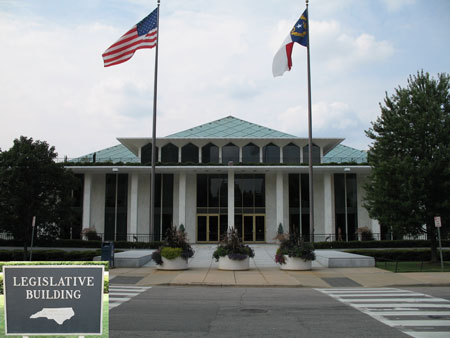
North Carolina Legislature Building

North Carolina Legislature Building

I received an e-mail from a very reliable source that told me that S1004 (Level Playing Field Study) will be in the House Public Utilities Committee this Wednesday.  Their plan is to refer the study bill to Rules with NO CHANGES.  Time Warner Cable and the telecom Lobby want the study bill (S. 1004) to go to Revenue Laws ONLY, and not the Broadband Committee as specified and required in the companion House bill (H. 1252) and advocated by Rep. Faison in the last committee hearing on H 1252.

We must make sure that this bill goes to Broadband Committee as it was publicly voted to do.

I issued this statement to Fiona Morgan from the Independent Weekly this morning on the current developments:

“It has come to my attention from a credible source on the inside that S1004 will be sent to the Revenue Laws Study Committee in the House Public Utilities Committee on Wednesday.  It will not go to the Joint Legislative Committee on High Speed Internet in Rural Areas as the Public Utilities Committee had voted to send  it to about a month ago.  An immense amount of pressure was applied by Time Warner Cable to place S1004 in Revenue Law, as it is a more favorable committee for them to pass this to a full vote.  The don’t want a “turf war” on this important issue.  They want a free market where they, and only they, are free to monopolize the markets in which they operate.  The very definition, from the Revenue Law Study Committee website, of the committee is that “The Committee reviews the State’s revenue laws to determine which laws need clarification, technical amendment, repeal, or other change to make the laws concise, intelligible, easy to administer, and equitable.”  This has nothing to do with the State’s revenue laws.  It makes sense that it be placed in the Joint Legislative Committee on High Speed Internet in Rural Areas, where the real issues of accessibility, speed and affordability can be addressed.  Anything less is a travesty to the citizens to which are legislators are beholden to, and shows that Time Warner and the cable/telecom industry got what they paid for from Sen. Hoyle ($25750 in PAC money) and Rep. Brubaker ($16250 in PAC money).

Municipal broadband is becoming more of a necessity because the current providers refuse to upgrade their infrastructure to technology that is found in this century worldwide.  We will continue to fall behind in health care, education and commerce at the speeds at which we move currently.  If we want to compete, we must first compete with the high-speeds the rest of the world moves at.  Most other developed countries have speeds at least 4 to 5 times the speeds we move at.  Japan is at 160Mbps compared to our 10Mbps.  South Korea will be at 1Gbps by 2012, 100 times faster.  For our state’s very survival, we need someone to step up and upgrade our broadband access and speed.  Municipalities are very capable and, more importantly, very willing to provide this step towards the future.   All the while, our current providers like to live on their gross profits in the past. “

My first point of contention is that if this is already predetermined, then what is a public committee for anyway.  In North Carolina,  we did away with back room meetings to decide things of a legislative manner.

My second point is, why is this being sent to Revenue Laws, when clearly it doesn’t even belong there?  A committee on Broadband is far more appropriate, if not the only place you could send it!  Sen. Hoyle and Rep. Brubaker sit on the Revenue Laws Study Committee, if you catch my drift.

Lastly, North Carolina is 5th highest in unemployment.  If we do not give ourselves the tools (and that includes affordable, accessible and up-to-date high speed Internet access), we will continue to head south economically.

Please write the committee members on the House Public Utilities Committee and tell them they should make the Senate concur with the House and send it first to the Broadband Committee and then onto Revenue Laws, the way they originally voted to address this important issue.  Tell them we need more accessibility, more affordability and a chance for our state to compete on a global level economically.  Let them know that we do not have that right now, due to archaic infrastructure supplied by greedy monopolies and duopolies.

Here are the members’ names and e-mail addresses:

Rep. Lorene Coates <[email protected]>, Rep. Harold J. Brubaker <[email protected]>, Rep. Nelson Cole <[email protected]>, Rep. Bill Faison <[email protected]>, Rep. Russell E. Tucker <[email protected]>, Rep. Kelly Alexander <[email protected]>, Rep. Hugh Blackwell <[email protected]>, Rep. Angela Bryant <[email protected]>, Rep. Becky Carney <[email protected]>, Rep. Beverly M. Earle <[email protected]>, Rep. Bruce Goforth <[email protected]>, Rep. W. Robert Grady <[email protected]>, Rep. Jim Gulley <[email protected]>, Rep. Pricey Harrison <[email protected]>, Rep. Hugh Holliman <[email protected]>, Rep. Julia C. Howard <[email protected]>, Representative Linda Johnson <[email protected]>, Representative Marvin Lucas <[email protected]>, Rep. Daniel McComas <[email protected]>, Rep. Tim Moore <[email protected]>, Rep. Wil Neumann <[email protected]>

A sample letter:

Dear Public Utilities Committee Member,

Please make sure that the study activated by SB1004 (The “Level Playing Field” bill)  is in fact level and balanced by mandating that the Joint Legislative Committee on High-Speed Internet in Rural Areas also studies broadband issues in North Carolina AND that the study includes an examination of how the public AND private sector are addressing broadband affordability, accessibility and capacity in North Carolina. Right now SB1004 just has Revenue Laws Study Committee studying what is wrong with municipal broadband ownership and no focus on the private sector broadband deficiencies. There is nothing “level” about that!

Please feel free to elaborate on this letter or write your own, but please write today!

Search This Site:

Contributions:

Recent Comments:

Your Account:

Stop the Cap!
